The best walks and hikes around Halle
4.4
(1512)
7,197
hikers
348
hikes
Hiking around Halle offers diverse landscapes shaped by the Saale and Unstrut rivers, featuring scenic river valleys, floodplains, and vineyard-dotted hills. The region includes varied geological formations and several nature reserves such as Tote Täler and the Nature Park "Unteres Saaletal." These areas provide a range of terrain from gentle riverside paths to steeper cliffs and forested sections.
Best hiking trails around Halle
- The most popular hiking route is Reebok hike - Hallerbos, a 4.4 miles (7.2 km) trail that takes 1 hour 54 minutes to complete. This easy route features gentle elevation changes through forested areas.
- Another top favourite among local hikers is Walk on the trail of the pine marten - Hallerbos, a moderate 9.7 miles (15.6 km) path. This trail leads through varied woodland, offering a longer excursion with moderate ascents.
- Local hikers also love the Hyacinth walk (6.3 km) - Hallerbos, a 3.9 miles (6.3 km) trail leading through natural woodlands, often completed in about 1 hour 37 minutes.
- Hiking around Halle is defined by river valleys, vineyard-dotted hills, and diverse nature reserves. The extensive network of routes offers options for various ability levels, from easy walks to more challenging moderate trails.
- The routes in Halle are highly rated by the komoot community with an average score of 4.4 stars from more than 1100 reviews. More than 5000 hikers have used komoot to explore Halle's varied terrain.
Last updated: June 29, 2026
4.8
(176)
730
hikers
7.15km
01:55
80m
80m
Easy hike. Great for any fitness level. Easily-accessible paths. Suitable for all skill levels.
4.7
(51)
240
hikers
6.26km
01:38
40m
40m
Easy hike. Great for any fitness level. Easily-accessible paths. Suitable for all skill levels.

Sign up for free
4.6
(47)
204
hikers
15.6km
04:07
140m
140m
Moderate hike. Good fitness required. Easily-accessible paths. Suitable for all skill levels.
4.7
(46)
247
hikers
4.95km
01:21
70m
70m
Easy hike. Great for any fitness level. Easily-accessible paths. Suitable for all skill levels.
4.8
(118)
522
hikers
Moderate hike. Good fitness required. Easily-accessible paths. Suitable for all skill levels.
Get access to more routes and recommendations from other explorers.
Sign up for free
Already have an account?
Our route recommendations are based on thousands of hikes, rides, and runs completed by other people on komoot.
Start today with a free account
Your next adventure awaits.
Login or Signup
Popular around Halle

Other adventures around Halle


Tips from the Community


enjoy
1
0

In 1648, King Philip IV of Spain gave the city of Halle and the Hallerbos to the Duke of Arenberg as collateral for a loan. When the king was unable to repay his debt in time, the duke acquired two thirds of the forest in 1655, which together amounted to 900 acres (i.e. approximately 1,125 ha). The Sint-Waltrudis chapter of Bergen remained the owner of one third. After a period of joint management, difficulties arose between the two owners. In order to put an end to the endless quarrels, they decided to withdraw from joint ownership, and to that end they had the forest measured in 1779. They placed 24 pyramid-shaped "meerstenen" or boundary posts with the inscription SW ("of Sint-Waltrudis") on one side and AR ("for Arenberg") on the other. Nineteen of these still stand on the original dividing line in the forest. Source: Wikipedia.
1
0

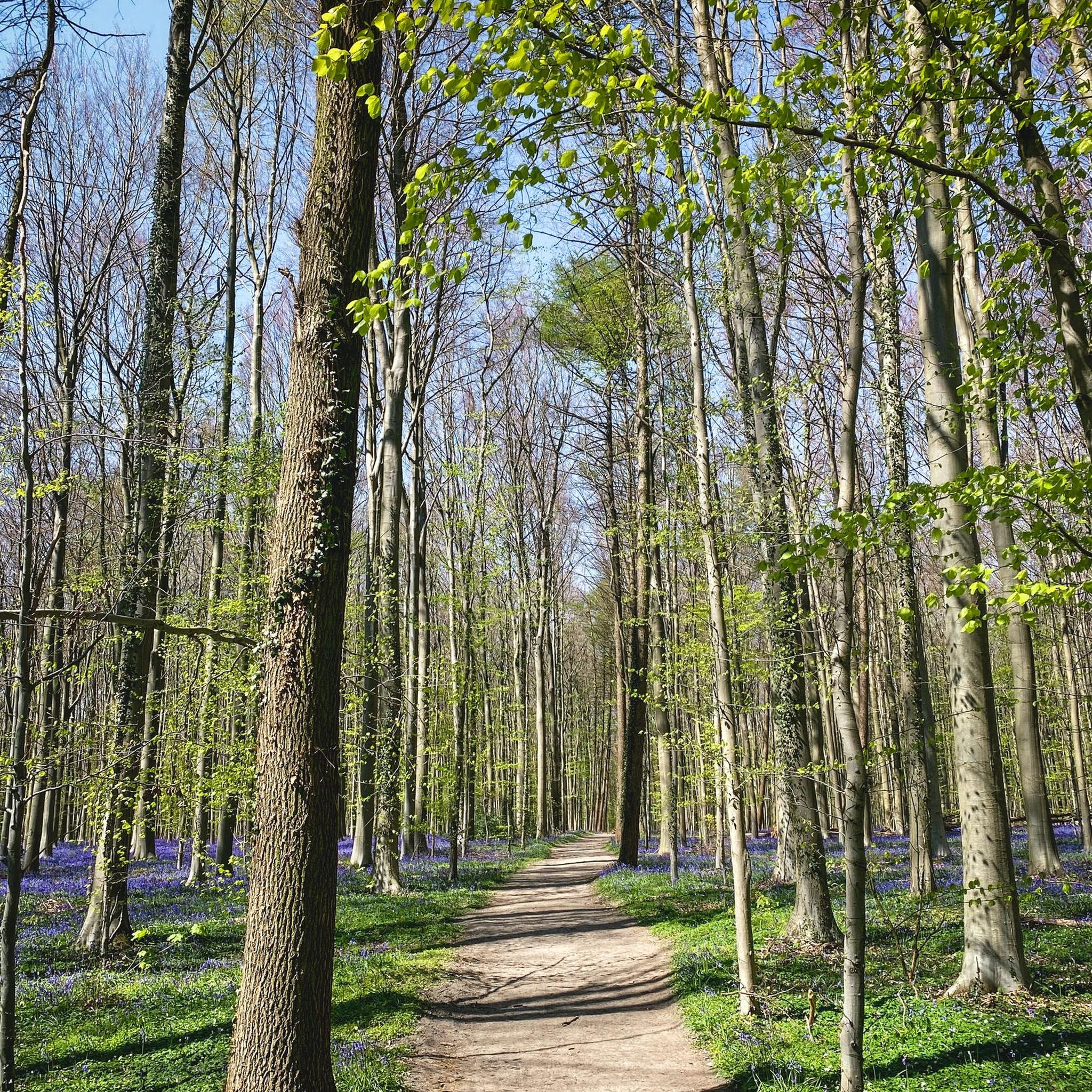
The Hallerbos (French: Bois de Hal) is a forest with an area of 552 ha southeast of Halle (511 ha on Halle territory). The forest is largely owned by the Flemish Region and a small part by the Walloon Region and private properties. The Hallerbos is a quiet recreation area, which is highly appreciated by the population of the surrounding highly urbanized areas. It is very accessible thanks to the many paths, and for an introduction there are three hiking trails. The forest is part of the Flemish Ecological Network, has been a Flemish nature reserve since 2021 and is protected in Europe as a Natura 2000 area 'Hallerbos and nearby forest complexes with source areas and heaths' (BE2400009) (together with other sub-areas such as the Markvallei, Zuunvallei with the Gaasbeek domain, De Wolfsputten, Kesterbeekvallei, Kesterheide, the Terrijst forest reserve, Lembeekbos, Zevenbronnen, Gasthuisbos, Begijnenbos). Since 2023, the forest has been part of the Brabantse Wouden National Park.
0
0

It is a beautiful area that is definitely worth the strenuous walk to admire!
2
0

This small pond lost in the middle of the woods serves as shelter and refuge for local wildlife.
3
0


A beautiful shelter or resting place...
2
0
Frequently Asked Questions
What types of landscapes can I expect when hiking around Halle?
Halle's hiking landscape is incredibly diverse, shaped by the Saale and Unstrut rivers. You'll find scenic river valleys, floodplains, and vineyard-dotted hills, particularly in the Saale-Unstrut Valley. The region also features varied geological formations like Muschelkalk and Buntsandstein, and extensive nature reserves with steep cliffs, narrow valleys, and deciduous forests.
Are there many hiking trails available in Halle?
Yes, Halle offers a vast network of hiking trails. There are over 300 routes available, catering to various ability levels. You'll find a good mix of easy walks, with over 200 routes, and more challenging moderate trails, with over 100 options.
What are some notable natural features or landmarks to look out for on hikes in Halle?
The region is rich in natural beauty and historical sites. You can explore the unique orchid meadows of the Tote Täler Nature Reserve, discover the diverse ecosystems of the Nature Park "Unteres Saaletal," or wander through the extensive Dölauer Heide with its Kolkturm tower and Heidesee lake. The Brachwitzer Alps along the Saale River also offer scenic trails. For historical interest, some routes provide views of or pass by Neuenburg Castle.
What is the best time of year to go hiking in Halle?
The best seasons for hiking in Halle are typically spring and autumn. During these times, the weather is generally pleasant, and the natural landscapes, from blooming meadows to vibrant fall foliage, are at their most beautiful.
Are there family-friendly hiking options in Halle?
Absolutely. Halle offers many easy hiking paths suitable for families. Areas like Peißnitz Island provide central green spaces perfect for walks and picnics, while the Halle Mountain Zoo (Bergzoo Halle) even has special hiking trails designed for children within its beautiful landscape on the Reilsberg.
Can I bring my dog on hiking trails in Halle?
Many trails in Halle are dog-friendly, allowing you to enjoy the outdoors with your canine companion. However, it's always recommended to check local regulations for specific nature reserves or protected areas, as rules regarding dogs (e.g., leash requirements) can vary.
Are there any circular hiking routes in Halle?
Yes, the diverse terrain around Halle, including river valleys and nature parks, lends itself well to circular routes. While specific named circular routes are not detailed here, the extensive network of trails allows for many possibilities to plan your own loops, especially in areas like the Dölauer Heide or the Nature Park "Unteres Saaletal".
What do other hikers say about the trails in Halle?
The hiking routes in Halle are highly regarded by the komoot community, with an average score of 4.4 stars from over 1100 reviews. Hikers often praise the varied terrain, the scenic river views, and the well-maintained paths that make exploring the region a pleasure.
Are there any long-distance hiking opportunities near Halle?
While Halle itself offers numerous day hikes, its proximity to the Saale and Unstrut rivers, and its location on the edge of the Harz Mountains, suggests potential for connecting to longer-distance trails. The region's extensive network of paths could be used to create multi-day excursions, particularly along the river valleys or through the larger nature parks.
What kind of geological formations can be observed while hiking in Halle?
Halle's geological diversity is a highlight for hikers. The area features varied formations including Muschelkalk, Buntsandstein, and porphyry rock. The Nature Park "Unteres Saaletal" even has a dedicated "Geopfad Wettin" (geological path) where you can learn more about the region's geological history.
Are there any places to explore within the city of Halle itself?
Within Halle, you can enjoy the city's significant green spaces. Peißnitz Island, surrounded by the Saale River, is a popular spot for walks and recreation. Rabeninsel is another lovely green area. The university's Botanical Garden, established over 300 years ago, also offers a tranquil outdoor experience.
Most popular attractions around Halle

Get inspired with the komoot mobile app


Explore more
Browse the best Hikes in other regions.
