Attractions and Places To See around Ponsacco - Top 20
Best attractions and places to see around Ponsacco include historical landmarks, cultural sites, and natural areas. Historically a borderland between the Republics of Pisa and Florence, Ponsacco retains many signs of its past as a fortified castle. The town is situated near the confluence of the Cascina and Era rivers, with green spaces like the Poggini Area offering trails for walking or cycling. Visitors can explore a blend of history and local charm in this region.
Best attractions and places…
Last updated: May 25, 2026
The Castle of Lari (Lari Fortress, Pisa)
Highlight • Castle
Tip by

Brunelleschi’s Fortress of Vicopisano
Highlight • Castle
Translated by Google •
Tip by

Sign up now to discover places like this
Get recommendations on the best single tracks, peaks, & plenty of other exciting outdoor places.
Sign up for free
Romanesque Parish Church
Highlight • Religious Site
Perched on a tuff spur opposite the village, and separated from it by a deep escarpment, the parish church is unique because …
Translated by Google •
Tip by

Virgo Interferometer – European Gravitational Observatory
Highlight • Monument
Tip by

The Cherries of Lari
Highlight • Settlement
Tip by
Sign up for free to discover even more attractions around Ponsacco.
Sign up for free
Already have an account?
Start today with a free account
Your next adventure awaits.
Login or Signup

Tips from the Community

The Parish Church of San Martino: Architectural Highlights Perched on a tuff spur opposite the village, and separated from it by a deep escarpment, the parish church is unique because it is predominantly built of terracotta (the façade is stone), like most medieval parish churches in Tuscany. The construction of the parish church dates back to the second half of the 13th century, when a new parish church was created, detached from the previous parish church of San Gervasio. The Interior Of grandiose proportions, the parish church appears to have a rather uniform masonry, despite having been restored several times over the centuries. According to studies conducted on its architectural structure, different periods of construction appear to coexist. Nevertheless, the most striking style is late Romanesque. The interior consists of three naves of five bays with brick columns, a raised presbytery, and three side chapels. Inside, there is also a hexagonal baptismal font, a holy water stoup, and a large marble basin. The latter, destroyed in the 17th century, was presumably used for the immersion baptismal rite and came from the church of Santa Maria da Ripezzano, near Palaia. The parish church is also a scenic location for ceremonies and weddings. https://www.terredipisa.it/attrazione/palaia-pieve-san-martino/
1
0
EGO, the European Gravitational Observatory, located in Cascina, in the Pisan countryside, is the institutional headquarters of the Virgo experiment, the only gravitational wave detector in Europe and one of four in the world. Gravitational waves are very faint cosmic signals that allow us to observe extraordinary phenomena in the deep Universe, such as the merging of black holes or stars. https://www.ego-gw.it/mission/ Book a guided tour, remotely or in person VISIT EGO & THE VIRGO INTERFEROMETER
0
0

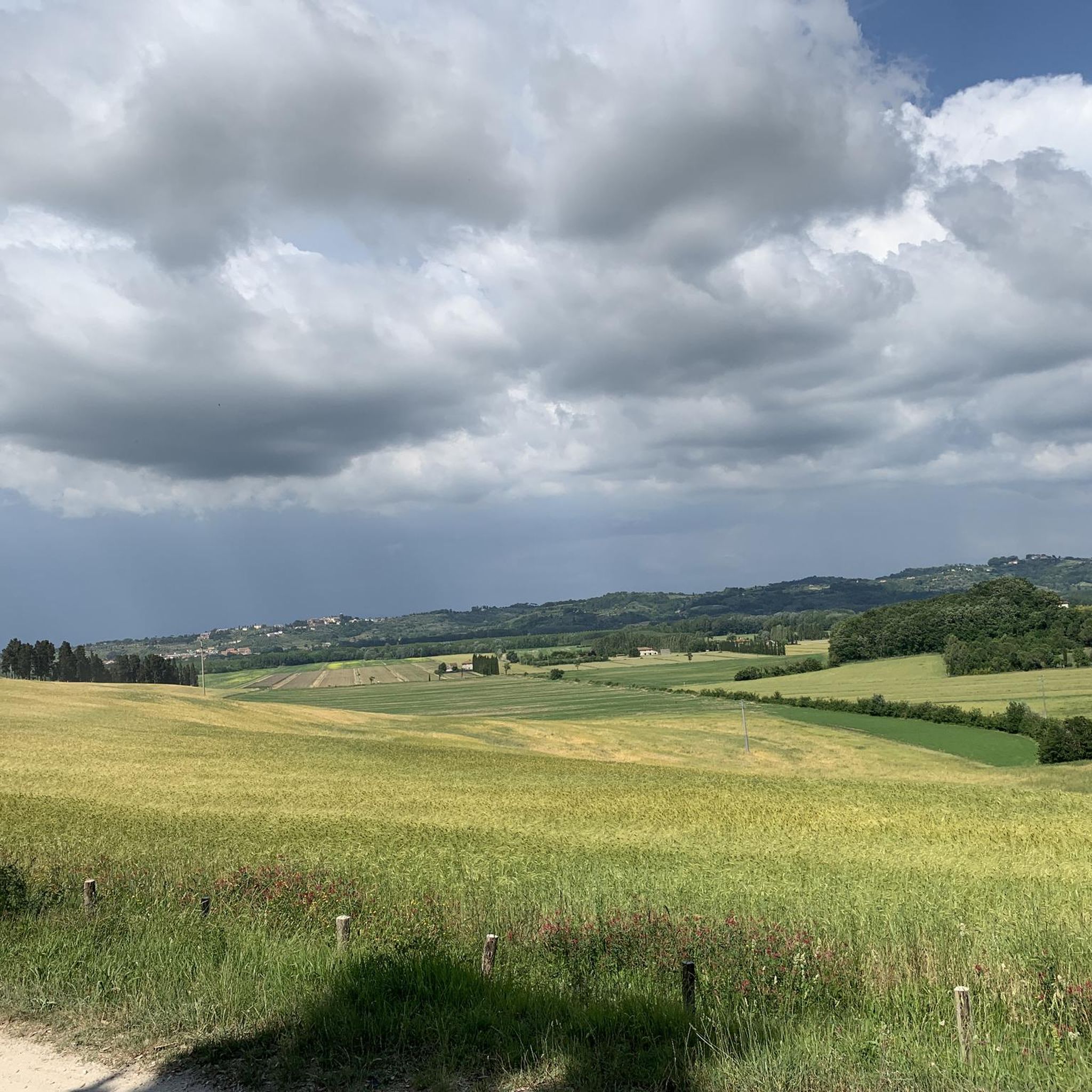
A medieval town with charming streets and climbs. Buildings full of history.
0
0

Long straight on flat ground. Recommended? I don't know….
0
0
The historic town center is always worth a stop!
0
0

Lari is a town located in the Pisan hills, whose economy is mainly agricultural. Among the fruit production of its territory, the cherry stands out. The whole area, in fact, is famous not only for the large quantity of cherries produced (half of the whole of Tuscany), but also for their variety and renowned quality, so much so that the DOP (i.e. PDO, protected designation of origin) , was requested with the name "Ciliegia di Lari". The biodiversity and quality of the cherries of the Pisan hills is due not only to the peculiarities of the soils and the climate, but also to the knowledge and experience gained over time by the numerous agricultural producers in the wake of tradition. Every year between May and June, in the historic center of Lari there is a Cherry Festival (and local food and wine products) accompanied by cultural and folkloristic events. An opportunity not to be missed!
3
0
Lari is famous for its Castello dei Vicari, located at the top of the hill and in the center of the city. This interesting fortress was started around the year 1000 in a strategic point of the Arno valley and grew in splendor until 1400, when it began to host the Vicars, i.e. the magistrates who had the task of administering a large part of the Pisan territory on behalf of the Grand Duke of Tuscany. Today, after being restored, it is open to the public and hosts conferences, meetings and exhibitions, as well as guided tours, entertainment, concerts, theater, wedding ceremonies and other initiatives for groups and school parties. Timetable: 01.01 — 31.03 and 01.11 — 31.12: Saturday and holidays from 10.30am to 12.30am and from 3pm to 6pm 01.04 — 31.05: Monday-friday from 3.30pm to 7pm. Saturday and holidays from 10.30am to 12.30am and from 3.30pm to 7pm 01.06 — 30.09: Every day from 10:30am to 13:00pm/3:00pm to 7:00pm 01.10 — 31.10 Monday-friday from 3pm to 6pm. Saturday and holidays from 10.30am to 12.30am and from 3pm to 6pm Full price ticket €4.00 Guided tour on booking €5.00 Reduced ticket and school parties €3.00 For reservations or other information, tel 0587 687116 or mail to info@castellodilari.it
2
0

This is the Rocca del Brunelleschi, commissioned to the architect Filippo Brunelleschi after the village besieged for eight months by the Florentines, had been definitively conquered by them against the city of Pisa. The victory for Florence had been very important and had to be maintained over time: Vicopisano covered a decidedly strategic area thanks to the confluence of the Arno river which connected it to Pisa and the Auser river which put it in communication with Lake Sextum and therefore with the Lucchesia. . In 1435 the project was entrusted to Filippo Brunelleschi who showed his idea to the government commission through a project made of wood and clay; the project gathered enthusiasm and work began immediately which drastically changed a large part of the town of Vicopisano. The existing tower was modified with the aim of being impregnable and autonomous in terms of water and food.
1
0
Frequently Asked Questions
What historical sites can I explore in and around Ponsacco?
Ponsacco and its surroundings are rich in history. You can visit the impressive Medici Villa of Camugliano, a Renaissance-style villa with a castle-like appearance. Other notable historical sites include the Oratory of the Madonna della Tosse, the Church of San Giovanni Evangelista with its leaning bell tower, and the Torre dell'Orologio (Clock Tower). Further afield, explore The Castle of Lari (Lari Fortress, Pisa), which hosts guided tours, and Brunelleschi’s Fortress of Vicopisano, a strategically important medieval structure.
Are there any cultural attractions or museums in Ponsacco?
Yes, Ponsacco offers several cultural points of interest. The PALP Museum, located in the renovated Praetorian Palace, hosts various exhibitions. You can also visit the Museum of Sacred Art, showcasing collections of sacred furnishings and liturgical vestments, and the Museum of Wood, which highlights Ponsacco's tradition as a city of furniture and furnishings. For culinary enthusiasts, the Tessieri School is one of Italy's largest cooking schools.
What natural areas are available for outdoor activities near Ponsacco?
The Poggini Area is identified as Ponsacco's primary 'green lung,' offering ideal trails for walking or cycling. The town is also situated near the confluence of the Cascina and Era rivers, providing a scenic natural backdrop for exploration.
Are there family-friendly attractions in the Ponsacco area?
Absolutely! Families can enjoy The Cherries of Lari, especially during its annual Cherry Festival between May and June. The Castle of Lari also offers guided tours and entertainment suitable for all ages. For a unique educational experience, the Virgo Interferometer – European Gravitational Observatory provides guided tours and is wheelchair accessible.
Can I find hiking trails around Ponsacco?
Yes, there are several hiking opportunities. You can explore trails in the Poggini Area, or try routes like the 'Casale Le Torri Resort loop from Ponsacco' (6.5 km, easy) or the 'Santuario Madonna di Ripaia – Montecastello Castle loop from Val di Cava' (10.1 km, moderate). For more options, refer to the Hiking around Ponsacco guide.
What cycling routes are available near Ponsacco?
The area around Ponsacco is great for cycling. You can find road cycling routes such as the 'Road Through Fields and Vineyards loop from Pontedera' (59 km, moderate) or mountain biking trails like the 'Poggini Fantasia – Casciana Alta Historic Center loop from Ponsacco' (34.6 km, moderate). Detailed routes are available in the Road Cycling Routes around Ponsacco and MTB Trails around Ponsacco guides.
Are there any unique or 'hidden gem' attractions worth visiting?
Beyond the main highlights, consider visiting the Castello Montebicchieri, a 13th-century castle with a church featuring 14th-century decorative elements. The Oratory of the Madonna della Tosse, with its antique terracotta tablet possibly by Luca della Robbia, is also a charming and historically significant spot.
What is the best time of year to visit Ponsacco attractions?
The region generally enjoys a pleasant climate. For outdoor activities and festivals like the Cherry Festival in Lari, late spring (May-June) and early autumn (September-October) are ideal, offering comfortable temperatures. Many historical sites and museums are open year-round, but it's always good to check specific opening hours.
Are there any attractions accessible for wheelchair users?
Yes, the Virgo Interferometer – European Gravitational Observatory is noted as being wheelchair accessible, offering an opportunity to learn about gravitational waves in an inclusive environment.
What kind of art can I see in Ponsacco?
Ponsacco's artistic heritage is primarily found in its religious buildings and museums. The Church of San Giovanni Evangelista houses a polychrome terracotta Madonna statue attributed to Benedetto da Maiano. The Oratory of the Madonna della Tosse features an antique terracotta tablet possibly from the 15th century, attributed to Luca della Robbia. The Museum of Sacred Art also displays over 120 fine works of art, primarily in noble metal, from the 16th and 17th centuries.
What do visitors enjoy the most about Ponsacco and its surroundings?
Visitors particularly appreciate the blend of historical significance and natural beauty. The medieval towns with charming streets and historical buildings, like those found near Brunelleschi’s Fortress of Vicopisano, are highly valued. The agricultural landscape, especially the cherry production around Lari, and the opportunities for outdoor activities in green areas like the Poggini Area, also receive positive feedback.
Most popular routes around Ponsacco
Most popular attractions around Ponsacco

Get inspired with the komoot mobile app


Explore more
Still not found the Highlight you’re looking for? See guides of the top attractions in other regions:
