The best traffic-free bike rides around Le Conquet
3.9
(37)
983
riders
20
rides
No traffic road cycling routes around Le Conquet traverse the westernmost tip of Brittany, characterized by a rugged coastline, historic lighthouses, and scenic bays. The terrain features diverse natural environments including hedgerows, moors, rocks, and dunes, with notable elevation changes along coastal roads. Cyclists will encounter a mix of flat sections and demanding climbs, particularly around the Kermorvan Peninsula and the Pointe Saint-Mathieu. The region also includes the tidal estuary of Ria du Conquet, a Natura 2000 classified site.
Best…
Last updated: May 24, 2026
4.2
(5)
77
riders
55.9km
02:46
580m
580m
Moderate road ride. Good fitness required. Some segments of this route may be unpaved and difficult to ride.
64
riders
20.2km
00:54
180m
180m
Moderate road ride. Great for any fitness level. Some segments of this route may be unpaved and difficult to ride.

Sign up for free
37
riders
11.5km
00:30
100m
100m
Easy road ride. Great for any fitness level. Mostly well-paved surfaces and easy to ride.
11
riders
Moderate road ride. Great for any fitness level. Some segments of this route may be unpaved and difficult to ride.
11
riders
20.6km
00:56
180m
180m
Moderate road ride. Great for any fitness level. Some segments of this route may be unpaved and difficult to ride.
Get access to more routes and recommendations from other explorers.
Sign up for free
Already have an account?
Our route recommendations are based on thousands of hikes, rides, and runs completed by other people on komoot.
Start today with a free account
Your next adventure awaits.
Login or Signup


Other adventures around Le Conquet

Tips from the Community

Phare de Saint-Mathieu is the name of a lighthouse in the village of Saint-Mathieu on the Saint-Mathieu Point in Plougonvelin in the Finistère department. It was built on the site of the former Saint-Mathieu Abbey. Its theoretical range is 29 nautical miles, which is approximately 55 kilometers. Together with the Kermorvan lighthouse, it indicates the Passage du Four (Chenal du Four), an important north-south passage from or to the Iroise Sea, which runs between the mainland and the island of Ouessant, thus saving about two days of travel time. In conjunction with the Portzic lighthouse, it illuminates the entrance to the Bay of Brest. The lighthouse has been listed as a French Historic Monument since May 23, 2011. It is open to the public. Just west of the lighthouse is the Sémaphore de la Pointe Saint-Mathieu.
1
0
A sign says: everyone travels at the same speed here. So cycling is allowed, but at walking pace.
1
0
Unfortunately, there's no restaurant. But the Breton cakes and biscuits are divine.
1
0

practical footbridge over the harbor allowing you to reach Le Conquet
0
0

Please note: following Storm Ciaran (over 200 km/h), which damaged the building on November 2, 2023, the church is temporarily closed to both worship and visits. Latin cross plan with three naves. Flat chevet flanked to the north and south by two single-story sacristies. Bell tower with two galleries and two bell chambers, supported by an octagonal spire framed at its base by four pinnacles. The main structure is made of granite and quartz microdiorite ashlar. Four-bay nave covered with yellow-painted wainscoting with white ribs. Pointed arches extending directly into the columns. Chancel flanked by two side chapels opening onto the transept. Floor covered with granite and schist slabs. The church dates from the mid-19th century. It presents itself as a homogeneous ensemble in the Flamboyant Neo-Gothic style. The church houses the tomb of Michel de Nobletz, a famous 17th-century preacher in Lower Brittany. Stained-glass windows adorn the windows and are divided into three distinct groups: the main window of the choir, which brings together 16th-century remains from the church of Lochrist; two hagiographic stained-glass windows, works by Robert Micheau-Vernez, in 1930-32; and finally, twelve stained-glass windows, designed in 1960 and 1971 by the glass painter Jacques Bony. The building was constructed between 1856 and 1859 based on plans by the diocesan architect Joseph Bigot, by the contractor Jézéquel, using materials from the original Saint-Christophe chapel and the Lochrist chapel from the 15th, 16th, and 17th centuries. The western façade dates from 1856.
0
0

Small church in the town center of Plougonvelin. Destroyed during the bombings of 1944, it was restored between 1948 and 1951.
0
0

The Saint-Mathieu lighthouse is classified as a historic monument. It was the first fire in Finistère. It peaks at 37 meters high. Tours are organized, if you are not afraid to climb the 163 steps that lead to its summit.
0
0

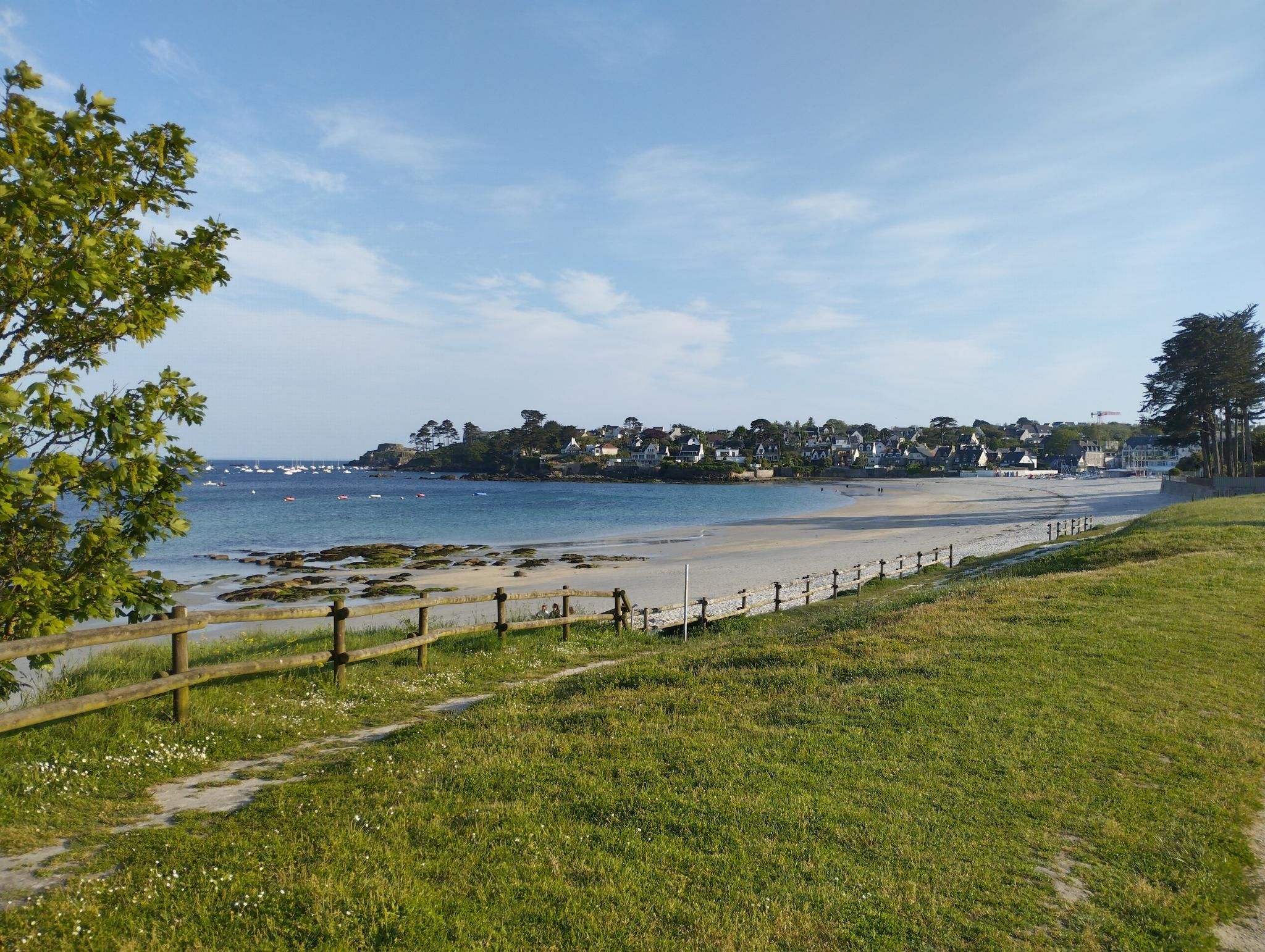
With its long beach of fine sand, its turquoise waters and its opulent residences, Plougonvelin almost seems to be a town out of time. Ideally located on the GR 34 (customs trail), it is an interesting stopover for those who want to eat or spend the night there. There are many amenities there, from accommodation to catering to leisure activities.
1
0
Frequently Asked Questions
How many no-traffic road cycling routes are available around Le Conquet?
There are over 20 traffic-free road cycling routes around Le Conquet, offering a variety of distances and difficulty levels. You'll find options ranging from easy rides perfect for a leisurely outing to more challenging routes with significant elevation changes.
What do other road cyclists enjoy most about the no-traffic routes in Le Conquet?
The no-traffic road cycling routes around Le Conquet are highly rated by the komoot community, with an average score of 3.7 stars. Cyclists frequently praise the stunning coastal views, the tranquility of the car-free paths, and the diverse landscapes that include rugged coastlines, historic lighthouses, and scenic bays.
Are there easy no-traffic road cycling routes suitable for beginners or families in Le Conquet?
Yes, Le Conquet offers several easy no-traffic road cycling routes. For instance, the View of the Rocky Coast – Rue Pavée de Locronan loop from Plougonvelin is an easy 18.6 km ride with minimal elevation, perfect for a relaxed family outing. These routes often provide a gentle introduction to the region's beautiful coastal scenery.
Are there more challenging no-traffic road cycling routes for experienced cyclists?
Absolutely. For experienced cyclists seeking a challenge, routes like the Croaë Footbridge – Saint-Mathieu Lighthouse loop from Plougonvelin offer a moderate 55.3 km ride with over 575 meters of elevation gain. Another option is the Fort Bertheaume – Chapelle de Bodonou loop from Plougonvelin, a 66.5 km route with similar elevation, providing a more demanding experience through diverse landscapes.
What kind of terrain can I expect on the no-traffic road cycling routes around Le Conquet?
The terrain on these routes is varied, primarily featuring well-maintained paved roads. You'll encounter coastal roads with panoramic sea views, some winding paths through natural environments, and occasional short but demanding climbs, especially on routes that follow the rugged coastline. The region's diverse landscape includes hedgerows, moors, rocks, and dunes.
What natural attractions can I see along the no-traffic road cycling routes?
Many routes offer stunning natural sights. You can cycle past the Corsen Point, the westernmost headland of mainland France, or enjoy views of the Iroise Sea from the Kermorvan Peninsula. The Croaë Footbridge crosses the Ria du Conquet, a Natura 2000 classified site known for its rich flora and fauna. You might also encounter beautiful beaches like Plage des Blancs-Sablons.
Are there any historical landmarks or points of interest on these routes?
Yes, the area is rich in history. Many routes pass by significant landmarks such as the Saint-Mathieu Lighthouse and the adjacent Ruins of Saint-Mathieu Abbey, offering breathtaking panoramic views. You can also spot the Kermorvan Lighthouse at the end of the Kermorvan Peninsula. The fishing port of Le Conquet itself has charming old streets and chapels.
Are there circular no-traffic road cycling routes available in Le Conquet?
Yes, many of the no-traffic road cycling routes around Le Conquet are designed as loops, allowing you to start and end at the same point. Examples include the Fort Bertheaume – View of the Rocky Coast loop from Pointe Saint-Mathieu and the Saint-Mathieu Lighthouse – Saint-Gwenaël Church loop from Trébabu, providing convenient and scenic circular journeys.
What is the best time of year for traffic-free road cycling in Le Conquet?
The spring and summer months (May to September) generally offer the most favorable weather for road cycling in Le Conquet, with milder temperatures and less rainfall. This period allows for the best enjoyment of the coastal scenery and outdoor activities. However, the rugged beauty of the region can be appreciated in all seasons, with autumn offering dramatic skies and fewer crowds.
Where can I park my car when starting a no-traffic road cycling route in Le Conquet?
Le Conquet and its surrounding areas offer various parking options. Depending on your chosen starting point, you can typically find public parking near popular attractions or village centers. For routes originating from specific points like Plougonvelin or Pointe Saint-Mathieu, designated parking areas are usually available, often free of charge.
Are there cafes or places to stop for refreshments along the no-traffic routes?
While the routes themselves are traffic-free, they often pass through or near charming villages and towns where you can find cafes, bakeries, and restaurants. Le Conquet itself, with its fishing port, offers several options for refreshments. Planning your route with komoot allows you to identify potential stops along the way.
Can I reach the no-traffic cycling routes by public transport?
Public transport options to Le Conquet are available, primarily via bus services connecting from larger towns like Brest. While bringing a bike on public transport can sometimes be challenging, it is often possible outside of peak hours or with specific services. It's advisable to check local bus schedules and bike policies in advance. For more extensive cycling, Le Conquet is also part of "La Littorale" (Voie 5 Bretagne), a comprehensive cycle route that can be accessed from various points.
Most popular attractions around Le Conquet

Get inspired with the komoot mobile app


Explore more
Browse the best Road cycling routes in other regions.
