The best traffic-free bike rides around Sankt Marien
4.2
(89)
633
riders
52
rides
No traffic touring cycling routes around Sankt Marien traverse a landscape characterized by gently rolling hills and river valleys within Upper Austria. The region features scenic paths along the Krems and Traun Rivers, offering views of floodplains and diverse natural settings. Cyclists can expect routes that wind through orchards, vineyards, and shaded forests, with some areas providing distant views of the Alpine foothills. This varied terrain provides options for different cycling preferences.
Best no traffic touring cycling routes around Sankt…
Last updated: May 14, 2026
4.9
(29)
132
riders
Moderate bike ride. Good fitness required. Mostly paved surfaces. Suitable for all skill levels.
4.4
(7)
55
riders
Moderate bike ride. Good fitness required. Mostly paved surfaces. Suitable for all skill levels.

Sign up for free
5.0
(3)
43
riders
Hard bike ride. Very good fitness required. Mostly paved surfaces. Suitable for all skill levels.
4.0
(2)
21
riders
Easy bike ride. Great for any fitness level. Mostly paved surfaces. Suitable for all skill levels.
5.0
(3)
12
riders
31.6km
01:58
270m
270m
Moderate bike ride. Good fitness required. Mostly paved surfaces. Suitable for all skill levels.
Get access to more routes and recommendations from other explorers.
Sign up for free
Already have an account?
Our route recommendations are based on thousands of hikes, rides, and runs completed by other people on komoot.
Start today with a free account
Your next adventure awaits.
Login or Signup
Popular around Sankt Marien
Tips from the Community

The Sulzbach flows into the Krems River near Halbarting. This point is located directly on the Krems Valley Cycle Path (R10), which runs from Neuhofen an der Krems to the Traun River and offers numerous scenic stretches. The cycle path offers particularly beautiful views of the estuary. The Sulzbach itself is an approximately 20-kilometer-long right tributary of the Krems River, with its source south of Nussbach at approximately 605 meters above sea level. It flows through the communities of Adlwang, Pfarrkirchen near Bad Hall, and Rohr im Kremstal before flowing into the Krems River near Halbarting. Overall, the confluence of the Sulzbach and the Krems River represents both a scenically attractive spot for cyclists and an ecologically important body of water.
0
0

Here you can see how the Traun connects to the Danube.
1
0


small, quiet, good for a break 😉
0
0

At the PV Kematen barbecue.
1
0

2 - Dogs were nice to me, just not afraid 😐
0
1

The two-winged Renaissance castle dates back to 1588. Further renovations were commissioned around 1670 by the canons Siegbert von Geilenkirchen and Thomas von Kandlberg. It is characterized by an arcaded walkway facing the courtyard. These arcades were enclosed by outbuildings until the renovation. The rooms on the upper floor also served as the official residence of the caretaker – and thus of the courts – for a long time. The Knights of Kast occupied the castle as a summer residence. The dilapidated castle was finally purchased by the municipality of Sierning in 1969 and renovated by the Traunviertel Cultural Association and the town of Sierning. An annex was added to the building, which houses the Sierning municipal office. Following the revitalization of the castle courtyard and the installation of state-of-the-art infrastructure, including a new castle café, it is now possible to host any event. The flagship events are the summer arts and crafts market with up to 10,000 visitors, the Sierning Advent with its Advent village in the castle courtyard, and the Guard Festival. Numerous cultural events and concerts take place throughout the year, both in the castle and in the covered courtyard.
0
0
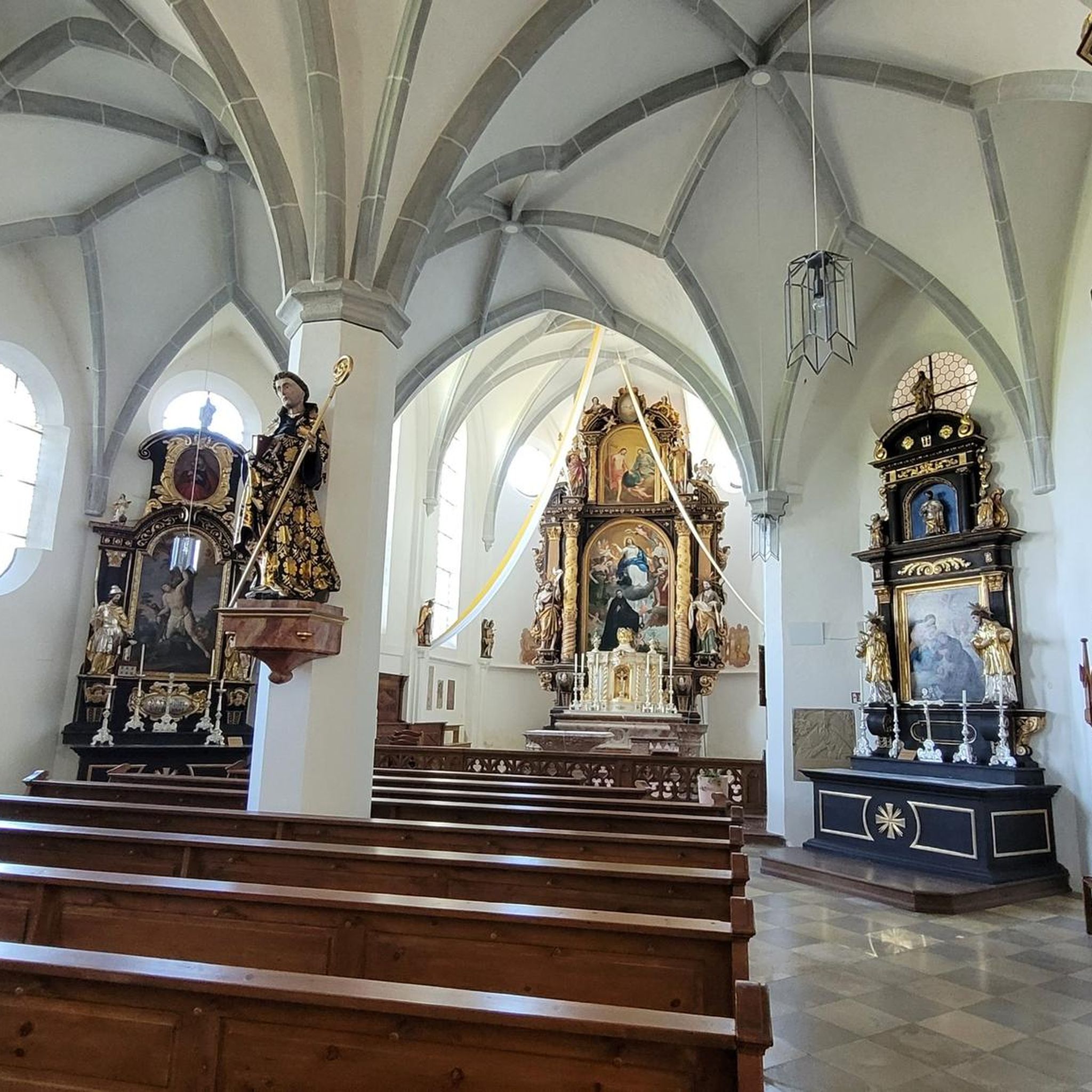
Shortly after the founding of Garsten Abbey, in the first quarter of the 12th century, the Benedictine Abbey of Gleink emerged from the Bamberg fiefdom of Glunich. The founders, Arnhalm I and his son Bruno, from the ministerial Gleink-Volkersdorf family, whose employers, the Styrian Otakars, co-founded the abbey, had the fortress converted into a monastery. The monastery complex, dedicated to the Apostle Andrew, already existed around 1120. The Romanesque monastery building was damaged by fire in the 13th century. In the first half of the 17th century, primarily due to looting during the Peasants' War of 1626, the monastery fell into dire straits. Under the following abbots, the great Baroque building period also began for Gleink. As part of the church reforms, Gleink was secularized on May 21, 1784. Parish pastoral care in Gleink was taken over by secular priests, and the monastery buildings were temporarily used as barracks. The bishops of the Diocese of Linz then happily used Gleink as a summer residence. In 1832, the Salesian Sisters came to Gleink from Vienna. At its peak, their monastery numbered up to 70 sisters. From around 1950 onwards, there were no new enrollments, and in 1977, it was finally dissolved. In 1950, the Order of the Missionaries of the Sacred Heart took over parish pastoral care and, until 1990, also operated a Caritas home, a feared reformatory for boys. Since 2022, the monastery building has served as the "cultural GUT storage" of the Diocese of Linz. The external depot of the Diocesan Archives houses archival materials from the parishes as well as the art and furniture depot with over 2,000 works of art and furniture.
0
0
Frequently Asked Questions
How many no traffic touring cycling routes are available around Sankt Marien?
There are over 50 dedicated no traffic touring cycling routes around Sankt Marien, offering a wide range of options for all skill levels. You'll find 16 easy routes, 27 moderate routes, and 9 more challenging options.
What kind of terrain can I expect on no traffic touring cycling routes in Sankt Marien?
The routes around Sankt Marien feature a diverse landscape, from gently rolling hills and picturesque fields to scenic riverside paths along the Krems and Traun rivers. You'll encounter varied gradients, with some routes offering more elevation gain, especially those venturing into the Kremstal valley. Many paths traverse orchards, vineyards, and shaded forests, providing a pleasant and varied cycling experience.
Are there any family-friendly no traffic touring cycling routes in Sankt Marien?
Yes, Sankt Marien offers several easy, traffic-free routes suitable for families. These routes typically follow flatter terrain along riverbanks or through quiet rural areas. An excellent option for a relaxed family ride is the Gasthaus Hiesmayr Schiedlberg – Weichstetten Parish Church loop from St. Marien, which is classified as easy and covers about 19 kilometers.
What are some notable landmarks or attractions I can see along these routes?
Many no traffic touring cycling routes in the Sankt Marien area pass by or offer views of interesting landmarks. You might encounter historic castles like Traun Castle, or the magnificent St. Florian Monastery. The region also features unique sites such as the Pilgrimage Church Christkindl and the spa town of Bad Hall. Routes along the Traun River may also offer glimpses of the Hasenufer Hydroelectric Power Plant.
Are there any circular no traffic touring cycling routes?
Yes, many of the no traffic touring cycling routes around Sankt Marien are designed as loops, allowing you to start and end at the same point. Examples include the Riverside Path Along the Traun – Bridge Over the Traun loop from Nöstlbach-St. Marien, which offers scenic river views, and the Willow Tree Tunnel – View of Schloss Achleiten loop from Nöstlbach-St. Marien.
Can I bring my dog on these no traffic cycling routes?
Generally, dogs are welcome on cycling paths in Upper Austria, provided they are kept on a leash and you clean up after them. However, specific regulations may vary in certain protected areas or private lands. It's always advisable to check local signage or specific route descriptions for any restrictions before heading out with your dog.
What is the best time of year for no traffic touring cycling in Sankt Marien?
The best time for touring cycling in Sankt Marien is typically from spring through autumn (April to October). During these months, the weather is generally mild and pleasant, and the landscapes are vibrant with blooming orchards or autumn colors. Summer offers longer daylight hours, while spring and autumn provide cooler temperatures ideal for longer rides. Winter cycling is possible, but some paths might be affected by snow or ice.
How long are the no traffic touring cycling routes in Sankt Marien?
The lengths of the no traffic touring cycling routes vary significantly. You can find shorter, easy routes around 19 kilometers, such as the Gasthaus Hiesmayr Schiedlberg – Weichstetten Parish Church loop from St. Marien. Moderate routes often range from 30 to 45 kilometers, like the Krems River Trail – Krems River loop from St. Marien. For more challenging and longer excursions, there are routes exceeding 70 kilometers, such as the Parish Church of Wolfern – St. Stephen's Church in Sierning loop from Nöstlbach-St. Marien.
Are there any routes that offer views of lakes or rivers?
Absolutely. Sankt Marien is located in a region with access to beautiful waterways. Many routes follow the Krems and Traun rivers, offering picturesque riverside views. While Sankt Marien itself isn't directly on a large lake, the wider area provides access to several, including Oedtersee Beach and Pichlinger Lake, which can be incorporated into longer touring plans.
What do other touring cyclists enjoy most about cycling in Sankt Marien?
The no traffic touring cycling routes in Sankt Marien are highly rated by the komoot community, with an average score of 4.2 stars. Reviewers often praise the peaceful, traffic-free environment, the diverse and scenic landscapes ranging from rolling hills to river valleys, and the well-maintained paths that make for an enjoyable and relaxing ride.
Are there options for both paved and gravel no traffic cycling routes?
Yes, the Sankt Marien area offers a mix of surfaces for no traffic touring cycling. Many routes utilize well-paved roads and dedicated cycle paths, ideal for road bikes. However, you can also find routes that incorporate sections of gravel paths, particularly along riverbanks or through forested areas, catering to gravel bike enthusiasts looking for a more varied off-road experience.
Most popular routes around Sankt Marien
Most popular attractions around Sankt Marien

Get inspired with the komoot mobile app


Explore more
Browse the best Cycling routes in other regions.
