The best traffic-free bike rides around Wiesenfelden
4.7
(25)
211
riders
37
rides
No traffic touring cycling routes around Wiesenfelden traverse the diverse landscapes of the Bavarian Forest, offering a mix of terrain suitable for various fitness levels. The region is characterized by its high proportion of green land, featuring lush forests, rolling hills, and idyllic waterside scenery along rivers and streams. Cyclists can expect paths that include both paved and gravel farm roads, with some routes featuring significant elevation changes.
Best no traffic touring cycling routes around Wiesenfelden
- The most popular no…
Last updated: September 30, 2026
8
riders
Moderate bike ride. Good fitness required. Mostly paved surfaces. Suitable for all skill levels.
5.0
(1)
9
riders
25.0km
02:06
400m
400m
Moderate bike ride. Good fitness required. Mostly paved surfaces. Suitable for all skill levels.

5.0
(2)
11
riders
17.3km
01:15
320m
320m
Moderate bike ride. Good fitness required. Mostly paved surfaces. Suitable for all skill levels.
5.0
(1)
5
riders
Moderate bike ride. Good fitness required. Mostly paved surfaces. Suitable for all skill levels.
4.8
(4)
11
riders
21.0km
01:25
330m
330m
Moderate bike ride. Good fitness required. Mostly paved surfaces. Suitable for all skill levels.
Get access to more routes and recommendations from other explorers.
Already have an account?
Our route recommendations are based on thousands of hikes, rides, and runs completed by other people on komoot.
Start today with a free account
Your next adventure awaits.



Tips from the Community

Pfarrkirche St. Tiburtius The late Romanesque basilica was remodelled in Baroque style between 1736 and 1738. It consists of the nave with a central aisle and two side aisles, the square choir with a semi-circular apse to the east, and the church tower on a square base in front of the west wall of the nave, which was extended in 1738 and covered with a pointed helmet in 1865; four bells hang in the tower. The church's nave is spanned by a flat ceiling; in the crossing in front of the choir, it is a cloister vault. Five arcades each separate the nave from the side aisles. The twelve apostles are depicted in paintings above the arcades. The high altar, erected around 1740, is flanked by sculptures of St. Roch of Montpellier and St. Wendelin. The altar panel, also painted by Johann Adam Schöpf, 1.50 meters wide and 2.25 meters high at the apex, depicts the martyrdom of Saint Tiburtius. The painter signed his work in an unusual way, writing the name J.A.Schöpf on the collar of a dog depicted in the lower left of the picture. In the upper part of the high altar, the eye of God is depicted in a triangle within a radiant halo and surrounded by angels. The side altars at the chancel arch were probably created, like the high altar, around 1740. The northern altar contains a carved figure of the Mother of God from the late 15th century, the right altar a statue of St. Sebastian. The altars in the side aisles from around 1765 are works by Mathias Obermayr. The right altar contains an older crucifix, a grieving Mary, and a John, from the first half of the 15th century. On the altar in the left side aisle, on a richly decorated base, stands a Pietà made by Mathias Obermayr from a single piece of lime wood. It is assumed that the Madonna with Child and "Christ at Rest" in the front arcades to the left and right are also works by Mathias Obermayr. The frescoes are by Johann Adam Schöpf; in two ceiling paintings and two wall paintings, they show scenes from the life of Saint Tiburtius, who died a martyr's death in Rome on August 11, 286. Source: Excerpts from www.wikipedia.de
5
0

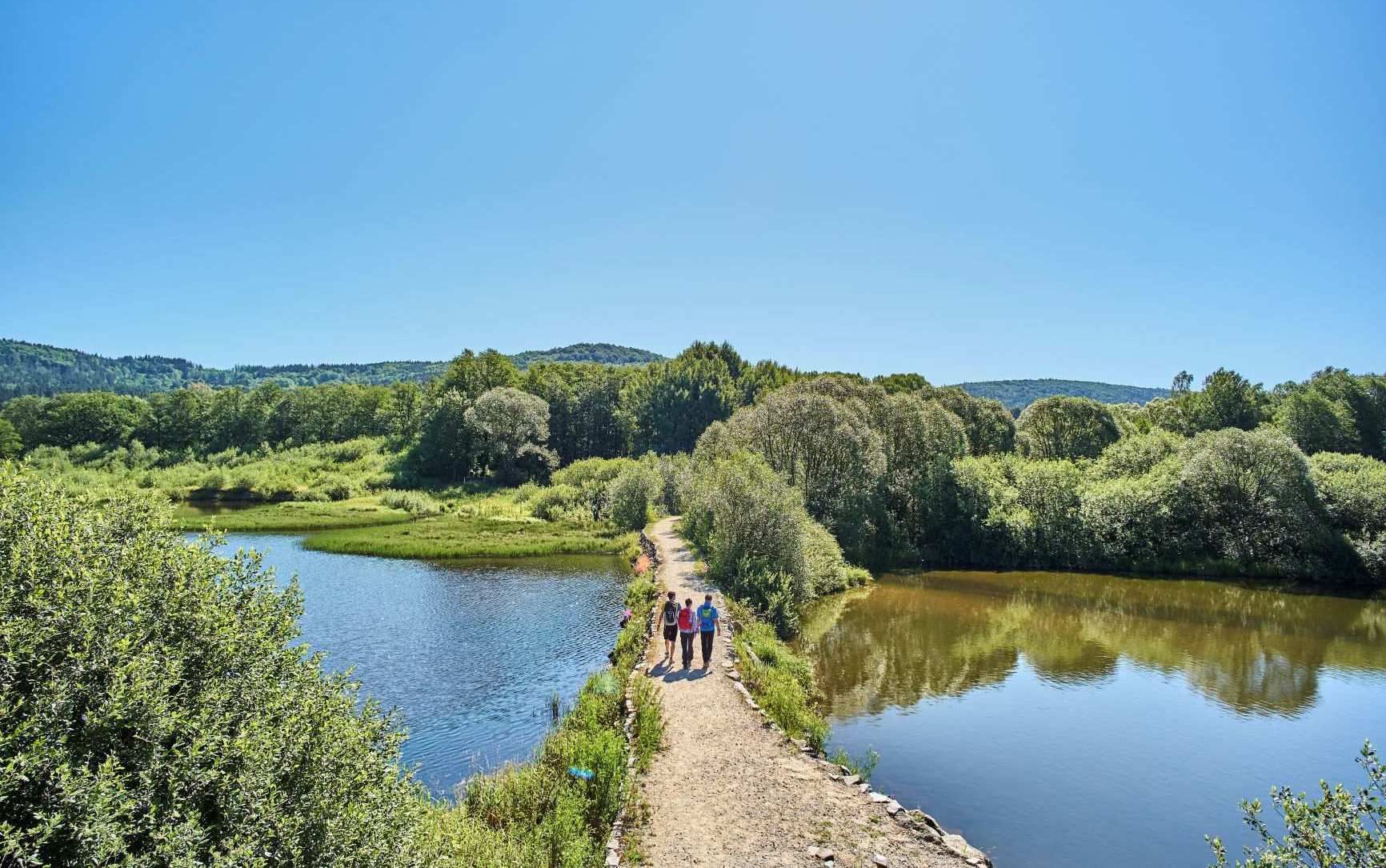
The thirteen-hectare Postfelden reservoir is a fishing water that the Wiesenfelden fishing club has leased. Here you can primarily pull catfish, carp, and pike out of the water. Swimming is forbidden here.
9
0
The Catholic parish church of St. Tiburtius is a late Romanesque basilica from the 12th century, which was redesigned in the Baroque style between 1736 and 1738. Particularly worth seeing are the impressive frescoes by Johann Adam Schöpf, which depict scenes from the life of St. Tiburtius of Rome. Unique is the signature of the painter Schöpf on the collar of a dog in the altarpiece.
11
0


Beautiful view of the castle...
0
0

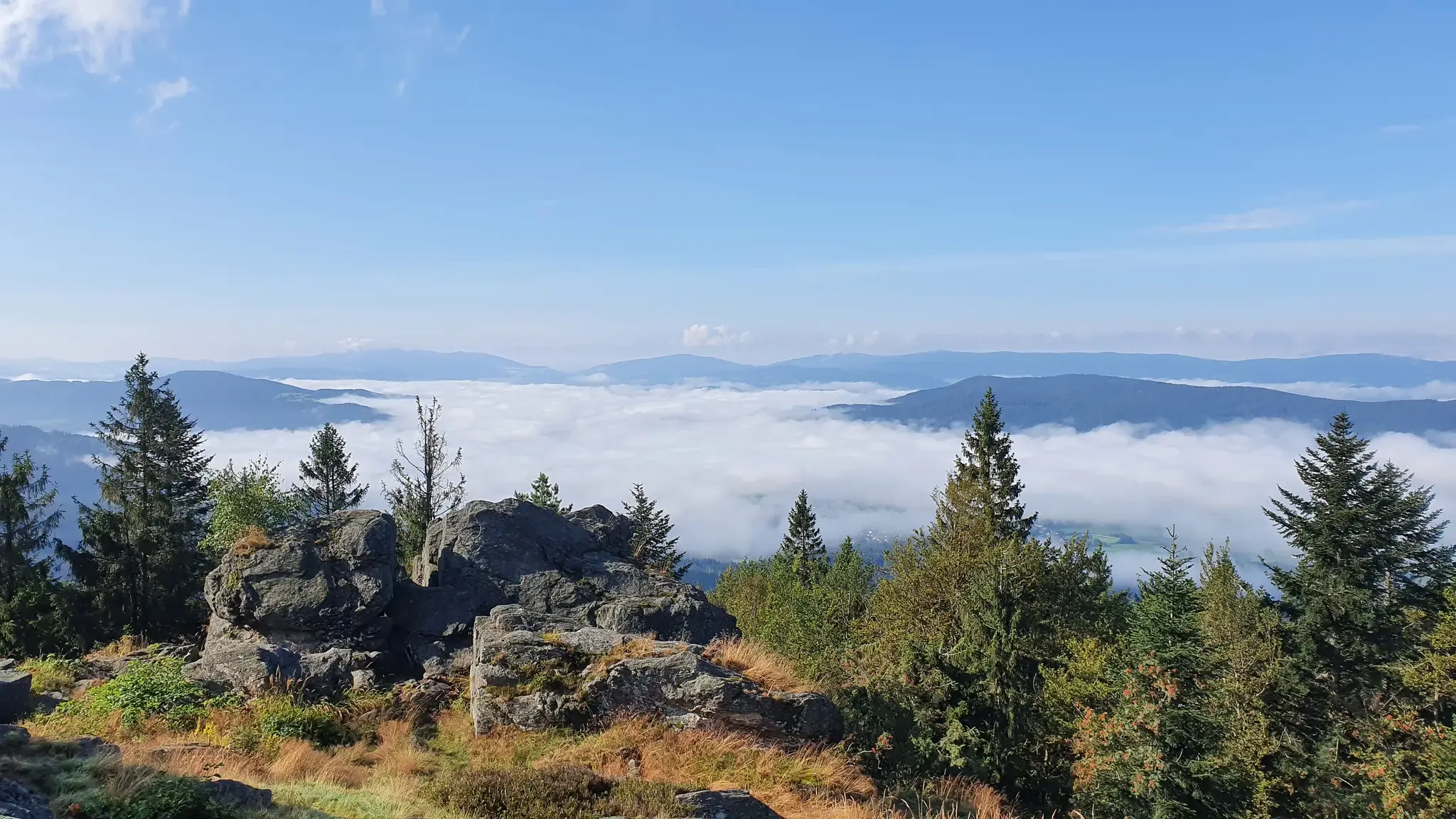
Very nice summit cross and beautiful view
1
2
Very beautiful cross and beautiful viewpoint
1
2
Parish Church of the Assumption of Mary The first parish register of the diocese, in which Wiesenfelden was mentioned as an independent parish, dates back to 1286. The 15th-century "Gothic" predecessor building had become dilapidated. However, the entire building was not demolished; instead, the choir was skillfully integrated into the new structure by altering the windows and vaulting. The present church was completed in 1764. Wiesenfelden was a very large parish in 1848, with a population of 2,472. The parish also included the curacy of the "Marian pilgrimage site of Heilbrunn" and the "Zinzenzell branch." The altarpiece depicts the Assumption of Mary, in reference to the patron saint (= patronage of a saint over a church). The two side altars formerly depicted Saint Barbara and Saint Wendelin; Since around 1920, the left side altar features figures of the Virgin Mary as Patrona Bavariae, and the image of Archangel Michael with the scales of souls is depicted in the excerpt. The right side altar depicts the figure of St. Sebastian, and the excerpt depicts St. Joseph with the Infant Jesus. The oil painting on the confessional depicts St. Peter, with a life-size cross from the Baroque period above. The front part of the nave is decorated with busts of the four evangelists with their symbols: St. Luke with the bull, St. John with the eagle, St. Mark with the lion, and St. Matthew with the angel. These are Baroque works from the late 17th century. The depictions of the Stations of the Cross are handcrafted oil paintings from the late 17th century. Of the Gothic interior furnishings, only a statue of the Virgin Mary and the figure of St. Sebastian remain. Source: Excerpts from www.bayerischer-wald.de / www.wiesenfelden.de/eigene_dateien/wanderwege/station_7_pfarrkirche_wiesenfelden.pdf
2
0
Frequently Asked Questions
How many no-traffic touring cycling routes are available in Wiesenfelden?
Wiesenfelden offers a wide selection of touring cycling routes designed to minimize traffic, with 46 options available. These routes cater to various skill levels, ensuring a pleasant ride through the scenic Bavarian Forest.
Are there any easy, traffic-free touring cycling routes suitable for beginners?
Yes, there are 7 easy, traffic-free touring cycling routes in Wiesenfelden. These routes are generally shorter and have less elevation gain, making them ideal for beginners or those looking for a relaxed ride. One such route is the Historic Rock Cellar – Wiesenfelden Lake loop from Weiherlandschaft bei Wiesenfelden, which is 14.4 km long.
What kind of terrain can I expect on these no-traffic touring cycling routes?
The no-traffic touring cycling routes around Wiesenfelden feature a diverse terrain. You'll encounter a mix of paved roads, gravel farm roads, and some forest trails. While many routes have significant elevation changes, there are also gentler paths. The varied surfaces make the region suitable for both traditional touring bikes and gravel bikes.
Are there any circular touring cycling routes that avoid traffic?
Many of the touring cycling routes in Wiesenfelden are circular, allowing you to start and end in the same location without retracing your steps. An example is the View of Falkenstein Castle – View of Falkenstein Castle loop from Zinzenzell, a moderate 34.1 km route that offers beautiful views.
What natural attractions can I see along the traffic-free touring cycling routes?
The routes often pass through picturesque natural scenery. You can explore idyllic waterside areas, especially around the region's rivers and streams. The Wiesenfelden Pond and Postfelden Reservoir are notable highlights. Some routes also offer views of the lush Bavarian Forest.
Are there any historical landmarks or points of interest along the way?
Yes, several routes incorporate historical landmarks. For instance, the Neukirchen Castle – Falkenfels Castle loop from Wiesenfelden takes you past impressive castles. The region is rich in history, and you might also encounter charming villages and traditional Bavarian architecture.
What do other touring cyclists enjoy most about cycling in Wiesenfelden?
The komoot community highly rates the touring cycling experience in Wiesenfelden, with an average score of 4.8 stars. Reviewers often praise the quiet, traffic-free nature of the routes, the stunning natural landscapes of the Bavarian Forest, and the well-maintained paths that offer a mix of challenge and relaxation.
Can I find routes that offer scenic viewpoints?
Absolutely. Many routes are designed to showcase the region's beauty. The Viewpoint Bench Near Aumbach – Jagawirt Aumbach loop from Wiesenfelden is a great example, offering panoramic vistas. You can often catch glimpses of the wider Bavarian Forest, and on clear days, even the distant Zugspitze.
Are there any routes that pass by lakes or reservoirs?
Yes, several routes offer beautiful waterside scenery. The Historic Rock Cellar – Wiesenfelden Lake loop from Weiherlandschaft bei Wiesenfelden specifically features the Wiesenfelden Lake. Other highlights like the Postfelden Reservoir and Fahnmühle Retention Basin are also accessible.
What is the typical duration for a moderate touring cycling route in Wiesenfelden?
For moderate touring cycling routes in Wiesenfelden, you can expect durations ranging from 1.5 to 2.5 hours for routes between 15-25 km, depending on your pace and elevation changes. For example, the Schiederhof Forest Inn – Wiesenfelden Wind Turbine loop from Wiesenfelden, at 14.8 km, typically takes around 1 hour and 6 minutes.
Are there any specific areas known for particularly quiet or less crowded routes?
The entire region around Wiesenfelden is known for its high proportion of green land and extensive network of paths, making it generally less crowded than urban areas. Focusing on routes that traverse smaller villages and forest sections, such as those around Pilgramsberg, Eggerszell, and Zinzenzell, will offer a particularly peaceful experience away from main roads.
Most popular routes around Wiesenfelden
Most popular attractions around Wiesenfelden

Get inspired with the komoot mobile app


Explore more
Browse the best Cycling routes in other regions.
