Top 20 Natural Monuments in the Lesser Caucasus
Best natural monuments in the Lesser Caucasus are found within a region characterized by its volcanic origin, dramatic mountain ranges, and diverse ecosystems. This area spans parts of southern Georgia, Armenia, and Azerbaijan, offering a variety of geological formations, alpine lakes, and canyons. The Lesser Caucasus is recognized for its rich biodiversity and unique natural features. It provides opportunities for exploring ancient geological formations and varied landscapes.
Best natural monuments in the Lesser Caucasus
- The most popular natural monuments is Symphony of Stones, a natural monument that features hexagonal basalt columns resembling organ pipes. These formations, which can protrude up to 300 meters, are a result of volcanic activity.
- Another must-see spot is Mount Aragats — South Peak panorama, a summit and natural monument. Mount Aragats is an isolated four-peaked volcano massif, with its northern summit being the highest point of the Lesser Caucasus at 4,090 meters above sea level.
- Visitors also love Birtvisi Canyon, a canyon with grey-brown, rounded rocks forming chains of hills, cliffs, and ravines. The rock consists of a smooth, hard sand-gravel-marl, partly karstified, offering a rugged terrain for exploration.
- Lesser Caucasus is known for its canyons, lakes, waterfalls, and volcanic formations. Visitors can explore a variety of natural monuments, from impressive geological structures to high-altitude lakes and powerful cascades.
- The natural monuments in the Lesser Caucasus are appreciated by the komoot community, with more than 38 highlights, 76 photos, and 52 upvotes.
Last updated: May 14, 2026
Symphony of Stones
Highlight • Natural Monument
Tip by

Geghard Rock Monastery
Highlight • Religious Site
Translated by Google •
Tip by

Sign up now to discover places like this
Get recommendations on the best single tracks, peaks, & plenty of other exciting outdoor places.
Sign up for free
Mother Armenia Statue
Highlight • Monument
The monument's location in Victory Park on one of Yerevan's hills is intended to convey the feeling that Mother Armenia is watching over the entire city. It occupies an area of 3,000 m² in the heart of Yerevan's large park. The 120-foot (36-meter) plinth houses a five-story museum, the Department of Defense Military Museum.[3] It is primarily dedicated to the heroism of the 650,000 Armenians who took part in World War II and the soldiers of the Nagorno-Karabakh conflict.[1] The statue itself has a size of 24 meters, the total height is 51 meters.
Translated by Google •
Tip by

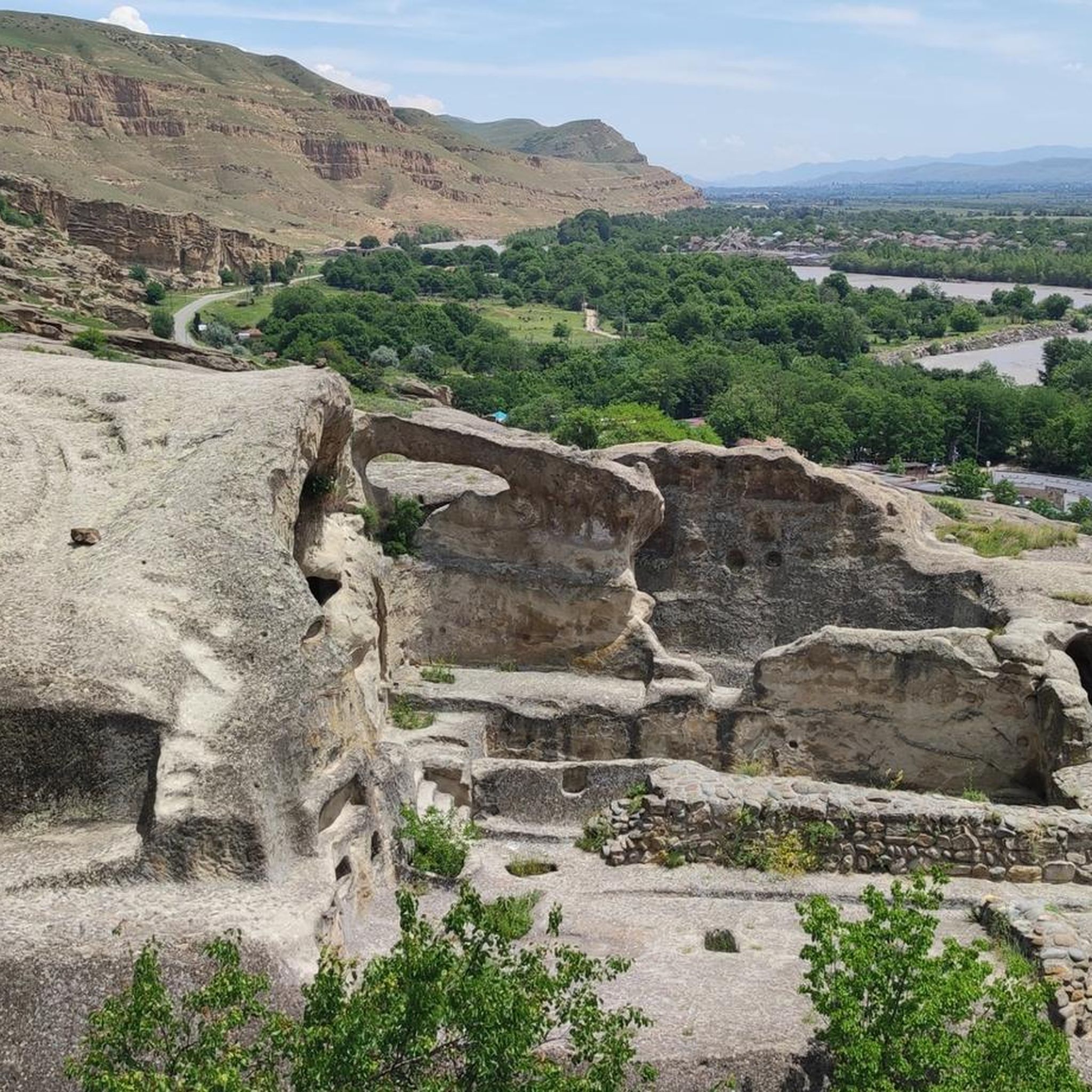
Uplistsikhe Historical-Architectural Museum-Reserve
Highlight • Historical Site
The Uplistsikhe cave complex with a 9th/10th century three-nave basilica
Built on a high rocky left bank of the Mtkvari River, it contains various structures dating from the Early Iron Age to the Late Middle Ages, and is notable for the unique combination of various styles of rock-cut cultures from Anatolia and Iran, as well as the co-existence of pagan and Christian architecture.
Tip by

Batumi Botanical Garden
Highlight • Natural Monument
The garden is located nine kilometers north of Batumi on the Green Cape, directly on the Black Sea. It extends from sea level to more than 100 meters along a steep chain of hills. Paths and terraces offer spectacular views over Batumi Bay. The subtropical climate of the region is particularly beneficial for the plants.
The garden was established in the 1880s by the Russian botanist Andrei Krasnow (1862–1914). He was assisted by the Georgian gardener Iason Gordesiani and his French colleague D'Alphonse. When Krasnov died in 1914, he was buried in the garden and a statue was erected in his honor.
During the Soviet era the garden was further expanded and developed. Since 1925 it has been a primary institution for the study of Caucasian maritime subtropical cultures.
The garden is home to over 5,000 species in nine sections. The arboretum counts 3,270 tree species. It is divided into eight different areas: Transcaucasia, Mediterranean, East Asia, Himalayas, North America, Mexico, South America and Australia. The eucalyptus collection is particularly large. The garden has 60 different species of this myrtle family, many of which are very old and tall. The palm tree, which is widespread in Georgia, is represented by 17 species. Bamboo is planted in dense groves. The bamboo Phyllostachys pubescens, which normally only grows around seven meters high in Central Europe, reaches up to 20 meters there.
Plant species bloom in winter in subtropical climates, the flowering time of which is usually in spring or summer. These include the Voronov snowdrop (Galanthus woronowii), the Lake Riza snowdrop (Galanthus rizehensis), the broad-leaved snowdrop (Galanthus platyphyllus) and the Krasnov snowdrop (Galanthus krasnovii), named after the first director of the Botanical Garden, Professor Krasnow.
Source: de.wikipedia.org/wiki/Botanischer_Garten_Batumi
Translated by Google •
Tip by

Birtvisi Canyon
Highlight • Canyon
A good starting point would actually be Tbisi; but the marshrutka sets off a kilometer earlier.
In the interior of the area there are only small paths; all are unmarked, sometimes difficult to find under the bushes and grass, and the castle can therefore only be found by those in the know. Streams appear and disappear.
Translated by Google •
Tip by

Borjomi Central Park
Highlight • Rest Area
Translated by Google •
Tip by

Gosh Lake
Highlight • Lake
Tip by

Leghvtakhevi Waterfall
Highlight • Waterfall
Translated by Google •
Tip by

Zundagi Waterfall
Highlight • Waterfall
Tip by

Sign up for free to discover even more natural monuments in the Lesser Caucasus.
Sign up for free
Already have an account?
Start today with a free account
Your next adventure awaits.
Login or Signup
Popular around Lesser Caucasus



Tips from the Community


Absolutely beautiful, highly recommend. There’s a beautiful stream near the place with breathtaking nature. The church is really lovely as well.
0
0

The garden was founded in 1912 and, with its 114 hectares, is the second largest botanical garden in Georgia. It stretches from sea level to over 100 meters above sea level – ideal for those who enjoy a bit of a sweat while strolling and are rewarded with spectacular views. On clear days, the view extends far beyond the Bay of Batumi to the Caucasus Mountains. The grounds are terraced and crisscrossed by shady paths, repeatedly interrupted by clearings, viewpoints, or simply beautiful plant scenes. More than 5,000 species in nine geographical zones make the walk a botanical journey around the world: Transcaucasia, the Mediterranean, the Himalayas, North and South America, East Asia, and even Australia are represented. The garden is particularly proud of its collection of over 60 different eucalyptus species – anyone who walks through these avenues will understand why. Those who love peace and quiet will find their place here. Photography enthusiasts will too. And for those who simply want to unwind, the sound of the sea, birdsong, and fragrant forest air provide a complete relaxing experience. There aren't any restaurants anywhere, but you'll find simple kiosks at the entrances, or you can sit down and bring your own food.
0
0

The founding of the monastery in the 4th century AD on the site of a pagan spring is attributed to Saint Gregory, the patron saint of the Armenian Apostolic Church (Wikipedia).
5
0

Beautiful and powerful waterfall with interesting road to it. The ideal time to start the route: around 11 am, to be at the waterfall by 2 pm, when the sun reaches it and illuminates it) The climb from the village of Dologani will not be easy, in some places there are bushes, but without thorns, quite a steep climb, but with excellent views. The path to the waterfall itself is also quite difficult and slippery, in some places littered with trees, you need poles and shoes with good grip. It is better to stop for a snack before the final descent to the lower waterfall, in the sun, when you see on the opposite side of the valley beautiful stone cliffs overgrown with greenery, high cliffs and a distant waterfall at the top (it is generally unlikely to approach it, but there is something to admire). At the Zundagi waterfall, where the trail will lead, you can go down a little further along the stream, there will be an excellent pool for swimming in the summer, as well as gorgeous views along the stream of huge boulders the size of a three-story house and a river running between them. The descent to the village of Zundagi is easy and pleasant)
2
0

located in the old city of Tbilisi, one of the ancient place Abanotubani. The waterfall is 22 meters tall.
0
0

Grey-brown, rounded rocks form many chains of hills and cliffs, canyons and ravines, constantly going up and down. The rock is a smooth, hard sand-gravel-marl; somewhat similar to the Elbe Sandstone Mountains, but not as sandy, but with larger stones/pebbles in it; partly karstified. Some climbers tried their hand at the vertical walls (some of these walls were covered in ivy from top to bottom). A good starting point would actually be Tbisi; but the marshrutka sets off a kilometer earlier. In the interior of the area there are only small paths; all are unmarked, sometimes difficult to find under the bushes and grass, and the castle can therefore only be found by those in the know. Streams appear and disappear.
0
0

The geological formation is incredible. The path is next to the basalt wall, it will be safe until a rock falls on someone's head. Today, entry was 300 drams. The structure they built for pedestrians is good, I believe it is possible to travel the route with a wheelchair too. I entered from the side that comes from the valley, going down the street next to the entrance to the Temple of the Sun (separate entrance). There is another entrance for those coming by car, and this one has a slightly steep slope. I didn't like the number of cars passing among the pedestrians, it seems to me that it will turn into a place for mass tourism.
0
0
Frequently Asked Questions
What unique geological features can I explore in the Lesser Caucasus?
The Lesser Caucasus is rich in unique geological formations. You can witness the impressive hexagonal basalt columns at the Symphony of Stones in Garni Gorge, which resemble giant organ pipes. The region is also home to volcanic structures like Mount Aragats, a stratovolcano with high-altitude lakes, and dramatic landscapes such as Birtvisi Canyon, known for its rugged, karstified rock formations.
Are there family-friendly natural monuments in the Lesser Caucasus?
Yes, several natural monuments are suitable for families. Leghvtakhevi Waterfall offers an accessible and scenic spot. Lake Parz is another family-friendly destination, though it can be quite popular on weekends. Borjomi Central Park also provides a pleasant environment with facilities for visitors.
What kind of outdoor activities can I do near the natural monuments?
The region offers diverse outdoor activities. You can find numerous hiking opportunities, including challenging trails around Mount Aragats and scenic waterfall hikes. For specific routes, explore the Waterfall hikes in the Lesser Caucasus guide. Cycling is also popular, with options ranging from easy to difficult, as detailed in the Cycling in the Lesser Caucasus guide and Road Cycling Routes in the Lesser Caucasus guide.
Where can I find impressive viewpoints in the Lesser Caucasus?
Many natural monuments offer breathtaking views. The South Peak panorama of Mount Aragats provides expansive vistas from Armenia's highest peak. Other notable viewpoints include Mother Armenia Statue, Borjomi Central Park, and Leghvtakhevi Waterfall, all offering picturesque settings.
Are there any historical or cultural sites near the natural monuments?
Yes, the region blends natural beauty with rich history. The Geghard Rock Monastery is a UNESCO World Heritage site carved into the rock, offering a unique combination of natural cave formations and ancient architecture. Another significant historical site is the Uplistsikhe Historical-Architectural Museum-Reserve, an ancient rock-hewn town.
What are some notable lakes in the Lesser Caucasus region?
The Lesser Caucasus features several beautiful lakes. Gosh Lake is a serene forest lake, while Lake Parz is a popular spot for relaxation. Additionally, Lake Sevan in Armenia, often called the 'Blue Pearl,' is one of Eurasia's largest and highest-altitude freshwater lakes, vital for the region's hydroecology and a paradise for birdwatchers.
What is the best time to visit the natural monuments in the Lesser Caucasus?
The best time to visit largely depends on the activity. For hiking and exploring the mountainous areas like Mount Aragats, late spring to early autumn (May to October) generally offers the most favorable weather conditions. Waterfalls and canyons like Birtvisi Canyon are also best enjoyed during these warmer months when accessibility is easier and the scenery is vibrant.
What kind of terrain can I expect on hiking trails around these natural monuments?
The terrain varies significantly across the Lesser Caucasus. You can expect rugged, rocky paths in areas like Birtvisi Canyon, which features chains of hills, cliffs, and ravines. Volcanic areas, such as around Mount Aragats, will have stony soils and potentially challenging ascents. Forested areas around lakes like Gosh Lake offer more moderate, wooded paths.
Are there any impressive waterfalls to visit in the Lesser Caucasus?
Yes, the Lesser Caucasus is home to numerous waterfalls. Leghvtakhevi Waterfall is a popular and easily accessible option. The region also boasts other cascades like the Makhuntseti Waterfall in Georgia, known for its 36-meter drop, and the scenic Mirveti and Jocho Waterfalls, which are often part of pleasant hiking loops.
What do visitors enjoy most about the natural monuments in the Lesser Caucasus?
Visitors frequently praise the breathtaking panoramic views, especially from high-altitude locations like Mount Aragats. The unique geological spectacles, such as the 'stone symphony' of basalt columns at Symphony of Stones, are also highly appreciated. Many enjoy the diverse landscapes, from serene lakes to dramatic canyons, and the opportunities for challenging hikes and exploration.
Are there any cave systems worth exploring in the Lesser Caucasus?
Yes, the Lesser Caucasus features several natural cave systems, often formed in limestone. These caves offer a glimpse into subterranean geological wonders. For instance, Karin Tak cave, formed in Middle-Upper Jurassic limestones, contains multiple chambers and has yielded significant archaeological findings, providing insights into ancient human activity.
Most popular routes in the Lesser Caucasus
Most popular attractions in the Lesser Caucasus

Get inspired with the komoot mobile app


