Top 20 Natural Monuments in Herne
Best natural monuments in Herne showcase the city's transformation from an industrial landscape into vibrant natural habitats. These areas provide green oases and unique ecological insights within the Ruhr area. Herne offers a diverse array of protected spaces, blending industrial heritage with thriving nature. Visitors can explore renatured streams, ancient forests, and redeveloped mining spoil tips that now serve as significant natural landmarks.
Best natural monuments in Herne
- The most popular natural monuments is Rossbach valley, a forest and…
Last updated: September 29, 2026
The geographical center of the Ruhr region
Highlight • Monument
But as is often the case, opinions differ. Some clever "heads" claim that …
Translated by Google •
Tip by

Old Turning Basin at Zeche Unser Fritz
Highlight • Lake
Translated by Google •
Tip by

Sign up now to discover places like this
Get recommendations on the best single tracks, peaks, & plenty of other exciting outdoor places.
Pluto-Wilhelm Slag Heap Viewing Platform
Highlight • Viewpoint
Showing Translation
Tip by

New Course of the Ostbach
Highlight • River
Translated by Google •
Tip by

Ostbachtal Pond in Herne
Highlight (Segment) • Lake
"... The Ostbach has several sources in and around Hiltrop and, together with the Westbach, is the receiving water for the urban area of Herne. In the past, after …
Translated by Google •
Tip by

Königsgrube Pumping Station — Emscherkunst
Highlight • Structure
Translated by Google •
Tip by

Rossbach valley
Highlight • Forest
Translated by Google •
Tip by

Dürerhalde
Highlight • Natural Monument
Translated by Google •
Tip by

Twisted Trees Natural Monument in Gysenberger Forest
Highlight • Natural Monument
Translated by Google •
Tip by

Corona Memorial Site Herne
Highlight • Monument
Translated by Google •
Tip by

Sign up for free to discover even more natural monuments in Herne.
Already have an account?
Start today with a free account
Your next adventure awaits.
Popular around Herne
Long live the break – bike tours with beer gardens & culinary delights
Healthy cycling on Germany’s Emscher River
The most beautiful railway cycle paths in the Ruhr area (north/northeast)
Tour de Trinkhalle: The 19 most iconic kiosks in the Ruhr area

Mit Rosbacher auf Tour im Ruhrgebiet
Cycling in Herne
Hiking in Herne
Road Cycling Routes in Herne
Running Trails in Herne
MTB Trails in Herne
Other adventures in Herne


Tips from the Community

Similar to the Börniger Plague Cross from 1637, which is almost within sight, a linden tree was planted next to the stone. According to the information plaque, this similarity is intentional.
0
0

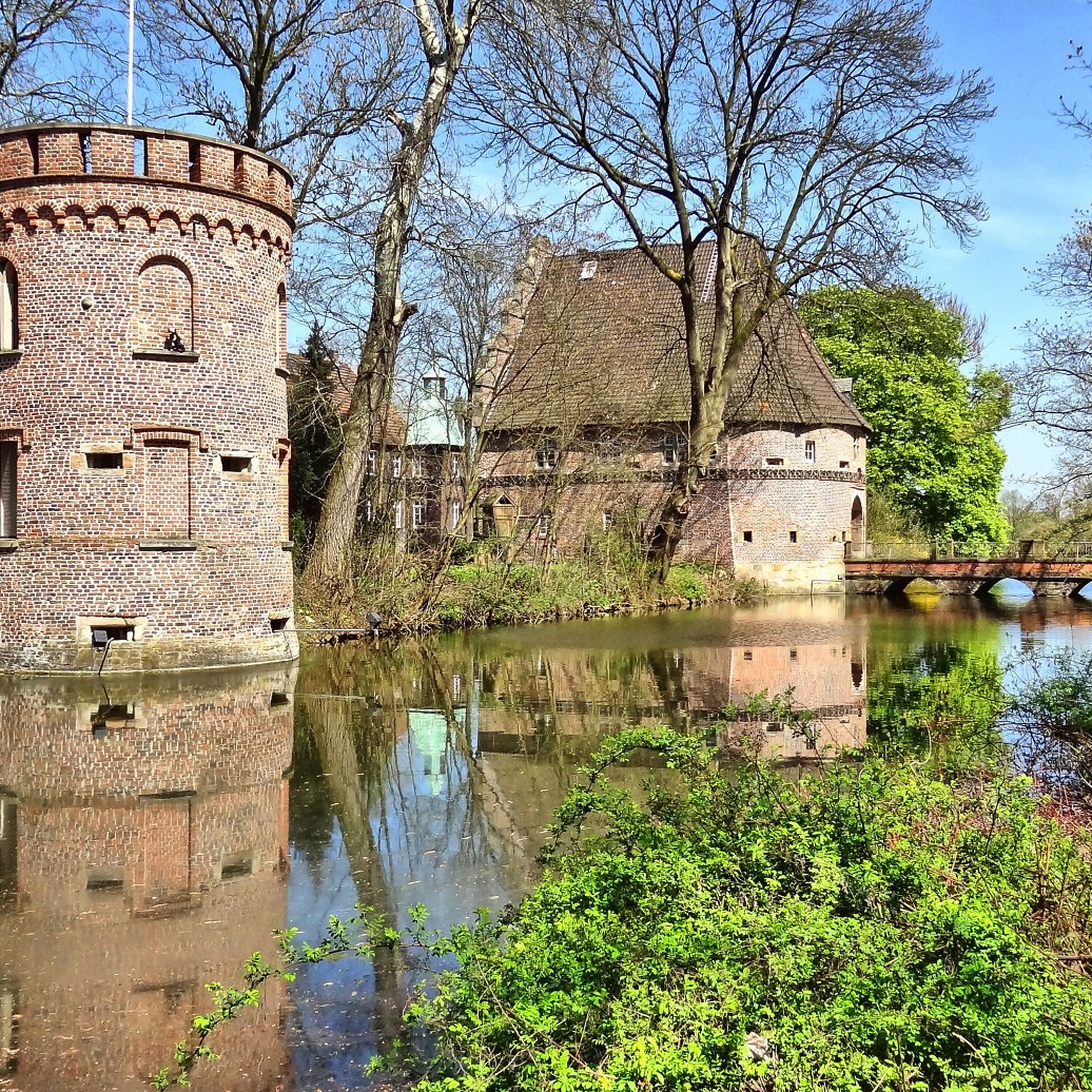
Anyone who travels through the region with "blue-green glasses" will be amazed at how many streams and small bodies of water can be discovered, even in the heart of the city. Some of them have only recently seen the light of day again, such as the Ostbach. It was rerouted from an underground canal into a near-natural streambed in 2023. The effort is worthwhile in many ways: Open watercourses can absorb more water during rainfall than closed canals, they are important habitats for animals and plants, and on hot summer days, evaporation cools the air. A little further upstream, in the Emschergenossenschaft's Blue Classroom, students can take a closer look at these and other aspects of the so-called blue-green infrastructure. More information on the Ostbach renaturation: https://www.eglv.de/medien/ostbach-erobert-neues-bachbett/
1
0

Info from Emscherkunstweg https://emscherkunstweg.de/kunstwerk/koenigsgrube/
0
0
A former pumping station of the Emschergenossenschaft (Emscher Coal ... Drops of water and sounds emerge from it. Where the over 12-meter-deep basin once stood, and rainwater does not naturally seep away, a fen forest is emerging, a biotope of seven advanced black alder trees that prefers moist conditions and is reminiscent of the floodplain landscapes along the Emscher River in pre-industrial times. On the paved forecourt, local rainwater is collected via gutters in a cistern and, together with the photovoltaic pergola, enables completely self-sufficient operation. As an artistically redesigned ruin, Jeschaunig's work points to both the magnificent technologies and the enormous ecological destruction that mining brought with it, while simultaneously pointing a way for new life and climate-positive spaces to emerge in the city.
0
0

You have to look closely not to miss the stone. A parked car is enough.
1
0

Very beautiful forest area with beautiful small streams
0
0


Nice walking trail in the nearby area, perfect for a Sunday afternoon stroll
10
0
Frequently Asked Questions
What are some unique natural monuments to explore in Herne?
Herne offers a variety of unique natural monuments. You can visit the Rossbach valley, a renatured stream and forest area forming part of the Langeloh nature reserve. Another fascinating spot is the Old Turning Basin at Zeche Unser Fritz, a lake that reflects the area's industrial past now reclaimed by nature. Don't miss the geographical center of the Ruhr region, marked by a granite stone in Herne-Röhlinghausen.
Are there family-friendly natural monuments in Herne?
Yes, several natural monuments in Herne are suitable for families. The Old Turning Basin at Zeche Unser Fritz, the New Course of the Ostbach, and the Rossbach valley are all categorized as family-friendly. Additionally, the Twisted Trees Natural Monument in Gysenberger Forest is located in a forest with a playground and various training equipment, making it great for a family outing.
What kind of wildlife can be observed in Herne's natural monuments?
Herne's natural monuments provide habitats for diverse wildlife. In the Naturschutzgebiet Langeloh – In der Hemke, you might spot the fire salamander in the renatured Roßbach stream, and rare bird species like the lesser spotted woodpecker, honey buzzard, goshawk, and stock dove in the ancient beech forests. The Naturschutzgebiet Voßnacken is crucial for endangered amphibians, insects, and various bird species, with a small lake offering opportunities to observe native waterfowl.
What are the best natural monuments for hiking or walking in Herne?
For hiking and walking, the Naturschutzgebiet Langeloh – In der Hemke features a 4.8 km 'Naturpfad Langeloh' with information stations. The Bergehalde Pluto-Wilhelm, a redeveloped mining spoil tip, offers panoramic views and is integrated into the Erzbahntrasse, popular with hikers. Königsgruber Park also provides excellent trails for hiking and jogging, with a biological educational trail and a geological ramp.
Are there any natural monuments in Herne with historical significance?
Many natural monuments in Herne showcase the region's industrial past. The Bergehalde Pluto-Wilhelm is a former mining spoil tip transformed into a nature reserve, offering views of the Ruhr area's industrial heritage. Königsgruber Park is developed on the former Königsgrube coal mine site, demonstrating how nature reclaims industrial landscapes. Even the geographical center of the Ruhr region is a man-made monument marking a significant location.
What outdoor activities can I do near Herne's natural monuments?
Herne's natural monuments are surrounded by opportunities for outdoor activities. You can find numerous hiking routes, such as the 'Langeloh Nature Reserve – Rosbachtal Forest Path loop' or the 'Rossbach valley – Field Path at Langeloh loop'. For cyclists, the Erzbahntrasse, which passes by Bergehalde Pluto-Wilhelm, is a popular choice. There are also road cycling and MTB trails available. For more details on routes, you can explore the Hiking in Herne, Road Cycling Routes in Herne, and MTB Trails in Herne guides.
Are there any natural monuments that are wheelchair accessible in Herne?
The geographical center of the Ruhr region is noted as wheelchair accessible. While many natural areas involve trails, some paths within parks like Volkspark Sodingen and Königsgruber Park may offer accessible sections. It's always recommended to check specific trail conditions for detailed accessibility information.
What geological features can be observed in Herne's natural monuments?
Herne's natural monuments offer insights into geological transformation. The Naturschutzgebiet Voßnacken is a significant wetland biotope formed by mining subsidence, showcasing the direct impact of geological changes. Königsgruber Park features a geological ramp that visually explains the typical rock layers of the Ruhr area. The redeveloped mining spoil tips like Bergehalde Pluto-Wilhelm also represent significant man-made geological alterations.
What is the best time of year to visit Herne's natural monuments?
The best time to visit Herne's natural monuments largely depends on your interests. Spring and summer are ideal for observing diverse flora and fauna, especially butterflies at Bergehalde Pluto-Wilhelm and aquatic life in areas like Langeloh. Autumn offers beautiful foliage in the ancient forests. Winter can provide peaceful, crisp walks, though some areas might be less accessible depending on conditions. The 'Naturpfad Langeloh' is enjoyable in milder weather.
Are there any natural monuments in Herne that are considered 'hidden gems'?
While many of Herne's natural monuments are well-known, the individual ancient trees scattered across the city can be considered hidden gems. These include several old beech trees in areas like 'Wäldchen 'Unser Fritz'' and near the 'Herner Mark' allotment garden, as well as horse chestnuts and winter lindens. These are protected for their scientific, historical, or aesthetic value and offer quiet spots for reflection.
Where can I find information about individual protected trees in Herne?
Herne protects individual trees as natural monuments, recognized for their age, size, or unique form. These include several old beech trees (Fagus sylvatica) found in locations such as the 'Wäldchen 'Unser Fritz'' and near the entrance to the 'Herner Mark' allotment garden in Sodingen. Other notable individual trees, like horse chestnuts (Aesculus hippocastanum) and winter lindens (Tilia cordata), are also protected in various parts of the city.
What is the significance of the Naturschutzgebiet Resser Wäldchen?
The Naturschutzgebiet Resser Wäldchen, spanning parts of Herne and Gelsenkirchen, is a significant moist to wet woodland area. It is heavily influenced by mining subsidence and is predominantly covered by deciduous forest, including hornbeam-oak forests and older oak stands. It's considered one of the few remaining fragments of the former Emscherbruch natural landscape, providing a peaceful spot to experience unique flora and fauna adapted to this environment.
Most popular routes in Herne
Most popular attractions in Herne

Get inspired with the komoot mobile app


Explore more
Extend your search for the best caves by checking out these guides of the top ones in Herne:
