Attractions and Places To See around Nossa Senhora Da Vila - Top 20
Best attractions and places to see around Nossa Senhora Da Vila are concentrated within the broader Alentejo region of Portugal, particularly near Montemor-o-Novo and Évora. This area features a landscape rich in historical sites, ancient monuments, and routes suitable for cycling and exploring the countryside. Visitors can discover a blend of cultural heritage and natural paths, reflecting the region's long history and rural character. The attractions offer insights into prehistoric and medieval eras, alongside opportunities for active outdoor pursuits.
Best…
Last updated: May 21, 2026
Almendres Cromlech
Highlight • Historical Site
Translated by Google •
Tip by

Ecopista of the Ramal de Mora: Évora – Arraiolos
Highlight (Segment) • Cycleway
Tip by

Sign up now to discover places like this
Get recommendations on the best single tracks, peaks, & plenty of other exciting outdoor places.
Sign up for free
Montemor-o-Novo Castle
Highlight • Castle
This castle was conquered from the Moors by order of D. Afonso Henriques, and its current walls were built during the reign of D. Dinis.
Translated by Google •
Tip by

Arraiolos Rug Interpretive Center
Highlight • Historical Site
The Arraiolos rug technique is a form of cross-stitch that completely covers the linen foundation.
Tip by

Almendres Menhir
Highlight • Monument
Translated by Google •
Tip by
Sign up for free to discover even more attractions around Nossa Senhora Da Vila.
Sign up for free
Already have an account?
Start today with a free account
Your next adventure awaits.
Login or Signup

Tips from the Community

Cromeleque dos Almendres, located near Évora, is the largest and most important megalithic monument in the Iberian Peninsula. Built between the late 6th and 3rd millennium BC, it is about 2000 years older than Stonehenge. VisitEvora +3 This "Portuguese Stonehenge" is composed of about 95 granite monoliths (menhirs) arranged in circles and ellipses on a gentle slope in the Serra do Monfurado. VisitEvora +1
0
0
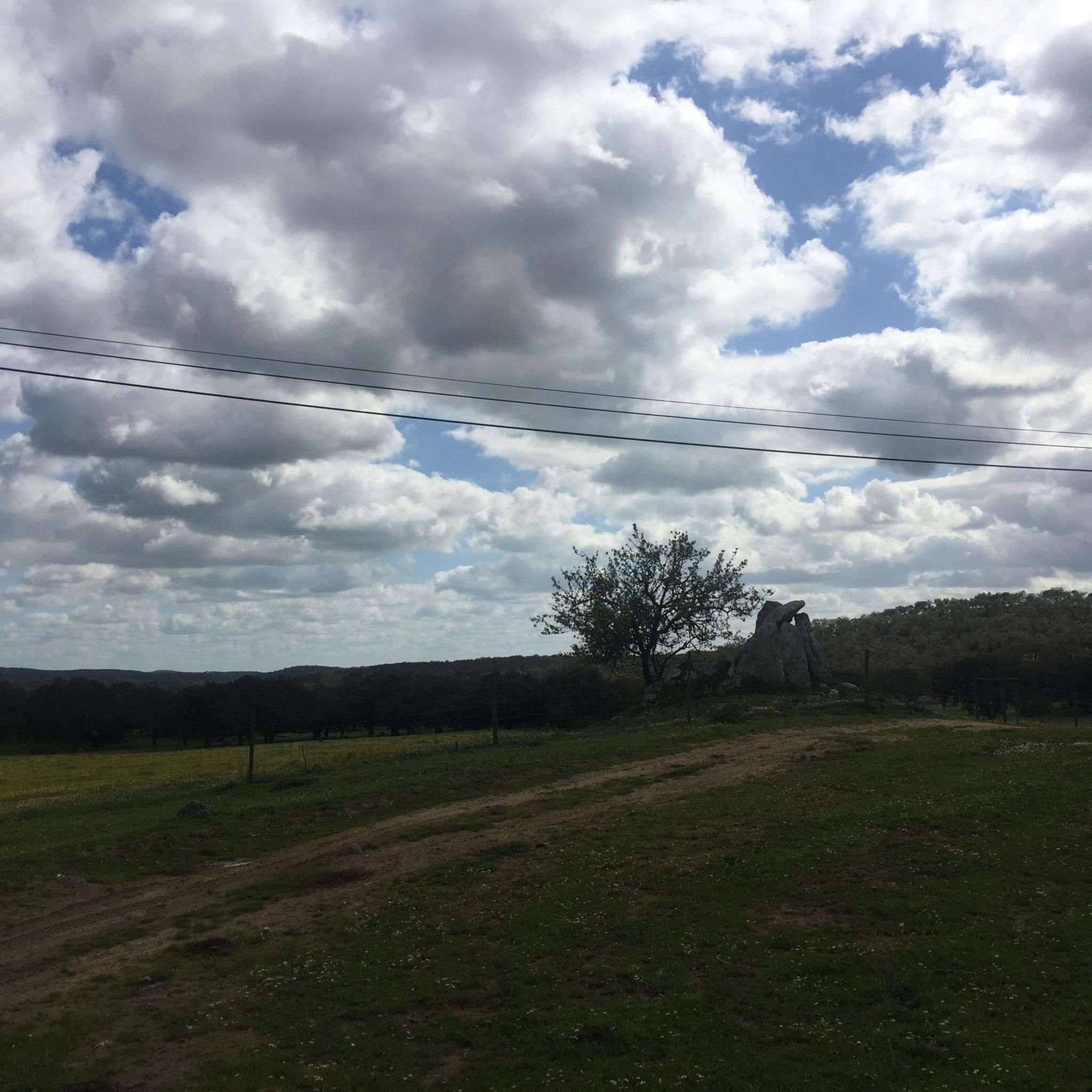
The Cromeleque dos Almendres, located in Nossa Senhora de Guadalupe, Évora, is the most important megalithic monument on the Iberian Peninsula and one of the largest in Europe. Composed of about 95 stone monoliths (menhirs) arranged in concentric circles, this enclosure is about 2,000 years older than the famous Stonehenge. 👍🥾
0
0

Arraiolos rugs (tapetes de Arraiolos) are embroidered Portuguese needlework rugs traditionally crafted by hand in the town of Arraiolos, north of Évora, in Portugal. The Arraiolos rug technique is a form of cross-stitch that completely covers the linen foundation. Early Arraiolos rugs utilized designs derived from the Persians by way of the Moors, from whom the Portuguese learned the craft. By 1410, there were about 100 carpet workshops in Lisbon, but by 1551 persecution of the Moors had reduced the number to 6. Convent workshops continued to produce rugs replacing the early Persian designs with Portuguese folk-art patterns in more limited colors. By latter part of the 19th century, the making of Arraiolos rugs practically did not exist, being reduced to embroiderers that made rugs to order or for their own household. A workshop founded in 1916 in Évora helped revive the faltering industry; it is now regulated by a professional organization.
9
0
Montemor-o-Novo Castle is located in the parish of Nossa Senhora da Vila, in the municipality of Montemor-o-Novo, in the district of Évora, in Alentejo, Portugal. In a dominant position on the highest hill in the region, the castle originally sheltered the village within its walls, which, as it developed, expanded along the slope to the north. Historical documents confirm that Vasco da Gama finalized his plans for his voyage to India in this castle. Background The earliest human occupation of this site possibly dates back to a prehistoric Romanized fort, according to the abundant archaeological evidence in the region. This was where the Roman roads from Santarém and the mouth of the River Tagus met, continuing via Évora to Mérida. The site would have been fortified for this reason. Centuries later, during the Muslim invasion of the Iberian Peninsula, the name Almançor remained in the region, in the toponymy of the Almansor river. Some authors claim that there was also a Muslim fortification here. The medieval castle During the Christian reconquest of the Iberian Peninsula, the town was conquered by Portuguese forces under the command of D. Sancho I (1185-1211). With a view to repopulating and defending it, the sovereign granted it a Charter in 1203. It is believed that the construction of the medieval castle began at this stage. During the reign of D. Dinis (1279-1325), major reforms were undertaken to the town's defences, including the construction of the town's fence, which was completed in 1365. Once the Avis dynasty was established, the domain of Montemor-o-Novo became a third part of the lordship of Constable D. Nuno Álvares Pereira. Throughout the 15th century, the castle underwent renovation work, carried out by master stonemason Afonso Mendes de Oliveira. In the 15th and 16th centuries, the town reached its greatest prosperity, due not only to regional trade, but also to the fact that the Court remained for long periods in Évora, which made the town the scene of events such as the Cortes of 1495, when King Manuel I (1495-1521) decided to discover the sea route to India. This sovereign granted the town a new charter in 1503. Later, under the reign of King Sebastian (1557-1578), it was granted the title of Notable Town (1563), considering it to be an ancient place with a large population.
7
1

This route, along the deactivated Ramal de Mora, not only allows you to visit cultural points of interest in the city of Évora, whose historic centre was declared a UNESCO World Heritage Site, but also allows you to enjoy the magnificent landscape of the typical Alentejo plain, predominantly made up of montado and olive groves, on a route that is almost always in a rural environment, providing direct contact with nature. A short detour and a visit to Arraiolos, a town famous for its hand-made carpets, is essential, as is a stop in the village of Graça do Divor, where it is worth visiting the old houses. This Eco-track is part of the Great Montado Route, under the responsibility of CIMAC – Intermunicipal Community of Central Alentejo, which will allow the inclusion of almost 184.805 km of deactivated railway lines (Reguengos Branch, Vila Viçosa Branch, Montemor Branch, Mora Branch and Évora Line) in the Great Montado Route, in a process that includes 9 of the 14 municipalities of Central Alentejo (Arraiolos, Borba, Estremoz, Évora, Montemor-o-Novo, Mora, Redondo, Reguengos de Monsaraz and Vila Viçosa).
6
2
Montemor-o-Novo Castle is the original site of the medieval town of Montemor-o-Novo. This castle was conquered from the Moors by order of D. Afonso Henriques, and its current walls were built during the reign of D. Dinis. It was gradually abandoned by the population from the 15th century onwards, and today it preserves important testimonies of the medieval and modern history of Montemor-o-Novo, such as sections of the wall, the Paço dos Alcaides, the Church of Santiago (currently the Castle Interpretation Centre), the Church of Santa Maria do Bispo, the Clock Tower, the Porta da Vila, the Porta do Anjo, the Torre da Má Hora and the Convento da Saudação. (Source: https://www.feriasemportugam.com)
17
0

Stands a little off to the side and is impressive.
3
0
Frequently Asked Questions
What historical sites can I explore near Nossa Senhora Da Vila?
The region is rich in history. You can visit the impressive Montemor-o-Novo Castle, which preserves medieval walls and structures like the Church of Santiago and the Clock Tower. Additionally, the broader Alentejo region, particularly Évora, offers sites like the Chapel of Bones, Cathedral of Évora, and the Roman Temple of Évora.
Are there any ancient megalithic monuments in the area?
Yes, you can discover the Almendres Cromlech, a significant Neolithic monument featuring over 90 upright stones forming an oval, dating back to between 4000 and 2800 BC. Nearby, you'll also find the Almendres Menhir, a tall standing stone with ancient carvings.
What cycling opportunities are available around Nossa Senhora Da Vila?
Cyclists can enjoy the Ecopista of the Ramal de Mora: Évora – Arraiolos, a greenpath following an old railway line through natural surroundings, ideal for a slow day trip. For more structured road cycling, explore routes like the 'Giraldo Square – Évora Public Library loop' or the 'Dolmen of Monfurado – View of Montemor-o-Novo loop'. You can find more options on the Road Cycling Routes around Nossa Senhora Da Vila guide.
Can I find easy hiking trails suitable for a relaxed walk?
Absolutely. There are several easy hiking options, including the 'Almendres Cromlech loop from Almendres Cromlech' and the 'Almendres Menhir loop from Guadalupe', both offering pleasant walks to ancient sites. For more choices, refer to the Easy hikes around Nossa Senhora Da Vila guide.
What cultural experiences, beyond historical ruins, can I find?
Beyond ancient sites, you can delve into local craftsmanship at the Arraiolos Rug Interpretive Center. This center showcases the traditional hand-embroidered Arraiolos rugs, offering insight into their history and the unique cross-stitch technique.
Are there any family-friendly attractions or activities?
The Ecopista of the Ramal de Mora: Évora – Arraiolos is a great option for families, offering a flat, scenic path for cycling or walking away from traffic. Exploring the open-air Almendres Cromlech can also be an engaging educational experience for all ages.
What are the options for running trails near Nossa Senhora Da Vila?
Runners have several choices, including loops from Montemor-o-Novo and Arraiolos. Popular routes include the 'Running loop from Montemor-o-Novo' (easy) and the 'Running loop from Castelo de Montemor-o-Novo' (moderate). More running trails can be found in the Running Trails around Nossa Senhora Da Vila guide.
What do visitors enjoy most about the attractions in this region?
Visitors particularly appreciate the blend of historical depth and natural beauty. The Ecopista is praised for being a 'hidden gem' for getting into the countryside, while the Almendres Cromlech is valued for its ancient significance, being '1000 to 2000 years older than Stonehenge'.
Is there anything wheelchair accessible among the attractions?
Yes, the Arraiolos Rug Interpretive Center is noted as being wheelchair accessible, allowing visitors to explore the history and artistry of traditional Arraiolos rugs.
What kind of terrain and difficulty can I expect on trails?
The trails vary in difficulty. The Ecopista is generally flat and easy, suitable for relaxed cycling or walking. Hiking trails range from easy loops around sites like Almendres Cromlech to moderate running and road cycling routes that cover longer distances and may include gentle inclines.
What is the best time to visit the outdoor attractions?
For outdoor activities like cycling and hiking, spring (April-May) and autumn (September-October) generally offer the most pleasant weather, with milder temperatures. Summers can be very hot in the Alentejo region, making early mornings or late afternoons preferable for outdoor excursions during those months.
Most popular attractions around Nossa Senhora Da Vila

Get inspired with the komoot mobile app


Explore more
Still not found the Highlight you’re looking for? See guides of the top attractions in other regions:
