The best road cycling routes around Chemilli
4.6
(12)
249
riders
157
rides
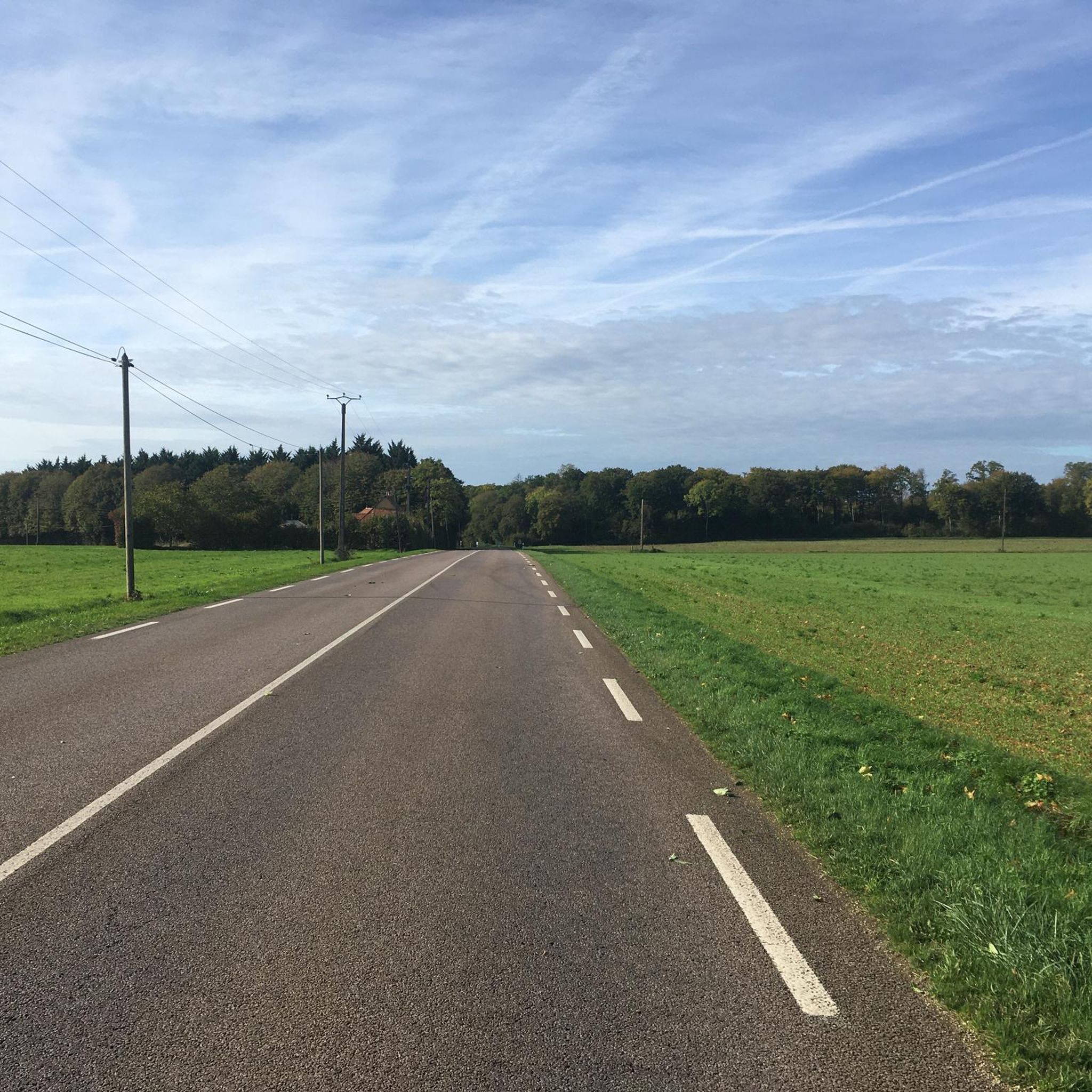
Road cycling routes around Chemilli traverse a landscape characterized by rolling hills, dense woodlands, and open country roads. The region features a mix of historic sites and tranquil rural scenery, providing varied backdrops for rides. Elevation gains are moderate, making it suitable for cyclists seeking a balance of challenge and scenic enjoyment. The terrain primarily consists of paved country roads, often shaded by trees.
Best road cycling routes around Chemilli
- The most popular road cycling route is Relais du Roi…
Last updated: May 21, 2026
9
riders
Moderate road ride. Good fitness required. Some segments of this route may be unpaved and difficult to ride.
3.0
(2)
7
riders
45.2km
02:06
490m
490m
Moderate road ride. Good fitness required. Mostly well-paved surfaces and easy to ride.

Sign up for free
6
riders
49.0km
02:06
410m
410m
Moderate road ride. Good fitness required. Mostly well-paved surfaces and easy to ride.
6
riders
62.3km
02:40
530m
530m
Moderate road ride. Good fitness required. Mostly well-paved surfaces and easy to ride.
7
riders
43.6km
02:02
460m
460m
Moderate road ride. Good fitness required. Mostly well-paved surfaces and easy to ride.
Get access to more routes and recommendations from other explorers.
Sign up for free
Already have an account?
Our route recommendations are based on thousands of hikes, rides, and runs completed by other people on komoot.
Start today with a free account
Your next adventure awaits.
Login or Signup




Tips from the Community

The priory was founded at the beginning of the 11th century and is dedicated to Saint Gauburge (or Walburge), abbess of a large Bavarian monastery in the 8th century. Originally owned by the lords of Bellême, it passed, from the 12th century, to the Royal Abbey of Saint-Denis-en-France. From the end of the 15th century, it was directly dependent on royal power until the Revolution. An important rural estate, its buildings bear witness to its special status and the magnitude of its revenues. Since 1972, it has housed the headquarters of the Perche Ecomuseum, which bears witness to the peasant life of the Perche and develops a diverse cultural program.
0
0

A lovely artist's village not to be missed.
1
0

The Saint-Martin church, listed as a Historic Monument, is located in Nocé, Normandy. It was probably built in the 12th century near the ruined and abandoned Nocé castle after the Hundred Years' War. Originally, the church was surrounded by a cemetery that was moved in the 18th century. In the 15th century, the walls were razed and the Romanesque framework of the nave replaced by a new paneled framework. In the 16th century, after the troubles of the Hundred Years' War, the building was modified: a single large roof was built in place of the various previous volumes and the framework was transformed, a new chapel was added against the south facade and a stone bell tower was built to the right of the nave. This tower, square from base to top, stands twenty meters high. The church is composed of a rectangular nave, three bays and a choir with a Romanesque semicircular chevet. A succession of three chapels opens a side aisle separated from the nave by pillars. The chapels are covered with ribbed vaults. A sacristy is fitted out behind the church. Note the altarpiece and the tabernacle in painted and gilded wood with steps, installed in the choir and lit by two bays with tracery, a painting presenting the disciples of Emmaus and one of the Annunciation, as well as a polychrome terracotta statue and a stone statue of Saint Madeleine without forgetting a stone statue of Our Lady of Pity.
0
0
The name of the parish is attested in the forms Sanctus Jovinus in 1147, Saint Jouin in 1429, Saint-Jouin-de-Blavon in 1801. Saint Jouin (in Latin Jovinus), brother of Saint Maximin, was a hermit in Poitou. The determinant refers to the forest of Blavou mentioned around 850 in the Acts of the bishops of Le Mans, it is no longer present today except by the toponyms: Saint Jouin de Blavou
0
1
L'église du Pin-la-Garenne, dédiée à Saint-Barthélémy est un édifice pour le moins composite. La construction de deux bas-côtés et d'un clocher, au milieu du 19e siècle, lui a conféré son aspect contemporain qui ne manque pas de surprendre, à commencer par ces multiples clochetons de pierre alignés comme un cortège de part et d'autre d'une toiture couvrant d'un seul tenant le choeur et la nef. Cet ensemble architectural a en fait connu des mutations successives. Celles-ci ont totalement occulté le sanctuaire du 11e siècle érigé à l'emplacement d'une ancienne chapelle castrale elle-même bâtie sur la basse-cour attenante à la motte du Pin. Selon des éléments fournis dans un mémoire du début du 18e siècle, ce premier lieu de culte attesté aurait été édifié à flanc de coteau autour de l'an 900 par un seigneur du Pin nommé Geoffroy de Couthril en vertu d'une permission du pape Romain 1er De l'édifice roman alors dédié à Saint-Ouen et donné pour moitié au prieuré de Saint-Martin-du-Vieux-Bellême par Gautier, seigneur du Pin, il ne subsiste que le portail d'entrée protégé pendant des siècles par un narthex détruit en 1838. Exposé dès lors aux intempéries, le portail fut victime lors d'une tentative de restauration, de rajouts qui portèrent atteinte à la pureté originelle des voussures. Du côté du choeur, des traces d'une abside romane étaient, paraît-il, encore discernables au cours du 19e siècle. Au début du 17e siècle, la nef fut reconstruite et surmontée, probablement à cette même période, par un clocher en pointe qui dominait le faîte du toit au-dessus de l'entrée principale. Le haut pignon souligné de rampants,orné d'une verrière flamboyante, est un vestige à peu près intact de cette période. Il comporte, de part et d'autre de la voûte du portail, deux pierres sculptées représentant des animaux à droite, il s'agit du lion, attribut de la famille du Grenier qui a fourni une très longue lignée de seigneurs du Pin et de la Pellonnière (du début eu 15e siècle à 1704). A gauche, l'animal semble représenter un loup. Peut-être s'agit-il de l'emblême particulier de Loup du Grenier, seigneur du Pin et de la Pellonnière devenu seigneur de Saint-André de Dolus et de Saint-Pierre en 1612, à la suite de son mariage avec Anne Martel, fille d'Anne de Pons, dame d'Oléron. Le titre de Marquis d'Oléron (titre de courtoisie) resta dès lors attachée à cette famille jusqu'à René du Grenier, petit-fils du précédent, décédé sans postérité. En ce même 17e siècle, paraît également avoir été érigée, du côté nord, la chapelle des frères de la Charité qui disposait d'une entrée particulière donnant sur le cimetière (espace formé par l'actuelle place Robert Drouin). Cette porte est encore visible lorsqu'on observe le mur extérieur du côté de la place. En 1704, la veuve de René du Grenier, Anne de Maillé, marquise d'Oléron, dame du Pin, fit don par testament de la somme de 700 livres afin de construire une contre table dans le choeur de l'église. Il s'agit du maître-autel actuel et de son retable. Une somme de 300 livres fut aussi affectée par la donatrice à la réalisation de deux petits autels latéraux. Dédiés à l'origine à la Vierge et à Sainte-Barbe,ils furent dressés en biais, à la limite du choeur et de la nef selon une disposition encore visible dans plusieurs églises du Perche (Saint-Germain-de-la-Coudre, Saint-Mard-de-Réno, Marcilly, etc..) Lors des agrandissements du 19e siècle, ces deux autels furent transférés à l'extrémité des bas-côtés où ils forment aujourd'hui les autels du Sacré-Coeur et de Saint-Joseph. En 1744, des émanations provenant du sol imposèrent l'interdiction momentanée du culte qui fut transféré à Eperrais. Les inhumations à l'intérieur de l'église devinrent dès lors plus rares jusqu'à leur interdiction pure et simple. Par la suite, on fit paver la nef et le choeur sous lequel, selon la tradition, reposent les premiers seigneurs du Pin. Au début du 19e siècle, Jean Baptiste Patu de Saint-Vincent, époux de Nicole Le Conte de Gersant, dame du Pin et de la Pellonnière, fit également construire la chapelle dite "du château", dédiée à Saint-Louis (à gauche du choeur). En 1768, la construction du grand chemin de Mortagne à Bellême amena à créer, du côté sud, un talus à forte déclivité (plus de trois mètres entre l'église et la nouvelle chaussée), ce qui semble avoir provoqué un affaiblissement de l'édifice. Au lendemain de la Révolution et de l'Empire, l'accroissement démographique fut tel (1090 habitants au Pin en 1808, 1335 en 1845) que le conseil de fabrique dut envisager des agrandissements afin d'accueillir des fidèles de plus en plus nombreux. Ces travaux furent entrepris à partir de 1826, à l'instigation de Jules Patu de Saint-Vincent, fils du précédent. La chapelle Saint-Louis ainsi que celle de la Charité furent alors intégrées dans un bas-côté nord. Afin de consolider la nef,on ajouta un bas-côté sud avec sous-sol et double perron sous lequel une élégante porte de style Louis XIII devait permettre d'accéder à une crypte. L'aménagement de cette dernière qui prévoyait un escalier d'accès direct avec le choeur de l'église, demeura inachevé. La démolition de l'ancien clocher et la construction de la nouvelle tour, flanquée latéralement toujours dans le but de renforcer la structure, furent entreprises simultanément à partir de 1838, non sans susciter de vives contestations de la part du conseil municipal. Jules Patu de Saint-Vincent imposa finalement ses vues (il est vrai qu'il finançait l'opération). Ses conceptions artistiques (certains seraient tentés de parler de "prétentions"..) mêlant curieusement romantisme et renaissance italienne, lui faisaient admirer le Dôme de Milan. C'est d'un voyage en Lombardie qu'il ramena, dit-on, l'idée d'agrémenter les toitures des bas-côtés de ces pinacles qui tentent d'élever vers le ciel une église aux apparences désormais bien éloignées de sa forme originelle. Il fit aussi édifier une vaste sacristie. Spécialiste de chant grégorien (on lui doit un livre d'initiation), il installa dans la tribune un petit orgue aujourd'hui disparu. Hors d'usage et trop détérioré pour qu'une restauration puisse être envisagée par la commune, l'instrument a en effet été vendu en 1979 à un groupe de jeunes passionnés qui est parvenu à le reconstruire et, récemment, à le remettre en service dans la tribune de l'église de La Loupe. En 1880, alors qu'était envisagée la translation du cimetière vers son site actuel, les abords du côte de la route, furent renforcés par un mur de soutènement et par deux perrons séparés par un terre-plein assurant une mise en valeur assez réussie de l'entrée principale. En 1940, la sacristie, victime d'un pillage, fut incendiée. Lors de sa démolition, on découvrit dans le chevet plat, une fenêtre romane, murée probablement lors de la mise en place du retable légué par la marquise d'Oléron. Une nouvelle sacristie de proportion plus modeste fut reconstruite au lendemain de la Libération (en 1948) grâce entre autres à des dons remis par des descendants de Robert Drouin, l'émigrant canadien du 17e siècle. Chaque époque a ainsi apporté sa contribution à l'édification de ce sanctuaire. Même si les aménagements les plus importants, réalisés pour l'essentiel à l'initiative du Jules Patu de Saint-Vincent, ont été parfois contestés, ils ont le mérite de conférer une nouvelle originalité à un lieu de prière où se sont succédées des générations d'hommes et de femmes. A ce titre, l'église du Pin-la-Garenne mérite le coup d'oeil et, intérieurement une découverte, source d'évocation d'une histoire méconnue.
0
1

The Saint-Rémy church is one of these churches surrounded by their cemetery and a surrounding wall forming a parish enclosure. In the cemetery, a cut boxwood path leads to the entrance to the church which is via a bell tower-porch. The latter, square and low, is topped with a spire covered in slate, like the rest of the church. The sacristy, at the rear of the apse, is covered in tiles. The church consists of a single nave onto which two small chapels open, dedicated respectively to the Sacred Heart and the Virgin. Unpretentious from the outside, the Saint-Rémy church is however not without surprises. The choir, slightly narrower than the nave, is decorated with monumental paintings evoking the Passion of Christ (19th century). The choir vault is also painted. The altarpiece, with black marble columns, has in its center a beautiful high-relief panel representing the Baptism of Christ (limestone, early 18th century). The altars (Main altar and altars in the side chapels) are in pink and black marble (18th century). A choir enclosure, decorated with two angels, separates the choir from the nave (19th century). Two beautiful wooden confessionals with carved pediments (17th century), set into the wall, frame the entrance to the interior of the nave. At the entrance to the bell tower-porch, you can admire the coat of arms of François Bohier, dated 1553. He was the dean of the chapter of Tours on which the cure of Sérigny then depended. These stones were found in 1972, in the gable of the church, during the renovation of the sacristy. The four historic stained glass windows are from the 20th century (one is dated 1939) and obviously come from the same workshop but are not signed.
0
0
Latin cross plan with one nave. Bell tower rising at the corner of one of the side walls of the nave and one of the arms of the transept. Very simple front facade: semi-circular portal and oculus. Gable of the north arm of the transept pierced with a broken bay with tracery. Church built in the 16th century. A bay dates back to the 11th century; the north chapel dates from the 16th century; church remodeled in the 17th century
0
0
Frequently Asked Questions
How many road cycling routes are available in Chemilli?
Chemilli offers a wide selection of road cycling routes, with over 160 tours available. These routes cater to various skill levels, from easy to challenging, ensuring there's something for every road cyclist.
Are there road cycling routes suitable for beginners in Chemilli?
Yes, Chemilli has several road cycling routes ideal for beginners. There are 27 easy routes that feature moderate elevation gains and generally tranquil rural scenery, perfect for those new to road cycling or looking for a relaxed ride.
What kind of scenery can I expect on road cycling routes in Chemilli?
Road cycling routes in Chemilli traverse a diverse landscape of rolling hills, dense woodlands, and open country roads. You'll encounter a mix of historic sites, tranquil rural scenery, and often shaded paved roads, providing varied and picturesque backdrops for your rides.
Are there challenging road cycling routes for experienced cyclists?
While many routes are moderate, Chemilli does offer some options for more experienced cyclists. There are 5 routes classified as difficult, providing greater elevation gains and more demanding terrain for those seeking a challenge. The region's moderate elevation gains generally offer a balance of challenge and scenic enjoyment.
What historical sites or landmarks can I see while road cycling in Chemilli?
Many routes in Chemilli pass by interesting historical sites. For example, the Feugerets Castle – Relais du Roi Saint Louis loop from Igé offers rolling terrain passing historic castles. You can also explore highlights such as Monthimer Castle, or the charming settlements of Bellême and La Perrière.
Are there circular road cycling routes in Chemilli?
Yes, many of the road cycling routes in Chemilli are designed as loops, allowing you to start and end at the same point. Examples include the popular Relais du Roi Saint Louis – Shaded Country Road loop from Le Gué-de-la-Chaîne and the La Perrière – Monthimer Castle loop from Mamers.
What is the typical length of road cycling routes in Chemilli?
The road cycling routes in Chemilli vary in length, but many popular options are around the 40-60 km range. For instance, the Relais du Roi Saint Louis – Shaded Country Road loop from Le Gué-de-la-Chaîne is approximately 49 km, and the Porte Saint Denis – Château de Bellerive loop from Mamers is about 62 km.
When is the best time of year for road cycling in Chemilli?
Given the region's characteristics of rolling hills and often shaded country roads, spring and autumn are generally excellent times for road cycling in Chemilli. The weather is typically milder, and the natural scenery is vibrant. Summer can also be pleasant, especially on routes that offer tree cover.
What do other cyclists say about road cycling in Chemilli?
The road cycling experience in Chemilli is highly regarded by the komoot community, with an average rating of 4.6 stars from over 10 reviews. Cyclists often praise the varied terrain, the mix of historic sites and tranquil rural scenery, and the well-maintained paved country roads.
Are there routes that pass through forests or offer shaded sections?
Yes, the region is characterized by dense woodlands, and many routes feature shaded country roads. The Relais du Roi Saint Louis – Shaded Country Road loop from Le Gué-de-la-Chaîne is specifically noted for its shaded sections, and the Relais du Roi Saint Louis – Forêt Domaniale de Bellême loop from Igé takes you through the Bellême Forest, offering a refreshing ride.
Can I find less crowded road cycling routes in Chemilli?
Chemilli's road cycling network is extensive, with over 160 routes. While some popular routes may see more traffic, the vast number of options, especially those venturing into the tranquil rural landscapes and dense woodlands, means you can often find less crowded paths to enjoy a peaceful ride.
Most popular attractions around Chemilli

Get inspired with the komoot mobile app


Explore more
Browse the best Road cycling routes in other regions.
