The best road cycling routes around Chaise-Dieu-Du-Theil
4.2
(10)
309
riders
124
rides
Road cycling around Chaise-Dieu-Du-Theil offers varied terrain within the Eure department of Normandy, France. The region features rolling hills, extensive forests, and river valleys, forming part of the Parc Naturel Régional du Perche. Road cyclists can navigate routes through agricultural land interspersed with wooded areas and remnants of hedgerows. The landscape includes undulating terrain that provides both climbs and descents.
Best road cycling routes around Chaise-Dieu-Du-Theil
- The most popular road cycling route is Conturbie Pond – Saint-Pierre Church loop from…
Last updated: July 2, 2026
12
riders
76.2km
03:32
470m
470m
Moderate road ride. Good fitness required. Mostly well-paved surfaces and easy to ride.
5.0
(1)
11
riders
53.9km
02:18
220m
220m
Moderate road ride. Good fitness required. Mostly well-paved surfaces and easy to ride.

Sign up for free
6
riders
68.2km
02:53
330m
330m
Moderate road ride. Good fitness required. Mostly well-paved surfaces and easy to ride.
2
riders
52.1km
02:10
280m
280m
Moderate road ride. Good fitness required. Mostly well-paved surfaces and easy to ride.
4
riders
43.1km
01:49
150m
150m
Easy road ride. Great for any fitness level. Mostly well-paved surfaces and easy to ride.
Get access to more routes and recommendations from other explorers.
Sign up for free
Already have an account?
Our route recommendations are based on thousands of hikes, rides, and runs completed by other people on komoot.
Start today with a free account
Your next adventure awaits.
Login or Signup



Tips from the Community

In the center of Randonnai, the 16th-century Saint-Malo church, enlarged in 1836, houses several works classified as Historic Monuments, including a classical altarpiece with paintings of Saint Andrew and Saint Sebastian. Funeral slabs serve as threshold steps. Inside, a plaque commemorates the departure of Pierre Tremblay (whose birthplace is in La Filonnière) in 1647 for New France. He is the ancestor of the Tremblays of Quebec and North America.
0
0
This building was erected towards the end of the 15th century, on the former medieval fiefdom known since 1260 as the "Normandel Farm" and long owned by the Viron family. In the chapel dedicated to him, a beautiful 16th-century statue depicting Saint Firmin as a bishop and the magnificent white stone altarpiece, sculpted and ornamented in the purest Renaissance style, evoke the ardent faith of this evangelizer of Roman Gaul in the 3rd century. The current church, restored at the end of the 19th century in the style of the period after a long period of neglect, retains some traces of the old construction: the masonry of the rear wall overlooking the cemetery, with the remains of a small closed door and two buttresses of large rubble, and on the gable of the transept overlooking the road, a large Flamboyant Gothic window. The church of Normandel preserves other elements of great interest. In the chapel, on the right side, is a beautiful 16th-century polychrome stone Virgin and Child. Below the statue, a second stone altarpiece, finely carved and ornamented in the Renaissance style, shows, on one side, Mary seated near Jesus holding a chalice, and Joseph leaning on his cane, to whom the young John the Baptist appears to be bidding farewell before departing for the desert. In the nave, the large Christ on the cross, surrounded by Mary and Saint John, is moving in its sobriety: the outstretched arms of the crucified bear the full weight of our humanity, raising it to God. In the sacristy, an old fragment of an embroidered banner bears the image of Saint Firmin and the inscription "Charity of Normandel - 1513."
0
0
Since 1823, the commune's territory has united the former parish of La Trinité, which was under the bishopric of Chartres, and that of Beaulieu, under the bishopric of Evreux, located on either side of the Avre River, which marked the separation. The tall brick bell tower-porch was added in the 19th century to the older nave (15th-16th centuries?), rectangular in plan, whose wooden vault rests on an exposed roof frame. This modest rural church houses, as a counterpart to the Curé d'Ars, a 15th-century polychrome stone Virgin of exceptional artistic quality. The two sculpted doors of the sacristy come from La Trinité, as well as the engraved "flat tomb" attached to the nave wall. It dates from the 15th century. and the inscriptions are difficult to decipher: Jean Fillon, wearing a canon's hood and a chasuble, his hands clasped and his feet resting on two small dogs, is depicted in a Gothic setting with two angels, silhouettes of altar boys, and canons. Near the baptismal font decorated with three fleurs-de-lis is a large painting of Saint Gilles the hermit, with the doe lying at his feet. A beautiful series of stained-glass windows from the early 20th century illustrate scenes from the New Testament, and two others show Joan of Arc at the king's coronation in Reims, then taking communion in her prison before being led to the stake.
0
0
12th century building constructed from limestone and flint. The sacristy was added in the 18th century and the porch in the 19th century. When the villages of Chaise-Dieu and Le Theil merged, this building was chosen as the parish church for the commune.
0
0
The church of Chéronvilliers has been listed as a historical monument since April 24, 1953. The protection covers the entire building (interior and exterior). This building contributes to the beauty of the Eure landscapes and the richness of France's heritage. Over the centuries, the buildings, which have been grafted or agglomerated in the surrounding area, have been built within the framework of a social structure: the parish. These buildings constitute references in terms of local architecture, because they are often made with local materials: tiles or slates (from the 19th century), stones (flint, Grison, Seine Valley, sandstone, etc.), bricks or cob, lime plaster and nearby sand or earth. This gives colors that often range from beige to brown or red, and volumes perfectly suited to the Normandy climate (roof slopes, etc.). These churches have been the subject of specific analysis work because their surroundings are not completely urbanized. The empty spaces or breathing spaces located nearby help to preserve their setting. The site of the church is very interesting because, located in a very diffuse urban fabric, it opens onto the agricultural plots and offers beautiful views, particularly from the RD 21 to the south. These spaces must be preserved.
0
0

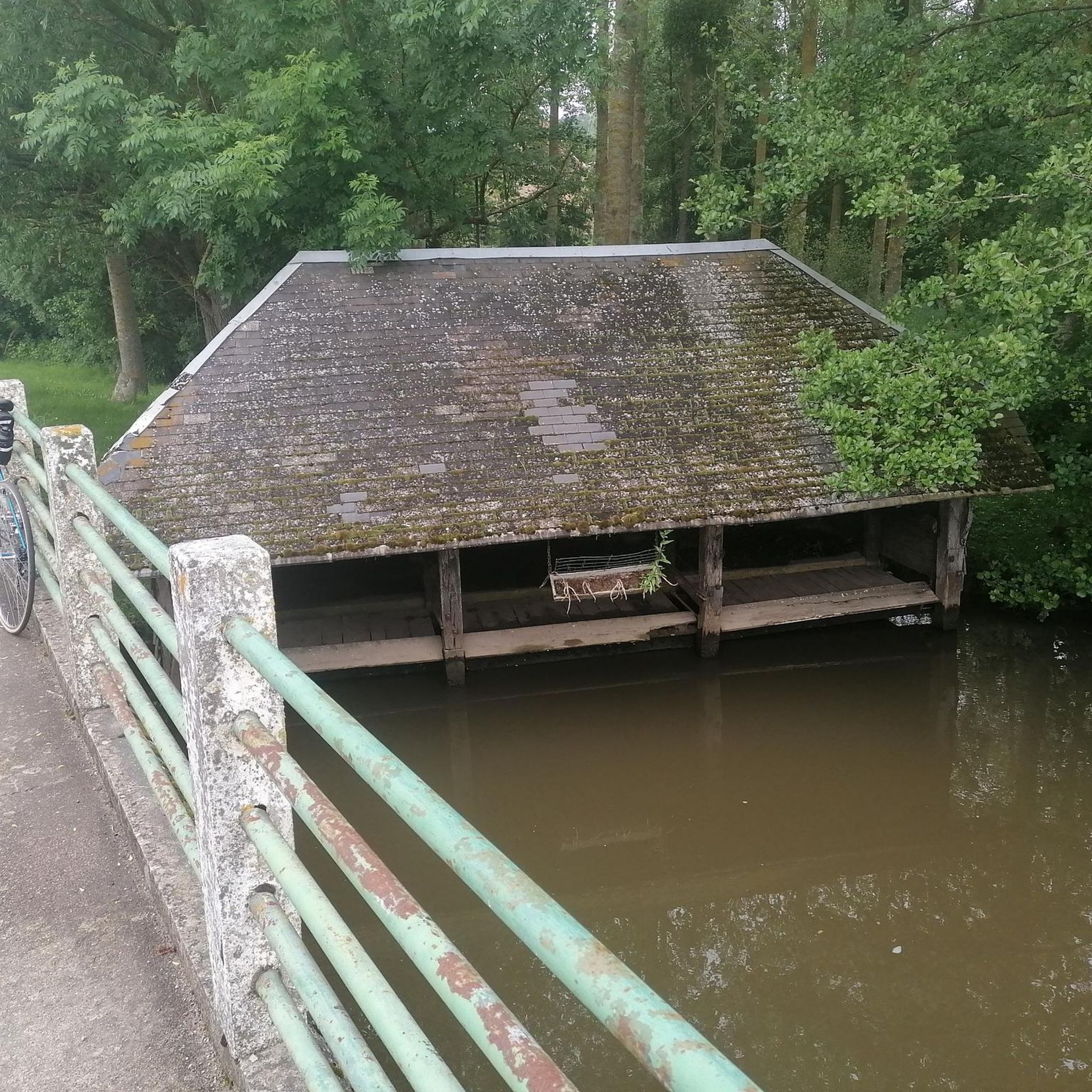
Right next to the town hall, the ideal place for a break
0
0
The church is located near a departmental road and is surrounded by a cemetery. Church oriented with a longitudinal plan composed of a single nave. The entrance to the building is via a porch body. An annex building is attached to the north side of the choir. The western facade of the porch body rises on two levels delimited by a projecting cornice. It is pierced by a low-arched door as well as a rose window in the upper part. The bell tower, of polygonal plan, is positioned on the ridge of the roof. It is covered with a polygonal spire surmounted by a ridge cross and has two roof eaves. The building is covered with a gable roof. That of the annex building ends in a hip. The side walls are pierced with arched bays and supported by buttresses. The annex building is pierced by a quadrangular window and door. The buttresses of the choir bear witness to the Romanesque origins of the church. The nave, built in the 16th century, was enlarged in the 19th century by a bay to the west. The bays of the building were re-pierced around 1822.
0
0
In the nearby park shaded by large trees, the ruins of fortifications recall the memory of the six towers of the old castle built in the 11th century……. In the nearby park shaded by large trees, the ruins of fortifications recall the memory of the six towers of the old castle built in the 11th century by Geoffroy IV, Count of Perche, in order to control this border region near the Chartres region, Normandy, and the possessions of the Lords of Bellême and Alençon which extended as far as Sées. During the Hundred Years' War, Charles, Count of Evreux and King of Navarre, allied with the English against the King of France, seized the fortress in 1364. It was then besieged and retaken on behalf of King Charles V by his younger brother Philip the Bold, Duke of Burgundy, using catapults that threw large stones to collapse sections of the walls. But after the English victory at Verneuil in 1424, they rushed to destroy Marchainville, setting fire to the town and the castle. The church, too, has experienced some vicissitudes. It occupies the site of a very old small monastery, given to the abbey of Saint-Evrouit by a certain Fulchierus of Chartres, who was chaplain to Baldwin I, King of Jerusalem and author of an account of the first crusade. The monks built the priory church in the 11th century, of which the thick right wall with its flat buttresses, the cornice in grison stone, and the support points of the descending roof, which housed a small adjoining cloister, still remain. The church was enlarged (end of the 15th or beginning of the 16th century) along its entire length by a side nave resting on stone arches, whose voussures connect without capitals to octagonal pillars. On the unfortunate initiative of Abbot Fleuriel, this side nave was knocked down in 1723, and the roof of the church lowered. It was not until 1810 that a new priest, Abbot Dubois, had the four arcades of the current chapel of the Virgin reopened. The three other old arcades, still visible, remain blocked in the left wall of the nave. Unfortunately, on March 15, 1820, the shock of an earthquake caused the old square bell tower of the priory, which was located above the entrance to the choir, to collapse, which caused considerable damage. Thanks to the generosity of the inhabitants and the personal contribution of the Bishop of Séez, the church was repaired and a new bell tower was erected next to the entrance porch in 1824. On the classical-style altarpiece, a painting, dated 1949, of the Holy Virgin surrounded by angels replaces the painting of the Assumption hanging in the nave. The 18th century tabernacle presents a pretty wooden statuette of the resurrected Christ, with on each side those of a holy bishop with a kneeling donor, and perhaps a Father of the Church. Two pretty statues of Saint Lawrence and Saint Peter adorn the altarpiece of the chapel of the Virgin, where in the center appears the traditional image of Our Lady of Victories presenting Jesus as a child on a starry sphere that symbolizes the world. Above, appear God the Father, his arms outstretched, and the Holy Spirit. Finally, let us not forget the curious statue of Saint Louis with his scepter, presenting the crown of thorns and the three nails of the crucifixion, nor the ancient painting, in the nave, of Saint Eloi as bishop, with his anvil of patron saint of blacksmiths.
0
0
Frequently Asked Questions
How many road cycling routes are available around Chaise-Dieu-Du-Theil?
There are over 130 road cycling routes available around Chaise-Dieu-Du-Theil, offering a wide range of options for different skill levels and preferences.
What kind of terrain can I expect when road cycling in Chaise-Dieu-Du-Theil?
The region is characterized by rolling hills, lush forests, and scenic river valleys, forming part of the Parc Naturel Régional du Perche. You'll encounter undulating terrain with both challenging climbs and enjoyable descents, often traversing agricultural land interspersed with wooded areas and hedgerows.
Are there routes suitable for beginners or those seeking an easier ride?
Yes, approximately 57 of the routes around Chaise-Dieu-Du-Theil are classified as easy, making them suitable for beginners or those looking for a more relaxed ride. An example of an easy route is the Washhouse on the banks of the Iton – Church of Notre-Dame-Outre-l'Eau loop from Bourth, which covers about 42.8 km.
What interesting landmarks or points of interest can I see along the road cycling routes?
Many routes pass by notable landmarks. You might encounter the historic Bois Francs Castle, or cycle along the scenic Bois Francs Greenway. Other routes feature charming churches like Saint Martin Church or the Church of Saints Gervais and Protais in Pullay.
Are there any dedicated cycling paths in the region?
Yes, a significant attraction for cyclists is the Bois Francs Greenway. This former railway line has been transformed into an asphalt path, extending for approximately 9 kilometers and connecting Verneuil-sur-Avre to the Center Parc des Bois-Francs.
What do other road cyclists say about the routes in Chaise-Dieu-Du-Theil?
The road cycling routes in Chaise-Dieu-Du-Theil are highly rated by the komoot community, with an average score of 4.4 stars from over 10 reviews. More than 300 road cyclists have explored the varied terrain, often praising the tranquil natural beauty and the mix of challenging and enjoyable sections.
Are there any longer or more challenging road cycling routes for experienced riders?
Yes, there are 79 moderate routes for more experienced riders. For example, the Conturbie Pond – Saint-Pierre Church loop from Bourth is a moderate 76.2 km route with over 470 meters of elevation gain, offering a good challenge.
Can I find circular road cycling routes in the area?
Many of the road cycling routes around Chaise-Dieu-Du-Theil are designed as loops, allowing you to start and finish in the same location. Examples include the Route des Roches – Iton River loop from Bourth and the Soligny-la-Trappe Abbey – Conturbie Pond loop from Bourth.
What is the best time of year for road cycling in Chaise-Dieu-Du-Theil?
The region's lush forests provide shaded routes, which can be particularly appealing during warmer weather. Spring and autumn generally offer pleasant temperatures and beautiful scenery, while summer allows for longer daylight hours. Always check local weather conditions before heading out.
Are there family-friendly road cycling routes in Chaise-Dieu-Du-Theil?
While many routes involve rolling hills, the region does offer easier sections and dedicated paths like the Bois Francs Greenway, which are suitable for families. Look for routes classified as 'easy' on komoot for options that are generally flatter and shorter.
Are there cafes or restaurants along the road cycling routes?
The road networks traverse charming villages, providing opportunities to find local cafes, pubs, and restaurants. While not every route will have amenities directly on the path, planning your ride through or near these villages will allow for refreshment stops.
What accommodation options are available for cyclists in Chaise-Dieu-Du-Theil?
The area offers various accommodation options, including hotels and gîtes, many of which are accustomed to hosting cyclists. It's advisable to inquire directly with establishments about secure bike storage facilities when booking.
Most popular routes around Chaise-Dieu-Du-Theil
Most popular attractions around Chaise-Dieu-Du-Theil

Get inspired with the komoot mobile app


Explore more
Browse the best Road cycling routes in other regions.
