The best road cycling routes around Ballon-Saint-Mars
4.4
(23)
1,154
riders
21
rides
Road cycling routes around Ballon-Saint-Mars traverse a landscape characterized by rolling hills and open countryside in the Sarthe department of France. The region offers varied terrain with paved surfaces suitable for road bikes and diverse elevation profiles. Cyclists can expect panoramic views from elevated points, such as the Donjon de Ballon, and will pass through areas featuring historical architecture and natural features like the limestone hillside. The network includes options for different fitness levels, from gentle rides through villages to…
Last updated: July 2, 2026
21
riders
7.21km
00:20
60m
60m
Easy road ride. Great for any fitness level. Mostly well-paved surfaces and easy to ride.
5.0
(1)
6
riders
37.6km
01:27
130m
130m
Easy road ride. Great for any fitness level. Mostly well-paved surfaces and easy to ride.

Sign up for free
6
riders
26.8km
01:06
130m
130m
Easy road ride. Great for any fitness level. Mostly well-paved surfaces and easy to ride.
5
riders
54.8km
02:14
300m
300m
Moderate road ride. Good fitness required. Some segments of this route may be unpaved and difficult to ride.
4
riders
60.2km
02:27
300m
300m
Moderate road ride. Good fitness required. Mostly well-paved surfaces and easy to ride.
Get access to more routes and recommendations from other explorers.
Sign up for free
Already have an account?
Our route recommendations are based on thousands of hikes, rides, and runs completed by other people on komoot.
Start today with a free account
Your next adventure awaits.
Login or Signup

Tips from the Community

This 11th century medieval bridge is a beautiful place to contemplate Beaumont-sur-Sarthe for a short moment. In addition to the river, you can see the castle located on the heights of the town.
0
0

The first mentions of a place of worship in Tuffé refer to the Sainte-Marie church of the abbey and then the priory, from the 7th century. The creation of the parish of Tuffé is perhaps contemporary or later but currently not documented. Could the priory’s Sainte-Marie church, mentioned much earlier than the Saint-Pierre church, also have once been the parish church of Tuffé? Could the embryo of the current parish church be this private chapel that Hugues Doubleau gave to the abbey with the Sainte-Marie church at the beginning of the 11th century, according to the cartulary of the Saint-Vincent abbey in Le Mans ? In any case, the parish is only attested late by texts (beginning of the 12th century in the same cartulary), but the non-oriented plan of the church, as well as the term Saint-Pierre, argue for the age of the building. The addition of Saint-Paul to the term seems very late, even abusive, since the archival documents systematically refer to a Saint-Pierre church, as does the decoration of the building in the 19th century. If this is an error, it was perhaps induced by Julien-Rémy Pesche at the beginning of the 19th century. The oldest part of the current building is the nave, much remodeled subsequently but the base of the walls of which shows in places a structure made of small rubble stones from the Romanesque period at the latest. But above all, the north gable wall and the first bay of the gutter walls show traces of openings and corner chains made of bricks alternating with limestone cut stones. This formula, rare if not unique in Perche Sarthois, is debated as to its dating. Some historians see it as a testimony to Carolingian architecture. Others, more cautious, put forward an archaic dating of the 11th century, where the use of brick alternating with stone would be an economic choice rather than an aesthetic one: this would explain a certain irregularity in the implementation, particularly in the arch of the old door of the north gable wall. The same uncertainty hangs over the addition of the buttresses and the opening of the current north gate. The nave is covered with a new framework and a spire and the paneling was installed in 1604 as evidenced by the signature (repainted in 1885) “In 1604 this Church was labruchée – Tomas Mabile attorney of the Fabrique de Séans ". The dating of the other parts of the church is not much easier. The construction of the east chapel (presbytery side) is not in too much doubt, the Renaissance decoration of the door to the street and the cupboard, although crude, indicates the middle of the 16th century. This chapel, dedicated to the Virgin, belonged to the lords of Chéronne. Its western counterpart (square side), dedicated to the Sacré-Cœur and built by the lords of Ramée, is less easy to date due to lack of ancient decor. This chapel could have been built shortly before or shortly after that of Chéronne, but undoubtedly not simultaneously, as evidenced by the slight asymmetry of the roofs and the different profile of the structural members. The apse, generally considered to also date from the 16th century, could only be from the 3rd quarter of the 18th century, as a bundle of clues suggests: the axial wall left blind probably to accommodate an altarpiece, the plan burrow made between 1757 and 1759 which still shows a circular apse undoubtedly Romanesque, as well as a document from 1775, indicating that the priest "would have had the necessary and pleasant works done to the great altar of the said church caused by the demolition and construction that Mrs de Saint-Vincent would have had the gable of the said church made. The sacristy would be a 17th century addition.
0
0


This old Romanesque bridge built in medieval times, between the 11th and 12th centuries, spans the Sarthe. Since 1988, it has been on the list of historic monuments. Stopping there for a moment, you have a nice view of the village of Beaumont-sur-Sarthe.
1
0

Priory of Saint Hippolyte de Vivoin, on the route of the Velobuissonière
0
0

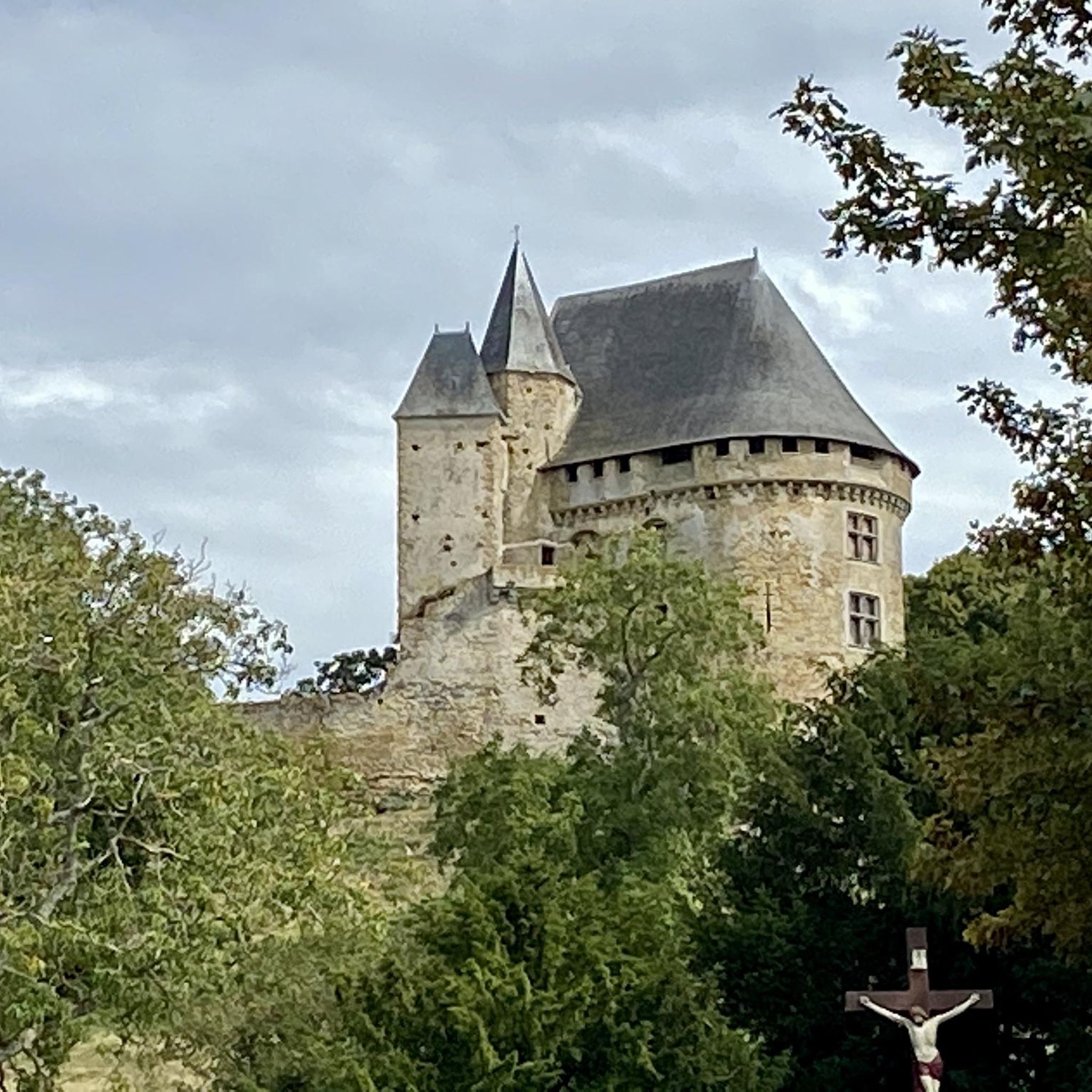
The keep of Ballon is a fortified castle located in the commune of Ballon, in the department of Sarthe in France. It was built in the 11th century and is considered one of the oldest dungeons in the country. The Ballon keep was originally built in wood, but was rebuilt in stone in the 12th century. It was used for defensive purposes during the Hundred Years War and was besieged several times. Over time it was used as a prison, but also as a barn and a dwelling. The keep is accessible to visitors and offers a panoramic view of the surrounding countryside. The visit allows you to discover the history of the castle, its different owners and its different uses over the centuries. The Ballon Dungeon is a fascinating example of French medieval architecture and offers a unique experience for history and architecture enthusiasts.
0
0

During your hike, enjoy the view of the Château de Ballon dating from the 15th century.
2
0
On your route, enjoy the view of the Château de Ballon dating from the 15th century.
2
0
Frequently Asked Questions
How many road cycling routes are available in Ballon-Saint-Mars?
There are over 250 road cycling routes around Ballon-Saint-Mars, offering a wide variety of options for different skill levels and preferences. This includes 100 easy routes, 146 moderate routes, and 11 more challenging routes.
What kind of terrain can I expect on road cycling routes in Ballon-Saint-Mars?
Road cycling routes in Ballon-Saint-Mars feature a landscape of rolling hills and open countryside. The terrain varies, with some routes offering gentler rides and others including sustained climbs, providing diverse challenges for cyclists.
Are there easy road cycling routes suitable for beginners in Ballon-Saint-Mars?
Yes, Ballon-Saint-Mars offers 100 easy road cycling routes perfect for beginners or those seeking a relaxed ride. An example is the Palet de Gargantua loop from Mézières-sur-Ponthouin, an easy 23.6 miles (37.9 km) path with minimal elevation.
What historical landmarks or scenic viewpoints can I see while cycling?
Many routes offer views of historical landmarks and scenic spots. You can often see the medieval Donjon de Ballon, which provides exceptional panoramic views over the Saosnois region. Other historical points of interest include Les Halles de René and the Beaumont-sur-Sarthe Roman Bridge.
Are there any natural features or unique landscapes to discover?
Beyond historical sites, the region features natural areas like the Calcareous Grasslands ("Les Buttes"), known for diverse orchid species blooming in May and June. While primarily for hiking, surrounding roads offer views and access to these ecological spots. The Arboretum de la Résidence Bel'Air also provides a botanical point of interest.
Can I find places to stop for refreshments or food along the routes?
Yes, the region is cyclist-friendly. Establishments like the Cidrerie du Moulin Neuf - Alinea bis, a former cider house now a tea room, welcome cyclists and walkers, offering a pleasant stop during your ride.
What is the best time of year to go road cycling in Ballon-Saint-Mars?
The region is enjoyable for road cycling throughout the warmer months. Spring (May/June) is particularly beautiful when the diverse orchid species in the Calcareous Grasslands are in bloom. The mild weather of late spring and early autumn generally offers comfortable cycling conditions.
Are there family-friendly road cycling options in Ballon-Saint-Mars?
Yes, with 100 easy routes available, many are suitable for families. These routes often pass through picturesque villages and offer gentler rides through the countryside, allowing for an enjoyable experience for all ages.
Where can I park my car when starting a road cycling route?
While specific parking locations for each route are not detailed here, many routes start from towns or villages like Mézières-sur-Ponthouin or Ballon-Saint Mars, where public parking is generally available. It's advisable to check local parking options in your chosen starting point.
How do other cyclists rate the road cycling experience in Ballon-Saint-Mars?
The road cycling experience in Ballon-Saint-Mars is highly regarded by the komoot community, with an average rating of 4.3 out of 5 stars from 20 reviews. Nearly 1000 road cyclists have used komoot to explore the varied terrain, often praising the scenic views and diverse route options.
Are there any circular road cycling routes in the area?
Yes, many of the road cycling routes in Ballon-Saint-Mars are designed as loops. For instance, the Donjon de Ballon – Prieuré de Vivoin loop from Ballon-Saint Mars is a popular circular route, offering varied terrain and views of the Donjon de Ballon.
Are there challenging road cycling routes for experienced cyclists?
For experienced cyclists seeking a challenge, Ballon-Saint-Mars offers 11 difficult routes. Additionally, there are 146 moderate routes, such as the Donjon de Ballon – Prieuré de Vivoin loop from Mézières-sur-Ponthouin, a 46.1 miles (74.1 km) trail with significant elevation gain, providing a good workout.
Can I access road cycling routes using public transport?
The region benefits from a well-developed network of paths. While specific public transport links directly to route starting points are not detailed, the local Tourist Office (Office de Tourisme Maine Coeur de Sarthe) can provide information on local transport options that might facilitate access to various cycling routes.
Most popular routes around Ballon-Saint-Mars
Most popular attractions around Ballon-Saint-Mars

Get inspired with the komoot mobile app


Explore more
Browse the best Road cycling routes in other regions.
