The best cycling routes around Great Shelford
4.6
(33)
436
riders
35
rides
Touring cycling routes around Great Shelford traverse a landscape characterized by gentle hills and flat countryside in Cambridgeshire. The area features dedicated cycling infrastructure, including sections of the National Cycle Network and traffic-free paths. Notable natural features include the Gog Magog Hills, offering moderate climbs, and the tranquil Nine Wells Local Nature Reserve. This blend of varied terrain and established routes makes Great Shelford suitable for diverse cycling experiences.
Best touring cycling routes around Great Shelford
- The most popular touring cycling route is Moulton Packhorse Bridge – Cherry Hinton Chalk Pits loop from Shelford, a 54.7 miles (88.1 km) trail that takes 5 hours 9 minutes to complete. This difficult route includes varied terrain and climbs through the Cambridgeshire landscape.
- Another top favourite among local touring cyclists is Linton Water Tower – The Roman Road Bridleway loop from Shelford, a moderate 28.5 miles (45.8 km) path. This route offers a mix of quiet country lanes and scenic views, typically completed in 3 hours 32 minutes.
- Local touring cyclists also love the Chisholm Trail Bridge – Baits Bite Lock loop from Shelford, a 22.7 miles (36.5 km) trail leading through flat countryside and along established cycle paths, often completed in about 2 hours 12 minutes.
- Touring cycling around Great Shelford is defined by gentle hills, flat countryside, and a network of dedicated cycle paths. The routes offer options for various ability levels, from easy, traffic-free paths to more challenging climbs in areas like the Gog Magog Hills.
- The routes in Great Shelford are highly rated by the komoot community with an average score of 4.5 stars from over 20 reviews. More than 400 touring cyclists have used komoot to explore Great Shelford's varied terrain.
Last updated: June 23, 2026
3.5
(4)
50
riders
Easy bike ride. Great for any fitness level. Mostly paved surfaces. Suitable for all skill levels.
47
riders
Easy bike ride. Great for any fitness level. Mostly paved surfaces. Suitable for all skill levels.

Sign up for free
3.8
(4)
30
riders
89.2km
05:15
420m
420m
Hard bike ride. Very good fitness required. Mostly paved surfaces. Suitable for all skill levels.
22
riders
42.1km
03:21
340m
340m
Moderate bike ride. Good fitness required. Mostly paved surfaces. Suitable for all skill levels.
4.3
(7)
33
riders
40.4km
02:26
90m
90m
Moderate bike ride. Good fitness required. Mostly paved surfaces. Suitable for all skill levels.
Get access to more routes and recommendations from other explorers.
Sign up for free
Already have an account?
Our route recommendations are based on thousands of hikes, rides, and runs completed by other people on komoot.
Start today with a free account
Your next adventure awaits.
Login or Signup

Tips from the Community

The Windmill at Fulbourn stands on an outlier of the Gog Magog Hills 4 miles east of the City of Cambridge. Low chalk hills run to the south of it; northwards the Windmill overlooks the Fens which are at most only a few feet above sea level. The cap of the Windmill rises to 160 feet above sea-level and from it there is an uninterrupted view of the roofs and towers of Ely Cathedral. It has long been an outstanding landmark in the south Cambridgeshire countryside. It was the enclosure of the parish for the improvement of cultivation that led to the building of the present Windmill. Much of the land in the north of the parish was low-lying and waterlogged and needed draining to convert it into profitable arable land. Fulbourn Fen was a peat fen only 20 feet above sea level over which the Great Wilbraham River spread its waters in times of flood. The Act of Enclosure for Fulbourn was passed in 1806 and the Commissioners completed their work two years later. The drainage of the parish reduced the level of water in the upper reaches of the Great Wilbraham River on which the manorial watermill was situated. The loss of power brought to an end the life of a mill which had first been recorded in Domesday Book. In 1808 the machinery of the watermill was put up for sale. A new mill was therefore needed and the Enclosure Commissioners allotted one acre on Mill Hill, on which to build a mill and miller’s cottage, to John Chaplin, a considerable landowner and farmer. He used copies of Old Moore’s Almanack as a diary, entering personal events and business notes in the margins of the calendar. In 1808 he recorded against 11 July, ‘I laid the first brick of my mill’; 22 November, ‘Mill sails put up’; 15 December, ‘Began grinding’. It is a large octagonal smock mill with a brick base and wooden superstructure. Its outline is squat with a shallow conical cap. The fantail, as usual in Cambridgeshire mills, is close against the cap. The mill holds three stones, one of French burr and two of Derbyshire stone. With floors 24 feet in diameter, there is exceptional space for working the mill. (https://fulbournwindmill.org.uk/history.html)
1
0

As you go past the water tower, turn right (straight is Rivey Lane) down the gravel access road onto the Icknield way. Keep heading straight. After the woods on the left you'll see a small farmer's field, and a path on the left taking you down to Linton.
0
0

A nice peaceful towpath ( if it’s quiet) runs from Chesterton, past Milton and ends at Clayhithe bridge.
0
0
A good place to cross the river Cam, makes a good short cut from Newmarket Road to Chesterton.
0
0
A pleasant ride along the river Cam, cycle paths are smooth and fast flowing, look out for cows, they have a habit of hanging out near the gates!
0
0


Frequently Asked Questions
How many touring cycling routes are available around Great Shelford?
There are over 40 touring cycling routes around Great Shelford, offering a diverse range of experiences. These include 22 easy routes, 17 moderate routes, and 1 difficult route, catering to various skill levels.
What kind of terrain can I expect when touring cycling around Great Shelford?
The terrain around Great Shelford is characterized by a mix of gentle hills and flat countryside. While many routes are relatively flat, you can find moderate climbs in areas like the Gog Magog Hills, where gradients can reach up to 6.5% over 1.2 km. Some routes may also feature worn or rough road surfaces, adding to the challenge.
Are there any easy touring cycling routes suitable for beginners or families?
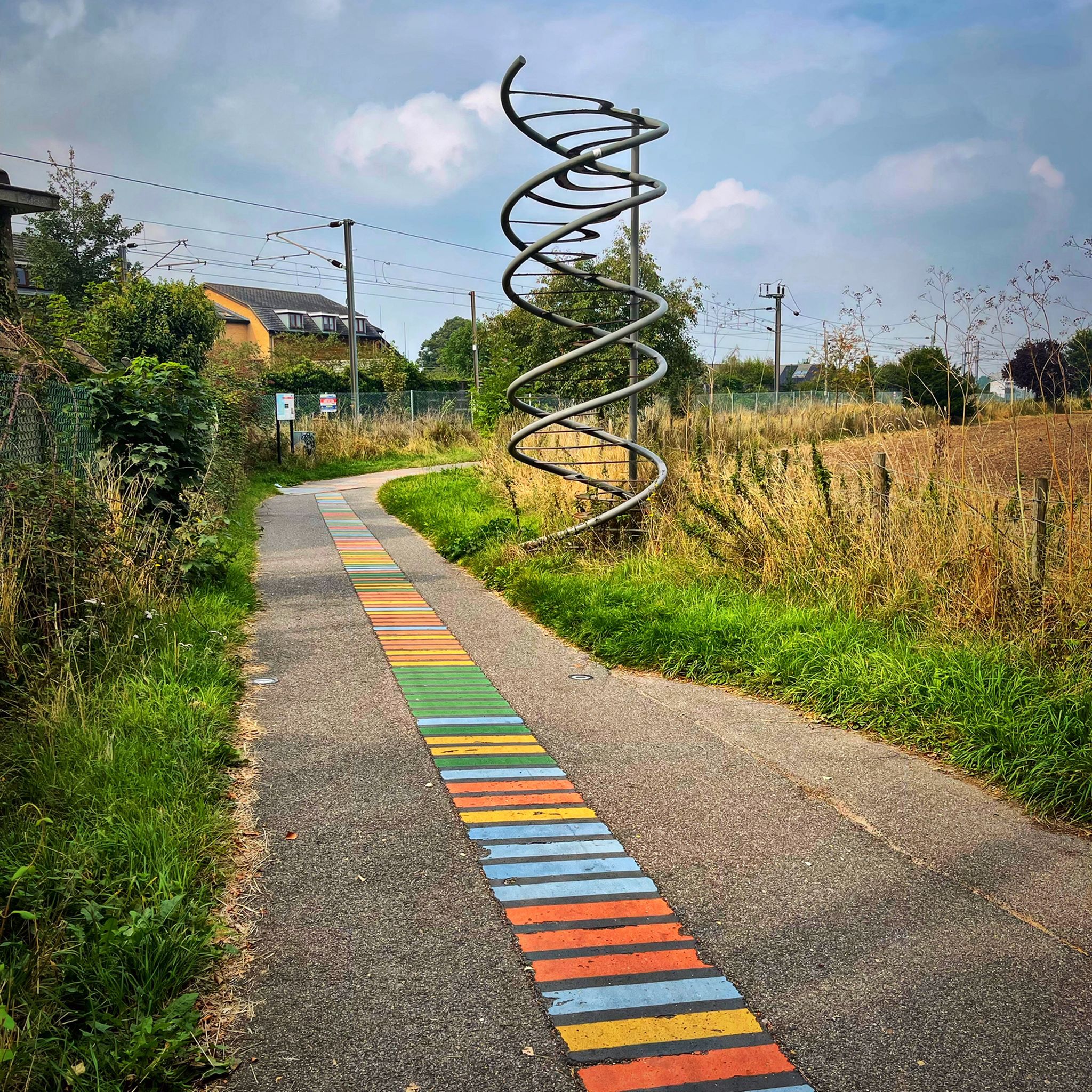
Yes, Great Shelford offers several easy touring cycling routes perfect for beginners or families. Many routes utilize dedicated cycling infrastructure like the DNA Path Rainbow Cycleway and sections of the Cambridge Guided Busway Cycle Path, which provide traffic-free cycling through pleasant countryside. These paths are generally flat and well-maintained.
Are there any circular touring cycling routes starting from Great Shelford?
Yes, many touring cycling routes around Great Shelford are designed as loops. For example, the Linton Water Tower – The Roman Road Bridleway loop from Shelford is a moderate 28.5-mile route, and the Byron's Pool – Haslingfield Village loop from Shelford offers a 43.7 km moderate ride. These circular routes allow you to start and finish in Great Shelford.
What are some scenic viewpoints or natural features I can explore on a touring cycling route?
You can enjoy breathtaking views of the Cambridgeshire landscape from the Gog Magog Hills. For tranquil natural features, consider cycling to the Nine Wells Local Nature Reserve, which features woodland, scrub, and water, or the Clay Pit (Pocket Park) with its rich variety of native flowers and wildlife.
Can I access touring cycling routes around Great Shelford using public transport?
Great Shelford is well-connected, and you can access many cycling routes via public transport. The village has a railway station, and several bus routes serve the area, making it convenient to reach starting points for your touring cycling adventures. The Cambridge Guided Busway Cycle Path also offers traffic-free access from Cambridge and surrounding areas.
Where can I park my car when starting a touring cycling route in Great Shelford?
Great Shelford offers various parking options. You can often find parking near the Great Shelford Recreation Ground or in designated village car parks. It's advisable to check local signage for any restrictions or fees before parking.
Are there any dog-friendly touring cycling routes in the area?
While many routes are suitable for cycling with dogs, especially those on quiet country lanes or dedicated cycle paths, it's always best to check specific route details for any restrictions, particularly in nature reserves or private land. Always ensure your dog is on a leash where required and that you clean up after them.
What attractions or landmarks can I see along the touring cycling routes?
Beyond natural beauty, you can encounter unique landmarks. The DNA Path Rainbow Cycleway is a notable cycle path decorated with colorful stripes representing the BRCA2 gene. You can also cycle towards Cambridge to see historic sites like King's College Chapel or the Mathematical Bridge at Queens' College.
What do other touring cyclists enjoy most about cycling in Great Shelford?
The touring cycling routes around Great Shelford are highly rated by the komoot community, with an average score of 4.5 stars from over 20 reviews. Cyclists often praise the blend of quiet country lanes, dedicated cycle paths, and the scenic beauty of the Cambridgeshire landscape, including views from the Gog Magog Hills.
Are there any routes that offer a more challenging experience for experienced touring cyclists?
Yes, experienced touring cyclists can find more challenging routes. The Moulton Packhorse Bridge – Cherry Hinton Chalk Pits loop from Shelford is a difficult 88.1 km route with varied terrain and significant climbs. Another challenging option is the Chapel Hill Climb – Haslingfield Village loop from Shelford, which covers 77.1 km with considerable elevation gain.
Are there options for longer touring cycling routes from Great Shelford?
Absolutely. Great Shelford serves as an excellent base for longer touring cycling routes. The Moulton Packhorse Bridge – Cherry Hinton Chalk Pits loop from Shelford is a substantial 88.1 km ride. Additionally, connections to the National Cycle Network, such as NCN Route 11, allow for extended journeys, including routes that can take you as far as St Ives via the guided busway or King's Lynn.
What is the best time of year to go touring cycling around Great Shelford?
The best time for touring cycling around Great Shelford is generally from spring through autumn (April to October). During these months, the weather is typically milder, and the countryside is in full bloom. While winter cycling is possible, be prepared for colder temperatures and potentially wet or icy conditions on some paths.
Are there places to stop for refreshments like cafes or pubs along the routes?
Yes, many touring cycling routes around Great Shelford pass through charming villages or near amenities where you can find cafes and pubs. These provide excellent opportunities to refuel and rest during your ride. It's a good idea to check opening times in advance, especially in smaller villages.
Most popular routes around Great Shelford
Most popular attractions around Great Shelford

Get inspired with the komoot mobile app


Explore more
Browse the best Cycling routes in other regions.
