The best road cycling routes around Diest
4.6
(65)
4,288
riders
200
rides
Road cycling around Diest is characterized by its varied landscapes, transitioning between the hilly Hageland and the Kempen region. The terrain features rolling hills, well-paved surfaces, and segments along the Demer River valley. This area provides diverse routes for road cyclists, offering both moderate and more challenging options.
Best road cycling routes around Diest
- The most popular road cycling route is Paalse Plas – Schulensmeer loop from Diest, a 34.0 miles (54.7 km) trail that takes 2 hours 26 minutes to complete. This moderate route offers scenic views around two significant lakes.
- Another top favourite among local road cyclists is Averbode Abbey – Houterenberg Climb loop from Diest, a moderate 20.6 miles (33.2 km) path. This route features the historic Averbode Abbey and includes the Houterenberg hill.
- Local road cyclists also love the Houterenberg Climb – Entrance Abbey Tongerlo loop from Diest, a 47.9 miles (77.0 km) trail leading through the rolling terrain of the Hageland, often completed in about 3 hours 26 minutes.
- Road cycling around Diest is defined by the undulating landscapes of the Hageland and Kempen, the Demer River valley, and the presence of historic abbeys. The network offers options for various ability levels, from moderate rides to more demanding journeys.
- The routes in Diest are highly rated by the komoot community with an average score of 4.5 stars from over 65 reviews. More than 4000 road cyclists have used komoot to explore Diest's varied terrain.
Last updated: May 17, 2026
3.8
(4)
191
riders
54.7km
02:26
130m
130m
Moderate road ride. Good fitness required. Some segments of this route may be unpaved and difficult to ride.
4.8
(14)
187
riders
33.2km
01:31
130m
130m
Moderate road ride. Great for any fitness level. Some segments of this route may be unpaved and difficult to ride.

Sign up for free
77
riders
87.2km
03:54
290m
290m
Moderate road ride. Good fitness required. Some segments of this route may be unpaved and difficult to ride.
5.0
(1)
114
riders
71.6km
03:38
500m
500m
Moderate road ride. Good fitness required. Some segments of this route may be unpaved and difficult to ride.
5.0
(3)
126
riders
49.5km
02:13
150m
150m
Moderate road ride. Good fitness required. Some segments of this route may be unpaved and difficult to ride.
Get access to more routes and recommendations from other explorers.
Sign up for free
Already have an account?
Our route recommendations are based on thousands of hikes, rides, and runs completed by other people on komoot.
Start today with a free account
Your next adventure awaits.
Login or Signup



Tips from the Community

A bit tough if the tires are too hard...
5
0

The Schulensmeer is the largest inland lake in Flanders. Numerous benches invite you to take a break.
5
0

Steep climb that starts at the church of Molenbeek.
3
0

Vlierbeek Abbey is located northeast of Leuven. To the south, it borders the Negenbunders and the Molenbeek valley, which, until the first half of the 20th century, connected to the then-existing part of the Lovenarenbroek. The avenues, the abbey site, and the surrounding fields have largely been preserved over the past two centuries. The priory was founded by the Benedictines of Affligem in 1127. The first monastic buildings were erected from 1158 onwards, and the first church was built in 1170. During the Wars of Religion, the abbey was destroyed. Reconstruction did not begin until 1642. A second building campaign began in 1776, during which only the church and the abbot's quarters were completed. The ruins of the original church tower still exist. The abbey was dissolved in 1796, but thanks to the Concordat, the first monks were able to return in 1801. In 1829, Vlierbeek became an independent parish. The abbey church is a defining feature: a remarkably homogeneous building in the Classical style, a series of geometric volumes devoid of any ornamentation. Adjacent to the church is the cemetery, which is still in use. In the garden adjacent to the church, we still find remains of the cloister, rebuilt in the 17th century. The old abbot's quarters date from the 16th century but have been renovated several times. In the vegetable garden, a 17th-century gazebo with a rococo stucco ceiling still stands, used as a chapel since 1963. Several outbuildings adjacent to the western enclosure wall were converted into private residences in the 19th century. The 18th-century carriage house was also converted into a residence. Farmhouse buildings from the 17th century stand against the northern fence, which originally housed a bakery and brewery. The 17th-century northern gate was originally equipped with a drawbridge, the ironwork of which has been preserved. The western gate with the gatehouse dates from the 16th century. Behind the farm, traces of the Baroque garden and its associated canal system can still be seen. The plot of the former 17th-century parterre garden is still recognizable. Also worth mentioning are the garden belonging to the rectory and the garden near the former coach house, as well as remnants of the 18th-century moated island garden in the northeast corner, remnants of hedges, the old cloister, and the vegetable garden. Inventory of Immovable Heritage: Vlierbeek Abbey Domain, https://id.erfgoed.net/erfgoedobjecten/135101
5
0
Northeast of the Sint-Jansberg monastery complex on Schomstraat lies the Oude Pastorij farm, a U-shaped farm dating from the first half of the 19th century, with the open side of the yard facing the street. The brick buildings under gable roofs (Flemish pantiles), hipped on the side wings, are situated around a rectangular yard separated from the street by a long wall and several recent service buildings. The house is located in the center of the central wing, a double house of four bays and two stories on a raised ground floor with a pitched plinth. The rectangular windows have wooden lintels and painted sills, and the rectangular door has a wooden lintel. The house is flanked on both sides by slightly projecting stables of three bays each, with a modified layout. Spacious transverse barns are housed in the perpendicular wings, each of three bays and equipped with an anchored brick basket-arch gate. These volumes feature arched windows and rectangular doors beneath a wooden lintel. Inventory of Immovable Heritage: Carthusian Monastery of Sint-Jansberg and its surroundings, https://id.erfgoed.net/erfgoedobjecten/302683
4
0

The municipality of Zelem had three parsonages throughout its history. The first was, and still is, located on the Kolenberg and called "Hoeve Oude Pastorij," better known locally as the "Donkelhoeve." Between 1969 and 1972, this farm served as a filming location for the BRT serial "Wij, Heren van Zichem" (We, Lords of Zichem), stories about "De Witte van Sichem" (The White Man of Sichem) and "Het leven van Herman Coene" (The Life of Herman Coene), written by Ernest Claes. In those stories, the farm belonged to farmer Coene. In those days, the pastor's residence was always connected to a farm that provided the pastor with his daily necessities.
5
0

This isn't the main entrance. This entrance immediately leads you past the old sheepfold (later a cowshed), the old abbey farm (built in 1640), and the old washhouse (built in 1640).
8
0
Frequently Asked Questions
How many road cycling routes are available around Diest?
Diest offers an extensive network of over 200 road cycling routes. This includes a wide variety of options, with 9 easy routes, 173 moderate routes, and 22 more challenging routes, catering to different fitness levels and preferences.
What kind of terrain can I expect when road cycling in Diest?
Road cycling in Diest features diverse terrain, transitioning between the hilly Hageland and the Kempen region. You'll encounter rolling hills, mostly well-paved surfaces, and picturesque segments along the Demer River valley. Some routes might include short unpaved sections.
Are there any notable landmarks or attractions along the road cycling routes in Diest?
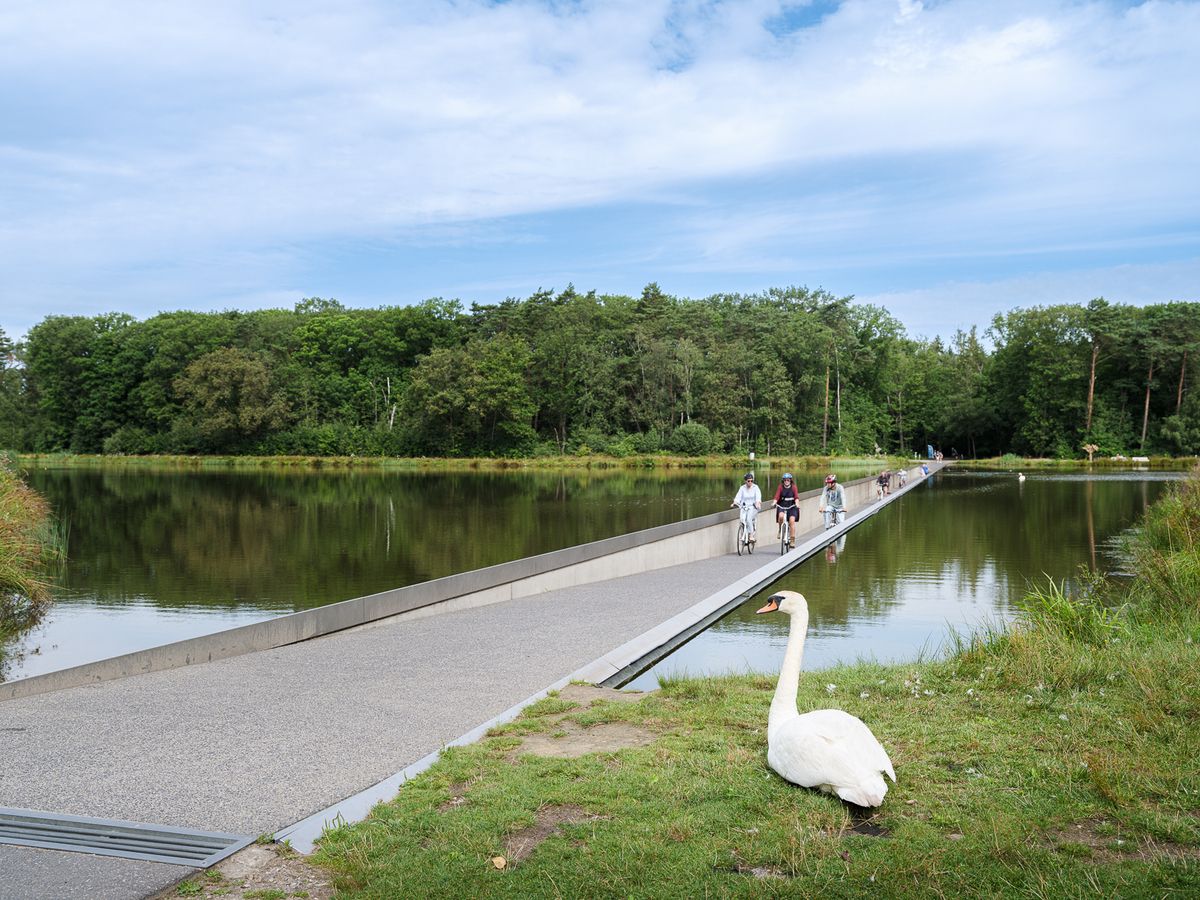
Yes, several routes pass by significant landmarks. For instance, the Averbode Abbey – Houterenberg Climb loop from Diest features the historic Averbode Abbey. Other attractions in the area include the Footbridge over the Weefberg Pond and various grottoes like the Lourdes Grotto Oostham.
Where can I find scenic viewpoints while cycling in Diest?
The rolling landscapes of the Hageland and Kempen regions naturally offer many scenic views. Routes that include climbs, such as the Houterenberg or Chartreuzenberg, often reward cyclists with panoramic vistas. The areas around lakes like Paalse Plas and Schulensmeer also provide beautiful waterside scenery.
Are there circular road cycling routes available in Diest?
Yes, many road cycling routes in Diest are designed as loops, allowing you to start and end at the same point. Examples include the Paalse Plas – Schulensmeer loop from Diest and the Houterenberg Climb – Entrance Abbey Tongerlo loop from Diest.
What is the best time of year for road cycling in Diest?
The most pleasant time for road cycling in Diest is typically during spring, summer, and early autumn. These seasons offer milder weather and longer daylight hours, making for more enjoyable rides through the diverse landscapes.
Are there cafes or pubs along the road cycling routes in Diest?
Yes, many routes pass through or near charming villages and historic towns where you can find cafes and pubs. These provide excellent opportunities for a refreshing stop, a coffee, or a meal, adding to the overall cycling experience.
Is it easy to find parking for cyclists in Diest?
Diest, as a town, generally offers various parking options. For specific routes, it's advisable to check the starting point details on komoot, as many routes begin from accessible locations with nearby parking facilities.
Can I access road cycling routes in Diest using public transport?
Diest is well-connected by public transport, making it possible to reach the starting points of many cycling routes. You can typically use trains or buses to get to Diest, and then begin your ride from there.
What do other road cyclists enjoy the most about road cycling in Diest?
The road cycling routes around Diest are highly rated by the komoot community, with an average score of 4.5 stars from over 65 reviews. Cyclists often praise the varied terrain, the beautiful natural scenery, and the well-maintained paths that offer a good mix of moderate and challenging rides.
Are there any routes suitable for beginners or those looking for an easier ride?
While many routes are moderate, there are 9 routes specifically categorized as easy, making them suitable for beginners or those preferring a more relaxed pace. These routes typically feature less elevation gain and shorter distances.
What are some of the longer road cycling routes available in Diest?
For those seeking a more demanding journey, longer routes are available. The Houterenberg Climb – Entrance Abbey Tongerlo loop from Diest covers 77.0 km, and the Chartreuzenberg Climb – Vlierbeek Abbey loop from Diest is 71.6 km, both offering significant distances and elevation.
Most popular attractions around Diest

Get inspired with the komoot mobile app


Explore more
Browse the best Road cycling routes in other regions.
