The best mountain hikes around Ouffet
4.8
(9)
20
hikers
9
hikes
Mountaineering routes around Ouffet are set within the varied terrain of Belgium's Liège province. The region features rolling hills, dense forests, and river valleys carved by the Ourthe and Néblon rivers. Nearby, significant rock formations like the Sy Rocks offer genuine rock climbing opportunities and add to the challenging nature of some routes. This landscape provides diverse conditions for strenuous hikes and outdoor pursuits.
Best mountaineering routes around Ouffet
- The most popular mountaineering route is Natural Rock Tunnel near Bomal…
Last updated: August 9, 2026
5.0
(3)
7
hikers
15.7km
04:32
380m
380m
Moderate mountaineering route. Good fitness required. Mostly accessible paths. Sure-footedness required.
4.0
(2)
4
hikers
14.4km
04:07
330m
330m
Moderate mountaineering route. Good fitness required. Easily-accessible paths. Suitable for all skill levels.

Sign up for free
5.0
(1)
2
hikers
14.6km
04:14
370m
370m
Moderate mountaineering route. Good fitness required. Easily-accessible paths. Suitable for all skill levels.
5.0
(1)
2
hikers
16.9km
04:46
360m
360m
Moderate mountaineering route. Good fitness required. Easily-accessible paths. Suitable for all skill levels.
5.0
(1)
2
hikers
10.1km
02:51
210m
210m
Moderate mountaineering route. Good fitness required. Mostly accessible paths. Sure-footedness required.
Get access to more routes and recommendations from other explorers.
Sign up for free
Already have an account?
Our route recommendations are based on thousands of hikes, rides, and runs completed by other people on komoot.
Start today with a free account
Your next adventure awaits.
Login or Signup

Other adventures around Ouffet

Tips from the Community

Ideal resting place during a longer hike.
0
0
Nice rocky path along the Ourthe
0
0


Varied and surprising: forest, climbing, valleys, meadows, city!
0
0

A beautiful bridge with a view of the castle
1
0


On the side of the bridge, you'll find a four-language (FR/NL/DE/UK) information board with the information about the bridge Herwig mentions. It could use replacing. Other interesting facts about the bridge with visible remains: the metal cross, surmounted by a cast and painted iron statue of Christ on the railing, dates from the eighteenth century. As mentioned, the limestone base inscribes the construction years of the various successive bridges: 1725, 1909, and 1954. The base of the cross itself has also been replaced. The previous one, also part of the city's small heritage, stands on the side of the church next to the old graves. This stone stood there between 1909 and 1940 and was blown up during the war. It was replaced in 1954, just like the bridge. If you go down the stairs towards the parking lot on the other side of the bridge (the side with the information board), you will see another reminder, remains and information about the mill.
6
0
At approximately 37 meters, the top of the Anticline, also known as the Homalius Rock and especially the Falize Rock, is literally the highest point in Durbuy. It has been a highlight for many visitors for years, thanks in part to the surroundings and beautiful water features. The rock is somewhat older than the average visitor. It's said to be more than 300 million years old. However, the rock layers are much older: around 375 million years old. The name Anticline comes from the geological phenomenon known as an anticline. It's the opposite of a syncline. While the former is a fold formed over many years, with the innermost layers being the oldest and the folds running downwards, synclines have folds running downwards. Such folds can form for various reasons and range from very small to large, as seen here. Originally, everything was, of course, horizontal. The inverted U-shape created by uplift in Durbuy is not only beautiful to see but also special. And Durbuy has beautifully highlighted this. Another beautiful anticline can be found in Han-sur-Lesse, also in the Famenne-Ardenne region, albeit in the province of Namur (here we are in Luxembourg), where it has been given the name "Tête de bouc" (Tick of the Rock). There's a waterfall and a large water feature at the end of the expansive pond in front of the rock, which you can also climb. And everywhere there's space to admire it all while sitting and relaxing—or enjoying the water. Don't forget the many smaller works of art and curiosities, and take a look in the water.
8
0
Frequently Asked Questions
How many mountaineering routes can I find around Ouffet?
The Ouffet region offers a variety of mountaineering routes, with komoot featuring 9 distinct tours. These routes traverse rolling hills, dense forests, and river valleys, providing diverse conditions for strenuous hikes.
Are there any easy mountaineering routes suitable for beginners in Ouffet?
While many routes in Ouffet involve significant elevation changes, there is at least one easier mountaineering route available. For example, the Sy Rocks – Palogne Estate loop from Bomal is a moderate option that offers a good introduction to the region's terrain without being overly demanding.
What kind of natural landmarks can I expect to see along the routes?
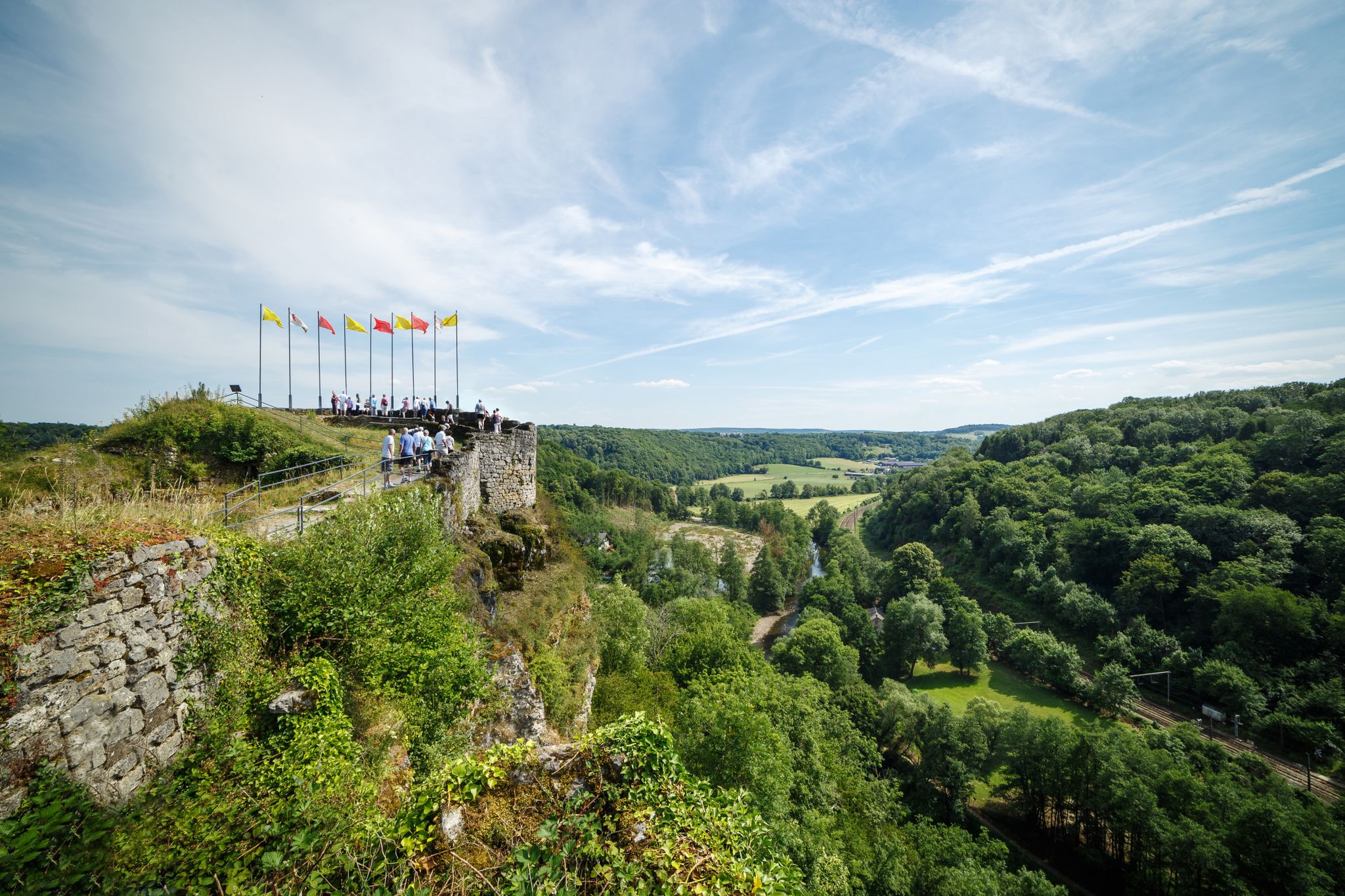
The Ouffet region is rich in natural features. You might encounter unique geological formations like The Anticline near Durbuy, or the impressive Sy Rocks, which rise dramatically above the Ourthe River. Some routes also pass by interesting cave entrances, such as the Natural Rock Tunnel near Bomal.
Are there any circular mountaineering routes in Ouffet?
Yes, many of the mountaineering routes around Ouffet are designed as loops, allowing you to start and end at the same point. Examples include the popular Natural Rock Tunnel near Bomal – Sy Rocks loop from Sy and the Sy Rocks – Sy Bridge loop from Durbuy.
What do other mountaineers enjoy most about the routes in Ouffet?
The routes in Ouffet are highly rated by the komoot community, with an average score of 4.8 stars. Reviewers often praise the varied terrain, the scenic river valleys, and the challenging nature of the trails that provide a true mountaineering experience in the Ardennes.
Are the mountaineering routes in Ouffet suitable for families?
While many routes are challenging, some moderate options might be suitable for families with older children who are accustomed to longer hikes and elevation changes. Always check the route's difficulty and length, such as the Durbuy Bridge - 1725 – Durbuy Castle loop from Durbuy, to ensure it matches your family's fitness level.
Can I bring my dog on the mountaineering trails in Ouffet?
Generally, dogs are welcome on trails in the Ouffet region. However, it's always recommended to keep your dog on a leash, especially in forested areas or near wildlife, and to check for any specific local regulations or protected areas that might have restrictions.
What is the best time of year for mountaineering in Ouffet?
The region offers beautiful scenery year-round. Spring and autumn provide pleasant temperatures and vibrant foliage, while summer is ideal for longer days. Winter mountaineering is possible but requires appropriate gear and experience due to potentially colder conditions and icy patches.
Are there any historical sites or castles along the mountaineering routes?
Yes, some routes integrate historical elements. For instance, the Durbuy Bridge - 1725 – Durbuy Castle loop from Durbuy leads through forested areas and past historical sites, including castles. You can also find highlights like Modave Castle nearby.
Where can I find parking for the mountaineering routes in Ouffet?
Parking is typically available near the starting points of many routes, especially in towns like Durbuy or Sy. It's advisable to check specific route descriptions on komoot for detailed parking information, as options can vary.
What kind of wildlife might I encounter on the trails?
The dense forests and river valleys of the Ouffet region are home to various wildlife. You might spot deer, wild boars, and a diverse range of bird species. Keep an eye out for smaller mammals and amphibians near water sources.
What should I wear for mountaineering in Ouffet?
Given the varied terrain and potential for significant elevation changes, sturdy hiking boots with good ankle support are essential. Layered clothing is recommended to adapt to changing weather conditions, and waterproof outerwear is advisable, especially during spring and autumn. Don't forget a backpack with water, snacks, and a map.
Most popular attractions around Ouffet

Get inspired with the komoot mobile app


Explore more
Browse the best Mountain Hikes & Routes in other regions.
