Routes

Planner

Features

Updates

App

Login or Signup

Get the App

Login or Signup

Login or Signup

Routes
Places to see
Italy
Lombardy
Milan

Cerro Al Lambro

Attractions and Places To See around Cerro Al Lambro - Top 20

Attractions and places to see around Cerro Al Lambro include a selection of historical and cultural sites, primarily religious architecture. The municipality, located in the Metropolitan City of Milan, Lombardy, benefits from its flat terrain. The Lambro river traverses the eastern part of the area, forming a natural border and contributing to the local landscape. This region offers opportunities to explore significant historical religious buildings and the surrounding natural environment.

Best attractions and places to see around Cerro Al Lambro

  • The most popular attractions is Chiaravalle Abbey, a religious building that is considered one of Lombardy's most beautiful churches. Founded in the 12th century by Saint Bernard of Clairvaux, it showcases Romanesque and Gothic architectural styles. Its distinctive bell tower, known as "Ciribiciaccola," houses an ancient bell still rung by hand by the monks.
  • Another must-see spot is Mirasole Abbey, a religious building and historical site. It serves as a place of worship and prayer within a large, tranquil courtyard. Visitors can expect to see a site founded by the Umiliati brothers between the 12th and early 13th centuries, featuring a 14th-century entrance tower that gives it the appearance of a fortified grange.
  • Visitors also love Sanctuary of Santa Maria ad Fontem, a religious building and historical site. A tabernacle dedicated to the Virgin Mary stood here in the 13th century, next to a source said to be miraculous. The Trivulzio family built a chapel in 1470, followed by the sanctuary a century later, making it a significant historical and spiritual location.
  • Cerro Al Lambro is known for its religious architecture, historical sites, and the natural presence of the Lambro river. The area offers a mix of historical religious sites and natural landscapes to see and explore.
  • The attractions around Cerro Al Lambro are appreciated by the komoot community, with more than 500 upvotes and over 190 photos shared.

Last updated: May 26, 2026

Chiaravalle Abbey

Highlight • Religious Site

One of the most beautiful churches in Lombardy, the Chiaravalle Abbey is a Cistercian monastic complex located in the South Milan Agricultural Park. Founded in the 12th century by Saint Bernard of Clairvaux, it was consecrated in 1221 and has a Romanesque and Gothic architectural style. Particularly known is the bell tower called Ciribiciaccola, in which there is an ancient bell still rung by hand by the monks today.

Translated by Google •

Tip by

See rides here

Send to Phone

Save

Mirasole Abbey

Highlight • Religious Site

Place of worship and prayer, located inside a large courtyard, in a peaceful and relaxing setting

Str. Consortile Mirasole, 7, 20090 Opera MI
abbaziamirasole.org
02576103

Translated by Google •

Tip by

Save

Sign up now to discover places like this

Get recommendations on the best single tracks, peaks, & plenty of other exciting outdoor places.

Sign up for free

Sanctuary of Santa Maria ad Fontem

Highlight • Religious Site

Here, already in the 13th century, a tabernacle dedicated to the Virgin Mary stood next to a source that was said to be miraculous. Even if no miracle is known, over time the fame of this place grew so much that it led the Trivulzio family to build a chapel in 1470 and a real sanctuary a hundred years later. During the plague of 1630 many reported having been saved by the miraculous waters which are still collected today in tubs located at the back of the lower church.

Translated by Google •

Tip by

Save

Rocca Brivio

Highlight • Historical Site

Spectacular period residence on the edge of a beautiful singletrack

Translated by Google •

Tip by

Save

Campomorto Abbey

Highlight • Religious Site

The Abbey takes its name from the bloody battle of 1061 between the Milanese and Pavia. The church was built shortly after the clash, the adjacent monastery, however, dates back to the 14th century and part of it remains today.

Translated by Google •

Tip by

Save

Sign up for free to discover even more attractions around Cerro Al Lambro.

Sign up for free

Already have an account?

Start today with a free account

Your next adventure awaits.

Login or Signup
Popular around Cerro Al Lambro

Road Cycling Routes around Cerro Al Lambro

Cycling around Cerro Al Lambro

MTB Trails around Cerro Al Lambro

Gravel biking around Cerro Al Lambro

Hiking around Cerro Al Lambro

Running Trails around Cerro Al Lambro

Tips from the Community

Alex
July 12, 2025, Campomorto Abbey

Campomorto Abbey inside and outside

Translated by Google

0

0

The name of the Abbey derives from the name of the village – vicus – Mirasole, in which it was located. Certainly, due to the presence of a religiously significant place such as an Abbey, the name Mirasole also takes on a different allusion, evoking the tension of the ascetic life to keep one’s gaze fixed on Christ, the sun of life. The grange of Mirasole (the granges were rural units dependent on an Abbey, around which a group of buildings used for agricultural and residential purposes was composed) was born between the 12th century and the early 13th century by the Umiliati brothers, with a community of lay people only. The Umiliati, recognized in 1201 by Pope Innocent III as a true order, spread throughout Lombardy, founding numerous houses – including Mirasole – and becoming part of the agricultural and spiritual reclamation project that led to Milan being surrounded by a crown of Abbeys. The rule of the Umiliati was an absolute novelty, as it adapted the Benedictine and Augustinian precepts to the intense work activity of its members, particularly in the field of wool processing. The Umiliati were the first in the history of the church to have a third order, the so-called tertiaries, that is, lay people recognized as an integral part of the religious order, while living in their own homes. In the 13th and 14th centuries, the Humiliated Abbey of Mirasole was a thriving center of religious life and agricultural activity. Suffice it to say that in 1344 the community was made up of 44 members: 29 friars, 11 nuns and 4 servants; and that the annals of the Fabbrica del Duomo report, between 1387 and 1398, an intense collaboration with Mirasole for the annual supply of fine wood to the Veneranda Fabbrica. Probably for defensive purposes, the entrance tower dates back to the 14th century, which configures the Abbey as a fortified grange with a quadrangular plan, originally surrounded by a defensive moat with two entrances equipped with a drawbridge. Starting from the second half of the 14th century, as a result of the demographic and economic crisis caused by the black plague epidemic, the tertiaries no longer exist and the number of wage earners is insufficient to work. The friars then decide, as was usual for religious orders of the time, to grant exponents of the Milanese bourgeoisie and nobility the lease of increasingly larger lands to recover liquidity. The friars limited themselves to collecting negligible rents and, in addition to this, the tenants benefited from all the productive activities. In 1482 Mirasole was reduced to a commendation, that ecclesiastical provision by which the Pope grants a vacant office, for example that of abbot, to a religious or lay person who enjoys the income of the Abbey without becoming its owner and being able to administer the property through his representative. Following the failed attack on San Carlo Borromeo, by a member of the Humiliati family of the Brera, in 1571 Pope Pius V abolished the order of the Humiliati. In 1582 the ownership of the Abbey of Mirasole passed to the Collegio Elvetico of Milan, established by Pope Gregory XIII for the education of the Swiss clergy. Here, after more than three centuries, the monastic life of Mirasole ended and, except for the church and the cloister, all the Abbey buildings were destined to tenant farmers and wage earners. The subsequent historical and architectural events of Mirasole were influenced by Napoleon. After the Italian campaign, in 1797 Napoleon suppressed the Swiss College and donated the Abbey, complete with funds and farm, to the Ospedale Maggiore in Milan, to reward it for the care provided to his sick and wounded soldiers. In the early 19th century, the tenant farmer occupied the entire manor house, built the neoclassical portico with terrace and even transformed the cloister into the courtyard of his home. In 1876, the Hospital obtained a reduction in Masses from the Archbishop's Curia of Milan, due to the insufficiency of alms; in 1903, the Church was declared closed to religious services and, from this moment, began a long period in which Mirasole was inhabited exclusively by peasant families. The last ones date back to the 1950s. The Hospital promoted a first restoration project in 1930 and, in 1964, another of greater scope. The final works took place in the 1980s, thanks to the work of Franca Chiappa, a benefactor of the Hospital.

Translated by Google

1

0

Carlo Salera
February 27, 2024, Rocca Brivio

This monumental complex was born as a defensive bulwark. Towards the end of 1300, it lost its military function to become a manor house within the land purchased by the Brivios, nobles of Germanic origin whose wealth came from agricultural activities. The name of Rocca derives from the fact that originally the building was one of the defensive bulwarks erected along the Milan - Lodi road in the early Middle Ages, at the time of the wars that pitted the Municipality of Milan against the Municipality of Lodi. The current building was built in 1600 by the Brivio marquises on the ruins of the pre-existing castle. It was at the center of important war episodes, such as the Battle of Marignano in 1515 and in 1859, when on 8 June Napoleon III and Vittorio Emanuele II entered Milan victorious, defeating the Austrians. From an architectural point of view it is a baroque palace built with a rather elaborate scheme: the north-west part houses a noble chapel, rich in typically seventeenth-century stucco and gilding. The entrance has a large portal with a beautifully crafted wrought iron gate, the work of a craftsman from Melegnano from the 1700s, rich in scrolls and arabesques. Since 1996 it has been public property and hosts painting exhibitions, classical music concerts and conferences of national importance in its halls with frescoed ceilings and large fireplaces.

Translated by Google

1

0

The church inside the abbey complex is beautiful

Translated by Google

0

0

Stunning fortified abbey with a beautiful cloister that can be visited for free, don't miss it

Translated by Google

0

0

Here, already in the 13th century, a tabernacle dedicated to the Virgin Mary stood next to a source that was said to be miraculous. Even if no miracle is known, over time the fame of this place grew so much that it led the Trivulzio family to build a chapel in 1470 and a real sanctuary a hundred years later. During the plague of 1630 many reported having been saved by the miraculous waters which are still collected today in tubs located at the back of the lower church.

Translated by Google

3

0

Sixteenth-century fortress immersed in the countryside between San Giuliano and Melegnano. It can be reached either by taking a pleasant dirt road through the fields or by a more comfortable asphalt road. It is not always open so don't be disappointed if the gate is closed

Translated by Google

1

0

The Abbey takes its name from the bloody battle of 1061 between the Milanese and Pavia. The church was built shortly after the clash, the adjacent monastery, however, dates back to the 14th century and part of it remains today.

Translated by Google

2

0

Frequently Asked Questions

What historical and cultural sites can I visit around Cerro al Lambro?

The area around Cerro al Lambro is rich in historical and cultural sites, primarily religious architecture. Notable places include the Cistercian Chiaravalle Abbey, known for its Romanesque and Gothic styles, and Mirasole Abbey, a tranquil place of worship with a fortified grange appearance. You can also explore the Sanctuary of Santa Maria ad Fontem, built around a source once believed to be miraculous, and Rocca Brivio, a noble country palace with a medieval past.

Are there any significant religious buildings to explore near Cerro al Lambro?

Yes, religious architecture is a highlight of the region. You can visit Chiaravalle Abbey, considered one of Lombardy's most beautiful churches, and Mirasole Abbey, a historic site founded by the Umiliati brothers. Another significant spot is the Sanctuary of Santa Maria ad Fontem, which has a history dating back to the 13th century. Additionally, Campomorto Abbey also offers a glimpse into the area's religious past.

What is the history behind Chiaravalle Abbey?

Chiaravalle Abbey is a Cistercian monastic complex founded in the 12th century by Saint Bernard of Clairvaux. Consecrated in 1221, it showcases a blend of Romanesque and Gothic architectural styles. A distinctive feature is its bell tower, known as "Ciribiciaccola," which houses an ancient bell still rung by hand by the monks today. It's considered one of Lombardy's most beautiful churches and a significant center of Cistercian spirituality.

Can you tell me more about Mirasole Abbey?

Mirasole Abbey is a religious building and historical site founded by the Umiliati brothers between the 12th and early 13th centuries. It functions as a place of worship and prayer within a large, tranquil courtyard. The abbey features a 14th-century entrance tower, giving it the appearance of a fortified grange, and was once a thriving center of religious life and agricultural activity.

What kind of natural landscape characterizes Cerro al Lambro?

The territory of Cerro al Lambro is primarily flat, with the

Lambro river

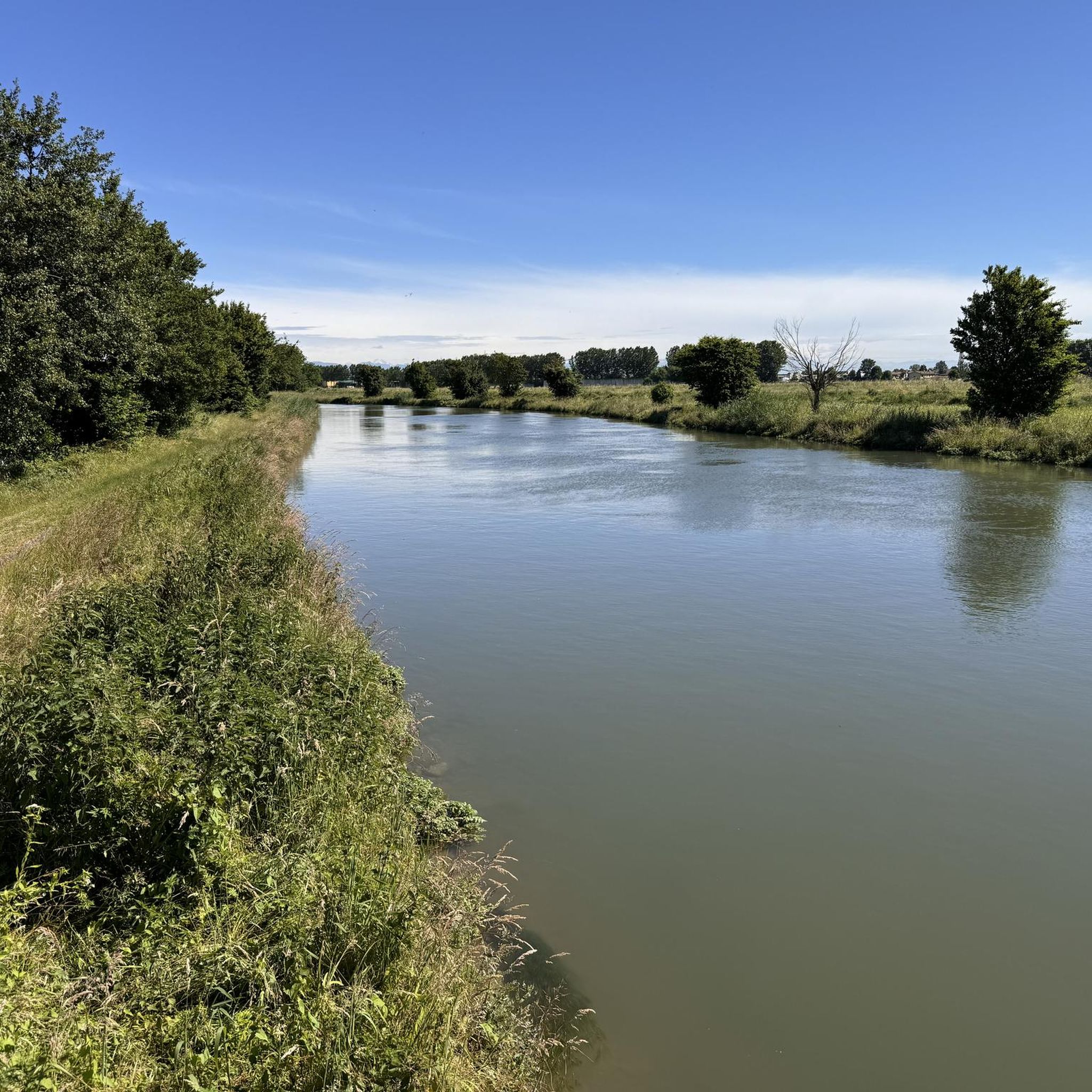
flowing through its eastern part, forming a natural border with San Zenone al Lambro. The area is also noted for being rich in other waterways, offering a serene, agricultural landscape that is ideal for outdoor activities like cycling and hiking along the riverbanks.

What outdoor activities can I do near Cerro al Lambro?

Given the flat terrain and presence of waterways, the area is well-suited for various outdoor activities. You can find numerous routes for gravel biking, including long loops along the Muzza Canal and Adda River. There are also many running trails and hiking routes, often connecting historical sites like the Medici Castle and Melegnano Castle.

Are there hiking trails suitable for different skill levels near Cerro al Lambro?

Yes, the area offers a variety of hiking trails. You can find easy routes, such as a 7 km loop from Melegnano connecting the Medici Castle and Melegnano Castle. There are also moderate options, like the 12 km loop from Cerro al Lambro to the Melegnano Castle, and longer moderate trails up to 16 km, often following the river or connecting historical points of interest.

Can I find routes for gravel biking in the area?

Absolutely. The flat landscape and network of waterways around Cerro al Lambro are excellent for gravel biking. You can explore extensive routes like the 66 km Muzza Canal Riverside Path – Adda River loop or the challenging 102 km loop from Melegnano to Cascina Villambrera, offering diverse terrain and scenic views along the canals and rivers.

Are there family-friendly attractions around Cerro al Lambro?

Many of the historical and religious sites are considered family-friendly. Chiaravalle Abbey, Mirasole Abbey, and the Sanctuary of Santa Maria ad Fontem offer educational and peaceful experiences for all ages. Rocca Brivio, a historic palace, is also listed as family-friendly, providing a glimpse into the region's past.

What do visitors particularly enjoy about the attractions near Cerro al Lambro?

Visitors appreciate the historical and architectural significance of the sites. For instance, Chiaravalle Abbey is praised for its beauty and spiritual importance, with its unique Gothic tower and renovated water mill. Mirasole Abbey is valued for its peaceful and relaxing setting. The Sanctuary of Santa Maria ad Fontem is found to be a suggestive place worth visiting, often noted for its contrast with the surrounding agricultural landscape.

What is Rocca Brivio and where is it located?

Rocca Brivio is a spectacular noble country palace situated near the Lambro river, within the municipal area of San Giuliano Milanese. It stands on the site of a former medieval castle that guarded the road from Milan to Lodi. The current palace, built around 1680, retains the name "fortress" but lost its defensive functions, becoming a grand residence.

Is there a story behind Campomorto Abbey's name?

Yes, Campomorto Abbey takes its name from a bloody battle that occurred in 1061 between the Milanese and Pavia forces. Legend has it that during the Visconti period, a commander named Boschino Mantegazza accidentally wounded his son in battle at this site. To atone for his guilt, he decided to have a church and a convent built there for pilgrims, leading to the abbey's establishment.

What is the best time of year to visit Cerro al Lambro?

Given the region's flat terrain and focus on outdoor activities and historical sites, spring (April-June) and autumn (September-October) are generally the best times to visit. The weather is mild and pleasant for exploring the abbeys, palaces, and enjoying hiking or biking along the Lambro river without the intense heat of summer or the chill of winter.

Most popular routes around Cerro Al Lambro

Road Cycling Routes around Cerro Al Lambro

Most popular attractions around Cerro Al Lambro

Castles

Store rating

Get inspired with the komoot mobile app

With a free komoot account, you can easily find, customize, and navigate endless outdoor adventures.

or

Join komoot Now

Store rating

Explore more

Still not found the Highlight you’re looking for? See guides of the top attractions in other regions:

MelzoTruccazzanoGessateInzagoCassina De' PecchiLiscateBellinzago LombardoBasianoVignatePeschiera BorromeoSettalaRodanoMasateCassano D'AddaPozzuolo MartesanaCambiagoGorgonzolaTrezzo Sull'AddaTrezzano RosaGrezzagoSegrateSettimo MilaneseCernusco Sul NaviglioMedigliaVimodronePozzo D'AddaVaprio D'AddaPantigliatePessano Con BornagoPioltelloVittuoneParco Lombardo Della Valle Del TicinoPeroBuccinascoBusseroSesto San GiovanniAssagoRozzanoCorsicoTribianoRobecco Sul NaviglioBressoBareggioNoviglioCornaredoCinisello BalsamoCusagoBollateCesano BosconePaulloSan Donato MilaneseTrezzano Sul NaviglioAlbairateBaranzateArlunoZibido San GiacomoCorbettaRhoAreseCologno MonzeseNovate MilaneseGaggianoSan Giuliano MilaneseColturanoAbbiategrassoOperaSenagoCormanoCassinetta Di LugagnanoMagentaCarugatePaderno DugnanoMelegnanoBubbianoCislianoDresanoCarpianoOzzeroRescaldinaSanto Stefano TicinoRosateLocate Di TriulziGarbagnate MilaneseVernateMorimondoCusano MilaninoNervianoSolaroCasarileBinascoPregnana MilaneseCesateSedrianoCerro MaggioreGudo ViscontiDairagoLacchiarellaZelo SurrigoneVermezzo con ZeloPieve EmanueleBasiglioParco Del TicinoCalvignascoOssonaVanzagoBusto GarolfoMeseroCasorezzoLainateArconateCastano PrimoInverunoBernate TicinoCuggionoRobecchetto Con IndunoPogliano MilaneseTurbigoMagnagoVanzaghelloBoffalora Sopra TicinoVilla CorteseBuscateMarcallo Con CasoneVizzolo PredabissiSan Vittore OlonaSan Giorgio Su LegnanoParabiagoLegnanoMotta ViscontiNosateCanegrateNatural Park Valle del TicinoBesateParco delle GroaneSan Zenone Al LambroSan Colombano Al LambroParco dei MuliniParco Nord MilanoParco del RoccoloIdroscaloParco Della Collina Di San ColombanoParco Del GelsoParco Dell’Alto Martesana

Nearby adventure guides

Things to Do around Melegnano

background

Get ready to conquer new peaks

Sign up for Free

Explore
RoutesRoute plannerFeaturesHikesMTB TrailsRoad cycling routesBikepackingSitemap
Download the app
Follow Us on Socials

© komoot GmbH

Privacy Policy