The best MTB trails around Formia
4.5
(205)
542
riders
41
rides
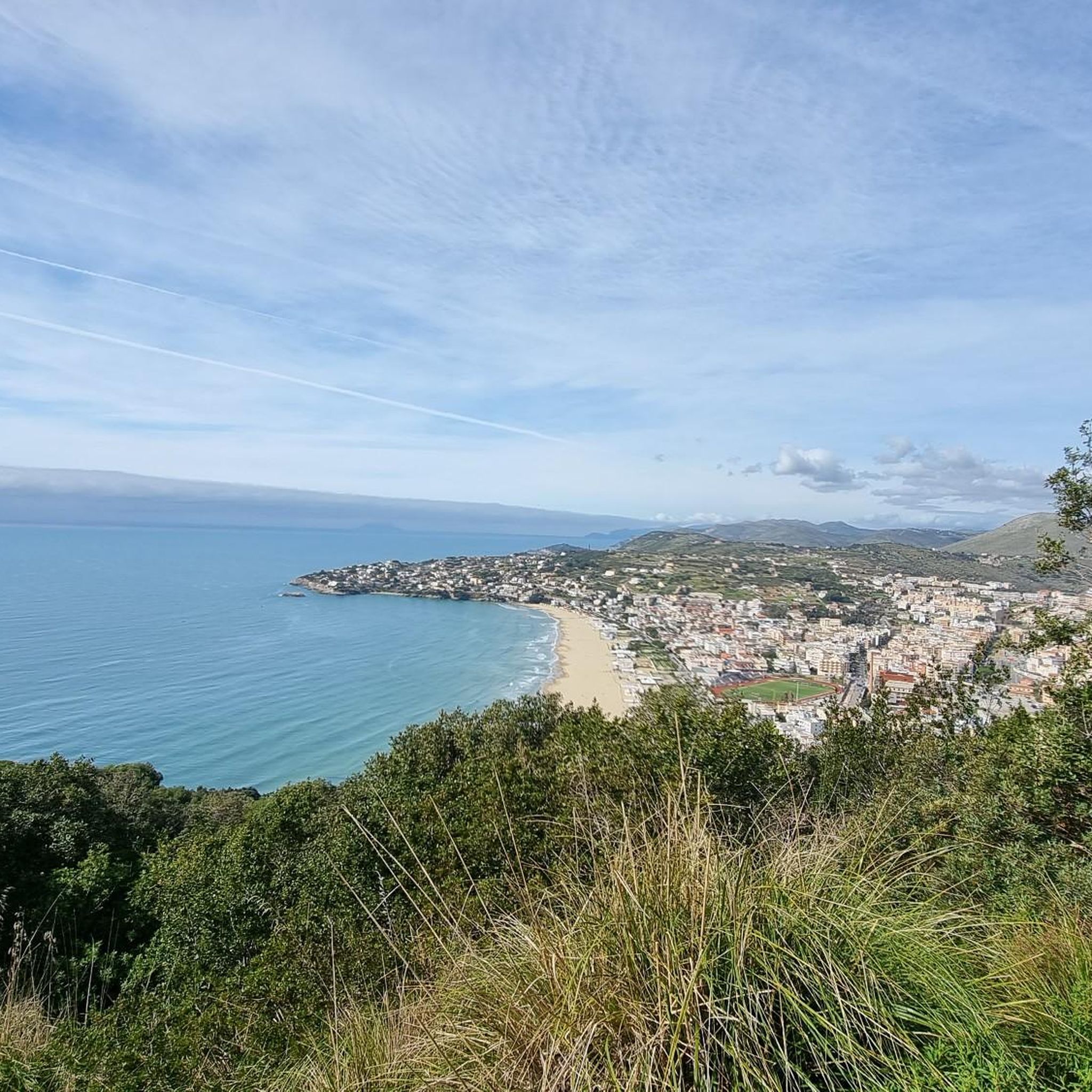
Mountain biking around Formia offers a diverse landscape characterized by coastal hills, dense Mediterranean vegetation, and significant elevation changes. The region features a mix of challenging climbs and technical descents, often providing views of the Tyrrhenian Sea. Trails frequently traverse the Monti Aurunci, presenting varied terrain from rocky paths to forested singletracks.
Best mountain bike trails around Formia
- The most popular mountain bike trail is Saint Philip Neri's Way - MTB Stage 2, a 21.1 miles (33.9 km) trail…
Last updated: May 11, 2026
4.7
(15)
87
riders
33.9km
03:45
1,420m
1,420m
Hard mountain bike ride. Very good fitness required. Advanced riding skills necessary. Some portions of the route may require you to push your bike.
4.7
(18)
83
riders
34.1km
03:34
1,310m
1,310m
Hard mountain bike ride. Very good fitness required. Advanced riding skills necessary. Some portions of the route may require you to push your bike.

Sign up for free
5.0
(3)
29
riders
56.9km
05:33
1,910m
1,910m
Hard mountain bike ride. Very good fitness required. Advanced riding skills necessary. Some portions of the route may require you to push your bike.
4.7
(20)
48
riders
49.3km
03:07
550m
550m
Moderate mountain bike ride. Good fitness required. Suitable for all skill levels.
5.0
(1)
27
riders
Moderate mountain bike ride. Good fitness required. Advanced riding skills necessary.
Get access to more routes and recommendations from other explorers.
Sign up for free
Already have an account?
Our route recommendations are based on thousands of hikes, rides, and runs completed by other people on komoot.
Start today with a free account
Your next adventure awaits.
Login or Signup
Other adventures around Formia

Tips from the Community

The Park of Monte Orlando covers an area of 89 hectares, of which 59 are land area and 30 are marine area. Located within the territory of Gaeta, the Park represents the terminal part of the Aurunci mountain system. This protected area is managed by the Riviera di Ulisse Regional Park Authority together with the areas of the Gianola and Monte di Scauri Suburban Regional Park and the Natural Monument of Sperlonga. With a typically rounded shape, Monte Orlando is connected to the mainland to the north by a thin strip of land and ends in the south with a high rocky coast characterized by spectacular cliffs. The territory is affected by the corrosive action of water; in fact, rain penetrating the rocks dissolves the calcium carbonate contained within them, giving rise to numerous and typical erosive forms. The sea has also contributed to shaping the promontory and, over the centuries, through wave motion, has modeled and etched the rocks, leaving fossil traces, recognizable signs of the ancient sea level. Human intervention, in different historical eras, has left its mark on Monte Orlando. Particular attention should be paid to the military fortifications, built both outside and inside the current Park, which made Gaeta a fortress of strategic importance for the Kingdom of Naples. At the summit, we find the Mausoleum of Lucius Munatius Plancus.
0
0
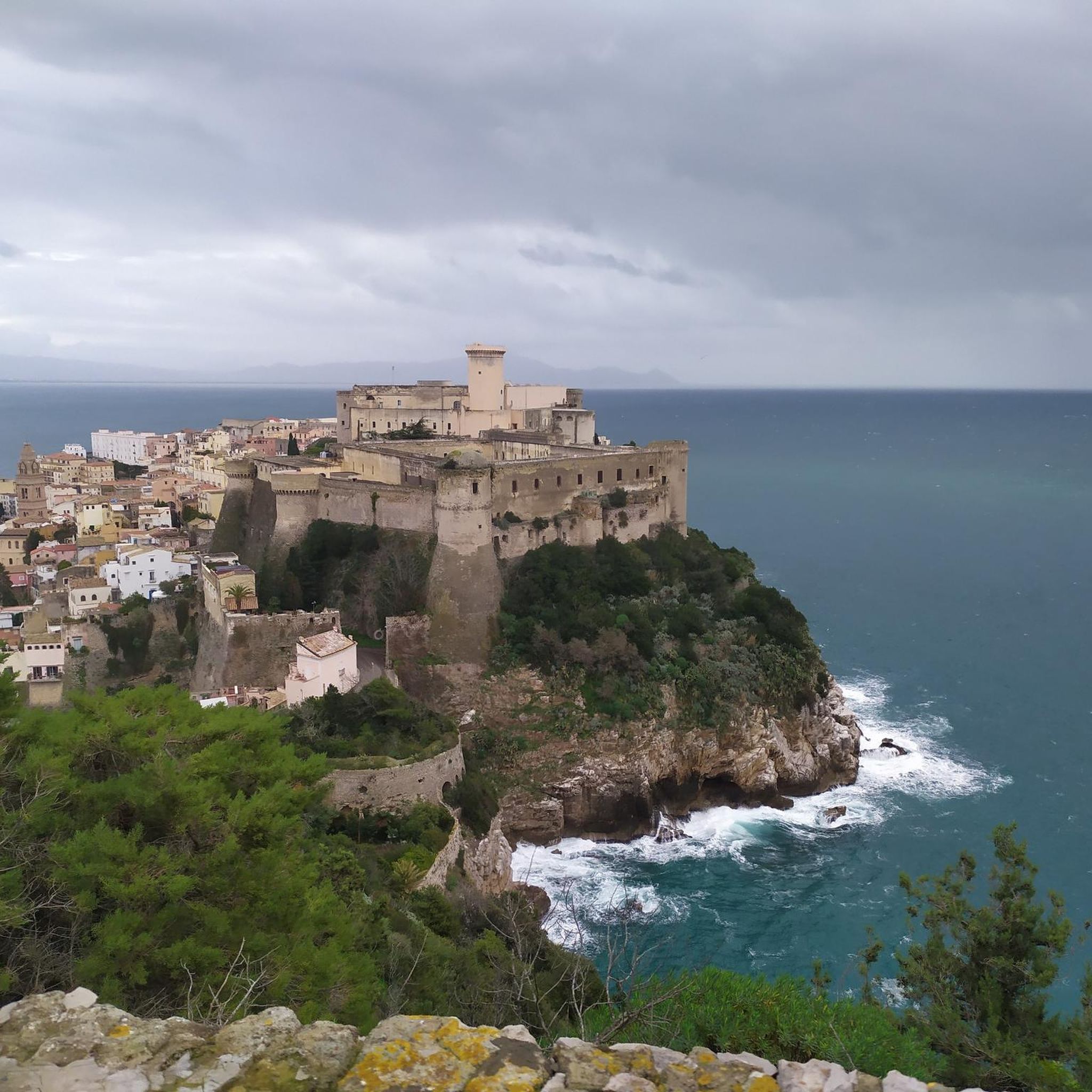
The city of Gaeta owes its name to Caieta, Aeneas's nurse, who, according to tradition, is buried right here. According to another interpretation, it derives from the Greek term indicating the “cavity” of the famous gulf. Whatever the truth, what is certain is that the city has a very ancient history, a past that can still be felt in some areas such as the medieval quarter of Sant’Erasmo, attested as early as the era of the Duchy of Gaeta and the maritime republics. A decadent nostalgia can be felt in the streets of the quarter, visibly marked by the bombings of World War II. However, houses dating back to the 12th century are still visible along narrow alleys made of stairs, underpasses, and arches. The medieval quarter has two hearts. The first is the Church of San Giovanni a Mare, a 10th-century Romanesque building with evident Byzantine influence. The second is the Cathedral, consecrated in the 12th century. Inside, a splendid marble Easter candelabrum is kept, while outside stands the imposing Arab-Sicilian bell tower, with interwoven arches, inlays, and majolica tiles. Above all dominates the Aragonese-Angevin castle, which dates back to the 8th century and was later enlarged in the 13th and then in the 16th centuries. Finally, visit the Church of the Annunciation with the Golden Grotto, the Sanctuary of the Split Mountain with the mausoleum of Lucius Munatius Plancus, and the characteristic Via dell'Indipendenza.
0
0
Beautiful trail, also suitable for cycling, naturally downhill, at times very stony and loose with very large rocks, steps, and rocky parts. The gradients in some sections are double-digit but for short stretches. Excellent riding skills or carrying the bike are required. The panorama repays the difficulties.
0
0
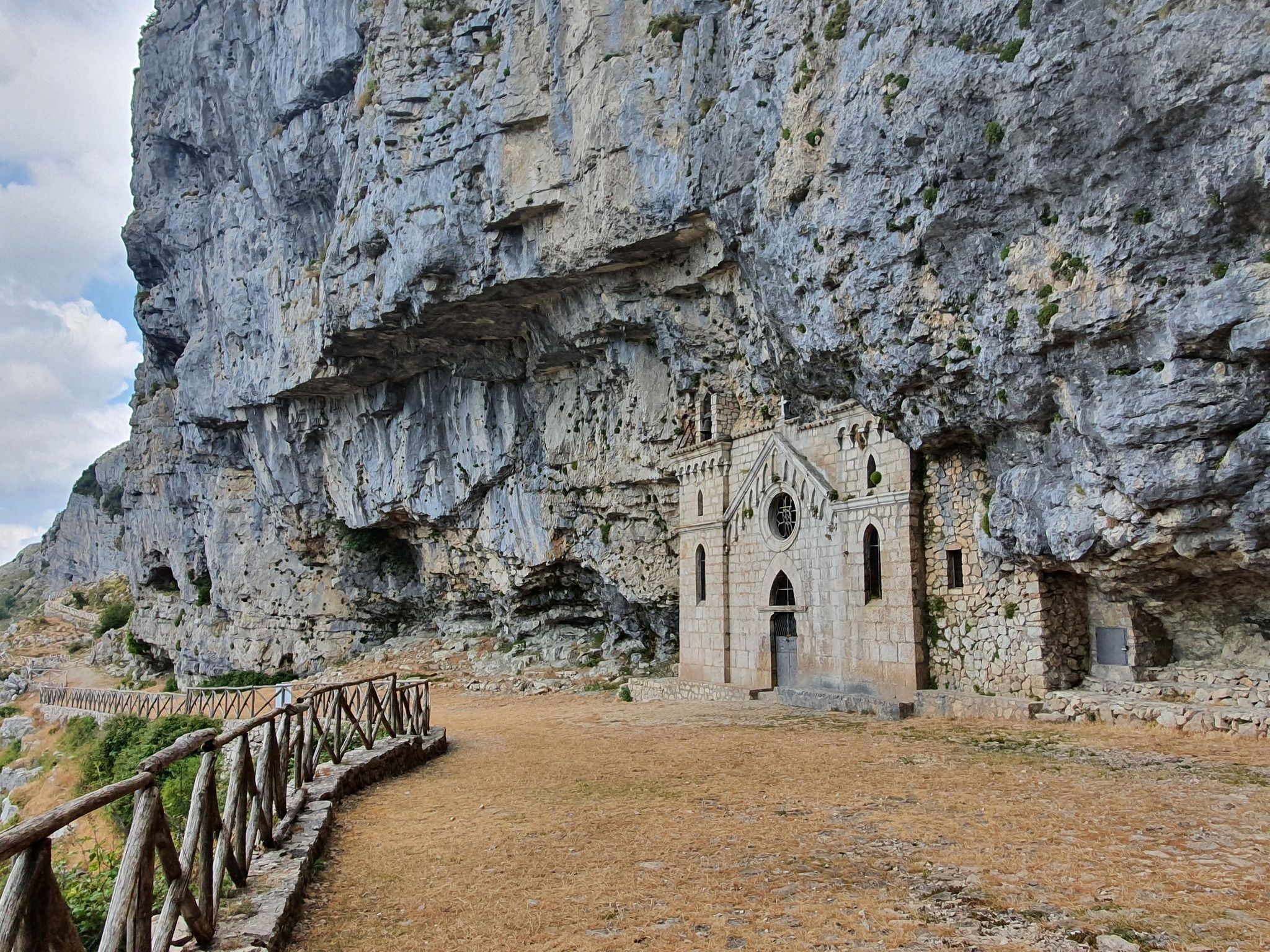
The hermitage of San Michele Arcangelo is a small church located on the slopes of Mount Altino, which belongs to the Aurunci Mountains chain, at 1220 m above sea level in the territory of Maranola (a hamlet of Formia). Set in the rock, it is located along the path that leads from Sella Sola to the summit of the Redentore, on a sheer spur. The rock sanctuary, dedicated to Saint Michael the Archangel, dates back to 830, as it is mentioned in the Codex diplomaticus cajetanus. However, the stone facade, which closes a natural cavity, was rebuilt in neo-Gothic style at the end of the 19th century, in 1893, when Archbishop Francesco Niola climbed Mount Altino on a pastoral visit. He indicated the interior of the grotto as an ideal location for the new construction, in order to avoid the damage suffered by the previous church, caused by runoff water, falling rocks, and ice. The new project was drawn up by the engineer Silvio Forte of Trivio. The rock was squared to form the environment of the Church, and a space twelve meters long, ten wide, and seven high was obtained. On the back wall, opposite the entrance, a niche also carved into the rock houses the statue of Saint Michael. The facade, facing west and with two projecting volumes on the sides, has in the center a pointed arch entrance door, surmounted by a rose window open to let light into the church's interior. On the arch of the door, next to the inscription “Angelorum Principi”, are the dates 830, the year of the foundation of the old monastery, and August 5, 1895, the day of the inauguration of the new Sanctuary. These dates are also reported on a plaque placed inside the church. Both the rose window and the other openings of the facade were closed by polychrome stained glass windows, now lost.
0
0
After the dirt road immersed in a beautiful beech forest, you reach a picnic area where you turn right towards Christ the Redeemer.
0
0
Once at the top of the climb, a wonderful panorama opens up over the valley with a view of Christ the Redeemer.
0
0

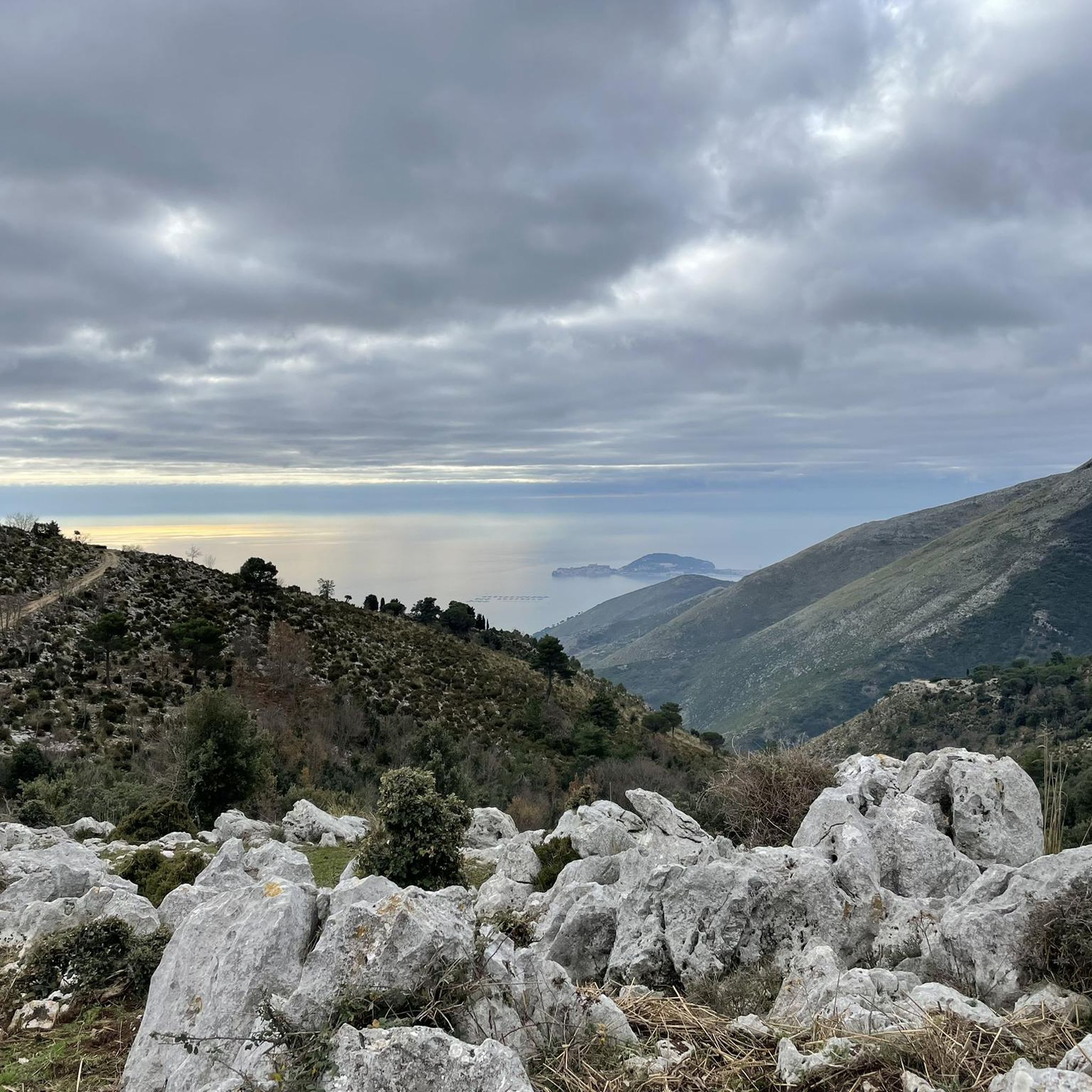
The climb to the Redentore rewards with a breathtaking panorama of the Gulf of Gaeta
0
0

excellent yes it goes well in the Gulf of Gaeta
0
0
Frequently Asked Questions
How many mountain bike trails are available around Formia?
There are over 40 mountain bike trails around Formia listed on komoot, offering a diverse range of experiences for different skill levels.
Are there mountain bike trails suitable for beginners in Formia?
Yes, Formia offers some trails suitable for beginners. While many routes feature significant elevation changes, there is at least one easy trail available. For those looking for a slightly greater challenge but still manageable, there are also nearly 30 moderate trails to explore.
What kind of terrain can I expect on mountain bike trails in Formia?
Mountain biking around Formia is characterized by coastal hills, dense Mediterranean vegetation, and significant elevation changes. You'll encounter varied terrain, from rocky paths and forested singletracks in the Monti Aurunci to routes offering panoramic views of the Tyrrhenian Sea.
Are there any challenging mountain bike trails for experienced riders?
Absolutely. Formia is well-suited for experienced mountain bikers, with 11 difficult routes available. These trails often feature demanding ascents and technical descents. An example is the Saint Philip Neri's Way - MTB Stage 2, which covers 21.1 miles (33.9 km) with over 1,400 meters of elevation gain.
Can I find circular mountain bike routes in Formia?
Yes, many of the mountain bike trails in Formia are designed as circular routes, allowing you to start and finish in the same location. A popular option is the Trabacco Powder Warehouse loop from Formia, a 21.0 miles (33.9 km) trail through varied landscapes.
What are the typical lengths and durations of mountain bike trails in Formia?
Trail lengths vary, but many routes are between 20 to 35 miles (32 to 56 km). Durations can range from around 2.5 hours for moderate trails to over 5 hours for more challenging and longer routes. For instance, the Ascent to Monte Redentore – View of Maranola loop from Castellonorato is a difficult 35.3 miles (56.8 km) ride that typically takes over 5.5 hours.
What do other mountain bikers say about the trails in Formia?
The mountain bike trails in Formia are highly rated by the komoot community, with an average score of 4.5 stars from over 180 reviews. Riders often praise the diverse terrain, challenging climbs, and the stunning panoramic views of the Tyrrhenian Sea and surrounding mountains.
Are there any scenic viewpoints or attractions along the mountain bike trails?
Yes, many trails offer spectacular viewpoints, particularly those ascending into the Monti Aurunci, providing vistas of the coastline and sea. You can also find interesting historical and natural attractions nearby, such as the Hermitage of St. Michael the Archangel or the Cima del Redentore (Monte Altino), which offers expansive views.
What are some notable landmarks or places to explore near the mountain biking routes?
Beyond the trails, Formia and its surroundings offer several points of interest. You might consider visiting the Church of St. Francis in Gaeta, or exploring the ancient Tiberius' Grotto and Tiberius' Cave and Fishpond of Sperlonga, which are significant historical and natural sites in the region.
Is there a mountain bike trail that offers views of Monte Redentore?
Yes, the Ascent to Monte Redentore – View of Monte Redentore loop from Castellonorato is a challenging 21.2 miles (34.1 km) route specifically designed to offer views of Monte Redentore, known for its demanding ascents through mountainous terrain.
Are there any trails that pass by historical sites like Itri Castle?
While not directly passing through, some routes are in the vicinity of historical landmarks. For example, the Itri Castle – View of Maranola loop from Castellonorato is a difficult 33.7 miles (54.2 km) trail that offers views towards the area of Itri Castle and Maranola.
Most popular attractions around Formia

Get inspired with the komoot mobile app


Explore more
Browse the best MTB trails in other regions.
