The best walks and hikes around Ginosa
4.5
(266)
1,045
hikers
36
hikes
Hiking around Ginosa, Italy, offers diverse terrain characterized by deep gravinas and canyons, notably the Gravina di Laterza. The landscape features a mix of rocky outcrops, Mediterranean scrub, and occasional forested areas. These geological formations create varied elevation changes and scenic viewpoints. The region provides a range of hiking experiences, from gentle paths along the canyon rims to more challenging routes exploring the ravines.
Best hiking trails around Ginosa
- The most popular hiking route is Gravina di Laterza Loop,…
Last updated: July 8, 2026
4.6
(27)
84
hikers
18.2km
04:56
240m
240m
Embark on the Gravina di Laterza Loop, a moderate hike that plunges you into the dramatic canyon landscapes of the Parco Naturale Regionale Terra delle Gravine. This 11.3-mile (18.2 km)…
1
hikers
9.09km
02:47
320m
320m
Moderate hike. Good fitness required. Easily-accessible paths. Suitable for all skill levels.

Sign up for free
4.7
(32)
121
hikers
Easy hike. Great for any fitness level. Easily-accessible paths. Suitable for all skill levels.
4.6
(8)
22
hikers
11.5km
03:10
190m
190m
Moderate hike. Good fitness required. Easily-accessible paths. Suitable for all skill levels.
4.2
(5)
25
hikers
4.56km
01:16
90m
90m
Easy hike. Great for any fitness level. Easily-accessible paths. Suitable for all skill levels.
Get access to more routes and recommendations from other explorers.
Sign up for free
Already have an account?
Our route recommendations are based on thousands of hikes, rides, and runs completed by other people on komoot.
Start today with a free account
Your next adventure awaits.
Login or Signup
Tips from the Community


The Grotta Croce (The Cross Grotto) is a natural cavity set in the walls of the canyon. This cave ist home to several birds, including kestrels and swifts and if you are lucky, you can spot the eagle that inhabits the area.
0
0
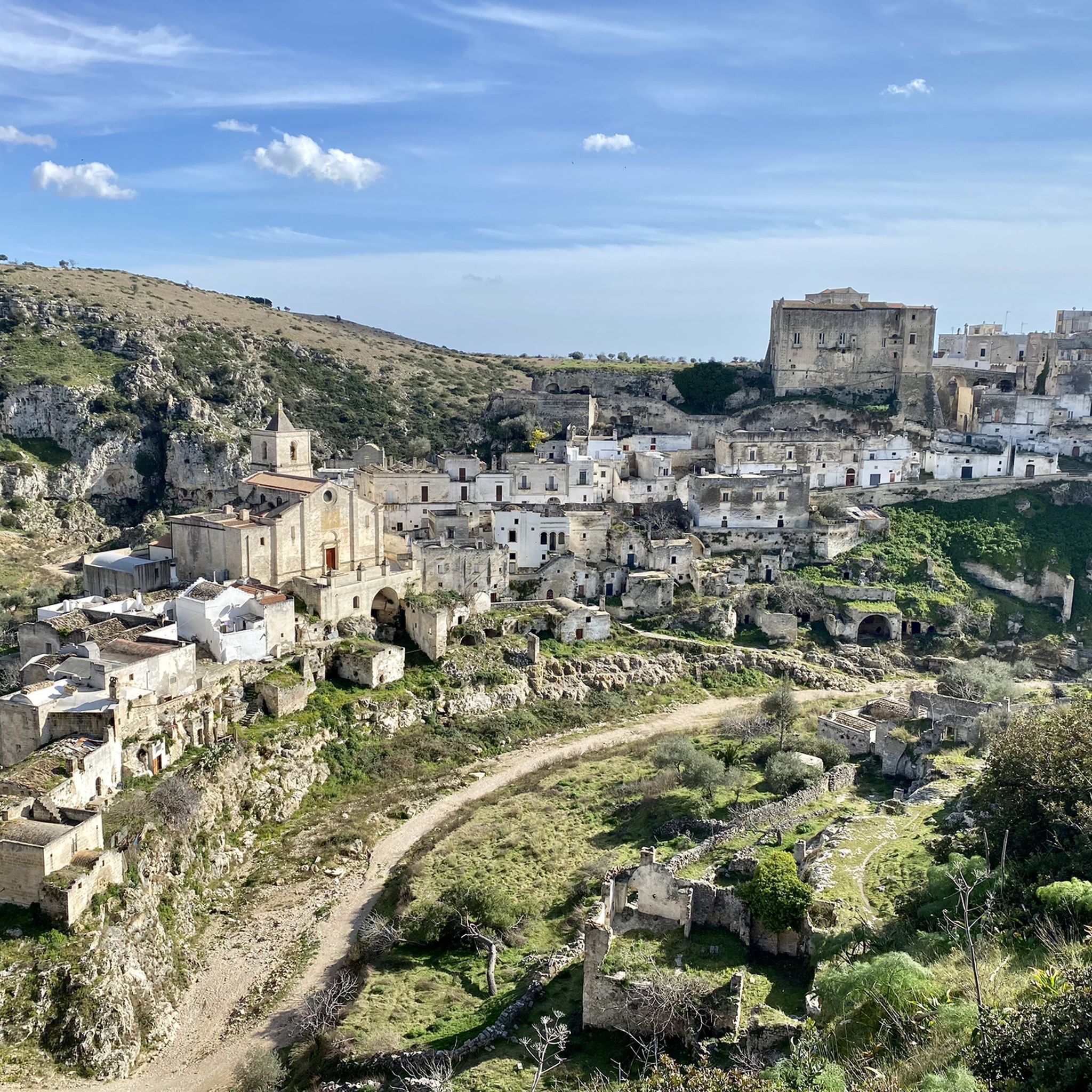
Along the sides of the ravine as it snakes its way around the town are the ruins of rock-cut settlements so distinctive of Ginosa. These are the settlements of people who cut their houses and churches into the rock. The best place to visit these dwellings is on the eastern side of the town, in the Rione di Rivolta. At the end of the 5th century AD when the Roman Empire came under attack from the Goths and other Germanic tribes attacking Rome, the open plains were no longer safe. And it was then that people sought refuge in the relatively safer ravines. The soft, limestone bedrock made it easy to cut into the sides of the ravines to create places to live that were easier to protect against the Goths to begin with, but also the Saracens later. Over the turbulent centuries of the Middle Ages that followed the fall of the Western Roman Empire fully developed communities emerged in these ravines. These early Medieval troglodytes ‘built’ surprisingly complex villages simply by cutting into the rock at different levels. Besides creating domestic spaces – Casa Grotto (cave house), they also cut churches into the sides of the ravines. They also cut channels and cisterns into the rock to supply water. The rock cut villages in the ravines around Ginosa were still inhabited up until the 20th century. Today the Casa Grottos and rock cut churches with their Byzantine frescoes are a popular tourist attraction, particularly Villagio Rivolta. Here visitors can see the typical structure of the casa grotto, where rooms at the front were communal and where cooking would have taken place, while animals were kept in the room at the rear – for safety. In front of the houses you can see the network of human-made cisterns, basins and channels that caught and stored rain water. What today seems like a random collection of ruined artificial caves is in fact a very elaborate village made up of 66 individual houses, constructed over five levels one on top of the other connected by stairs.
0
0
Below the castle and in amongst the buildings right on the edge of Rione di Casale you can not miss an eye-catching gabled façade and bell tower. These are the noticeable features of 16th century church, Chiesa Matrice. A church that for centuries has had a special place in the religious traditions and history of Ginosa. Do not let the seemingly out of the way location of Chiesa Matrice lead you to think this is an insignificant church. Everything about this sacred space is intimately linked to the changing historical fortunes and allegiances of Ginosa. Construction of the church began towards the end of the 15th century to appease French soldiers. At the time, Ginosa was caught up in the Italian Wars – a series of conflicts that involved most of the major states of western Europe fight for territory and power. Giambattista Doria not only enlisted French architects to build the church, he also had it dedicated to a prominent French Saint, Martin of Tours. Take a closer look at the fading painting on the front façade beneath the rose window. It is thought to represent the legend of Martin’s Cloak. Martin is depicted on horseback cutting his cloak in two, one half of which he gave to the poor, nude beggar he is said to have encountered at the gates of Amiens. Saint Martin’s and the French soldiers’ hold over the church here was not to last long. In one of the five chapels, in an ornate wooden display case, is an 18th century statue of Mary holding Jesus and a rosary. In 1756 the town chose to re-dedicate the church to Mary, Madonna del Rosario. Since its construction in the early 16th century, the church has witnessed a number of changes. In the 17th century, like many churches in Italy it was restored in a Baroque style. All that remains of this period are the painted walls and ceiling at the back of the right-hand aisle. The rest of aisle, the left-hand aisle, the nave and apse is simply white. It does make for a very bright interior. Chiesa Matrice was in fact built on top of an earlier church. The edge of the apse of that earlier church, built in about 1000 AD, can be seen through a glass panel in the floor of the apse.
0
0
One of Ginosa’s most striking landmarks, perhaps the most prominent historical site, is the Norman Castle. Built towards the end of the land spur in what is the northern end of the historical centre, the castle has commanding views over both Rioni di Casale and Rioni di Rivolta, and on to the surrounding plains beyond the ravine. The castle is the handiwork of Robert Guiscard, born in Normandy who was a significant figure in the Norman conquest of southern Italy during the 11th and 12th centuries. Guiscard became the Count of Apulia and Calabria between 1057 and 1059, and then Duke of Apulia and Calabria as well as Duke of Sicily between 1059 and 1085. He had the Ginosa castle built in 1080. A fortress, clearly occupying the most strategic spot being almost entirely surrounded by the ravine, built to protect the town against Saracen raids. At this time Puglia and much of southern Italy was being fought over between the Normans and the Byzantines. Today the castle looks more like a large palazzo than a Norman castle. This is because the distinctive Norman features, crenellated towers and a drawbridge, were removed or altered in the 16th century when the castle became the baronial seat of the Doria family. For example, the drawbridge was replaced by an arched bridge that links the castle’s entrance to Corso Vittorio Emanuele.
0
0
Along the sides of the ravine as it snakes its way around the town are the ruins of rock-cut settlements so distinctive of Ginosa. These are the settlements of people who cut their houses and churches into the rock. The best place to visit these dwellings is on the eastern side of the town, in the Rione di Rivolta. In this part of southern Italy, the relatively flat landscape is cut through with a number of deep canyons created by rivers flowing into the Gulf of Taranto; hence the name Terre delle Gravine. Archaeological evidence shows that during the ‘Roman period’ people lived on the fertile plains. The Roman villas that have been excavated suggest a prosperous local economy based on agriculture. Towards the end of the 5th century AD when the Roman Empire came under attack from the Goths and other Germanic tribes attacking Rome, the open plains were no longer safe. And it was then that people sought refuge in the relatively safer ravines. The soft, limestone bedrock made it easy to cut into the sides of the ravines to create places to live that were easier to protect against the Goths to begin with, but also the Saracens later. Over the turbulent centuries of the Middle Ages that followed the fall of the Western Roman Empire fully developed communities emerged in these ravines. These early Medieval troglodytes ‘built’ surprisingly complex villages simply by cutting into the rock at different levels. Besides creating domestic spaces – Casa Grotto (cave house), they also cut churches into the sides of the ravines. They also cut channels and cisterns into the rock to supply water. The rock cut villages in the ravines around Ginosa were still inhabited up until the 20th century. Today the Casa Grottos and rock cut churches with their Byzantine frescoes are a popular tourist attraction, particularly Villagio Rivolta. Here visitors can see the typical structure of the casa grotto, where rooms at the front were communal and where cooking would have taken place, while animals were kept in the room at the rear – for safety. In front of the houses you can see the network of human-made cisterns, basins and channels that caught and stored rain water. What today seems like a random collection of ruined artificial caves is in fact a very elaborate village made up of 66 individual houses, constructed over five levels one on top of the other connected by stairs.
0
0
In the heart of the centro storico is Piazza Orologio, named after the somewhat simple but conspicuous nonetheless clock tower. The tower and surrounding palazzos are a reminder of the glory days of Neoclassicism. Piazza Orologio is a relatively new addition to the townscape; a testament to more recent architectural developments in Ginosa. Until the beginning of the 1800s this is where the town’s prison, tax and municipal offices stood. These were destroyed and in 1820 the clock tower was erected. Then the square was appropriately named Piazza Nuovo (New Square). During the 19th century the surrounding blocks were also cleared, and the older buildings replaced with elegant, Neoclassical townhouses. On the façade of one of these, Palazzo Strada, the 19th century mosaic medallions are very well preserved. The square looks good throughout the day, but it is particularly picturesque at night.
0
0

Visiting the town during the Christmas period, everything appears with a certain atmosphere as the entire historic center is decorated for Christmas.
1
1
Frequently Asked Questions
How many hiking trails are available around Ginosa?
There are over 30 hiking trails around Ginosa, offering a variety of experiences. These routes explore the region's unique gravinas and Mediterranean landscape.
Are there easy hiking trails suitable for beginners in Ginosa?
Yes, Ginosa offers several easy trails perfect for beginners. There are 11 easy routes available, such as the View of the Gravina Canyon – View of the Gravina Canyon loop from Gravina di Laterza, which is 2.7 miles (4.3 km) long and takes about 1 hour 13 minutes to complete.
Can I find family-friendly walks around Ginosa?
Absolutely. Many of the easier trails are suitable for families. The landscape, with its dramatic gravinas, offers engaging scenery for all ages. Look for routes marked as 'easy' on komoot for the best family options.
Are there circular hiking routes in the Ginosa area?
Yes, many of the trails around Ginosa are circular, allowing you to start and end at the same point. Popular loop routes include the Gravina di Laterza Loop and the From Montescaglioso to Difesella – loop tour.
What are the best times of year to go hiking in Ginosa?
The best seasons for hiking in Ginosa are typically spring (April-May) and autumn (September-October). During these months, the weather is mild and pleasant, avoiding the intense heat of summer and the cooler, potentially wetter conditions of winter. The Mediterranean scrub is also vibrant during spring.
Are dogs allowed on the hiking trails near Ginosa?
Generally, dogs are welcome on hiking trails in Ginosa, especially if kept on a leash. It's always advisable to check specific trail regulations or local signage, particularly in protected areas. Remember to bring water for your dog and clean up after them.
What kind of scenery can I expect on hikes around Ginosa?
Hikes around Ginosa are defined by dramatic gravinas (deep canyons), rocky outcrops, and lush Mediterranean scrubland. You'll encounter varied terrain, from paths along canyon rims offering extensive views to routes exploring the ravines themselves. The geological formations create a unique and striking landscape.
Are there any interesting historical sites or natural landmarks to see while hiking?
Yes, the Ginosa area is rich in historical and natural landmarks, often integrated into the hiking experience. You can explore ancient rock settlements and churches. Notable highlights include the Grotta Croce in Laterza, the Sanctuary of Madonna della Loe and Rock Settlement, and the Rock Church of Santa Sofia. Many trails offer views of these fascinating sites.
How can I get to the hiking trails around Ginosa using public transport?
While some trails might be accessible via local bus services to Ginosa or nearby towns like Laterza, public transport options directly to trailheads can be limited. It's often recommended to use a car for greater flexibility in reaching various starting points. Always check local bus schedules in advance.
Is parking available near the trailheads in Ginosa?
Parking availability varies by trailhead. In Ginosa and surrounding towns like Laterza, you can usually find street parking or designated parking areas. For trails starting in more remote gravina areas, parking might be less formal, often along access roads. It's advisable to check maps or local information for specific starting points.
What do other hikers say about the trails in Ginosa?
The trails in Ginosa are highly regarded by the komoot community, with an average rating of 4.5 stars from over 200 reviews. Hikers frequently praise the dramatic scenery of the gravinas, the unique historical sites, and the variety of routes available for different skill levels.
Are there any hikes that offer scenic viewpoints of the gravinas?
Many hikes in Ginosa are specifically designed to showcase the stunning gravinas. Routes like the Grotta Croce in Laterza – View of the Gravina Canyon loop from Laterza provide excellent panoramic views of the canyons and the surrounding landscape.
What should I bring for a hike in Ginosa?
For hiking in Ginosa, essential items include sturdy hiking shoes, sufficient water (especially in warmer months), sun protection (hat, sunscreen), and a map or GPS device. Depending on the trail's difficulty, trekking poles can also be beneficial, particularly on uneven terrain within the gravinas.
Most popular attractions around Ginosa

Get inspired with the komoot mobile app


Explore more
Browse the best Hikes in other regions.
