Attractions and Places To See around Fontanellato - Top 20
Best attractions and places to see around Fontanellato include historical landmarks and cultural sites within this charming Emilia-Romagna village. Situated in the flat landscape of the Parma plain, Fontanellato is known for its natural springs and rich gastronomic tradition. It offers a blend of history, art, and local culture, recognized as a "slow city" and a City of Art and Culture.
Best attractions and places to see around Fontanellato
- The most popular attractions is Tabiano Castle, a castle that…
Last updated: July 6, 2026
Tabiano Castle
Highlight • Castle
Translated by Google •
Tip by

Chiesa di Santa Croce (Parma)
Highlight • Religious Site
Translated by Google •
Tip by

Sign up now to discover places like this
Get recommendations on the best single tracks, peaks, & plenty of other exciting outdoor places.
Sign up for free
Rocca Sanvitale di Fontanellato
Highlight • Castle
Translated by Google •
Tip by

Chiesa di Vicomero
Highlight • Religious Site
Translated by Google •
Tip by

Church of Saint Peter the Apostle
Highlight • Religious Site
The …
Translated by Google •
Tip by

Sign up for free to discover even more attractions around Fontanellato.
Sign up for free
Already have an account?
Start today with a free account
Your next adventure awaits.
Login or Signup

Tips from the Community

The Church of San Pietro Apostolo is a Catholic place of worship with neo-Byzantine architecture, located at Via Costa Pavesi 47 in Costamezzana, a hamlet of Noceto, in the province and diocese of Parma. It is the seat of a parish within the pastoral area of Pedemontana. HISTORY: The church was built starting in 1909 in the new lower village of Costamezzana, to replace the now inadequate medieval chapel located inside the castle. The work was completed in 1917, but the façade was not erected until 1930, designed by architect Camillo Uccelli. The adjacent rectory was built in 1932. In 1953, the monumental staircase in front of the façade was built, designed by engineer Celeste Merini. In 1954, the two main chapels and the apse were decorated with frescoes by the Noceto painter Pietro Furlotti. SOURCE and other information: https://it.wikipedia.org/wiki/Chiesa_di_San_Pietro_Apostolo_(Noceto)
0
0
Originally built between the 10th and 11th centuries, the castle was rebuilt in 1153 and expanded several times in the following centuries. With the exception of a few brief periods in the 12th and 14th centuries, the Pallavicino marquises maintained it almost uninterruptedly until their extinction in 1756. Assigned to the Sermattei family, the manor was purchased a few years later by the Landi cousins. Sold in 1882 to the Corazza family, the manor was renovated and transformed into an elegant stately home, rich in frescoes and stucco decorations. Since the early 21st century, the building, along with the surrounding village, has been used as a scattered hotel, with an adjoining farm. SOURCE: https://it.wikipedia.org/wiki/Tabiano_Castello
0
0
The Church of San Pietro Apostolo is a Catholic place of worship with neoclassical architecture, located at Strada Chiesa di Baganzola 15 in Baganzola, a hamlet of Parma, in the province and diocese of Parma. It is the seat of a parish within the pastoral area of the city. HISTORY: The original place of worship serving the village of Baganzola was built in the Middle Ages, but in 1180 it was destroyed, along with the village, by the fury of the waters of the nearby Parma River during a disastrous flood. The temple was completely rebuilt in Romanesque style on a single-nave plan, without an apse, developed on an unusual north-south orientation. In 1230, the Chapel of St. Petri de Bazanzola was mentioned in the Capitulum seu Rotulus Decimarum of the Diocese of Parma among the dependencies of the parish of Castelnovo. In the first half of the 15th century, as a result of the increase in the village's population, the medieval place of worship was profoundly modified, rotating the nave's orientation 90° and enlarging the entire structure. In 1564, the church was elevated to an independent parish and in 1685 it was elevated to the rank of honorary archpriest. In 1881, the place of worship underwent restoration work. In 1911, the church was partially renovated based on a design by engineer Massimo Maffei, with the construction of the apse, two chapels on the right and one on the left, adjacent to the façade, and the raising of the 13th-century neo-Romanesque bell tower. In 1933, the building was completely restored, including the removal of the tombstones inside and outside. Between 1966 and 1971, the side altars were removed and the old masonry high altar was replaced with a wooden altar. Between 1994 and 1998, the church was renovated again, with the floors redone, the plumbing installed, and the apse decorated. SOURCE and further information: https://it.m.wikipedia.org/wiki/Chiesa_di_San_Pietro_Apostolo_(Parma,_Baganzola)
0
0
OPENING HOURS Open Monday to Sunday from 8:30 to 10:30 and from 15:30 to 18:30. Weekday and Saturday services at 18:30, Sunday at 11:00 and 18:30. SOURCE https://parmawelcome.it/scheda/chiesa-di-santa-croce/
0
0
The Church of Santa Croce, of ancient Romanesque origins, stands along the route of the ancient Via Francigena. The building was built in 1210, while the year of consecration in 1222, with an architectural structure with three naves. The building underwent numerous modifications: it was first raised and then covered with a dome, finally enriched by a notable chapel called San Giuseppe, thus assuming its current appearance. Traces of the origins can be found in the capitals of the pillars of the three naves, which show purely medieval subjects and are decorative parts of great value. The author is among the followers of the masters who worked on the construction site of the Cathedral of Parma. The central nave is frescoed by Giovanni Maria Conti della Camera (around 1635) as is the Chapel of San Giuseppe where you can also admire a wooden group made by Angelo Fontana in the second half of the 18th century. The church also houses altarpieces and works of art from the Baroque period. SOURCE: https://parmawelcome.it/scheda/chiesa-di-santa-croce/
0
0

Chiesa Di San Pietro Apostolo: The Chiesa di San Pietro Apostolo in Costamezzana, a frazione of Noceto in the province of Parma, is a Catholic church with neo-Byzantine forms. The church has a neo-Byzantine style. Construction of the church began in 1909 in the new village of Costamezzana to replace the old medieval chapel located in the castle. The works were completed in 1917, but the facade was not built until 1930, according to a design by architect Camillo Uccelli. In 1954, the two main chapels and the apse were decorated with frescoes by the painter Pietro Furlotti. The church has a single nave with three chapels on each side, with an entrance in the northeast and a semicircular choir in the southwest. The symmetrical facade is completely covered in brick and is preceded by a spacious forecourt that is reached via a monumental stone staircase with two ramps.
8
0

Planning the tour of the Castles of the Duchy of Parme and Piacenza we reached the "Fortress of Fontanellato". Rocca Sanvitale is an imposing fortress built in the 14th century on a pre-existing 12th century building. Subjected to numerous restorations, over the centuries it was transformed from a defensive fortress into the residence of the noble Sanvitale Counts who then inhabited it for around six centuries. It has a square plan with crenellated walls and four corner towers and is still surrounded by a large moat once fed by water produced by a spring and rearranged at the beginning of the 17th century by the Parma architect Smeraldo Smeraldi; the entrance to the internal courtyard is via a drawbridge. In 1948 the last Count handed over the Fortress with its furnishings to the Municipality, which subsequently transformed it into a museum.
0
0
Frequently Asked Questions
What are the main historical attractions in Fontanellato?
The most prominent historical landmark is the Rocca Sanvitale di Fontanellato, a 14th-century moated castle in the village center. It features the famous Parmigianino frescoes in the 'Saletta di Diana e Atteone' and Italy's only active optical chamber. Other significant sites include the Santuario della Beata Vergine del Santo Rosario and the Chiesa di San Croce, known for their Baroque art and architecture.
Are there any unique or unusual places to see in Fontanellato?
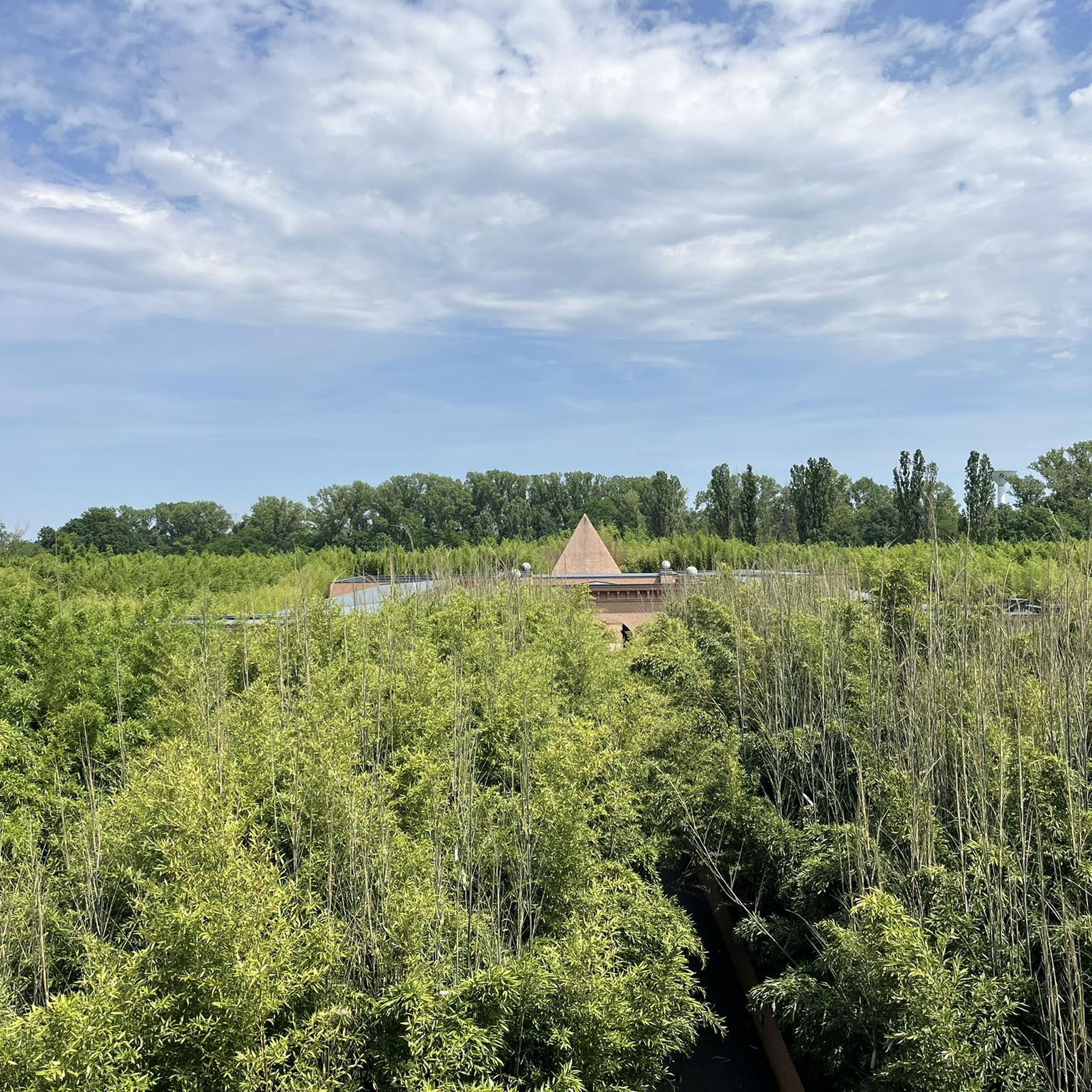
Yes, just outside the town center, you can explore the Labirinto della Masone, which boasts the world's largest bamboo labyrinth. This cultural park also houses the art collection of Franco Maria Ricci and hosts various exhibitions.
What natural features can I find around Fontanellato?
Fontanellato is named after its 'Fontana Lata' (large springs), which are characteristic of the Parma plain. These natural springs feed the elegant moat surrounding the Rocca Sanvitale and contribute to the fertile landscape. The flat terrain also makes it ideal for scenic walks and cycling.
What outdoor activities can I do near Fontanellato's attractions?
The flat terrain around Fontanellato is excellent for cycling and running. You can find various routes, such as the 'Castello di Fontanellato – Soragna and the Rocca Meli Lupi loop' for cycling, or several running loops from Fontanellato itself. For more details on routes, you can explore the Cycling around Fontanellato and Running Trails around Fontanellato guides.
Are there family-friendly attractions in Fontanellato?
Absolutely. The Rocca Sanvitale di Fontanellato is considered family-friendly, offering a fascinating glimpse into history with its moat and unique optical chamber. The Labirinto della Masone, with its impressive bamboo maze, also provides an engaging experience for all ages.
What do visitors enjoy most about Fontanellato?
Visitors particularly appreciate the well-preserved Rocca Sanvitale and its historical significance, including the Parmigianino frescoes. The unique experience of the optical camera inside the castle is also a highlight. Many also enjoy the charming atmosphere of the town and its gastronomic offerings.
What kind of local cuisine can I expect in Fontanellato?
Fontanellato is part of Emilia-Romagna, a region renowned for its gastronomy. You can savor local delicacies such as cured meats like culatello and spalla cotta, and traditional tortelli. The town also hosts events like 'La Dispensa dei Sanvitale' which showcase typical Italian products.
Are there any religious buildings worth visiting in the area?
Yes, besides the Santuario della Beata Vergine del Santo Rosario, you can visit the Chiesa di Santa Croce (Parma), an ancient Romanesque church with valuable wooden Baroque decorations and artworks. The Oratorio Dell'Assunta is another notable religious site with 17th and 18th-century artworks.
What is the best way to get to Fontanellato and its main attractions?
Fontanellato is situated in the Parma plain, making it accessible by car. The Rocca Sanvitale is centrally located in the village square. While specific public transport details aren't provided, the town's location in the Parma province suggests regional bus services might connect it to larger cities like Parma.
Can I visit other castles or historical sites nearby?
Yes, the region is rich in castles. Just a short distance away, you can visit Tabiano Castle, originally built by the Pallavicino family to control trade routes. It is open to the public for guided tours and events, offering another glimpse into the area's noble history.
Does Fontanellato host any markets or special events?
Fontanellato regularly hosts markets and a monthly antique fair, typically held around the castle's moat. These events attract collectors and visitors, offering a chance to experience local culture and find unique items.
Most popular routes around Fontanellato
Most popular attractions around Fontanellato

Get inspired with the komoot mobile app


Explore more
Still not found the Highlight you’re looking for? See guides of the top attractions in other regions:
