The best cycling routes around Parco regionale di Gianola e del Monte di Scauri
4.0
(61)
1,227
riders
91
rides
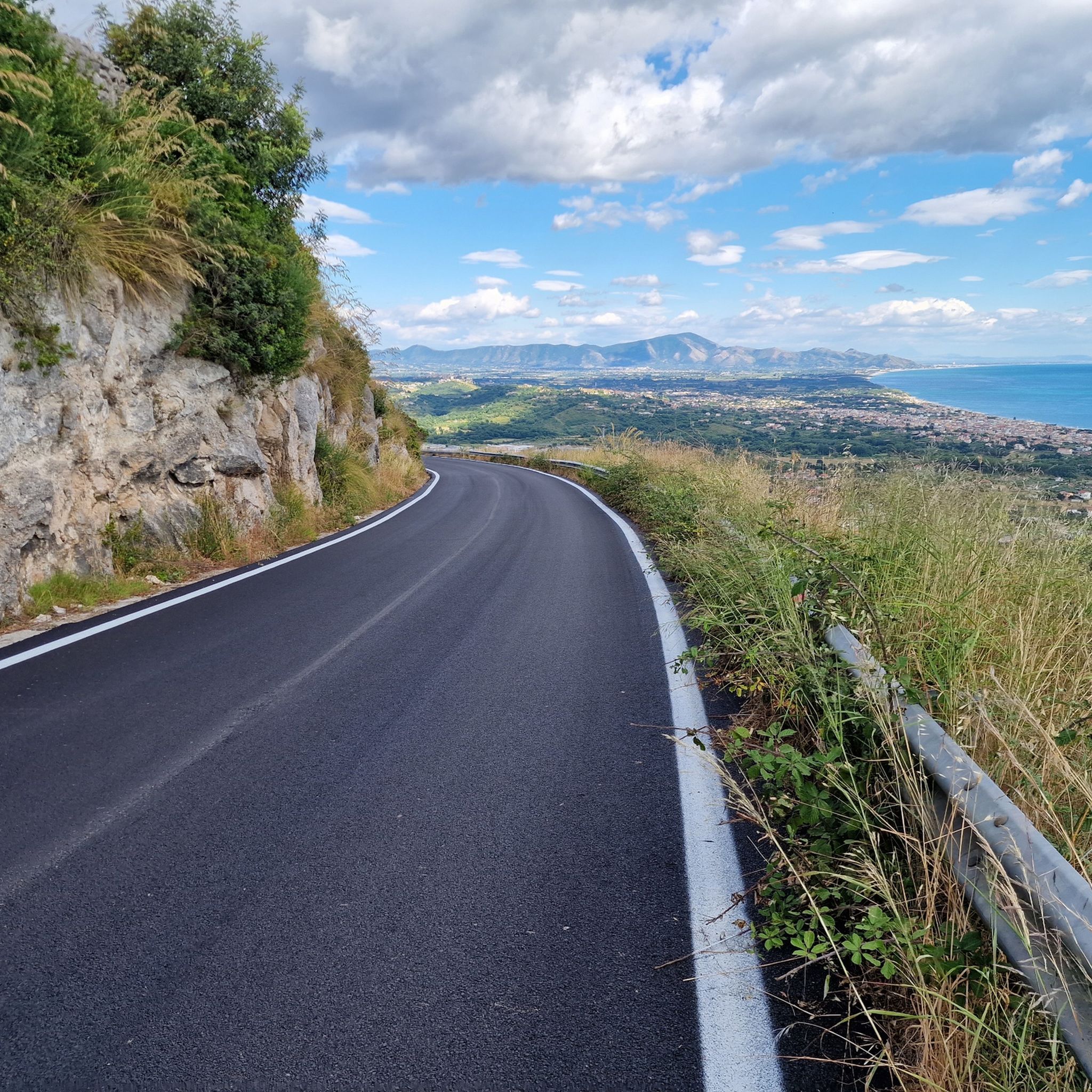
Touring cycling routes around Parco regionale di Gianola e del Monte di Scauri traverse a landscape characterized by coastal stretches, rolling hills, and Mediterranean vegetation. The region features varied terrain, including paths near the sea and routes with moderate elevation gains. This area provides opportunities for cycling through natural parks and past historical sites.
Best touring cycling routes around Parco regionale di Gianola e del Monte di Scauri
- The most popular touring cycling route is Sun Cycle Path – Giardinetti…
Last updated: July 8, 2026
5.0
(1)
25
riders
Hard bike ride. Very good fitness required. Mostly paved surfaces. Suitable for all skill levels.
10
riders
Easy bike ride. Great for any fitness level. Mostly paved surfaces. Suitable for all skill levels.

Sign up for free
8
riders
28.8km
02:36
1,020m
1,020m
Hard bike ride. Very good fitness required. Mostly paved surfaces. Suitable for all skill levels.
7
riders
33.5km
02:07
370m
370m
Moderate bike ride. Good fitness required. Mostly paved surfaces. Suitable for all skill levels.
4.6
(8)
94
riders
42.0km
02:55
530m
530m
Hard bike ride. Very good fitness required. Mostly paved surfaces. Suitable for all skill levels.
Get access to more routes and recommendations from other explorers.
Sign up for free
Already have an account?
Our route recommendations are based on thousands of hikes, rides, and runs completed by other people on komoot.
Start today with a free account
Your next adventure awaits.
Login or Signup
Popular around Parco regionale di Gianola e del Monte di Scauri
Tips from the Community

Riviera di Ulisse - Monte Orlando The rounded promontory of Monte Orlando juts out into the blue Gulf of Gaeta and ends in a spectacular cliff overlooking the sea. It represents the extreme seaward extension of the Monti Aurunci mountain range. Its position, extremely close to the sea, has determined and still determines today climatic characteristics that favour particular plant associations. This context, set within the flowering Mediterranean scrub that envelops the entire hill, offers numerous points of interest for a visit in every season of the year. From a geological point of view, rainwater and marine erosion have created caves, cavities, and crevices such as "Montagna Spaccata", "La Grotta del Turco", and the characteristic cliffs overlooking the sea. From a historical point of view, the territory of Gaeta was considered a safe refuge by Popes and Emperors in times of difficulty. Over the centuries, therefore, numerous military constructions were born, such as ramparts, powder magazines, ammunition depots, and firing platforms. Today, the testimony of these works is clearly visible within the park, as are the numerous archaeological remains from the Roman era, including the perfectly preserved Mausoleum of Lucius Munatius Plancus.
0
0
The Castle was built by Frederick II of Swabia between 1223 and 1226. The Castle had an important strategic function: from here one accessed the Kingdom of Sicily by sea. Frederick II's Castle remained standing for a few years because it was demolished during a revolt. In 1266, the new lord of Southern Italy, Charles I of Anjou, occupied Gaeta and rebuilt a fortress on the ruins of Frederick II's Castle facing the sea. A decisive year in the history of the Castle is 1435 because the Spaniard Alfonso V of Aragon established his seat and that of his court here, and from Gaeta began his expansion into the Kingdom of Naples. From the following year, Alfonso began the expansion and fortification works of the building. The French and the Spaniards long contested Gaeta, but the city and its Castle always remained in Spanish hands until the beginning of the eighteenth century. In 1734, the Kingdom of Naples came under the control of Charles III of Bourbon, who immediately began the restoration works of the Castle of Gaeta.
0
0
This famous archaeological site is the tomb of Lucius Munatius Planco, a Roman consul and founder of Lyon and Basel. The mausoleum is located on the summit of Monte Orlando, from where you can also admire the entire Gulf of Gaeta, the Aurunci mountain range, Monte Circeo, the Pontine Islands, and Vesuvius. An admirer and connoisseur of these places, fascinated by their beauty but also enticed by the strategic position and natural fortifications of Gaeta, Lucius Munatius Planco, by choosing Monte Orlando, wanted, once again, to excel and ensure his protection. Unlike the mausoleum, which is in good condition today, so much so that it is considered one of the most important existing Roman funerary art artifacts, his sumptuous villa has almost entirely disappeared. Few remains of it are left in the area of the Sanctuary of the SS. Trinità. The construction dates back to 22 BC and is perfectly circular in shape with a tumulus covering. Inside, this monumental tomb consists of four cells accessible from a circular corridor (ambulatory) and arranged according to the 4 cardinal points. The cells house an antiquarium of artifacts from different historical eras found in the area of Gaeta, and in the main one at the entrance, a copy of the original statue of the consul, currently in Rome, can be admired. The diameter of the structure is 29.54 meters, while the external circumference measures 93.10.
0
0

Fascinating place that offers views and sea
0
0

I rushed by, but I was still curious to visit it!
0
0


It can only be visited a couple of Sundays a month.
1
0
It could be wonderful if the cycle path wasn't reduced to small, discontinuous sections on the pavement.
0
0
Frequently Asked Questions
How many touring cycling routes are available in Parco regionale di Gianola e del Monte di Scauri?
The region offers over 80 touring cycling routes, catering to various skill levels. This includes 16 easy routes, 28 moderate, and 40 more challenging options for experienced cyclists.
Are there any easy touring cycling routes suitable for beginners or families?
Yes, there are several easy routes. A great option is the Giardinetti di Caposele – Caffè Zanzibar loop from Parco di Gianola e Monte di Scauri, which is 16.4 km long with gentle elevation changes, making it ideal for a relaxed ride.
What kind of historical sites or natural attractions can I see along the cycling routes?
The routes often pass by significant historical and natural landmarks. You can explore sites like the Roman Port of Gianola, the ruins of Mamurra's Seaside Villa, and scenic spots like Porticciolo Romano Beach. Many routes also incorporate the Lungomare Bike Path, offering coastal views.
What is the best time of year to go touring cycling in this region?
The Mediterranean climate makes spring (April-May) and autumn (September-October) ideal for touring cycling. Temperatures are pleasant, and the landscapes are vibrant. Summer can be quite hot, especially in July and August, while winter offers milder temperatures but with a higher chance of rain.
Are there any circular touring cycling routes available?
Many routes in the area are designed as loops, allowing you to start and end at the same point. An example is the Ponte Real Ferdinando – Sun Cycle Path loop from Parco di Gianola e Monte di Scauri, a moderate 48.9 km route offering a mix of coastal and inland scenery.
Where can I find parking for touring bike trails in Parco regionale di Gianola?
Parking is generally available near the main access points of the park and in the nearby towns such as Formia and Gaeta. Specific parking areas are often indicated on komoot route maps, particularly at popular starting points for tours.
What do other touring cyclists enjoy most about cycling in Parco regionale di Gianola e del Monte di Scauri?
The area is highly rated by the komoot community, with an average score of 3.98 stars from over 58 reviews. Cyclists frequently praise the diverse terrain, which includes beautiful coastal paths and routes through historical sites, as well as the well-maintained Lungomare Bike Path.
Are there any more challenging or advanced touring cycling routes?
Yes, for more experienced cyclists, there are 40 difficult routes available. These routes typically feature greater elevation gains and longer distances, providing a more demanding ride through the region's rolling hills and varied landscapes.
Can I access touring cycling routes using public transport?
The towns surrounding the park, such as Formia and Gaeta, are well-connected by regional train and bus services. From these towns, you can often cycle directly to the park's entrances or to the starting points of many routes. Check local transport schedules for specific connections.
Are there cafes or refreshment stops along the touring cycling routes?
Given the proximity to coastal towns and villages, many routes pass through or near areas with cafes, restaurants, and shops where you can stop for refreshments. The Sun Cycle Path – Giardinetti di Caposele loop from Parco di Gianola e Monte di Scauri, for instance, offers opportunities for stops in populated areas.
Are there any less crowded touring cycling options for a quieter experience?
To avoid crowds, especially during peak season, consider exploring routes that venture further inland into the Monte di Scauri area rather than sticking solely to the coastal paths. Early mornings or weekdays are also generally quieter times to ride.
What are some notable viewpoints on Monte di Scauri bike routes?
Routes that ascend into the Monte di Scauri area often provide panoramic views of the coastline and the Gulf of Gaeta. While specific named viewpoints vary, any route with significant elevation gain will offer rewarding vistas of the Mediterranean Sea and the surrounding natural park.
Most popular routes around Parco regionale di Gianola e del Monte di Scauri
Most popular attractions around Parco regionale di Gianola e del Monte di Scauri

Get inspired with the komoot mobile app


Explore more
Browse the best Cycling routes in other regions.
