The best traffic-free bike rides around Boucieu-Le-Roi
4.4
(178)
3,306
riders
28
rides
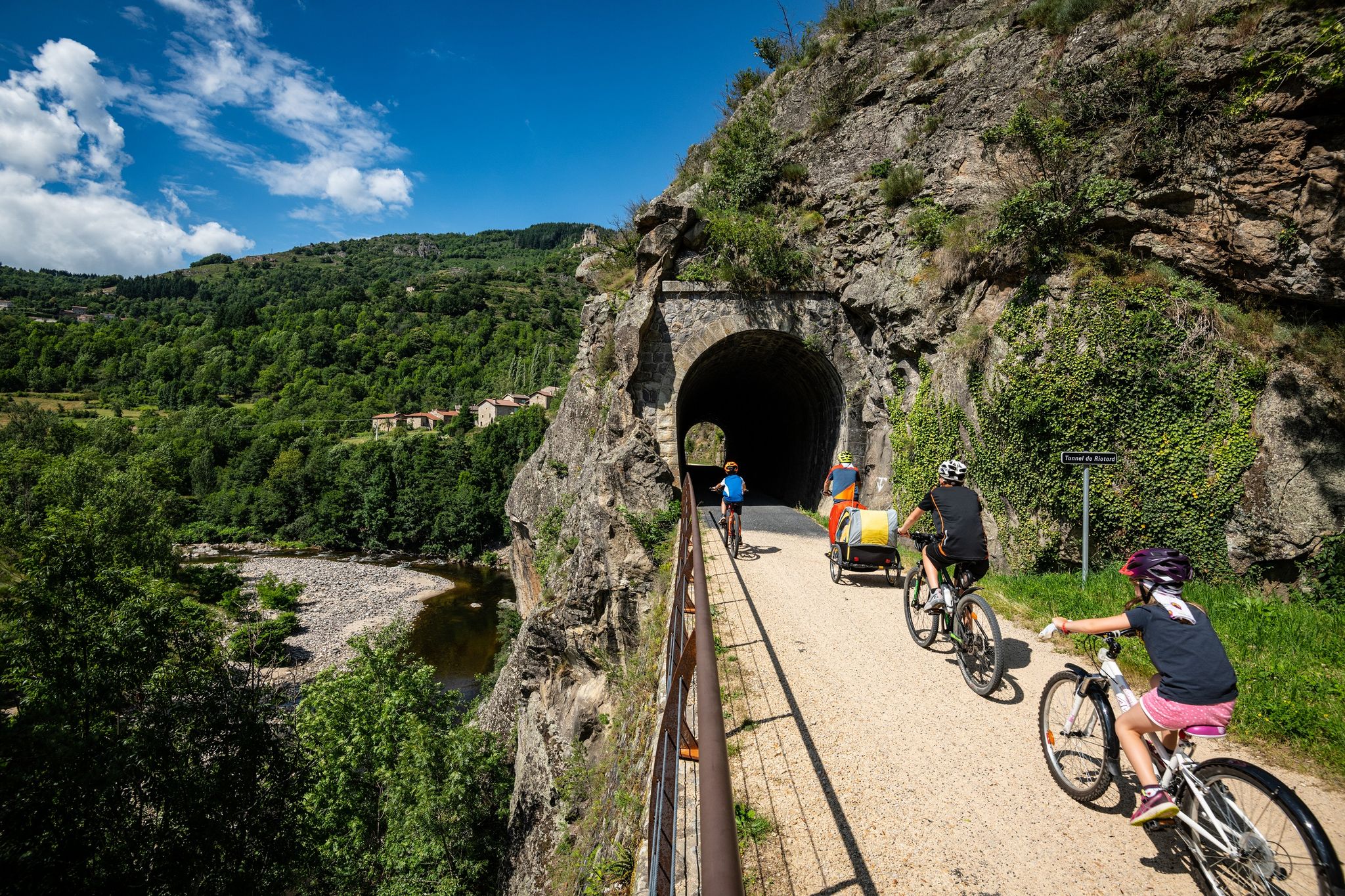
No traffic touring cycling routes around Boucieu-Le-Roi traverse the Doux Valley, a designated Sensitive Natural Zone characterized by its river, diverse flora, and surrounding forests. The terrain includes shaded paths along the Sumène river, open sections, and trails that ascend into the hills. Crests above the Doux Valley offer expansive views, with the mountains of the Massif Central visible in the distance. The region also features vineyards and lavender fields, providing varied landscapes for cycling.
Best no traffic touring cycling…
Last updated: July 3, 2026
3.0
(2)
51
riders
60.5km
04:20
1,110m
1,110m
Hard bike ride. Very good fitness required. Mostly paved surfaces. Suitable for all skill levels.
3.7
(3)
23
riders
38.0km
02:14
130m
130m
Moderate bike ride. Good fitness required. Mostly paved surfaces. Suitable for all skill levels.

Sign up for free
20
riders
27.2km
01:56
550m
560m
Hard bike ride. Very good fitness required. Mostly paved surfaces. Suitable for all skill levels.
22
riders
81.4km
05:52
1,670m
1,660m
Hard bike ride. Very good fitness required. Mostly paved surfaces. Suitable for all skill levels.
4.0
(1)
12
riders
51.3km
03:39
1,010m
1,010m
Hard bike ride. Very good fitness required. Mostly paved surfaces. Suitable for all skill levels.
Get access to more routes and recommendations from other explorers.
Sign up for free
Already have an account?
Our route recommendations are based on thousands of hikes, rides, and runs completed by other people on komoot.
Start today with a free account
Your next adventure awaits.
Login or Signup


Other adventures around Boucieu-Le-Roi

Tips from the Community

It is classified as a historical monument and houses a museum designated as a Museum of France. Primarily built between the 15th and 16th centuries, the Château de Tournon stands on the remains of a first building from the 10th century. (...) The site still presents exceptional works of art today, such as a triptych by Giovanni Capassini, but also collections on river navigation or the history of the town and the castle. Reconstructions of rooms, as well as sculptures, paintings, drawings or engravings, highlight the tour.
0
0
The following sentence is attributed to the French writer Victor Hugo (1802-1885): „One day, cannons will be exhibited in museums, like old torture instruments are now, and people will marvel that such things were ever in use.“ If only this vision of his had already become a reality! Then there would be no need for the many 'Monument aux Morts' with which villages and towns, across the country, commemorate their inhabitants who lost their lives in war.
0
0

A rare testimony of Gothic architecture in Ardèche, the Saint-Julien church is one of the best-preserved in the region. Listed as a historical monument, it recalls the ancient character of Tournon's heritage. https://www.tournon-sur-rhone.fr/ma-ville/decouvrir-tournon-sur-rhone/patrimoine/eglise-saint-julien/
0
0
The Château de Tournon is one of the most beautiful castles in the Ardèche. Its massive character and elevated position give it an imposing appearance. Built between the 15th and 16th centuries, its architecture bears witness to the evolution of society, between the medieval period and the dawn of the Renaissance. http://www.chateaumusee-tournon.com/index.php?option=com_content&view=article&id=549&Itemid=443
1
0
The first footbridge built by Marc Seguin between Tournon and Tain in 1825 was revolutionary for its time. It was the world's first iron cable suspension bridge, a true technical feat for the era. This footbridge helped facilitate trade and strengthen ties between the two towns. However, the original footbridge underwent several transformations over time. It was first raised to allow the passage of steamships, then a second footbridge was built by Marc Seguin in 1847, still based on the iron cable suspension principle. The two footbridges coexisted for a time, the first being used for pedestrian traffic and the second for road traffic. As road traffic intensified over time, it became necessary to build a new bridge to facilitate circulation. This is how the Gustave Toursier bridge was built in 1958. Located about 350 meters downstream from the Marc Seguin footbridge, this suspension bridge over 240 meters long comprises three spans. It is designed to support road traffic, thus facilitating exchanges between the two municipalities. The current footbridge, inaugurated in 1972, is therefore the fourth of its name. It was designed to resemble the 1847 footbridge, while meeting current safety standards and needs. https://www.ardeche-hermitage.com/fr/zoom-sur/la-passerelle-marc-seguin-celebre-son-bicentenaire/
0
0
The bridge called the King's Bridge was erected at the beginning of the 13th century. Indeed, in 1291, Philip the Fair officially declared the foundation of Boucieu and thus created a co-lordship with the lord Geronton de Valmordane. Boucieu le Roi was endowed with a charter of franchise (tax exemption for its inhabitants) and a bailiwick (court of justice). The charter of franchise would attract numerous merchants and notables. Access routes were therefore paramount, hence the construction of this 3-arch bridge. It would later be widened in 1773. https://www.ardeche-hermitage.com/fr/catalogue/detail/pont-du-roi-129249/
0
0
Go back up the Gorges du Doux aboard the Mastrou and stop at Boucieu le Roi, the village nicknamed “village of a thousand secrets”. Overlooking a wide meander of the Doux, this former capital of Haut-Vivarais owes its name to Philippe le Bel. The Maison du Bailli is one of the witnesses to this rich past: classified as a historic monument since 1927, this very beautiful house, with its corbelled turret, was the seat of the royal court of justice. The village was also deeply marked by Pierre Vigne, a missionary priest from Vivarais, whose tomb is in the church. Awarded the “village of character” label, Boucieu le Roi is one of the most beautiful villages in the Nord-Ardèche. https://www.trainardeche.fr/destination-boucieu/
0
0
Called the Mastrou or Train de l'Ardèche, the Vivarais railway is a 33-kilometer-long narrow-gauge tourist railway line connecting Lamastre to Saint-Jean-de-Muzols, near Tournon-sur-Rhône. A steam train, with a locomotive classified as a Historic Monument, invites young and old to discover the green Doux valley, a preserved area with panoramas inaccessible by road. A part of the Mastrou line can also be traveled by railbike starting from Boucieu-le-Roi. Twelve kilometers of downhill railbiking in the Doux gorges, with a return trip by historic railcar, to do as a couple, with family or with friends! https://www.trainardeche.fr/ https://www.velorailardeche.com/
0
0
Frequently Asked Questions
How many no-traffic touring cycling routes are available around Boucieu-Le-Roi?
There are over 25 dedicated no-traffic touring cycling routes around Boucieu-Le-Roi. While many are challenging, you can also find moderate options for a relaxed ride through the scenic Doux Valley.
What do other touring cyclists enjoy most about cycling in Boucieu-Le-Roi?
The komoot community highly rates the touring cycling experience in Boucieu-Le-Roi, with an average score of 4.4 stars. Cyclists frequently praise the tranquil atmosphere of the Doux Valley, the stunning natural landscapes, and the unique historical attractions found along the routes.
What kind of landscapes can I expect on these no-traffic routes?
You can expect a diverse range of landscapes. Routes often follow the picturesque Doux River, offering shaded paths and views of the surrounding forests. As you ascend, you'll encounter expansive vistas of the Massif Central, vineyards, and lavender fields. The entire Doux Valley is a 'Sensitive Natural Zone,' ensuring a preserved and beautiful environment.
Are there easy no-traffic touring cycling routes suitable for beginners or families?
While many routes are rated difficult, there are moderate options available. For a truly unique and family-friendly no-traffic experience, consider the Vélorail des Gorges du Doux, where you pedal along a historic railway line. The wider Ardèche region also offers the 'Dolce Via,' a 90 km secure itinerary accessible from the area, which is generally suitable for all levels.
Can I find circular no-traffic touring cycling routes in the area?
Yes, several no-traffic touring cycling routes in the Boucieu-Le-Roi area are designed as loops. For example, the challenging route Buisson Pass – Pont de Pierre loop from Saint-Félicien offers a substantial circular ride. Another option is the Passerelle Marc-Seguin – Arras Dam loop from Tournon - Saint-Jean, which is a moderate circular route.
What are the typical lengths and durations of these car-free cycling routes?
The no-traffic touring cycling routes vary in length and duration. You can find routes ranging from approximately 26 km, like the challenging Buisson Pass – Col du Buisson loop from Saint-Félicien which takes around 1 hour 50 minutes, to longer rides such as the moderate La Roche-de-Glun – Passerelle Marc-Seguin loop from Tournon - Saint-Jean, covering about 38 km and taking over 2 hours.
Where can I park my car when starting a no-traffic touring cycling route?
Boucieu-Le-Roi is recognized with the 'Accueil Vélo' label, indicating cyclist-friendly services. You'll find designated parking areas within the village, often near the starting points of popular trails or attractions like the Vélorail. Look for signs indicating public parking or facilities catering to cyclists.
Are there any viewpoints or notable attractions along the no-traffic cycling routes?
Absolutely. The region is rich in natural beauty and historical sites. You might encounter the 15th-century Saint Romain de Lerps Peak offering panoramic views, or the historic Old Lamastre train station. The village itself boasts landmarks like the Pont du Roi and the Maison du Bailli. The Trail along the Sumène also offers scenic sections.
What historical or cultural sites can I explore near the routes?
Boucieu-Le-Roi is a 'Village of Character' with a rich past. You can visit the 15th-century Pont du Roi, the Maison du Bailli with its watchtower, and the Saint Jean l'Évangéliste Church. The Pierre Vigne Museum, located in a former seigniorial castle, offers insights into local history. Don't miss the unique Chemin de Croix, established by Pierre Vigne, with its 39 chapel-stations.
Is the Vélorail des Gorges du Doux a good option for a no-traffic cycling experience?
Yes, the Vélorail des Gorges du Doux offers a truly unique and traffic-free cycling experience. You pedal along a century-old railway line through the stunning Doux Valley, with two scenic downhill routes available. The ascent is conveniently done by train, making it an accessible and enjoyable activity for all ages.
What is the best time of year for no-traffic touring cycling in Boucieu-Le-Roi?
Spring and autumn generally offer the most pleasant conditions for touring cycling in Boucieu-Le-Roi, with milder temperatures and beautiful scenery. Summer can be warm, but many routes offer shaded sections along the river. The region's vineyards and lavender fields are particularly vibrant in late spring and early summer.
Most popular routes around Boucieu-Le-Roi
Most popular attractions around Boucieu-Le-Roi

Get inspired with the komoot mobile app


Explore more
Browse the best Cycling routes in other regions.
