The best traffic-free bike rides around Chioggia
4.5
(59)
1,939
riders
25
rides
No traffic road cycling routes around Chioggia offer a unique blend of coastal, lagoon, and river landscapes. The region is characterized by its flat terrain, making it ideal for road cycling, with routes tracing the Adriatic Sea, the Venetian Lagoon, and the Adige River. Cyclists can explore extensive networks of cycle paths that traverse countryside, historic towns, and natural areas like the Po Delta.
Best no traffic road cycling routes around Chioggia
- The most popular no traffic road cycling route…
Last updated: May 19, 2026
5.0
(1)
111
riders
Moderate road ride. Good fitness required. Some segments of this route may be unpaved and difficult to ride.
41
riders
35.9km
01:28
40m
40m
Moderate road ride. Great for any fitness level. Some segments of this route may be unpaved and difficult to ride.

Sign up for free
34
riders
33.9km
01:33
40m
40m
Moderate road ride. Great for any fitness level. Some segments of this route may be unpaved and difficult to ride.
4.3
(3)
39
riders
Moderate road ride. Great for any fitness level. Some segments of this route may be unpaved and difficult to ride.
19
riders
Hard road ride. Very good fitness required. Mostly well-paved surfaces and easy to ride.
Get access to more routes and recommendations from other explorers.
Sign up for free
Already have an account?
Our route recommendations are based on thousands of hikes, rides, and runs completed by other people on komoot.
Start today with a free account
Your next adventure awaits.
Login or Signup
Popular around Chioggia
Trieste to Santa Maria di Leuca – the Adriatic Cycle Route
Bologna to Venice – along the waterways
From the boot’s toe to the heel – the most beautiful cycling Tours in Italy
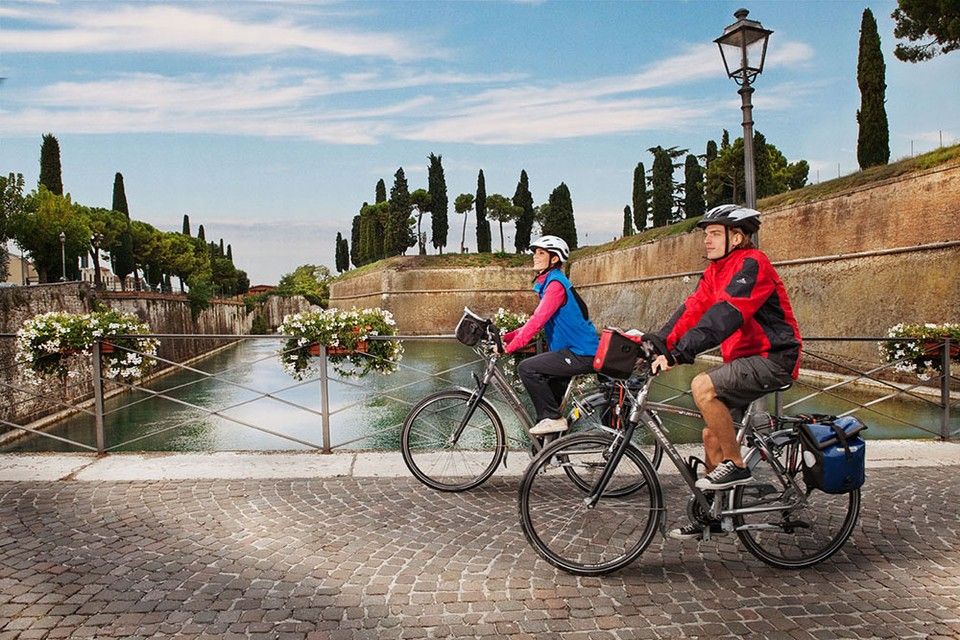
Between Lake Garda and the Adriatic Sea – cycle Tours in Italy’s Veneto

Traffic-free bike rides around Chioggia

Traffic-free bike rides around Chioggia
Other adventures around Chioggia


Tips from the Community

The Cathedral of Santa Maria Assunta represents the monumental heart of Chioggia, located at the southern end of Corso del Popolo. Rebuilt in the 17th century based on a design by Baldassarre Longhena after a fire destroyed the medieval building, the church features an imposing and sober facade, while the interior is a celebration of Venetian Baroque. The internal space is marked by wide naves housing pictorial masterpieces by artists such as Palma il Giovane and Pietro Liberi. Next to the cathedral stands the 64-meter-high Romanesque bell tower, on top of which is a lantern that historically served as a reference point for sailors. This complex is not just a religious center, but an architectural symbol that blends the solemnity of faith with the maritime history of the city.
0
0

Spectacular route, especially if done in spring.
0
0
The bell tower of Chioggia is one of the city's most iconic monuments, located next to the Cathedral of Santa Maria Assunta, but it is the nearby Sant'Andrea Tower that holds the record for fame. This Romanesque-style bell tower, about 30 meters high, houses the world's oldest mechanical clock, created by Giovanni Dondi in 1386 and still perfectly functional. The bell tower today serves as a vertical museum: climbing its seven floors, you can admire the stone weights of the clock, the ancient wrought-iron mechanism, and the bell chamber. Upon reaching the top, you can enjoy a breathtaking 360-degree view encompassing the entire historic center, the bridges over the Canal Vena, and the vastness of the Venetian Lagoon out to sea. It is a symbol of medieval engineering that dominates the Corso del Popolo, telling centuries of maritime history and artisanal precision.
0
0
The Canal Vena is the most picturesque and vital waterway of Chioggia, often described as the city's "Grand Canal". What makes it unique are its nine bridges, each with its own history and physiognomy, connecting the side foundations and allowing passage between the alleys. The most majestic is undoubtedly the Ponte di Vigo, located at the northern end of the canal, towards the lagoon. Built of marble in 1685, it represents the monumental gateway to the city: with its imposing staircase and elegant decorations, it offers a spectacular view stretching from the canal to the nearby island of Pellestrina. The other eight bridges, such as the Ponte di San Giacomo or the Ponte Caneva, follow one another along the route, offering postcard-perfect glimpses between moored boats and historic markets. These crossings are not just architectural structures, but the beating heart of Chioggia life, where the Venetian atmosphere blends with the authenticity of the fishing village.
0
0

Chioggia Cathedral The bishop's see, which had been located in Malamocco since 1100 after massive coastal erosion and a tsunami rendered the area uninhabitable, was moved to Chioggia. Next to the ancient Porta di Santa Maria, the first cathedral in the Clodiense region was built. Dedicated to the Nativity of the Virgin Mary, it was, according to some legends, erected on the foundations of an old pagan temple dedicated to the goddess Concordia. With the establishment of the bishop's see, in 1264, by order of Bishop Enrico Grancarolo and with the approval of the Doge, the relics of Saints Felice and Fortunato were transferred to this new cathedral, and an altar was dedicated to them. The church remained undamaged even after the Chioggia War and, during that same war, served as a deposit for goods and booty divided among the victors. The building was destroyed by fire at Christmas 1623; only the saints' relics and a few other objects were saved. On the north side of the cathedral, four high reliefs remain, which certainly belong to the medieval church: two made of Istrian stone: the first depicts a warrior martyr saint (S. Felice or S. Fortunato), the second a Madonna and Child, set in a trefoil niche dating from the mid-14th century. Two more from the same period, made of Greek marble and set in a smooth, profiled frame, depict the Virgin of the Annunciation and the Archangel Gabriel. Text / Source: Municipality of Chioggia https://www.comune.chioggia.ve.it/vivere-il-comune/luoghi/cattedrale-santa-maria-assunta/
15
0
Palazzo Comunale (Town Hall), Chioggia / Municipio The current Town Hall is a relatively new building, occupying the site of the former Praetorian Palace. This medieval structure had a central section with a monumental staircase and two side towers, one of which housed the antique clock, now located in the Sant'Andrea Tower. A fire in 1817 led to the demolition of the Praetorian Palace and the construction of the new Town Hall, built according to a typical Habsburg layout: an imposing neoclassical building. The bas-relief on the central tympanum depicts the coat of arms of the city of Chioggia: a rampant lion with a trident and spade at its sides, symbolizing fishing and horticulture, the main economic activities of Chioggia and Sottomarina. For many years it was used as a prison: On the opposite side of the facade, on the banks of the Vena River, is a gigantic door leading to the prisons. The portico contains many tombstones of historical figures and events, and the courtyard features a fountainhead from the Filipino Oratory. On the first floor is the council chamber, which houses three busts of Vittorio Emanuele II, Eleonora Duse, and Giuseppe Veronese, a canvas by Antonio Vassilacchi, and a reproduction of an antique map of Chioggia by Sabbadino. As a venue for ceremonies, it hosted various artistic performances dedicated to actresses like Eleonora Duse and composers such as Gioseffo Zarlino, born in Chioggia on March 22, 1517. He was a composer and music theorist from Chioggia who maintained close ties to his city. He is considered a Renaissance genius and combined many disciplines, including mathematics and astronomy. He was also a fine writer and philosopher; he was fluent in languages: Latin, Hebrew, and Greek, and he wrote the treatise on patience. His works and talent spread rapidly thanks to the invention of movable type and the manuscript; Zarlino articulated the physical basis of sound. Text / Source: Comune di Chioggia https://www.comune.chioggia.ve.it/vivere-il-comune/luoghi/municipio/
14
0

The Cathedral of Chioggia (Italian: Dom di Chioggia, Cattedrale di Santa Maria Assunta) is the main church in Chioggia, Italy, located in the southern part of the Venetian Lagoon. It dates back to 1627. The Baroque Cathedral of Santa Maria Assunta is also the cathedral of the Diocese of Chioggia and the largest building in the city of Chioggia in Veneto. An initial structure on the site was completed in 1110. From 1623 to 1674, it was reconstructed by the architect Baldassare Longhena, although the façade remains unfinished. Inside the church, there are many interesting works of art by renowned Venetian artists. https://www.venediginformationen.eu/inseln-der-lagune/insel-chioggia/chioggia-dom/chioggia-dom.htm
2
0

beginning of the Chioggia territory
0
0
Frequently Asked Questions
How many traffic-free road cycling routes are available around Chioggia?
There are over 30 dedicated traffic-free road cycling routes around Chioggia, offering a variety of experiences. These routes range from easy, mostly paved paths suitable for beginners to more moderate options for experienced cyclists.
What kind of landscapes can I expect on traffic-free road cycling routes in Chioggia?
Chioggia's unique location offers a diverse range of landscapes. You can cycle along the Adriatic Sea and the Venetian Lagoon, explore riverbanks like the Adige, or venture into the countryside. Many routes provide panoramic views of the water, while others pass through natural areas like the Po Delta, a UNESCO heritage site known for its birdlife, and unspoiled nature reserves such as Bosco Nordio.
Are there any easy, traffic-free road cycling routes suitable for beginners in Chioggia?
Yes, Chioggia offers several easy, traffic-free road cycling routes perfect for beginners. For example, the Adige Riverbank Trail – Strada delle Valli di Rosolina loop from Sant'Anna di Chioggia is an easy 49 km ride with minimal elevation gain, ideal for a relaxed outing. There are 13 easy routes in total to choose from.
What are some notable natural attractions or viewpoints along the traffic-free routes?
Many routes offer stunning natural sights. You can find highlights like the Boschettona Beach or the Veneto Coastal Botanical Garden. The Via delle Valli, Po Delta Regional Park and the Lagoon Cycle Path between Pellestrina and San Pietro in Volta are also popular for their scenic beauty and birdwatching opportunities.
Can I find circular traffic-free road cycling routes around Chioggia?
Yes, many of the traffic-free routes around Chioggia are designed as loops, allowing you to start and end in the same location. An example is the Adige Riverbank Trail – Strada delle Valli di Rosolina loop from Sant'Anna di Chioggia, which offers a circular experience along the river and through the Valli di Rosolina.
What is the best time of year for traffic-free road cycling in Chioggia?
The best time for traffic-free road cycling in Chioggia is generally during the spring (April-June) and early autumn (September-October). During these months, the weather is pleasant, with comfortable temperatures and less humidity than the peak summer. This allows for enjoyable rides along the coast, lagoon, and countryside without the intense heat or larger crowds of mid-summer.
Are there any routes that connect to the Venetian islands?
Yes, some routes offer connections to the Venetian islands. For instance, the View of Chioggia – El Chiosco Pellestrina loop from Chioggia incorporates a ferry ride to Pellestrina island, allowing you to cycle along its charming paths and potentially continue to Lido island, experiencing the unique island atmosphere and colorful fishermen's houses.
What do other cyclists say about the traffic-free road cycling routes in Chioggia?
The traffic-free road cycling routes in Chioggia are highly rated by the komoot community, with an average score of 4.5 stars. Cyclists frequently praise the tranquil nature of the routes, the stunning coastal and lagoon views, and the well-maintained paths that make for a relaxing and enjoyable ride away from vehicle traffic.
Are there any historical or cultural points of interest along these routes?
While focusing on traffic-free paths, many routes are close to or pass through areas with historical significance. Chioggia itself is a charming historic center with narrow streets, canals, and landmarks like the Church of San Domenico and the Sant'Andrea Clock Tower. Routes like the Bridge over the Vena Canal – Chioggia Historic Center loop from Cavanella d'Adige offer glimpses of the city's unique architecture and atmosphere.
Where can I find parking for these traffic-free road cycling routes in Chioggia?
Parking is generally available in and around Chioggia, Sottomarina, and near the starting points of many routes. Specific parking information can often be found on the individual route pages on komoot. For broader information on local amenities, you might find resources on the official tourism website for Chioggia, such as visitchioggia.com.
Are the traffic-free road cycling routes suitable for families with children?
Yes, many of the easy and moderate traffic-free routes are suitable for families. The extensive network of cycle paths in Chioggia, Sottomarina, and Isola Verde, particularly those along the Lusenzo Lagoon and the Sottomarina seafront, are designed to be safe and enjoyable for all ages, offering flat terrain and scenic views away from car traffic.
Most popular attractions around Chioggia

Get inspired with the komoot mobile app


Explore more
Browse the best Road cycling routes in other regions.
