The best traffic-free bike rides around Dahme/Mark
4.6
(199)
1,597
riders
9
rides
No traffic road cycling routes around Dahme/Mark offer access to a network of smooth asphalt paths, including sections of the Fläming-Skate. The region features diverse natural landscapes, characterized by expansive fields, dense forests, and river courses. While generally flat, the area includes gentle ascents and descents, providing varied terrain for road cyclists. The Dahme Cycle Path also traces the Dahme River, connecting the town to wider scenic routes.
Best no traffic road cycling routes around Dahme/Mark
- The most popular no…
Last updated: June 27, 2026
4.9
(22)
138
riders
48.4km
01:52
160m
160m
Easy road ride. Great for any fitness level. Mostly well-paved surfaces and easy to ride.
4.3
(7)
24
riders
32.2km
01:18
120m
120m
Moderate road ride. Great for any fitness level. Some segments of this route may be unpaved and difficult to ride.

Sign up for free
18
riders
Easy road ride. Great for any fitness level. Mostly well-paved surfaces and easy to ride.
3.0
(2)
12
riders
43.6km
01:46
190m
190m
Moderate road ride. Great for any fitness level. Some segments of this route may be unpaved and difficult to ride.
4.0
(2)
16
riders
23.1km
00:58
60m
60m
Easy road ride. Great for any fitness level. Mostly well-paved surfaces and easy to ride.
Get access to more routes and recommendations from other explorers.
Sign up for free
Already have an account?
Our route recommendations are based on thousands of hikes, rides, and runs completed by other people on komoot.
Start today with a free account
Your next adventure awaits.
Login or Signup


Tips from the Community

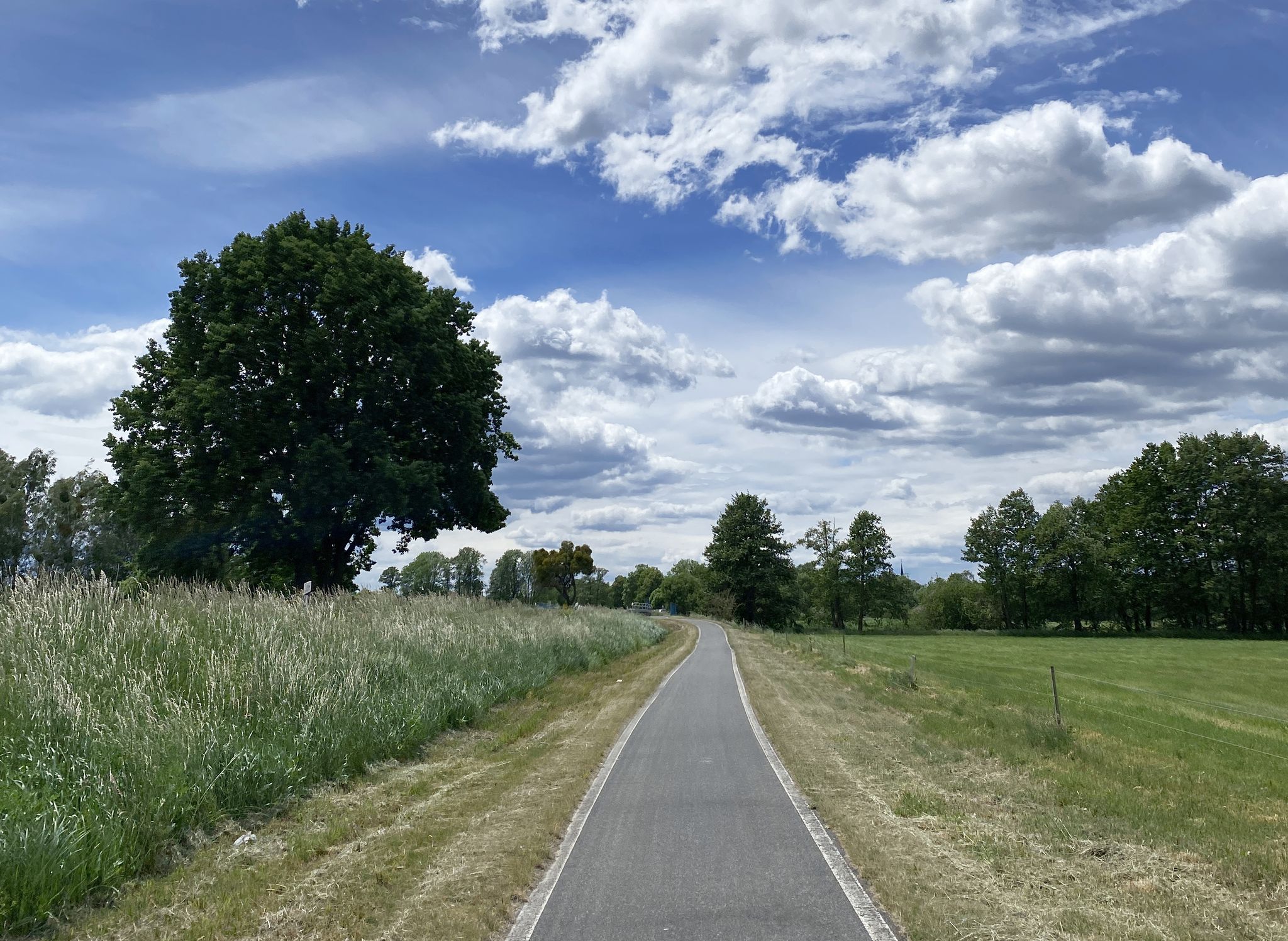
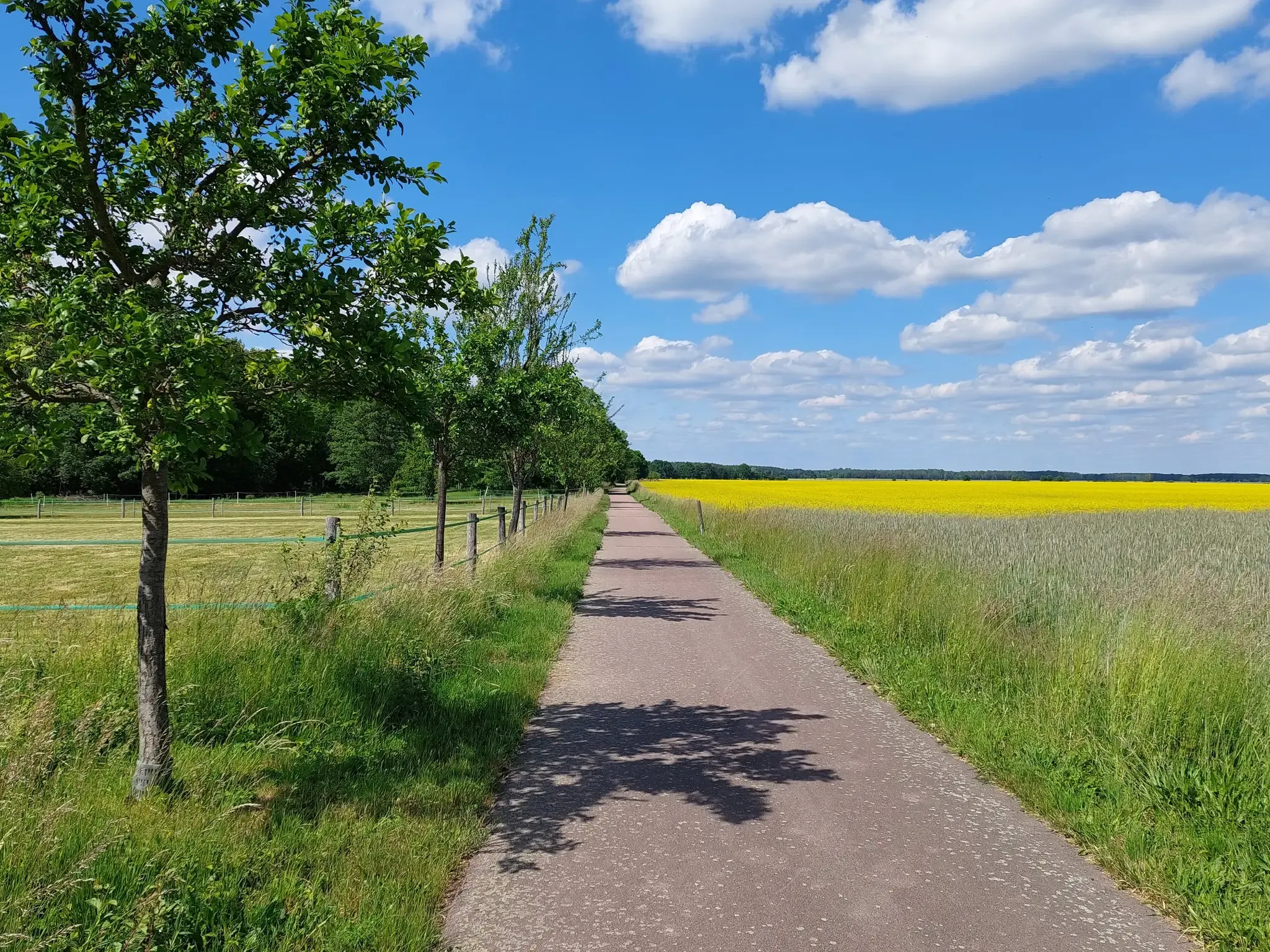
A beautiful, easy and short tour, which can also be ridden well in intense sunshine, as there is a lot of shade. Even the roads to be ridden are not busy. I didn't see any places to stop during the week.
0
0
The usual resting places of the Flämig-Skate are simply always top.
0
0

From Hohenseefeld towards Wiepersdorf, very strong headwinds should be expected
0
0

The furnishings include an altarpiece, which was created around 1700 and restored in 1975. Regrettably, no consideration was given to its original character.[4] It shows the Last Supper of Jesus in the predella and the crucifixion of Christ in its main image, divided into three panels by vine leaf columns, flanked by the birth and resurrection of Jesus Christ. Above the main image, the Ascension is depicted between two angels with instruments of the Passion. The side altarpieces have been missing since the restoration; some remnants were in the possession of a restorer in 2023. The altar was created by the Calau cabinetmaker Georg Wolschke and the Lübben painter Michael Scharbe,[5] who were also active, for example, in the parish church of St. Sebastian (Baruth/Mark) and in Gollmitz (Calau). The pulpit is decorated with corner columns; above it hangs a sounding board with a trumpeting angel. These include altar stalls with the coat of arms of Siegmund Seyfried von der Dahm, the governor of the Margraviate of Lower Lusatia, who died after 1710/1716.[6] The font is made of wood, hexagonal, and shaped like a table. It dates from the 18th century. A 16th-century crucifix is attached to the south wall. It is flanked by two stained glass windows on the south wall from 1911, a gift from Margarethe von Uckro (1859–1934), sister of the entail lord Paul von Uckro auf Uckro (1862–1919), and depicts "The Sinking Peter" and "Christ in Gethsemane." Next to the west gallery, there is also a Gothic sacrament niche on the east wall. In the patron's lodge hangs a memorial tablet for Ernst Siegmund von Rex, who died in 1756[7], as well as two of the family's children's gravestones at the lodge entrance. The flat interior ceiling is plastered and decorated with a stucco molding. Source: https://de.wikipedia.org/wiki/Dorfkirche_Uckro
3
0
On the western side of the box, two windows, each at the same height, are blocked with red brick. In the western section of the north wall of the nave, there is a pointed arch portal, blocked with fieldstone and brick. The fieldstone church tower was also rebuilt. On the north and south sides, there is a segmental-arched window on the ground floor. Approximately at the height of the nave's eaves, the observer can see a small, blocked opening. This opening is still present on the south side. Above the eaves, the builders did not use fieldstone, but rather an octagonal framework made of dark wood, the interstices of which were filled with reddish brick. On four of the eight sides, there is a rectangular arcade, which culminates in a curved tower cap with a lantern, turret ball, weather vane, and cross. Source: https://de.wikipedia.org/wiki/Dorfkirche_Uckro
3
0
The hall church was built from fieldstones with a rectangular floor plan. The building is one of a series of boulder buildings west of the Luckau-Golßen line.[3] They are unhewn except for the cornerstones and are layered in the lower section. The lines run through the upper half of the building. The choir is rectangular and recessed, while the church tower, although also rectangular in plan, protrudes noticeably from the alignment of the nave walls. On the south side of the nave there are two large, segmental-arched windows, the shape of which is further emphasized by plastered surrounds. Between the two windows there is a much smaller opening blocked up with bricks. Between the nave and choir is the aforementioned staircase to the pulpit. It is built from unevenly layered fieldstones and here too a blocked opening can be seen in the eastern section. In the choir, there are two additional windows on the north and south sides, while in the east wall, the original lancet-shaped triple window group was filled with fragments of brick. The gable is also constructed of unevenly layered, small fieldstones, which were supplemented with fragments and bricks. The Baroque patron's lodge dominates the north side of the nave. The rectangular building, made of fieldstone and brick, is strictly structured on its north side with three large windows on the upper floor. Below each of the outer walls is a rectangular door with a rectangular window in between. All openings, as well as the corners of the building, are highlighted with light plaster and a keystone. Source: https://de.wikipedia.org/wiki/Dorfkirche_Uckro
3
0
The exact construction date of the sacred building is unknown. The Dehio handbook only vaguely indicates the end of the 14th or beginning of the 15th century as the date of its construction. The church received an organ around 1700. In the first third of the 18th century, the parish added a patron's lodge and built a chancel staircase at the southeast corner of the nave. The top of the west tower was probably rebuilt at the same time. Between 1904 and 1905, the Schuke company from Potsdam installed a new organ for 2,044 Reichsmarks. It was restored in 1981, 1995, and 2005. Since 1970, the parish has used the patron's lodge as a parish hall. The church underwent extensive restoration in 1995, followed by the lodge in 2010 and 2011. The building and the surrounding cemetery served as hereditary burial sites for the former patron families, including the von Trosky family.[1][2] Source: https://de.wikipedia.org/wiki/Dorfkirche_Uckro
3
0
The Uckro Village Church is a fieldstone church in Uckro, a district of the town of Luckau in the Dahme-Spreewald district of Brandenburg. It belongs to the Evangelical Church District of Lower Lusatia. Source: https://de.wikipedia.org/wiki/Dorfkirche_Uckro
4
0
Frequently Asked Questions
How many no-traffic road cycling routes are available in Dahme/Mark?
There are 8 dedicated no-traffic road cycling routes around Dahme/Mark featured in this guide. These routes offer a variety of experiences, from easy rides to more moderate challenges.
What are the typical difficulty levels for these no-traffic road cycling routes?
The no-traffic road cycling routes in Dahme/Mark cater to various skill levels. You'll find 3 easy routes, perfect for beginners or a relaxed ride, and 5 moderate routes that offer a bit more challenge with gentle ascents and descents. An example of a moderate route is the Wildau-Wentdorf Village Church – Dammühle Watermill loop from Dahme/Mark.
Are there circular no-traffic road cycling routes in Dahme/Mark?
Yes, many of the no-traffic road cycling routes in Dahme/Mark are designed as loops, allowing you to start and end at the same point. For instance, you can explore the Rest area on the Fläming-Skate loop from Wahlsdorf or the Kasel-Golzig Village Church – Zützen Village Church loop from Drahnsdorf, both offering scenic circular rides.
What natural features or landmarks can I expect to see along these routes?
The region around Dahme/Mark is rich in natural beauty and historical sites. You can cycle through expansive fields and dense forests, and even visit the Dahme Spring, the source of the Dahme River. Other points of interest include the Fläming-Skate Loop 5, and various lakes like Holbecker Lake and Körbaer Teich. The historic town center of Dahme/Mark itself, with its castle ruins and Marienkirche, is also worth exploring.
Are these no-traffic road cycling routes suitable for families?
Many of the routes, especially the easy ones, are well-suited for families. The smooth asphalt of the Fläming-Skate network, which some routes utilize, is particularly good for all ages. Routes like the Kümmritz Village Church – Golßen Town Hall loop from Kümmritz offer a relatively flat and manageable distance for a family outing.
How can I access the no-traffic road cycling routes by public transport or car?
Dahme/Mark is accessible by public transport, though specific connections to trailheads may require planning. For those traveling by car, parking is generally available in the towns and villages where routes begin. The town of Dahme/Mark also features an easily accessible e-bike charging station at the town hall, which can be convenient for cyclists.
When is the best time of year to enjoy traffic-free road cycling in Dahme/Mark?
The spring, summer, and early autumn months offer the most pleasant conditions for road cycling in Dahme/Mark, with mild temperatures and vibrant landscapes. The region's diverse natural features, from blooming fields to colorful forests, are particularly beautiful during these seasons. While winter cycling is possible, be mindful of colder temperatures and potential icy patches.
What makes the road cycling experience in Dahme/Mark unique?
The Dahme/Mark region is renowned for its extensive network of smooth, traffic-free asphalt paths, most notably the Fläming-Skate. This infrastructure, combined with the diverse natural landscapes of forests, fields, and the scenic Dahme River, offers a unique blend of comfortable riding and picturesque scenery. The presence of historical towns and landmarks further enriches the cycling experience.
What do other road cyclists enjoy most about cycling in Dahme/Mark?
The komoot community highly rates the road cycling experience in Dahme/Mark, with an average score of 4.5 stars. Reviewers often praise the excellent quality of the asphalt on routes like the Fläming-Skate, the peaceful, traffic-free environment, and the beautiful, varied landscapes that make for a relaxing yet engaging ride.
Are there any specific long-distance cycling paths that connect to the Dahme/Mark area?
Yes, the Dahme Cycle Path, a 123-kilometer trail, traces the Dahme River and connects Dahme/Mark to the wider region, extending all the way to Berlin-Köpenick. This path offers a fantastic opportunity for longer, scenic rides, integrating the local no-traffic routes with a broader network.
Most popular attractions around Dahme/Mark

Get inspired with the komoot mobile app


Explore more
Browse the best Road cycling routes in other regions.
