The best traffic-free bike rides around Schenklengsfeld
4.8
(298)
1,004
riders
57
rides
No traffic touring cycling routes around Schenklengsfeld traverse a fertile plateau situated within the outliers of the Kuppenrhön mountain range. The landscape is characterized by idyllic forests, green hills, and terrain that gently slopes towards the Fulda and Werra valleys. This geographical setting provides diverse conditions for touring cyclists, with many routes following former railway lines, such as the Solztal bicycle path. The region offers a mix of moderate ascents and scenic stretches through varied natural environments.
Best no traffic touring cycling routes around Schenklengsfeld
- The most popular no traffic touring cycling route is View of Schenklengsfeld – Solztal Cycle Path loop from Schenklengsfeld, an 11.9 miles (19.1 km) trail that takes 1 hour 12 minutes to complete. This moderate route offers views of the surrounding area and follows a section of the Solztal Cycle Path.
- Another top favourite among local touring cyclists is Friedewald Cycle Path Church – Solztal Cycle Path loop from Schenklengsfeld, a moderate 13.1 miles (21.1 km) path. This route also incorporates parts of the Solztal Cycle Path, winding through the scenic valley.
- Local touring cyclists also love the Werra Bridge, Philippsthal loop from Schenklengsfeld, a 20.8 miles (33.5 km) trail leading through the broader regional landscape, often completed in about 2 hours 4 minutes.
- Touring cycling around Schenklengsfeld is defined by idyllic forests, green hills, and gently sloping valleys, with routes available for various ability levels, from easy to difficult.
- The routes in Schenklengsfeld are highly rated by the komoot community with an average score of 4.8 stars from more than 200 reviews. More than 700 touring cyclists have used komoot to explore Schenklengsfeld's varied terrain.
Last updated: May 15, 2026
4.6
(7)
34
riders
19.2km
01:13
220m
220m
Moderate bike ride. Good fitness required. Mostly paved surfaces. Suitable for all skill levels.
5.0
(9)
31
riders
Moderate bike ride. Good fitness required. Mostly paved surfaces. Suitable for all skill levels.

Sign up for free
4.7
(11)
27
riders
33.5km
02:05
340m
340m
Moderate bike ride. Good fitness required. Mostly paved surfaces. Suitable for all skill levels.
5.0
(6)
16
riders
Moderate bike ride. Good fitness required. Mostly paved surfaces. Suitable for all skill levels.
4.8
(5)
20
riders
Moderate bike ride. Good fitness required. Mostly paved surfaces. Suitable for all skill levels.
Get access to more routes and recommendations from other explorers.
Sign up for free
Already have an account?
Our route recommendations are based on thousands of hikes, rides, and runs completed by other people on komoot.
Start today with a free account
Your next adventure awaits.
Login or Signup
Popular around Schenklengsfeld
Tips from the Community

An evangelical church that appears simple and unpretentious both inside and out. All the more reason for the organ, with its baroque facade, to be the eye-catcher. The instrument was replaced by a new one in 1896. However, the facade still dates from the Schlottmann organ from 1752. Johannes Schlottmann (1726-1795) temporarily ran his organ-building workshop here in Friedewald. He is a truly tragic figure in music history. Envy from competitors, but certainly also too little business acumen, repeatedly got him into difficulties, including insolvency and imprisonment. His Friedewald workshop was auctioned off, and he worked as a travelling organ builder. The organs that have survived from him are nevertheless of remarkable quality.
1
0

The Protestant church at Dreienberg in Friedewald was rebuilt in 1746 as a church tower church with a baroque bell tower, and remodeled in 1958.
1
0

The exact date of the first church built on this site is unknown, as the records did not survive the Thirty Years' War. In the 17th century, the existing church was evidently destroyed and rebuilt several times. The current chancel tower church was built in 1746 according to plans by the Kassel state architect Giovanni Ghezzi, with the parish and their pastor, Konrad Hermann Meurer, carrying out the majority of the construction work themselves. A major renovation took place in 1958. Source: Wikipedia
1
0


The church's origins date back to the 15th century. The simple building was renovated several times before its demolition in 1930. The last service took place in January 1930, followed by the laying of the foundation stone for the new building, which was consecrated in August. The hall church, with its steeple extending into the nave and supporting an octagonal tent roof between battlements, is built in the style of a fortified church. The Pietà from the 1735 altar has been preserved. The wooden figures of St. Valentine and St. Pantaleon come from an altar of the Fourteen Holy Helpers from the early 16th century. On the back wall of the galleries is a depiction of St. Christopher. Also visible are statues of Mary, St. Joseph, and St. Elizabeth. (Source: Wikipedia)
1
0

Great nature, the climb is easy to ride
0
0

The preacher's house in the historic part of the cemetery is one of the few preserved and bears witness to the burial and cemetery culture.
2
0

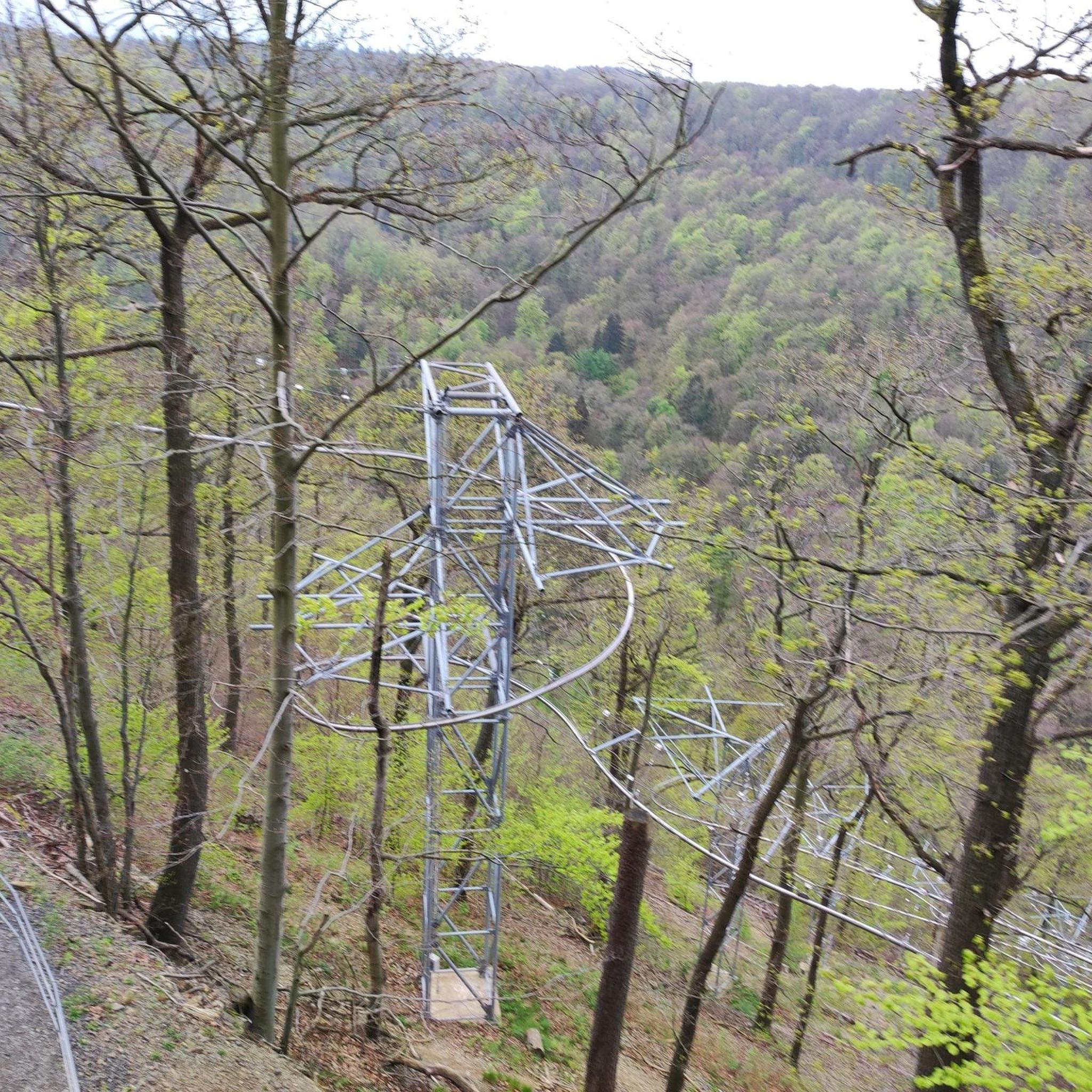
On the Wenigentaft - Soisdorf road: At this point, the border with its barriers crossed the Wenigentaft - Soisdorf road. The patrol track also led up to the Standorfsberg here. Due to the enormous gradient - probably the steepest in the entire system of GDR border fortifications - it was only used by vehicles in exceptional cases for safety reasons. The slabs were removed towards the end of the 90s.
0
0
Frequently Asked Questions
How many no-traffic touring cycling routes are available around Schenklengsfeld?
The Schenklengsfeld area boasts a significant network for touring cyclists, offering over 50 dedicated no-traffic routes. These routes cater to various skill levels, with 15 considered easy and 33 moderate, ensuring a pleasant experience for most riders.
What kind of terrain can I expect on no-traffic touring routes in Schenklengsfeld?
Schenklengsfeld is nestled on a fertile plateau within the Kuppenrhön mountain range, characterized by idyllic forests, green hills, and a landscape that gently slopes towards the Fulda and Werra valleys. You can expect routes with moderate ascents and descents, offering diverse scenery without overly challenging climbs.
Are there any particularly scenic no-traffic routes suitable for touring cyclists?
Absolutely. The region is known for its picturesque landscapes. For example, the View of Schenklengsfeld – Solztal Cycle Path loop from Schenklengsfeld offers lovely vistas, incorporating parts of the scenic Solztal valley. Another option is the View of the Rhön Mountains – St. Georg Church, Wenigentaft loop from Schenklengsfeld, which provides glimpses of the distant Rhön mountains.
What are some notable landmarks or attractions I can see along these routes?
The region offers several interesting points. You might encounter the ancient Schenklengsfeld Village Linden, considered one of Germany's oldest trees. For panoramic views, the Öchsenberg Summit and Celtic Cross is a significant highlight. While cycling, you could also pass by the ruins of Landeck Castle on the Landecker Berg, or the picturesque Wolfsbrunnen Castle.
Are there any circular no-traffic touring routes around Schenklengsfeld?
Yes, many of the no-traffic touring routes are designed as loops, allowing you to start and end in the same location. Examples include the Friedewald Cycle Path Church – Solztal Cycle Path loop from Schenklengsfeld, which covers about 21 km, or the longer Werra Bridge, Philippsthal loop from Schenklengsfeld, spanning over 33 km.
What is the best time of year to go touring cycling in Schenklengsfeld?
The region is popular for cycling, especially during May and July, when the weather is generally mild and the landscape is vibrant. Autumn also offers beautiful scenery with changing foliage, particularly in areas bordering the Meißner-Kaufunger Wald Nature Park.
Are there easy or beginner-friendly no-traffic touring routes available?
Yes, the guide includes 15 routes specifically categorized as easy. These routes typically have less elevation gain and shorter distances, making them ideal for beginners or those seeking a relaxed ride. The Solztal bicycle path (R7) is a particularly good example, following a former railroad route and offering a smooth, asphalted surface.
What do other cyclists say about the no-traffic touring routes in Schenklengsfeld?
The komoot community highly rates the cycling experience in this region, with an average score of 4.8 stars. Reviewers often praise the quiet, well-maintained paths, the diverse natural beauty, and the feeling of being immersed in nature away from vehicle traffic.
Can I find routes that offer views of the Rhön mountains?
Yes, the region's position within the outliers of the Kuppenrhön mountain range means that some routes provide excellent views. The Wüstfeld Water Tower – View of the Thuringian Rhön loop from Schenklengsfeld is one such route that offers glimpses of the Thuringian Rhön.
Are there any routes that follow former railway lines?
Yes, a notable example is the Solztal bicycle path (R7). This 32-kilometer combined cycling and footpath follows the route of a former district railroad, providing a relatively flat and asphalted surface through the scenic Solztal valley, connecting Schenklengsfeld with Bad Hersfeld.
What is the typical distance for no-traffic touring routes in this area?
The routes vary in length to suit different preferences. You can find shorter loops around 19-22 kilometers, such as the View of Schenklengsfeld – Solztal Cycle Path loop from Schenklengsfeld, as well as longer options extending to over 33 kilometers, like the Werra Bridge, Philippsthal loop from Schenklengsfeld.
Most popular routes around Schenklengsfeld
Most popular attractions around Schenklengsfeld

Get inspired with the komoot mobile app


Explore more
Browse the best Cycling routes in other regions.
