Top 6 Natural Monuments around São Cristóvão
Best natural monuments around São Cristóvão offer a blend of historical significance and natural beauty. São Cristóvão, the fourth oldest city in Brazil, is situated along the Vaza Barris, Paramopama, and Poxim rivers, which contribute to its natural landscape. The region is known for its riverine environments, including the Pedreiras village with its seven islands along the Vaza Barris River. These areas provide opportunities for ecotourism and experiencing the local ecology.
Best natural monuments around São Cristóvão
- The most popular…
Last updated: June 29, 2026
Great Cork Oak
Highlight • Natural Monument
Tip by

Alentejo Montado
Highlight • Forest
Translated by Google •
Tip by
Sign up now to discover places like this
Get recommendations on the best single tracks, peaks, & plenty of other exciting outdoor places.
Sign up for free
Reservoir of the Pego do Altar Dam
Highlight • Lake
Translated by Google •
Tip by
Chapel of São Brissos Dolmen
Highlight • Religious Site
Translated by Google •
Tip by

Fonte Ferrenha
Highlight • Natural Monument
Translated by Google •
Tip by
Sign up for free to discover even more natural monuments around São Cristóvão.
Sign up for free
Already have an account?
Start today with a free account
Your next adventure awaits.
Login or Signup
Popular around São Cristóvão

Tips from the Community

The Pego do Altar Dam is located a few kilometres from Alcácer do Sal and was built in 1949 to supply the agricultural area of the Sado River valley and to produce electricity. Today it is very popular with foreigners in their motorhomes and with sports fishing enthusiasts. It is a magical place due to its landscapes, its capacity for leisure activities and its importance in irrigating the fields, where the main irrigated crop is rice. Not far from the Pego do Altar Dam, the village of Santa Susana has a curious feature: some buildings with modernist architecture from the 1940s, which are due to a benefactor of the region, Henrique Louro Fernandes, whose monogram (HF) can be found on some of them. A small church, with two 16th-century panels inside, somewhat deteriorated but magnificent, completes the interesting visit to this place. Recently, the drought that hit this area “uncovered” an old 200-year-old bridge that was submerged by the waters of the dam.
8
0

excellent route with beautiful landscapes
3
0
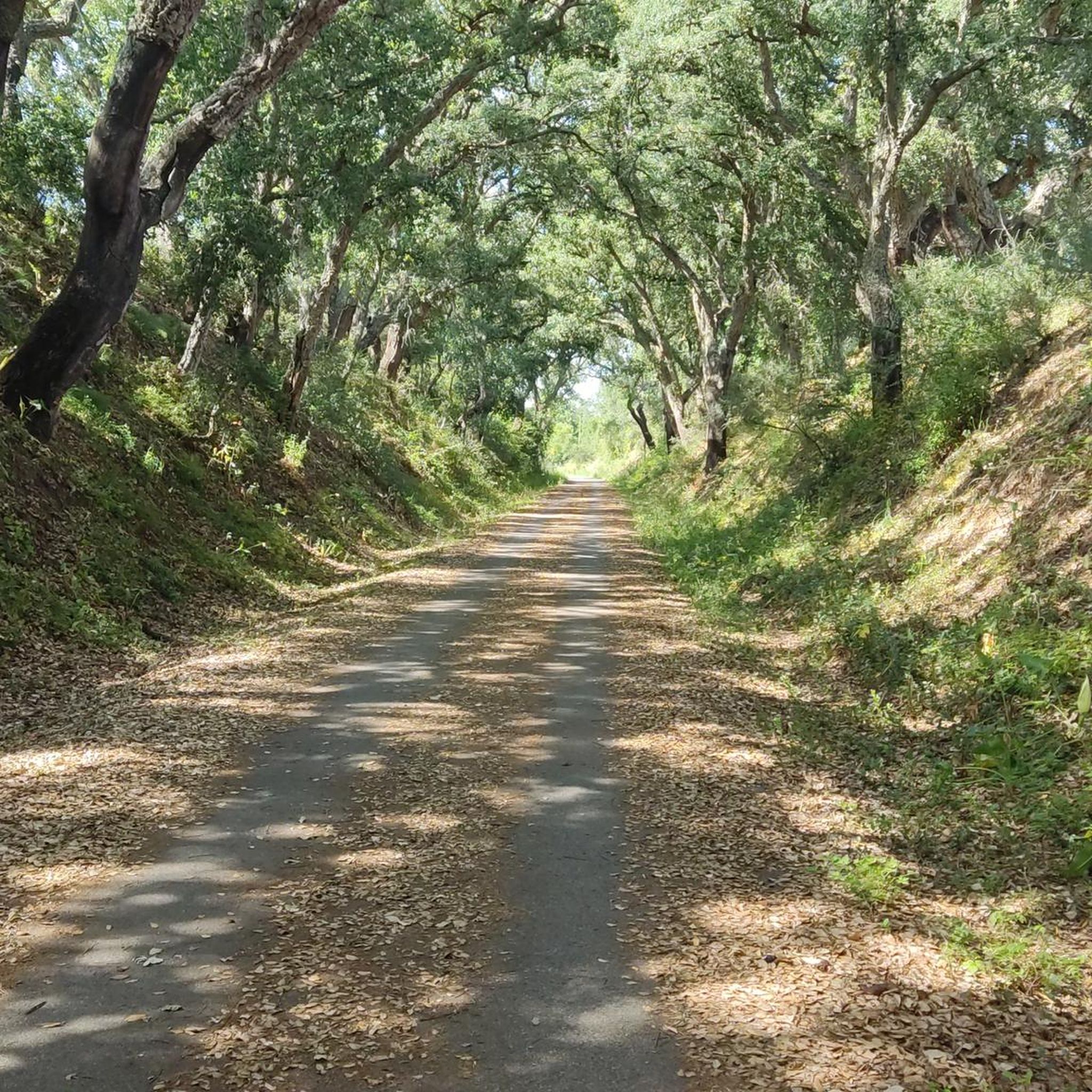
The Montado is a cultural landscape shaped by human activity. Over the ages mankind has been able to mould and sustain a multifunctional agro-silvo-pastoral ecosystem located in the south of the Tagus Valley. These areas were originally occupied by Mediterranean woodlands and are now populated by cork oaks and holm oaks - legally protected species since the 7th century - which grow in extreme edaphic-climatic conditions and very poor soils. Located in southern Europe, with a rich and wide variety of cultural influences, where the frontier between the Christian and Arab worlds was disputed during almost five centuries (up until the 13th century), the Montado has been influenced by a significant presence of military orders and a long period of feudal rule. Currently it still preserves remnants from previous epochs, in an economy that is sustained by the worldwide expansion of industrial cork production. The enormous biodiversity of the Montado system turns this area into a buffer zone against the advance of the ongoing global process of desertification. (1) This has been possible through a sustainable management of the balance between its arboreal, shrubby and herbaceous elements, based on the traditional knowledge and in the preservation of traditional forms of settlement.
4
0
The montado is one of the most emblematic landscapes in Portugal, especially in the Alentejo. It is a unique ecosystem, created by man, characteristic of the Alentejo. These are forests of holm oaks, cork oaks, oaks and chestnut trees, with a very delicate balance and which only exist in the Mediterranean, Algeria, Morocco and especially in the south of the Iberian Peninsula. This multifunctional system has trees as its structural component, with two species of oak standing out: the cork oak and the holm oak. It is around them that this semi-natural ecosystem with high levels of diversity develops. Livestock production in the Alentejo montado is very important, both at the farm level and on a regional scale. It is based on the silvo-pastoral system, with direct use of natural food resources by native breeds. The Alentejo Black Pig has a diet that consists of an extensive grazing regime in fields, in montados of holm oaks and cork oaks. The fruits of the trees are the main food resource of the montados. In the montados with holm oak, the holm oak dominates, producing acorns, in the montados with cork oak, producing slurry, and in the mixed montados, both species exist. Acorns and slurry are the fundamental energy source for finishing the Alentejo pig.
4
0
The Montado is an agrosilvopastoral system explored at several levels – trees, bushes and herbs – according to the potential of each region. On the tree level it can be made up of oaks like cork oak (Quercus suber), holm oak (Q. rotundifolia) and less frequently pyrene oak (Q. pyrenaica) and portuguese oak (Q. faginea), in pure or mixed populations with variable densities. The ground cover is occupied by pastures used by cattle or is used for dry land crops on a rotation system. The natural pastures can be occupied by shrubs, in variable proportions. Humans are an integral and fundamental part of this ecosystem. It was through our clearing action that the montados were created, ever since we started intervening on our natural surroundings. Human management is necessary, in a more or less intensive way, in order to maintain the montado. Without this intervention, the system evolves, naturally to form a dense forest, where people have more difficulty obtaining resources. The way this process of transformation of the Mediterranean forest developed influenced the structure of the system as it presents today. Some older practices still persist, now without context, making more difficult the adaptation of the system to the new ways of agrarian production. Other ways emerged, some well adapted to the system, other causing more or less serious disturbances. The montado is a system for using the soil developed on a physical background that involves climate, pedological and geomorphological factors with specific characteristics. It is why this ecosystem is restricted to such a limited area, when compared to other ecosystems in our planet.
5
0
Typical Alentejo farm. Private property. Not open to visitors...
3
0
Fonte Ferrenha is a spring of iron water that cannot be drunk immediately, due to the enormous amount of iron that gives it a rusty hue. To be able to drink this water, the liquid must be left to stand for at least two days...
7
0

The chapel is built on a dolmen. Great!
6
0
Frequently Asked Questions
What unique natural features can I explore around São Cristóvão?
São Cristóvão is blessed with a rich riverine environment. The Vaza Barris River, along with the Paramopama and Poxim rivers, defines much of its natural beauty. A notable feature is the estuary of the Vaza Barris, especially near the Pedreiras community, where you can find numerous mini-islands and extensive mangroves, creating a diverse ecological setting.
Are there opportunities for ecotourism near São Cristóvão's natural monuments?
Yes, the Vaza Barris River and its mini-islands near Pedreiras village offer excellent ecotourism opportunities. You can enjoy boat trips to explore the islands, observe the diverse fauna, and relax in a serene environment. It's a great way to experience the local ecology and the peaceful, traditional life of the fishing community.
Which natural monuments are considered family-friendly around São Cristóvão?
Several natural monuments are suitable for families. The Great Cork Oak and the broader Alentejo Montado are family-friendly forest areas where you can learn about unique ecosystems. Additionally, the Reservoir of the Pego do Altar Dam is a popular spot for leisure activities, including sports fishing, making it enjoyable for all ages.
What is the significance of the Vaza Barris River in São Cristóvão?
The Vaza Barris River is a central element of São Cristóvão's natural beauty and ecological importance. It flows through the city, contributing to its landscape alongside the Paramopama and Poxim rivers. Its estuary, particularly around the Pedreiras community, is known for its tranquil mini-islands and rich mangrove ecosystems, offering unique natural experiences and supporting local fishing traditions.
Can I find unique geological formations or natural springs in the area?
Yes, you can visit Fonte Ferrenha, a natural spring known for its iron-rich water. This spring has a distinctive rusty hue due to its high iron content, requiring the water to stand for at least two days before it can be consumed. It's a unique natural curiosity in the region.
Are there any historical sites integrated with natural monuments?
Absolutely. The Chapel of São Brissos Dolmen is a remarkable example. This religious building is uniquely constructed upon an ancient megalithic dolmen, offering a fascinating blend of historical architecture and natural geological formation.
What kind of wildlife can be observed near São Cristóvão's natural areas?
The riverine environments, especially the Vaza Barris River estuary and its mangroves, are home to diverse fauna. While specific species are not detailed, these rich ecological settings provide habitats for various birds, fish, and other aquatic life, making them interesting spots for nature observation.
What outdoor activities can I do near these natural monuments?
The region around São Cristóvão offers various outdoor activities. You can find numerous routes for cycling, running, and mountain biking. For example, there are routes like 'View of Montemor-o-Novo loop' for cycling and running, and '30 km Multi-Terrain Route' for MTB. You can explore more options on the Cycling around São Cristóvão, Running Trails around São Cristóvão, and MTB Trails around São Cristóvão guide pages.
Are there hiking trails available near the natural monuments?
Yes, you can find various trails suitable for hiking and running. For instance, there are easy to moderate running loops starting from Montemor-o-Novo and Castelo de Montemor-o-Novo. These trails allow you to experience the natural landscapes surrounding São Cristóvão. Detailed routes can be found on the Running Trails around São Cristóvão guide page.
What do visitors particularly enjoy about the natural monuments in São Cristóvão?
Visitors appreciate the unique combination of natural beauty and historical significance. The Chapel of São Brissos Dolmen is often highlighted for its extraordinary integration of an ancient megalithic structure with a religious building. The tranquil riverine landscapes, especially the Vaza Barris River and its islands, are also highly recommended for their serene environment and ecotourism potential.
What is a Montado and where can I see one near São Cristóvão?
A Montado is a unique agrosilvopastoral system, a cultural landscape shaped by human activity, primarily found in the Mediterranean region. It's characterized by forests of cork oaks and holm oaks, maintaining a delicate ecological balance. You can observe this system at the Great Cork Oak and the broader Alentejo Montado, which are emblematic landscapes in Portugal, especially in the Alentejo region.
What is the best time to visit the natural monuments around São Cristóvão?
While specific seasonal recommendations are not provided, São Cristóvão's natural attractions, particularly the riverine areas, can be enjoyed year-round. For outdoor activities like boat trips and exploring trails, milder weather is generally preferable. It's always a good idea to check local weather forecasts before your visit to ensure comfortable conditions.
Most popular routes around São Cristóvão
Most popular attractions around São Cristóvão

Get inspired with the komoot mobile app


Explore more
Extend your search for the best caves by checking out these guides of the top ones around São Cristóvão:
