Top 19 Natural Monuments around Sant Pol De Mar
Best natural monuments around Sant Pol De Mar include a variety of coastal and inland features. This charming coastal town in Catalonia offers diverse natural experiences, from extensive natural parks to picturesque beaches and coves. The region is characterized by its lush pine forests on coastal slopes, transitioning to holm oak and cork forests further inland. These natural landmarks provide opportunities to explore diverse landscapes and geological formations.
Best natural monuments around Sant Pol De Mar
- The most popular natural…
Last updated: May 20, 2026
Montalt
Highlight • Summit
Montalt is a mountain that belongs to the Catalan coastal range, within the Corredor mountain range and the …
Translated by Google •
Tip by

Horseshoe Stone
Highlight • Natural Monument
Translated by Google •
Tip by

Sign up now to discover places like this
Get recommendations on the best single tracks, peaks, & plenty of other exciting outdoor places.
Sign up for free
Rock Formations of Turó de L’Oriola
Highlight • Natural Monument
Translated by Google •
Tip by

Grandfather's Rock
Highlight • Natural Monument
Translated by Google •
Tip by

Aranyal Pond and Aqueduct
Highlight • Structure
This pond used to be a laundry room that was located near the so-called body shop, now gone, where the cars of the property were closed …
Translated by Google •
Tip by
Sign up for free to discover even more natural monuments around Sant Pol De Mar.
Sign up for free
Already have an account?
Start today with a free account
Your next adventure awaits.
Login or Signup

Tips from the Community

The true epicenter of Maresme enduro. Once you reach the top, it's time to switch gears: you're at the highest point of the system, and a labyrinth of trails and tracks of all levels unfolds before you. There are no rules here: from this central hub, you can drop down towards Sant Vicenç, Llavaneres, Can Boada, Massuet, or wherever your heart desires. Every direction offers a different descent, and all connect to legendary Maresme lines. A word of advice: when you reach Turó de l’Oriola, take a deep breath… and prepare to go wild, because this is one of the few places where you can literally ride down wherever you want.
1
0
The true epicenter of Maresme enduro. Once you reach the top, it's time to switch gears: you're at the highest point of the system, and a labyrinth of trails and paths of all levels unfolds before you. There's no instruction manual here: from this central hub, you can drop down towards Sant Vicenç, Llavaneres, Can Boada, Massuet, or wherever your heart desires. Every direction offers a different descent, and all connect to legendary Maresme lines. A word of advice: when you reach Turó de l’Oriola, take a deep breath… and prepare to go wild, because this is one of the few places where you can literally ride down wherever you want. A perfect spot to get lost—but in a good way.
0
0

The peak of Turó de L'Oriola presents rock formations distributed among the trees in the area.
1
0
Do not miss it https://www.youtube.com/watch?v=EQ8IOO_TL_M
3
0
It is a conglomerate of very rusty stones, located in a bucolic spot that allows us to enjoy views of Llavaneres, El Turó del Montalt and Montserrat. Hard climb from S. Andreu de Llavaneres, at one side of the track we will find a rock, if we climb it carefully, it seems that we have at our feet a sea of green color formed by the wooded mass of pines, as if we were in the bow of the Titanic.
4
0

It is a large granite block located between Turó de Montalt (596 m) and Turó del Mig (550 m), a hill where the municipal limits of Arenys de Munt, Dosrius and Sant Vicenç de Montalt meet. Of the two stones, the smaller one has an engraving that seems to represent a horseshoe, although the meaning is unknown. It could be, for example, a mark to delimit the old parishes. Granite is a hard rock, with a granular texture, which in the Maresme has been used for construction. Fresh granite is known as "snake's eye" as it is made up of a black mica which, in contrast to the other components, is reminiscent of a snake's eye. In this environment and during the next section of the route, we will find small accumulations of granite blocks, disordered, heterometric and rounded, which accumulate in a horizontal or slightly inclined relief. These capricious formations have their origin in weathering. Later, the rainwater dissolves the feldspar and the large initial rock cracks and gives rise to rounded shapes and a kind of sand, called "sauló" in Catalan.
1
0
El Montalt is a mountain belonging to the Catalan coastal range, within the Sierra del Corredor and the protected natural area in which it is included. A few kilometers from the coast, the top is surrounded by forest. A common point to face the final meters of ascent is the Coll de la Ferradura, a pass located to the northeast. It is a crossroads of different paths and forest tracks and, from this point, the path to the summit is narrow and has a very steep slope. The northern slope enters completely into the natural park, with different plateaus, other peaks and the Creu de Rupit, an outstanding cross in the middle of the path. To the northeast is the Sanctuary of the Corridor, with a car park and a tourist service office. From this point, through forest tracks, To the south, we find two towns, Sant Andreu de Llavaneres and Sant Vicenç de Montalt, well connected by tracks and paths. In the same way possible starting points for the ascent, to the west is the municipality of Dosrius and its population center of Canyamars, while to the east is the town of Arenys de Munt. On the other hand, the first stage of the Camino del Norte, or GR 83 long-distance path, which begins in the town of Mataró, passes very close, along its northern slope. Its top houses a geodesic vertex and a mailbox, offering magnificent views of the entire Maresme coast.
1
0

In the surroundings of the "Pedra de la Ferradura" we can find small accumulations of granite blocks, disordered, heterometric and rounded, which accumulate in a horizontal or slightly inclined relief. These capricious formations have their origin in weathering. Later, the rainwater dissolves the feldspar and the large initial rock cracks and gives rise to rounded shapes and a kind of sand, called "sauló" in Catalan.
20
0
Frequently Asked Questions
What natural features can I expect to see around Sant Pol de Mar?
The region around Sant Pol de Mar offers a diverse landscape, from extensive natural parks to picturesque beaches and coves. You'll find lush pine forests on coastal slopes, transitioning to holm oak and cork forests further inland. The area is also known for its unique rock formations and pristine coastlines.
Are there any historical or archaeological sites among the natural monuments?
Yes, the Reserva Natural del Montnegre i el Corredor is rich in history, featuring Neolithic dolmens like Piedra Arca and Piedra Gentil, Iberian remains, and medieval churches and hermitages. Additionally, the Horseshoe Stone is a large granite block with ancient incised engravings, believed to be historical boundary markers.
What kind of outdoor activities can I do near the natural monuments?
The natural monuments around Sant Pol de Mar are perfect for various outdoor activities. You can enjoy hiking, mountain biking, and horse riding along extensive trails within the Reserva Natural del Montnegre i el Corredor. The beaches and coves are ideal for swimming and relaxing. For more specific routes, explore the MTB Trails around Sant Pol De Mar or Running Trails around Sant Pol De Mar.
Which natural monuments offer the best views?
For magnificent panoramic views, head to Montalt, a prominent peak within the Catalan Coastal Range, offering vistas of the entire Maresme coast. Grandfather's Rock also provides scenic views of Llavaneres, El Turó del Montalt, and Montserrat from its forested location.
Are there family-friendly natural monuments in the area?
Yes, the Aranyal Pond and Aqueduct is a charming spot that is considered family-friendly. It features a historic pond, well, and aqueduct, surrounded by magnificent banana trees, offering a peaceful and picturesque environment for a family outing.
Can I find unique rock formations around Sant Pol de Mar?
Absolutely. Besides the Horseshoe Stone, the Rock Formations of Turó de L’Oriola present interesting geological features distributed among the trees. Grandfather's Rock is also a notable conglomerate of rusty stones.
What are the notable beaches or coves considered natural monuments?
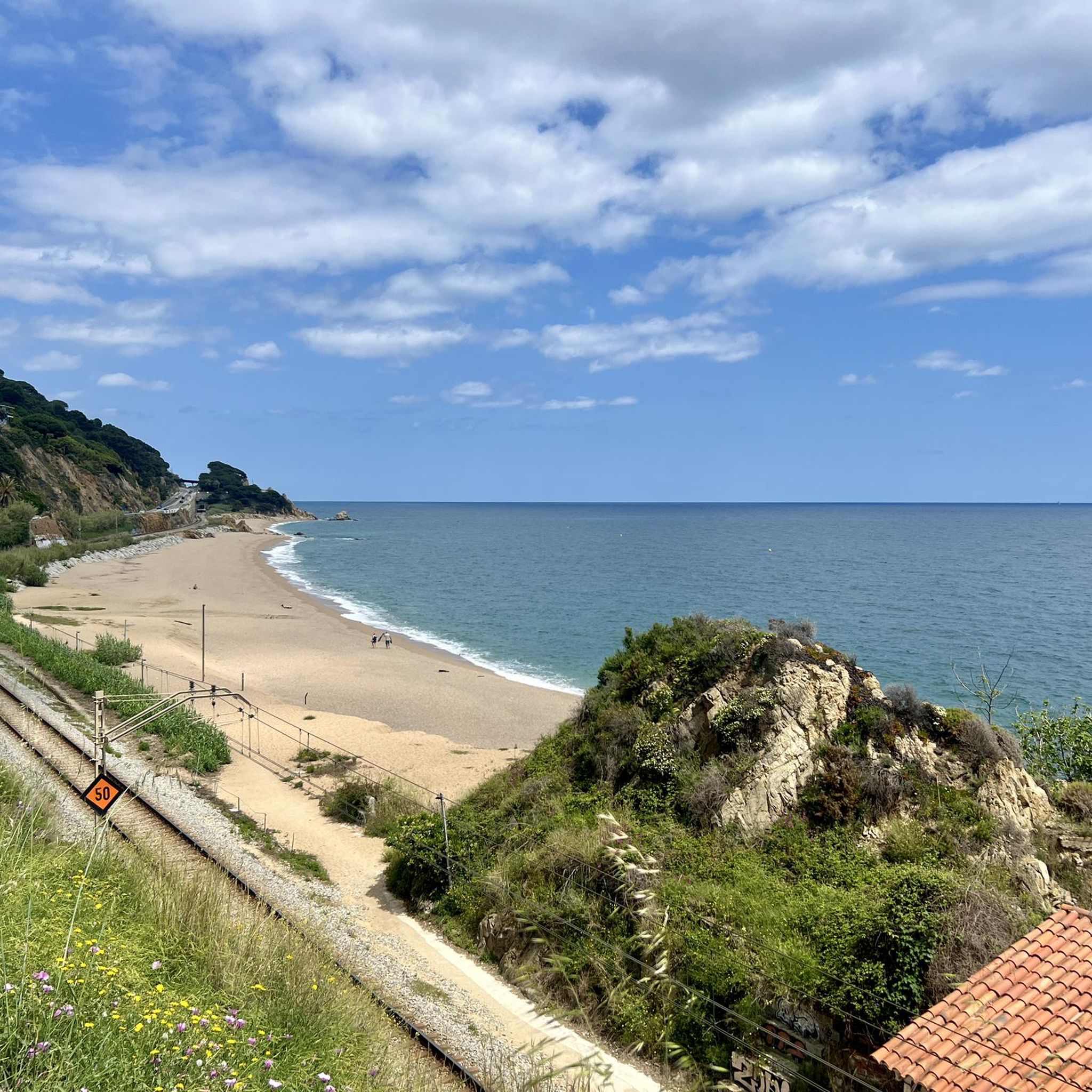
Sant Pol de Mar is known for its pristine beaches and rocky coves. Platja de les Roques Blanques, though semi-urban, is characterized by its coarse golden sand and a distinct rocky massif. Platja de la Roca Grossa (or Platja de la Cabra) is notable for the large rock in the water that gives it its name, marking a visual division between towns. Platja de la Murtra is a semi-natural beach known for its sandy terrain, clear waters, and serves as a resting place for the 'corb mari' (European shag) bird species.
Is there wildlife to observe in the natural areas?
The Reserva Natural del Montnegre i el Corredor is known for its rich biodiversity, hosting fauna such as wild boar, civet cats, squirrels, and migratory birds. At Platja de la Murtra, you can observe the 'corb mari' (European shag) bird species resting on its rocks, adding ecological interest.
What is the best time of year to visit the natural monuments around Sant Pol de Mar?
The region can be enjoyed year-round. Spring and autumn offer pleasant temperatures for hiking and exploring the natural parks, with lush vegetation and comfortable conditions. Summer is ideal for enjoying the beaches and coves, while winter provides a quieter experience for those seeking solitude in the forests.
How can I access the natural monuments, particularly by public transport or car?
Many natural monuments, especially within the Reserva Natural del Montnegre i el Corredor, are accessible via various forest trails and tracks. For places like Montalt, common starting points like Coll de la Ferradura are accessible by car, often with parking available. Some beaches like Platja de la Roca Grossa are more secluded and primarily accessed on foot. Public transport options may vary, so checking local bus routes to nearby towns or park entrances is advisable.
Are there specific hiking trails to explore these natural monuments?
Yes, the area offers numerous hiking opportunities. You can find trails that lead to highlights like Montalt, often starting from points like Coll de la Ferradura. For a variety of routes, including easy and moderate options, explore the Hiking around Sant Pol De Mar guide, which features trails like the 'Viewpoint of Roca Grossa – Calella Lighthouse loop' and 'Sant Pol de Mar – Cabra Beach loop'.
What makes the Reserva Natural del Montnegre i el Corredor special?
The Reserva Natural del Montnegre i el Corredor is special due to its vast size (approximately 15,000 hectares), rich biodiversity with over 1,000 plant species and diverse fauna, and its significant historical elements. It offers a comprehensive experience for nature lovers and history enthusiasts alike, with extensive trails for various activities and panoramic views from higher points.
Most popular routes around Sant Pol De Mar
Most popular attractions around Sant Pol De Mar

Get inspired with the komoot mobile app


Explore more
Extend your search for the best caves by checking out these guides of the top ones around Sant Pol De Mar:
