Top 19 Natural Monuments around Zovencedo
Best natural monuments around Zovencedo are primarily found within the Colli Berici, a region characterized by its distinctive hills and geological features. This area offers a unique blend of natural landscapes and historical human interaction with the environment, evident in its numerous caves and rock formations. The landscape provides insights into local geology and the historical utilization of natural shelters. Visitors can explore a variety of natural sites that reflect the area's distinct character.
Best natural monuments around Zovencedo
- The…
Last updated: May 16, 2026
Caves of the Hermitage of San Donato
Highlight • Cave
I would like to point out that in the second part of the descent from Monte Tondo the …
Translated by Google •
Tip by

San Bernardino Cave
Highlight • Cave
Translated by Google •
Tip by

Sign up now to discover places like this
Get recommendations on the best single tracks, peaks, & plenty of other exciting outdoor places.
Sign up for free
Monte Nero
Highlight • Natural Monument
Translated by Google •
Tip by
San Giovanni Ledge
Highlight • Natural Monument
Translated by Google •
Tip by
Dente di Attila
Highlight • Natural Monument
Translated by Google •
Tip by
Sign up for free to discover even more natural monuments around Zovencedo.
Sign up for free
Already have an account?
Start today with a free account
Your next adventure awaits.
Login or Signup

Tips from the Community

The Grotta di San Bernardino is a small and fascinating medieval hermitage, nestled at the base of a ten-meter-high limestone pinnacle (the only rock tower in the entire Berici Hills). The building's façade encloses a karst cavity about thirty meters long and ten meters wide. An evocative and mysterious setting. According to tradition, the name derives from the shelter it provided to Saint Bernardino of Siena, who preached in these areas in the 15th century. In the early 16th century, this cave, like others in the Berici Hills, was adapted as a temporary refuge for the local populations, while the Venetian plain was subjected to enemy raids. The oldest prehistoric remains in the Vicenza area (tools and animal bones dating back 200,000 years) were found inside the cave: it was likely used by Neanderthals as a hunting base. Interesting fact: the abundance of animal bones was the main cause of soil removal and the resulting significant impoverishment of San Bernardino's paleontological heritage. In fact, in 1890, the Camerini family, owners of the site, had the rich phosphate material excavated from the cave. It was transported downstream by cableway and used as fertilizer for the fields! The cave is occasionally open to the public, with guided tours organized by the Mossano Tourist Board (Pro Loco), which you can contact for details. http://www.tuttoberici.it/arte/S-Bernardino-Grotta-Mossano.htm https://www.archeoveneto.it/portale/wp-content/filemaker/stampa_scheda_estesa.php?recid=189
1
0
Attila's Tooth is a rocky outcrop on the edge of a sheer cliff. It's enclosed by a wooden fence for safety, easily surmountable since there's no protection above the cliff and vegetation obscures the drop. A few steps along the trail is the Croce del Monte Brojon, another very exposed vantage point with a beautiful view of the village of Lumignano below, the Hermitage of San Cassiano, and the plain, with the Euganean Hills on the horizon.
0
0
Monte Nero, above Montecchio Maggiore, is actually a hill: despite its modest size, it is quite unique in terms of its geology, morphology, and botanical rarities! Thirty million years ago, Monte Nero was a volcanic island emerging from the waters. This gave rise to the current peak, which, with its bare, arid, and dark basalt (hence the name "Nero"), stands out clearly from the surrounding limestone hills. It is a unique (micro)environment: you walk on the primitive, solidified lava flow; you encounter rare plants, including exotic and Mediterranean ones, which are, to say the least, unusual to find in these places. A short educational trail (also suitable for children) starts from the Church of San Pietro and illustrates the peculiarities of Monte Nero in six stages/panels. https://www.prolocoaltemontecchio.it/cosa-vedere/percorsi/naturalistici/
2
0

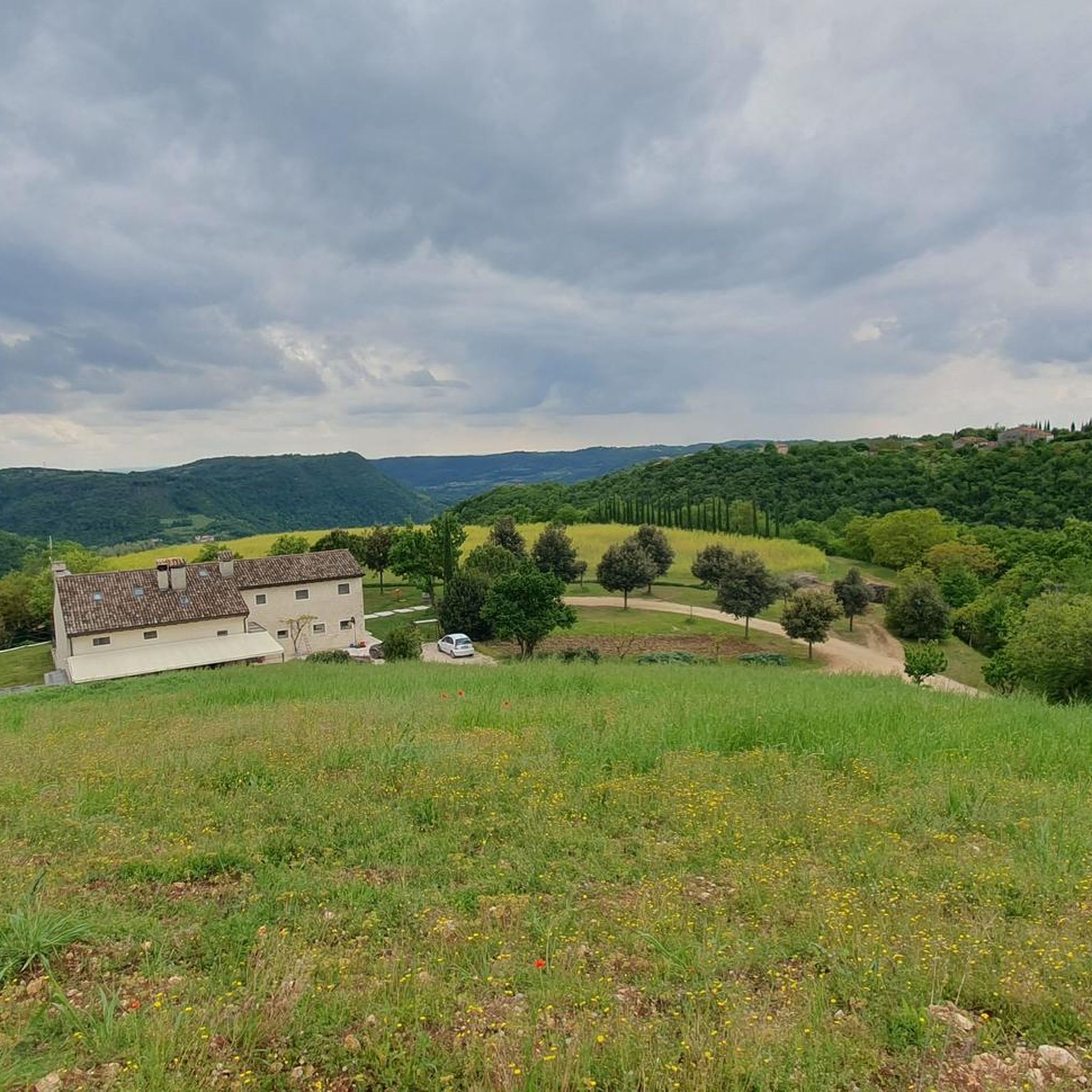
Natural caves near the church of San Donato. Beautiful view of the plain and the Euganei.
0
0

Reachable by following path 72 starting from Villaga Fantastic view of the plain, as well as a place of historical interest
3
0
A passage beneath a striking rock roof, at the foot of a cliff that cuts through a steep forest. In the area, as throughout the Berici Hills, there are numerous unique karst features (ledges, cliffs, roofs, and caves), the result of differential erosion between rocks of varying compactness, formed in different geological eras. They have been used as shelter and dwellings since prehistoric times. P.S.: A 'cèngia' is a horizontal passage that cuts through a vertical wall; a 'còvolo' (Venetian dialect) is a ravine in the rock.
2
0

The covoli di San Donato are wonderful, panoramic. It is a place where an ancient church once stood close to the covoli; later it became a female Benedictine monastery. Now stands a church dating back to the nineteenth century. The walls also have some climbing routes.
0
0

Panoramic place on the valley below and on the Euganean hills on the bottom !!! The path to arrive, visit and return to Mossano is wonderful
0
0
Frequently Asked Questions
What unique natural and historical sites can I visit around Zovencedo?
Zovencedo is notable for sites that blend natural features with human history. A prime example is the Sengia dei Meoni Rock House, ingeniously carved into a disused stone quarry (Priara de Cice). This dwelling was inhabited until 1959 and offers a unique glimpse into historical human adaptation to the natural environment. You can also explore the Caves of the Hermitage of San Donato, which combine natural caves with an ancient convent and neoclassical church, offering wide views of the plain and Euganean Hills.
Are there any natural monuments with significant historical or archaeological importance?
Yes, the San Bernardino Cave is a small medieval hermitage nestled at the base of a limestone pinnacle. It's historically significant as it has yielded prehistoric remains, indicating its use by Neanderthals. The Sengia dei Meoni Rock House also provides deep historical insight into a traditional way of life, showcasing how natural rock formations were utilized for shelter and livelihood for centuries.
What kind of geological features are prominent in the natural monuments near Zovencedo?
The area around Zovencedo, particularly within the Colli Berici, is characterized by diverse karst features. You'll find ledges, cliffs, natural shelters, and unique rock formations. These are the result of differential erosion between rocks of varying compactness. The San Giovanni Ledge is a great example, featuring a passage beneath a striking rock roof at the foot of a steep cliff.
Where can I find panoramic views of the surrounding landscape?
For expansive views, visit Dente di Attila, a challenging rocky outcrop located on the edge of a sheer cliff. From here, you can enjoy wide vistas of the surrounding area. The Caves of the Hermitage of San Donato also offer wide views of the plain and the Euganean Hills.
Are there family-friendly natural monuments or trails suitable for children?
Yes, Monte Nero, a unique volcanic hill near Montecchio Maggiore, offers a short educational trail suitable for children. This trail illustrates the hill's geological and botanical peculiarities. The area around the Sengia dei Meoni Rock House also provides opportunities for walks amidst natural scenery that can be enjoyed by families.
What outdoor activities can I do near these natural monuments?
The region around Zovencedo offers a variety of outdoor activities. You can find numerous hiking trails, including the 'Sengia dei Meoni Rock House – Zovoncedo Fountain loop' or the 'Fontana della Cazzola – San Giovanni Ledge loop'. For more options, explore the hiking routes around Zovencedo. There are also MTB trails and cycling routes available in the wider area.
What is the best time to visit the natural monuments around Zovencedo?
The Colli Berici region generally offers pleasant conditions for exploring natural monuments during spring and autumn, when temperatures are mild and the landscape is vibrant. Summer can also be suitable, though it might be warmer. Winter hiking is possible, but some paths might be muddy or slippery, especially around cave entrances or exposed ledges.
Are there any natural monuments that showcase unique geology?
Absolutely. Monte Nero is a fascinating example. Despite its modest size, this hill is geologically unique, being a former volcanic island. You can walk on primitive, solidified lava flow and observe rare plants, making it a distinct micro-environment compared to the surrounding limestone hills.
Can I explore ancient stone quarries in the area?
Yes, the region is rich in ancient stone quarries. The Sengia dei Meoni Rock House is itself carved into the Priara de Cice, a disused quarry. Many hiking trails around Zovencedo, such as the 'Life+ Zovencedo Calto San Gottardo trail', lead through these historical sites, offering insights into the local geology and the traditional Vicenza stone extraction industry.
What do visitors enjoy most about the natural monuments in Zovencedo?
Visitors particularly appreciate the unique blend of natural beauty and rich history. The ingenuity of human adaptation, as seen in the Sengia dei Meoni Rock House, and the historical depth of sites like the San Bernardino Cave, are highly valued. The panoramic views from various viewpoints and the opportunity to explore diverse karst features also receive positive feedback from the komoot community.
Are there any circular walks that include natural monuments?
Yes, several circular walks are available. For instance, the 'Sengia dei Meoni Rock House – Zovoncedo Fountain loop' is a moderate 7.76 km hike that allows you to explore the rock house and its surroundings. You can find more circular routes and detailed information on the hiking guide for Zovencedo.
Most popular routes around Zovencedo
Most popular attractions around Zovencedo

Get inspired with the komoot mobile app


Explore more
Extend your search for the best caves by checking out these guides of the top ones around Zovencedo:
