Top 4 Natural Monuments around Rocca Sinibalda
Best natural monuments around Rocca Sinibalda are found in the Alta Sabina hills of the Rieti province, a region characterized by Apennine landscapes with extensive forests, high-altitude grasslands, and dramatic river gorges. The area features limestone ridges and natural springs, offering diverse natural attractions. Rocca Sinibalda is nestled amidst the Riserva Naturale Regionale Monte Navegna e Monte Cervia and the picturesque Turano River Valley and Lake Turano. Visitors can explore a variety of natural settings, from waterfalls to lake features…
Last updated: June 28, 2026
Cottorella Spring
Highlight • Natural Monument
Translated by Google •
Tip by

Vallocchie Waterfall
Highlight • Waterfall
Translated by Google •
Tip by

Sign up now to discover places like this
Get recommendations on the best single tracks, peaks, & plenty of other exciting outdoor places.
Sign up for free
Cave of Saint Michael the Archangel
Highlight • Religious Site
Translated by Google •
Tip by

Ancient Baths of Vespasian
Highlight • Historical Site
Translated by Google •
Tip by
Ancient Fountain of Via San Clemente
Highlight • Natural Monument
Translated by Google •
Tip by
Sign up for free to discover even more natural monuments around Rocca Sinibalda.
Sign up for free
Already have an account?
Start today with a free account
Your next adventure awaits.
Login or Signup

Other adventures around Rocca Sinibalda

Tips from the Community

This is a historic fountain in Collelungo Sabino, located along Via San Clemente, in the province of Rieti. The site is adorned with murals depicting scenes from traditional Sabine life, with women at the ancient fountain, animals, and moments of rural sociality. The fountain itself is set in a small protected structure, typical of historic springs that played a central role in local communities, both as a water supply and as a meeting place. The presence of a poem entitled "The Source" painted on the wall further enhances its symbolic and cultural function, testifying to the importance of the fountain both from a naturalistic perspective and to the historical memory of the area. The outdoor pool for animals and the artistic care indicate a recent enhancement of the site, consistent with the inscription recalling its Roman origins and the 2018 redevelopment. This type of rural fountain represents one of the widespread heritages of Sabina, where spring water was often channeled and protected by small wall structures, serving both people and animals and constituting a landmark in the landscape. The pictorial decoration and poetry complete the function of collective memory and tourist and cultural valorization of the spring, typical of the municipalities of the province of Rieti and of the Sabine traditions.
0
0

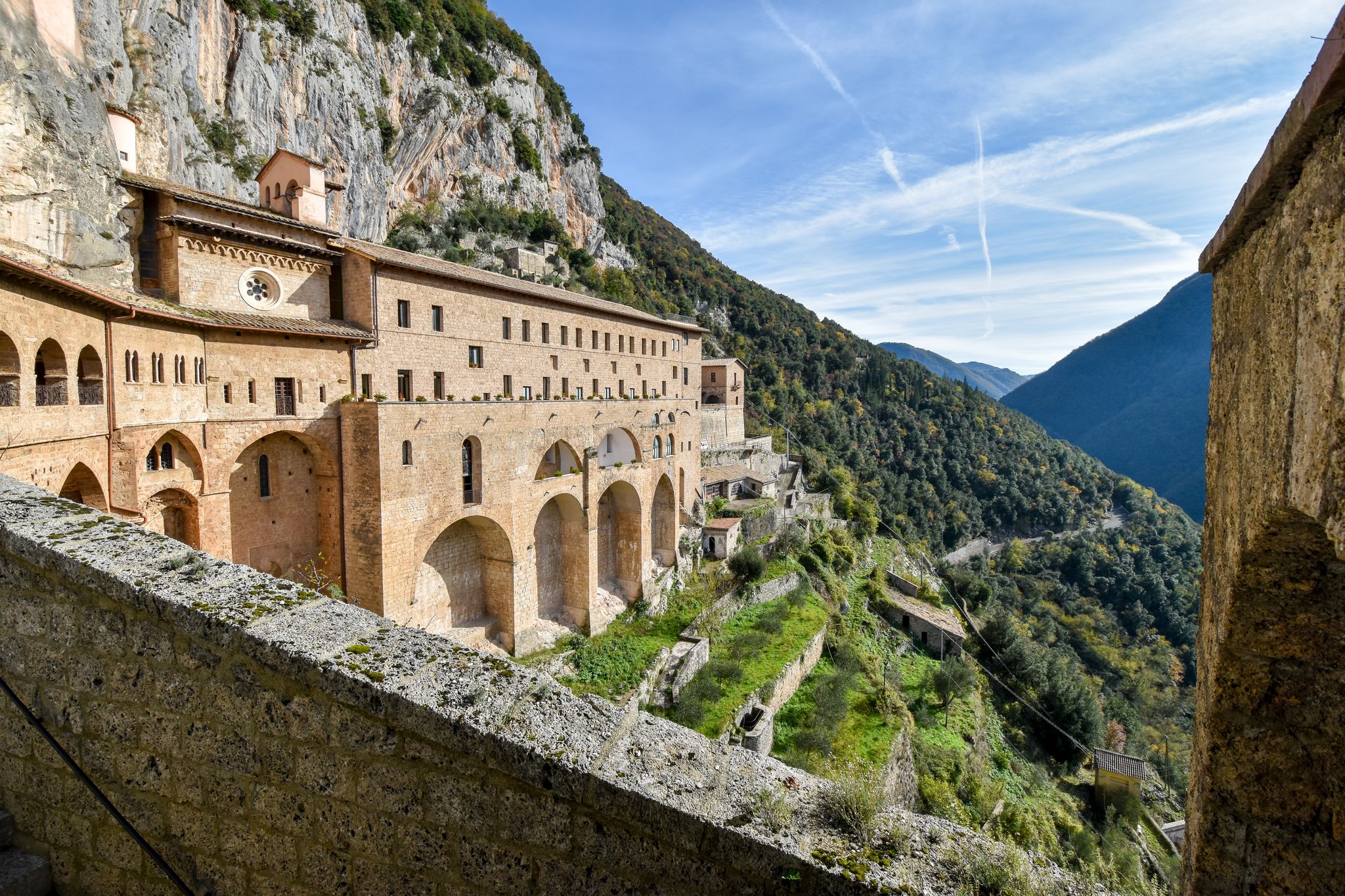
The Grotta di San Michele is immersed in the woods of the Cicolano Mountains, at about 1,000 meters above sea level. It is a small rock church built inside a natural cave, a place of great charm and spirituality. The cult of San Michele Arcangelo was introduced to Sabina by the Lombards and spread to many high and steep places in Italy, often associated with caves and natural cavities. According to local tradition, it is here that the warrior saint fatally pierced a terrible dragon, a symbol of evil. The cave is mentioned in the records of the pastoral visits of Cardinals Corsini (1779-82) and Odescalchi (1833-36), who describe it as the "rural church of San Michele Arcangelo". The origin of the small church is shrouded in mystery: the facade is in Romanesque style, while inside there are Carolingian elements, testifying to a very ancient history. Inside the cave there is a Carolingian altar with a mosaic; a main altar with a wooden statue of St. Michael the Archangel, depicted while killing the dragon; the Ossuary of the Hermits, a natural niche that preserves skulls and bones, probably of the deceased buried here before the construction of the cemetery of Montorio in the 19th century. The cave is protected by a wall structure with a small single-lancet window above the entrance and a window in the upper part. Access is via a mule track or a dirt path, accessible from Pozzaglia Sabina or Montorio in Valle. Every year, on the first Sunday of May, a Holy Mass is celebrated in the cave, which is well attended by the local community. The place is also part of the Cammino di San Benedetto, a spiritual and naturalistic itinerary that crosses Sabina.
0
0

This beautiful waterfall can be easily reached from the village of Castel di Tora. The route that starts from the La Posta farmhouse is simple and short, also suitable for families. The waterfall has its maximum flow at the end of spring-early summer and is enclosed in a very suggestive environment almost reminiscent of a tropical climate.
4
0

Rieti is a wonderful city surrounded by uncontaminated nature and rich in water springs, among which the Antiche Fonti di Cottorella stand out. This fascinating spring is located just one kilometer from the historic "Porta Romana" of Rieti and emerges from the slopes of the majestic Monte Belvedere. The very name of this mountain evokes evocative images that capture the attention of those who are on top of its heights, allowing a spectacular view of the Rieti valley below, the majestic Terminillo massif and the winding Velino river.
0
0

to do a bit on foot but it's worth it
1
0
Splendid thermal complex from the Roman era which bears witness to how the sulphurous waters of Cotilla were exploited since ancient times. To find out the opening times and days, call the municipality of Cittaducale. From the dirt road it is still possible to see the complex and admire its beauty.
0
0
Frequently Asked Questions
Are there family-friendly natural monuments around Rocca Sinibalda?
Yes, several natural monuments are suitable for families. The Vallocchie Waterfall is easily accessible from Castel di Tora, offering a simple and short route. The Cottorella Spring near Rieti is another family-friendly spot, known for its uncontaminated nature. Additionally, the Salto Fjord provides picturesque views and is also considered family-friendly.
What kind of geological features can I explore near Rocca Sinibalda?
The region around Rocca Sinibalda is rich in diverse geological features. You can explore the limestone ridges of Monte Navegna and Monte Cervia within the Monti Navegna e Cervia Regional Nature Reserve, which also features dramatic river gorges. The area is also known for its artificial lakes, such as Lake Salto and Lake Turano, which offer unique landscapes like the Salto Fjord, reminiscent of Nordic scenery.
What outdoor activities can I do near these natural monuments?
The area offers a variety of outdoor activities. You can find numerous hiking trails, ranging from easy to difficult, that allow you to explore the Sabina hills and the Monti Navegna e Cervia Regional Nature Reserve. For specific routes, you can check out the Hiking around Rocca Sinibalda guide. There are also options for mountain biking and running, with dedicated guides like MTB Trails around Rocca Sinibalda and Running Trails around Rocca Sinibalda.
Are there historical sites integrated with natural settings in the area?
Yes, the region beautifully blends history with nature. A notable example is the Ancient Baths of Vespasian, a Roman thermal complex that utilized the area's sulphurous waters. Another fascinating site is the Cave of Saint Michael the Archangel, a small rock church built inside a natural cave in the Cicolano Mountains, offering a place of great charm and spirituality.
What are some popular hiking trails near Rocca Sinibalda's natural monuments?
Many trails allow you to experience the natural beauty. An easy option is the route to Vallocchie Waterfall from Castel di Tora. For more extensive hikes, the Monti Navegna e Cervia Regional Nature Reserve offers trails with breathtaking views of the lakes and valleys. You can find detailed routes, including the 'Vallocchie Waterfall – Castel di Tora loop', in the Hiking around Rocca Sinibalda guide.
What do visitors enjoy most about the natural monuments around Rocca Sinibalda?
Visitors particularly appreciate the diverse natural settings and the tranquility. The Vallocchie Waterfall is praised for its suggestive, almost tropical environment. The Salto Fjord is loved for its wild beauty and views reminiscent of Nordic landscapes. The blend of natural beauty with historical elements, such as the Ancient Baths of Vespasian, also draws significant interest.
When is the best season to visit the natural monuments in this region?
The end of spring to early summer is ideal for visiting the Vallocchie Waterfall, as it has its maximum flow during this period. Generally, spring and autumn offer pleasant temperatures for hiking and exploring the Monti Navegna e Cervia Regional Nature Reserve, with lush greenery in spring and vibrant colors in autumn. Summer is also popular, especially for activities around Lake Turano and Lake Salto.
Are there any hidden natural gems worth discovering near Rocca Sinibalda?
Beyond the well-known spots, the region holds several hidden natural gems. The extensive beech and oak forests within the Monti Navegna e Cervia Regional Nature Reserve offer secluded paths and tranquil spots. The Cottorella Spring, while accessible, provides a serene natural escape just outside Rieti. Exploring the numerous hiking trails can also lead to discovering less-frequented viewpoints and natural formations.
Can I find viewpoints offering panoramic vistas of the area?
Absolutely. Monte Pelato, about a two-hour walk from Rocca Sinibalda, offers unparalleled views of the village, its historic castle, and the surrounding landscape. Within the Monti Navegna e Cervia Regional Nature Reserve, the limestone ridges of Monte Navegna and Monte Cervia provide stunning panoramic views of the lakes and valleys. The Salto Fjord also serves as a beautiful viewpoint overlooking Lake Salto.
What is the Monti Navegna e Cervia Regional Nature Reserve and what does it offer?
The Monti Navegna e Cervia Regional Nature Reserve is a protected area near Rocca Sinibalda, spanning approximately 3,600 hectares. It features Apennine landscapes with extensive beech and oak forests, ancient chestnut groves, high-altitude grasslands, and dramatic river gorges. It's an ideal destination for nature lovers, offering trekking, birdwatching, and opportunities to connect with pristine natural surroundings. The reserve also encompasses the picturesque Salto and Turano artificial lakes.
Are there any natural springs in the Rocca Sinibalda area?
Yes, the region is known for its natural springs. The Cottorella Spring, located just one kilometer from Rieti's historic 'Porta Romana', is a prominent example. These springs, like the sulphurous waters utilized by the Ancient Baths of Vespasian, highlight the area's rich hydrological features.
What is the significance of Lake Turano in the region?
Lake Turano, an artificial lake formed by the Turano River, is a significant natural feature in the region. It's known for its picturesque scenery, surrounded by green woods and mountains. The lake offers opportunities for outdoor activities such as picnicking, boating, and fishing. Charming villages like Castel di Tora and the partially ruined 'ghost village' of Antuni provide magnificent views of the lake, making it a relaxing spot for exploration.
Most popular routes around Rocca Sinibalda
Most popular attractions around Rocca Sinibalda

Get inspired with the komoot mobile app


Explore more
Extend your search for the best caves by checking out these guides of the top ones around Rocca Sinibalda:
