Top 4 Caves in Ascoli Piceno
Caves in Ascoli Piceno offer a diverse range of natural and man-made subterranean sites within the Marche region of Italy. The area features historical cave dwellings, Roman substructures, and natural grottoes, often integrated with religious sites. These locations provide insights into the region's geology, history, and local legends. Visitors can explore sites ranging from high-altitude mountain caves to those carved into urban travertine cliffs.
Best caves in Ascoli Piceno
- The most popular caves is San Marco Hermitage (Eremo di San…
Last updated: October 30, 2026
San Marco Hermitage (Eremo di San Marco)
Highlight • Religious Site
Translated by Google •
Tip by

Sant'Emidio alle Grotte
Highlight • Religious Site
Translated by Google •
Tip by
Sign up now to discover places like this
Get recommendations on the best single tracks, peaks, & plenty of other exciting outdoor places.
Cave of Blessed Corrado
Highlight • Cave
Translated by Google •
Tip by

Petrienno Cave
Highlight • Cave
Translated by Google •
Tip by
Ruins of the Vestibule of the Sibyl's Cave
Highlight • Cave
Showing Translation
Tip by

Start today with a free account
Your next adventure awaits.
Popular around Ascoli Piceno
Cycling the Marche – sea to the mountains, among villages and hills
The Apennine Cycleway (Part 2) - From Umbria to Calabria
Between history and nature – Grande Anello dei Borghi Ascolani
The Sibillini Mountains to Gran Sasso – the Great Apennine Crossing
On the trail of the Queen of the Fairies – Grande Anello dei Sibillini
From the boot’s toe to the heel – the most beautiful cycling Tours in Italy
Between mountains and sea — road cycling in Italy’s Marche
Hiking in Ascoli Piceno
MTB Trails in Ascoli Piceno

Running Trails in Ascoli Piceno
Other adventures in Ascoli Piceno


Tips from the Community

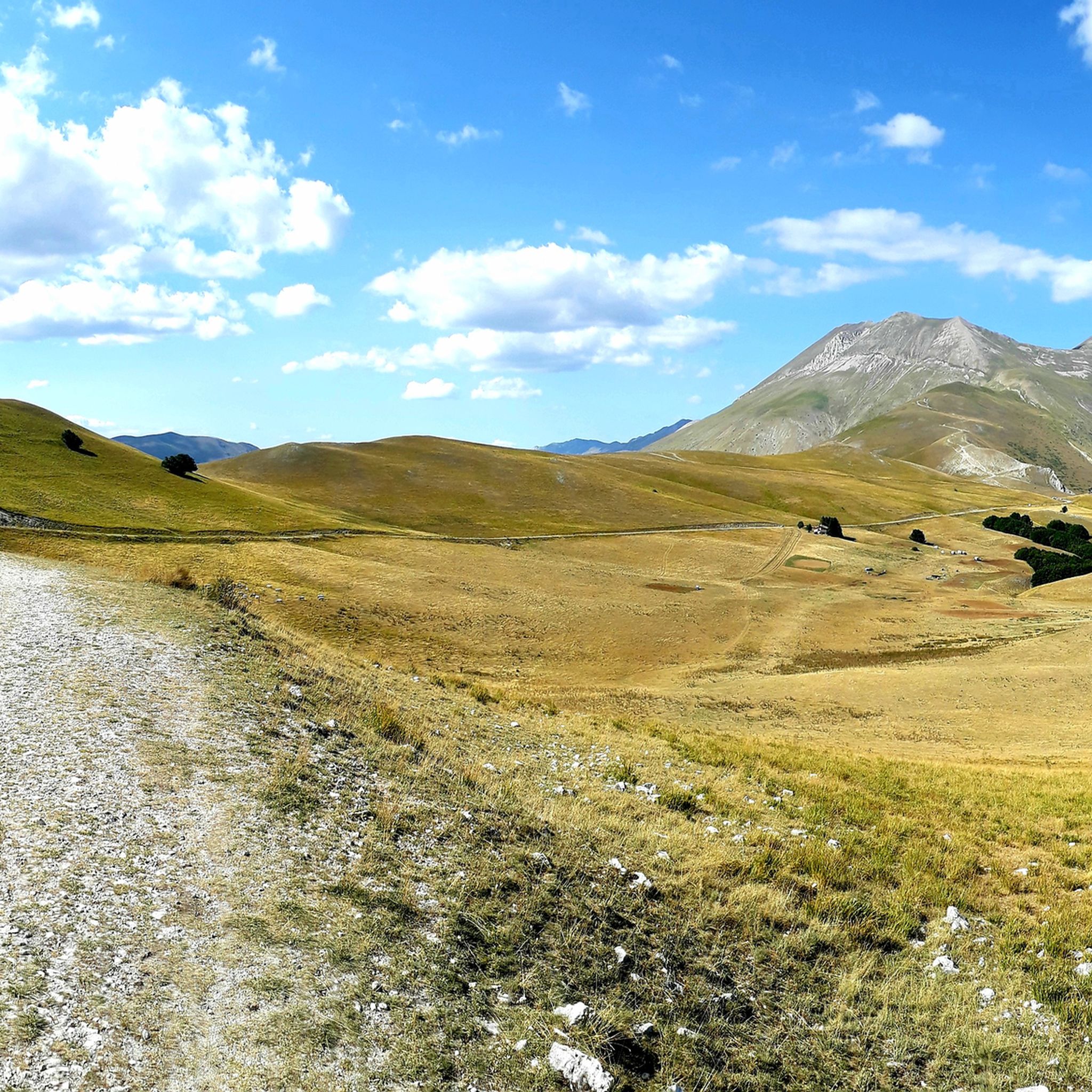
Mount Sibilla, which gives its name to the entire Monti Sibillini group, is known for the so-called Grotta della Sibilla, a cave carved into the rock near its summit. According to an ancient medieval legend, the cave was the access point to the underground paradise kingdom of Queen Sibilla or the Apennine Sibyl, a sorceress, enchantress, and seer who lived there with a court of ladies identified by popular tradition as "fairies" and who possessed supernatural knowledge and could provide prophecies and revelations. In the Middle Ages and the Renaissance, the fame of the Grotta della Sibilla attracted wandering knights, nobles, scholars, the curious, practitioners of magic/alchemy, and people interested in the occult from all over Europe. The remains of the cave's vestibule, which collapsed between 1953 and 1968, after a long history of expeditions to inspect its cavities, can be reached on the path leading to the summit of the Mount, on the meadow to the east of the plateau, past the so-called "Corona della Sibilla", a red-colored calcarenite rock shelf over 5 meters high that surrounds the summit at an altitude of about 2000 meters.
0
0

Il Tempietto di Sant’Emidio alle Grotte was built in a secluded, slightly hilly location, but still very close to the urban area of Ascoli Piceno. It was by popular demand that it was decided to entrust the project to the sculptor and architect Giuseppe Giosafatti, who convinced everyone with a very original design, definable in Baroque style, but which goes beyond canonical descriptions. Some define the work, completed and consecrated in 1720, as "little Petra", for the beautiful shape of the facade, but also and above all for its integration into the tuff wall, just as the rock-hewn facades that make up the archaeological site of Petra in Jordan are. The interior, substantially unchanged over the centuries, consists of ancient caves dug into the tuff rock. So, everything starts from the caves. What is known is that, as early as the year 250, there were interconnected caves. The story, partly with legendary aspects, has it that the remains of the current Patron Saint of Ascoli Piceno, Sant’Emidio, were kept in those caves for seven centuries (currently the saint's remains are in the crypt of the city's cathedral). It goes without saying that the place, as it was in its simplicity, with only the addition of a small altar in the main cave, became a place of pilgrimage and an oratory for worship and prayer. Then there was the great earthquake of L'Aquila in 1703, which produced seismic swarms for entire months that also troubled the citizens of Ascoli, albeit without victims. For this reason, due to the conviction that the saint had protected the city, the idea of creating an ex-voto in the burial place, in that tuff oratory, developed. The rest is history.
1
0
cave with a very small entrance, pretty, worth a visit.
1
0
Ancient 13th-century monastery built in travertine and embedded in the rock. It is located on Colle San Marco, a few kilometers from Ascoli Piceno, and is reachable via a stone staircase that acts as a bridge over a deep moat. Usually open on weekends and holidays during the spring and summer months. The path to get there is also suitable for families.
1
0

short but steep path
0
0

The evocative and unique Sanctuary Tempietto di Sant'Emidio alle Grotte represents a splendid example of Baroque religious art in the Marche. It is defined as "alle grotte" because it is built against the caves of the ancient Christian necropolis. It is secluded from the urban context, in a place rich in vegetation and silence. Here it is said that the decapitated Saint miraculously brought his own head to be buried. This place of Emidian worship was rediscovered in 1721 when the people of Ascoli wanted to thank their Patron Saint for the protection granted in the earthquake of 1703. The most renowned local architect of the time, Giuseppe Giosafatti, created his project for this purpose: he brought the early Christian caves to light by crumbling the rocky part which was then covered with a delicately sculpted travertine facade. (c) https://letsmarche.it/-/santuario-di-s.-emidio-alle-grotte-2
1
0
From the imposing chestnut forest, the main path leads to a clearing located on a huge travertine spur, overlooking the forest. On the rock face, you can see, at the top right, the fascinating structure of the Hermitage of San Marco, a natural cavity closed by a church-shaped building with a bell tower and connected to the path by a stone staircase. The wall, in Romanesque style, is made of ashlar stones and has a single-lancet window and five double-lancet windows. In ancient times, the building housed a convent founded by Cistercian monks at the beginning of the 13th century and consists of two overlapping rooms, connected by a staircase resting on the rock. It is a very “poor” construction, which recalls the Benedictine monastic rule. Inside the Hermitage, it is still possible to find traces of the primitive frescoes painted by the monks on the walls and on the vault of the lower room. On the ceiling of the cave, the splendid “tapestry” of maidenhair fern is noteworthy. The Hermitage of San Marco has been restored and brought back to its maximum splendor. It retains its evocative power that attracts tourists and travelers, lovers of history and nature. (c) https://visitascoli.it/esperienze/colle-san-marco-meta-di-eremiti-nel-corso-dei-secoli/
2
0

The evocative and unique Sanctuary Tempietto of Sant'Emidio alle Grotte represents a splendid example of Baroque religious art in the Marche.
0
0
Frequently Asked Questions
What types of caves can I explore in Ascoli Piceno?
Ascoli Piceno offers a diverse range of subterranean experiences. You can find natural caves like the Petrienno Cave, steeped in wilderness, as well as historically significant man-made structures. These include ancient Roman substructures like the Grotte dell'Annunziata, medieval underground passages in Monsampolo del Tronto, and religious hermitages such as the Cave of Blessed Corrado.
Are there any caves with historical or religious significance in the area?
Yes, several caves in Ascoli Piceno are rich in history and religious importance. The Cave of Blessed Corrado on Colle San Marco served as a retreat for a Franciscan friar in the 13th century. The Sant'Emidio alle Grotte sanctuary is built against ancient Christian necropolis caves, with local legends connecting it to Saint Emidius. Additionally, the Roman Grotte dell'Annunziata are monumental 2nd-1st century BC substructures that supported ancient Roman buildings.
Can I visit caves associated with local legends?
Absolutely. The Ruins of the Vestibule of the Sibyl's Cave, located high in the Sibillini Mountains, is famously linked to the legend of the Apennine Sibyl, a prophetic queen. Medieval tales describe knights venturing into her underground kingdom from this very spot. The area around it is known as the 'Fairies' Path' (Sentiero delle Fate).
Are there family-friendly cave experiences in Ascoli Piceno?
While many caves in the region involve some hiking, the underground galleries of Monsampolo del Tronto offer a unique family-friendly cultural experience. These medieval passages now host a permanent exhibition of Nativity Scenes, providing an accessible and engaging historical context without the need for strenuous caving.
What kind of natural features can I expect to see in the caves?
The natural caves in the Ascoli Piceno area, such as the Petrienno Cave, are often characterized by their wild, untouched environments. The Petrienno Cave itself is accessible by passing under a waterfall, offering a unique natural entrance. While not as ornate with stalactites and stalagmites as some larger systems, they provide a glimpse into the raw geological beauty of the 'lost Apennines'.
What is the best time of year to visit the caves in Ascoli Piceno?
The best time to visit the caves and explore the surrounding outdoor areas in Ascoli Piceno is generally during spring (April to June) and autumn (September to October). During these seasons, the weather is milder, making hiking to cave entrances more pleasant. Some higher-altitude caves, like the Grotta della Sibilla, are best accessed in summer when mountain trails are clear of snow.
Are there hiking trails associated with the caves?
Yes, many caves in the Ascoli Piceno region are part of or accessible via hiking trails. For instance, the Ruins of the Vestibule of the Sibyl's Cave is a popular trekking destination in the Sibillini Mountains. The Petrienno Cave can be reached via routes like the 'Petrienno Cave and Agore Waterfall Loop' or the 'Tallacano Village – Petrienno Cave loop'. You can find more hiking options in the region through guides like Hiking in Ascoli Piceno and Waterfall hikes in Ascoli Piceno.
What other outdoor activities can I do near these caves?
The area around Ascoli Piceno's caves offers numerous outdoor activities. Near the Petrienno Cave, you can enjoy waterfall hikes. The Sibillini Mountains, home to the Ruins of the Vestibule of the Sibyl's Cave, are excellent for more challenging hikes. For general outdoor exploration, consider checking out Hiking in Ascoli Piceno or City hikes in Ascoli Piceno for nearby routes.
Are there any hidden gem caves worth exploring?
The Grotta del Petrienno in the Acquasantano area is often described as a 'magical place' hidden by woods, offering a sense of stepping back in time amidst the wilderness. It's less known than some other sites and provides a more secluded experience.
Do I need special permits or equipment for caving in Ascoli Piceno?
For most accessible historical sites and natural cave entrances like the Cave of Blessed Corrado or the Sant'Emidio alle Grotte, no special permits are required, and standard walking shoes are usually sufficient. However, for exploring deeper or more technical natural caves, or for speleology, specialized equipment and potentially local guide services or permits would be necessary. Always check local conditions and accessibility before venturing into less-trafficked areas.
What are the Roman 'Grotte' in Ascoli Piceno?
The Roman 'Grotte' or Grotte dell'Annunziata are impressive artificial substructures dating back to the 2nd-1st century BC. These vaulted niches were built against the cliff of Colle dell'Annunziata, likely serving as foundations to stabilize the ground for a large Roman structure, possibly a temple. They also protected the slopes from landslides and provided enclosed spaces. You can learn more about their historical context on Wikipedia.
How long does it typically take to explore these cave sites?
The time required varies greatly. Visiting a historical site like the Cave of Blessed Corrado or Sant'Emidio alle Grotte might take 30 minutes to an hour. Exploring the Petrienno Cave, including the hike to reach it, could be a 2-3 hour excursion. For sites like the Ruins of the Vestibule of the Sibyl's Cave, the journey involves a significant mountain trek, making it a half-day or full-day activity.
Most popular routes in Ascoli Piceno
Most popular attractions in Ascoli Piceno

Get inspired with the komoot mobile app


Didn’t find what you were looking for?
Discover more caves in Ascoli Piceno region by region:
Explore more
Extend your search for the best caves by checking out these guides of the top ones in Ascoli Piceno:
