Top 4 Castles around São Cristóvão
Best castles around São Cristóvão refers to the historical structures and colonial buildings that define this UNESCO World Heritage site in Sergipe, Brazil. São Cristóvão, one of Brazil's oldest cities, is recognized for its well-preserved architectural heritage. While traditional European castles are not present, the city offers significant historical sites that reflect its colonial past. These sites, primarily churches, convents, and public buildings from the 17th and 18th centuries, showcase baroque and colonial architectural styles.
Best castles around São Cristóvão
…Last updated: July 3, 2026
Montemor-o-Novo Castle
Highlight • Castle
This castle was conquered from the Moors by order of D. Afonso Henriques, and its current walls were built during the reign of D. Dinis.
Translated by Google •
Tip by

Clock Tower
Highlight • Monument
Built during the reign of King Dinis (13th – 14th centuries), it became the castle’s main defence tower. …
Translated by Google •
Tip by

Sign up now to discover places like this
Get recommendations on the best single tracks, peaks, & plenty of other exciting outdoor places.
Sign up for free
Pego do Altar Dam
Highlight • Lake
Translated by Google •
Tip by
Castle Interpretive Center
Highlight • Historical Site
Open every day, except Mondays.
Translated by Google •
Tip by
Start today with a free account
Your next adventure awaits.
Login or Signup
Popular around São Cristóvão

Tips from the Community

Housed in the old church of St. Tiago (18th and 14th centuries) within the castle, the castle's interpretation center presents aspects of Montemor's history since ancient times in a permanent exhibition. The wall paintings from the 17th and 18th centuries are also worth seeing.
0
1

The Pego do Altar Dam is located a few kilometres from Alcácer do Sal and was built in 1949 to supply the agricultural area of the Sado River valley and to produce electricity. Today it is very popular with foreigners in their motorhomes and with sports fishing enthusiasts. It is a magical place due to its landscapes, its capacity for leisure activities and its importance in irrigating the fields, where the main irrigated crop is rice. Not far from the Pego do Altar Dam, the village of Santa Susana has a curious feature: some buildings with modernist architecture from the 1940s, which are due to a benefactor of the region, Henrique Louro Fernandes, whose monogram (HF) can be found on some of them. A small church, with two 16th-century panels inside, somewhat deteriorated but magnificent, completes the interesting visit to this place. Recently, the drought that hit this area “uncovered” an old 200-year-old bridge that was submerged by the waters of the dam.
11
0
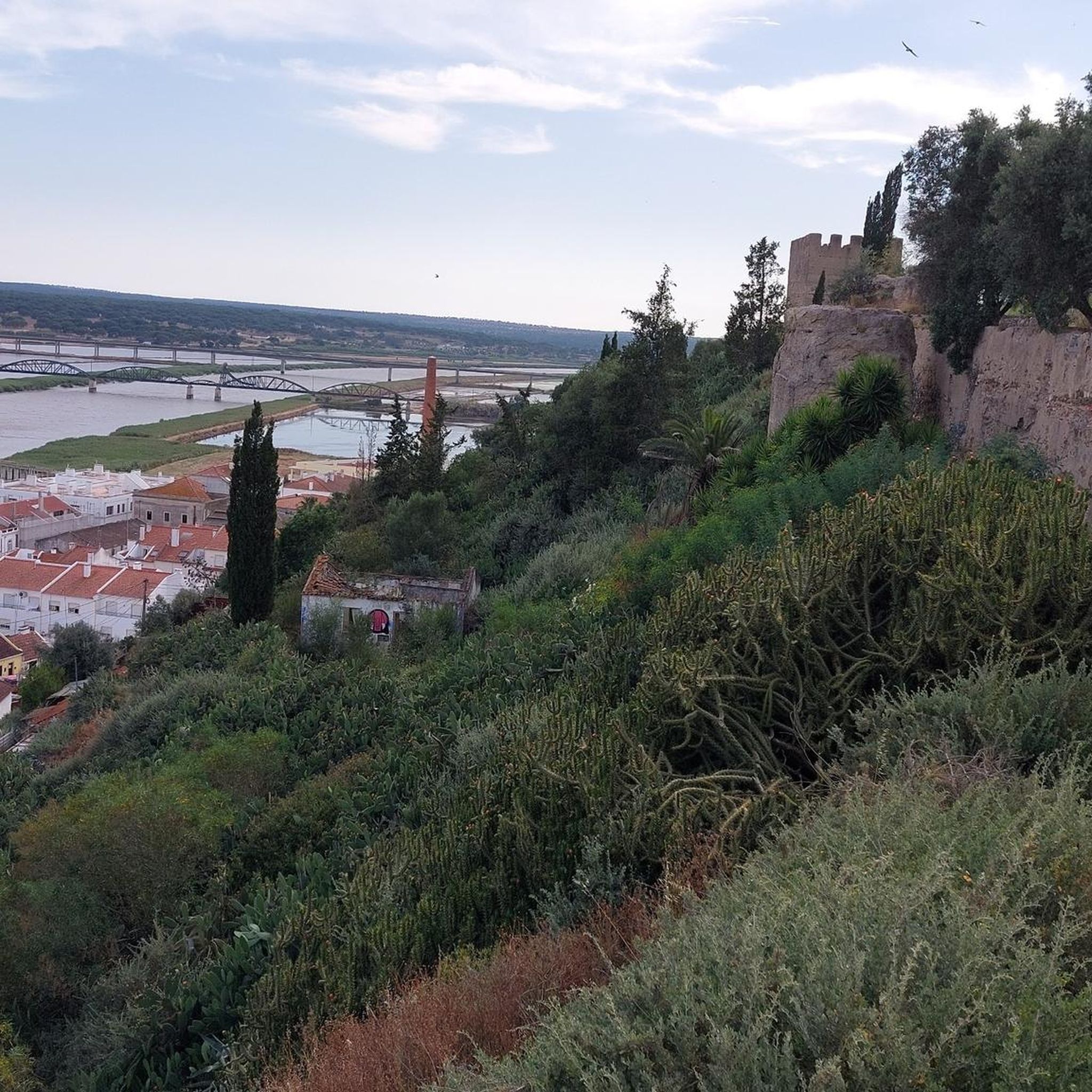
Montemor-o-Novo Castle is located in the parish of Nossa Senhora da Vila, in the municipality of Montemor-o-Novo, in the district of Évora, in Alentejo, Portugal. In a dominant position on the highest hill in the region, the castle originally sheltered the village within its walls, which, as it developed, expanded along the slope to the north. Historical documents confirm that Vasco da Gama finalized his plans for his voyage to India in this castle. Background The earliest human occupation of this site possibly dates back to a prehistoric Romanized fort, according to the abundant archaeological evidence in the region. This was where the Roman roads from Santarém and the mouth of the River Tagus met, continuing via Évora to Mérida. The site would have been fortified for this reason. Centuries later, during the Muslim invasion of the Iberian Peninsula, the name Almançor remained in the region, in the toponymy of the Almansor river. Some authors claim that there was also a Muslim fortification here. The medieval castle During the Christian reconquest of the Iberian Peninsula, the town was conquered by Portuguese forces under the command of D. Sancho I (1185-1211). With a view to repopulating and defending it, the sovereign granted it a Charter in 1203. It is believed that the construction of the medieval castle began at this stage. During the reign of D. Dinis (1279-1325), major reforms were undertaken to the town's defences, including the construction of the town's fence, which was completed in 1365. Once the Avis dynasty was established, the domain of Montemor-o-Novo became a third part of the lordship of Constable D. Nuno Álvares Pereira. Throughout the 15th century, the castle underwent renovation work, carried out by master stonemason Afonso Mendes de Oliveira. In the 15th and 16th centuries, the town reached its greatest prosperity, due not only to regional trade, but also to the fact that the Court remained for long periods in Évora, which made the town the scene of events such as the Cortes of 1495, when King Manuel I (1495-1521) decided to discover the sea route to India. This sovereign granted the town a new charter in 1503. Later, under the reign of King Sebastian (1557-1578), it was granted the title of Notable Town (1563), considering it to be an ancient place with a large population.
7
1

Former Chapel of São Tiago, today it is a museum space: Castle Interpretation Centre. Open every day, except Mondays.
5
0
The Clock Tower is currently the symbol of the city of Montemor-o-Novo. Built during the reign of King Dinis (13th – 14th centuries), it became the castle’s main defence tower. It underwent major renovations in the 16th century, when the Guard House was incorporated and a bell tower was installed to hold the clock bells. The clock had three bronze bells: one for the hours, another for the half-hours and the last for the quarter-hours. The main access door to the castle is located under the Clock Tower. It is called the town or Santarém gate. Classification: MN – National Monument, Decree no. 38 147, DG, 1st series, no. 4 of 5 January 1951 *1 / ZEP / “Non-built” zone, DG, 2nd series, no. 177 of 28 July 1962
10
0
Montemor-o-Novo Castle is the original site of the medieval town of Montemor-o-Novo. This castle was conquered from the Moors by order of D. Afonso Henriques, and its current walls were built during the reign of D. Dinis. It was gradually abandoned by the population from the 15th century onwards, and today it preserves important testimonies of the medieval and modern history of Montemor-o-Novo, such as sections of the wall, the Paço dos Alcaides, the Church of Santiago (currently the Castle Interpretation Centre), the Church of Santa Maria do Bispo, the Clock Tower, the Porta da Vila, the Porta do Anjo, the Torre da Má Hora and the Convento da Saudação. (Source: https://www.feriasemportugam.com)
17
0
Romantic place where you can explore the area for free and on your own. Infrastructure is non-existent. You can practically walk around the castle and everything is well signposted. Worth watching.
5
2
Frequently Asked Questions
What kind of historical sites can I explore around São Cristóvão?
While São Cristóvão, Brazil, does not feature traditional European-style castles, it is a UNESCO World Heritage site rich in colonial history. You can explore significant historical buildings and a former defensive fort. The city's historical center, particularly the Praça São Francisco, showcases a unique blend of Spanish and Portuguese influences in its 16th and 17th-century architecture. Notable sites include the Convento e Igreja de Santa Cruz (now the Museum of Sacred Art) and the Museu Histórico de Sergipe (former Provincial Palace).
What are the most popular historical structures mentioned in this guide?
The guide highlights several significant structures. Among them, Montemor-o-Novo Castle is a popular historical site. Other notable structures include the Clock Tower, which serves as the main defense tower and primary access to the castle, and the Angel Tower, a medieval tower protecting the western entrance.
What is the significance of the Praça São Francisco in São Cristóvão?
The Praça São Francisco is a UNESCO World Heritage site and a central feature of São Cristóvão's historical heritage. It is surrounded by a harmonious ensemble of public and private buildings from the 16th and 17th centuries, demonstrating the fusion of Spanish and Portuguese colonial urban planning. This square served as a vital cultural, social, and administrative hub for the town.
Are there any museums or interpretive centers related to the history of the area?
Yes, São Cristóvão offers several insights into its past. The Convento e Igreja de Santa Cruz now houses the Museum of Sacred Art, featuring one of Brazil's most comprehensive collections. Additionally, the Museu Histórico de Sergipe, located on Praça São Francisco, is Sergipe's oldest museological institution, offering a collection of sculptures, paintings, and historical artifacts. Within the castle complex, you can also find the Castle Interpretive Center, housed in the former Chapel of São Tiago.
What outdoor activities can I do near these historical sites?
The region around São Cristóvão offers various outdoor activities. For mountain biking enthusiasts, there are several MTB Trails around São Cristóvão, including multi-terrain routes of varying difficulties. Cyclists can explore Cycling routes around São Cristóvão, with options ranging from easy to difficult. For those who enjoy running, there are also dedicated Running Trails around São Cristóvão.
What is the historical significance of the Forte de São Cristóvão?
The Forte de São Cristóvão (also known as Forte Cotengiba) was a defensive fort built in 1590 by Cristóvão de Barros at the mouth of the Irapiranga River. It was initially a simple palisade and earthwork, constructed to defend the newly founded settlement of São Cristóvão. While no defense works or ruins of this fort remain today, its construction marks the city's origins and its strategic importance in colonial times. You can learn more about its history on Wikipedia.
Are there any family-friendly attractions among the historical sites?
Many historical sites in São Cristóvão are suitable for families, offering an educational experience about Brazil's colonial past. The Castle Interpretive Center is designed to provide historical context in an engaging way. Additionally, the Pego do Altar Dam, while not a castle, is listed as a family-friendly highlight, offering scenic landscapes and leisure activities.
What do visitors appreciate most about the historical sites in this region?
Visitors frequently appreciate the well-preserved architectural heritage and the deep dive into Brazil's colonial history that São Cristóvão offers. The concentration of historical buildings around squares like Praça São Francisco makes the city highly walkable, allowing for an immersive experience. The community has shared 63 photos and given 12 upvotes, highlighting the visual appeal and historical value of these sites.
Can I walk on the walls of any of the historical structures?
Yes, at Montemor-o-Novo Castle, the castle wall is completely preserved, and short parts of it can be walked on, offering impressive views and a sense of its medieval history.
What is the best time to visit São Cristóvão for exploring its historical sites?
São Cristóvão generally has a warm climate. Visiting during the drier months, typically from August to March, can be more comfortable for exploring the outdoor historical sites like Praça São Francisco and walking around the city's historical center. This avoids the heavier rainy season, making for a more pleasant experience.
Are there any religious historical buildings of note in São Cristóvão?
Yes, São Cristóvão is home to several significant religious edifices. These include the Convento e Igreja de Santa Cruz (now Museum of Sacred Art), the Igreja Matriz de Nossa Senhora da Vitória, and the Igreja de Nossa Senhora do Rosário dos Homens Pretos. The latter, erected in 1746, holds immense historical importance as it was built for enslaved and freed Black people in Brazil.
What kind of views can I expect from these historical sites?
From sites like Montemor-o-Novo Castle, you can expect panoramic views of the surrounding area, as it was strategically built on a hill. The historical center of São Cristóvão itself offers picturesque views of colonial architecture and well-preserved squares, providing a unique visual experience of Brazil's past.
Most popular routes around São Cristóvão
Most popular attractions around São Cristóvão

Get inspired with the komoot mobile app


Explore more
Looking for the best castles somewhere else? Discover other guides around São Cristóvão:
