Top 7 Castles around Aragon
Best castles around Aragon offer a journey through centuries of history in northeastern Spain. This historical region is characterized by diverse architectural styles and strategic importance. From imposing Romanesque fortresses to exquisite Islamic palaces, the structures provide insight into Aragon's rich past. The castles are often situated on strategic promontories, offering views of the surrounding landscape.
Best castles around Aragon
- The most popular castles is Carcassonne Citadel, a castle that features 3 kilometers of double surrounding walls and 52…
Last updated: June 25, 2026
Carcassonne Citadel
Highlight • Castle
Translated by Google •
Tip by

Count's Castle
Highlight • Castle
Translated by Google •
Tip by

Sign up now to discover places like this
Get recommendations on the best single tracks, peaks, & plenty of other exciting outdoor places.
Sign up for free
Aude Gate
Highlight • Historical Site
Translated by Google •
Tip by

Roquefère Castle
Highlight • Castle
Translated by Google •
Tip by

Mas-Cabardès Village
Highlight • Settlement
Tip by

Sign up for free to discover even more castles around Aragon.
Sign up for free
Already have an account?
Start today with a free account
Your next adventure awaits.
Login or Signup

Tips from the Community

It is an absolute must to visit the castle during the blue hour.
1
0

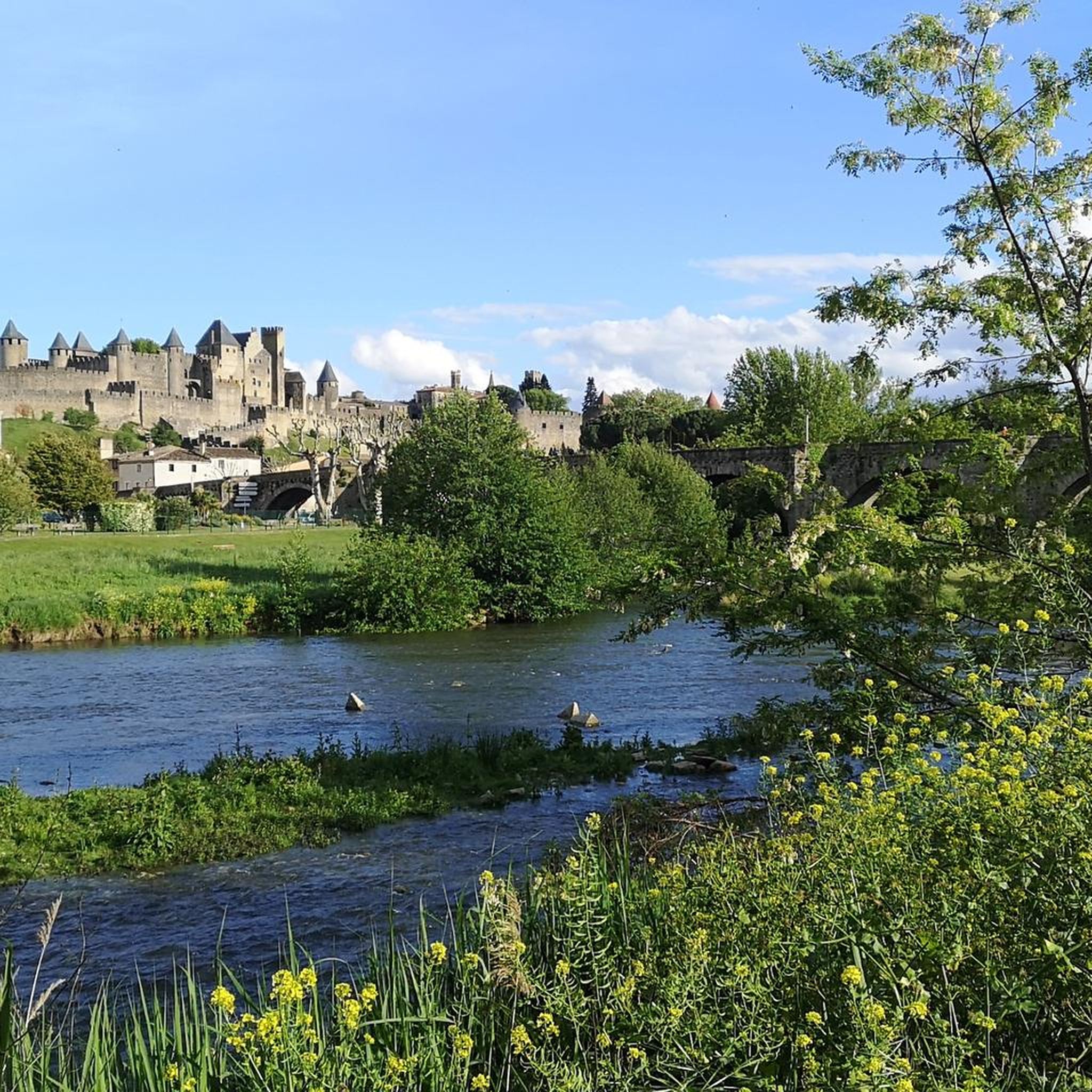
You haven't visited Carcassonne if you haven't visited the Cité. This fortress, listed as a UNESCO World Heritage Site, lines up three kilometers of double surrounding walls and 52 defense towers that protected the historic old town. But during the Peace of the Pyrenees in 1659, these ramparts lost their military importance and the town developed around them.
9
0

Built lengthwise in the hollow of the valley formed by the Orbiel, this Cathar village is not lacking in charm. Dominated by the remains of a medieval castle that played a strategic role during the wars of religion, you can discover in the town, in addition to the Church, various old corbelled and half-timbered houses testifying to past prosperity. Similarly, the so-called Weavers' Cross evokes a textile activity that has now disappeared, just like the agricultural exploitation which is no longer practiced in the town because of the steepness of the land. After having counted up to 900 inhabitants around 1860, the village only has 177 at the last census.
0
0
Part of the circuit of "Villages perched in the Black Mountain", Roquefère is a magnificent example. Set between two steep mountain sides, this tiny village has only 77 inhabitants at the last census. It is dominated by the castle built on a rock protuberance. The latter offered a surveillance point on the road between Carcassonne and the Albigeois. Its origin dates back to the 12th century, and it has undergone only a few changes in its configuration since feudal times, apart from the two square towers and the south facade redesigned in the 17th century. The castle has always been occupied since its origins. It now belongs to a private person. You should also know that you will find a drinking water tap on the small square next to the road, right next to a fountain with a metal wheel (see photo).
0
0

Huge complex with several wall rings and many towers
21
0
From here it costs money. It is worth it ..
28
2
The castle complex is well worth seeing, but the city is also worth a visit.
28
0
Frequently Asked Questions
What are some of the most historically significant castles in Aragon?
Aragon boasts a rich history reflected in its castles. The Carcassonne Citadel, a UNESCO World Heritage Site, is renowned for its extensive double walls and 52 defense towers, offering an immersive medieval experience. The Count's Castle, also within Carcassonne, reached its peak in the 12th and 13th centuries and played a significant role during the Cathar period.
Are there family-friendly castles to visit in Aragon?
Yes, several castles in the region are considered family-friendly. The Carcassonne Citadel and the Count's Castle are both listed as family-friendly, offering engaging historical experiences for all ages. Their impressive structures and rich history can captivate younger visitors.
What outdoor activities can I do near the castles in Aragon?
The region around Aragon's castles offers various outdoor activities. You can find numerous hiking routes, such as the 'Aragon Village – Sainte-Marie Church loop' or the 'Botanical trail loop'. For cyclists, there are options like the 'Rest Area in the Pine Forest – Sainte-Marie Church loop' for touring bicycles, and challenging gravel biking routes like the 'Pic de Nore – Pic de Nore Summit loop'. You can explore more routes in the Hiking around Aragon and Cycling around Aragon guides.
Are there hiking trails near these castles?
Absolutely. For hiking enthusiasts, there are several trails available. Easy options include the 'Aragon Village – Sainte-Marie Church loop' (6.8 km) and the 'Botanical trail loop' (4.6 km). For a more moderate challenge, consider the 'Sainte-Marie Church – Aragon Village loop' (15.8 km) or the 'Château de l'Abbé loop' (8.6 km). Find more details in the Hiking around Aragon guide.
What do visitors enjoy most about the castles in this region?
Visitors frequently praise the immersive historical experience and the magnificent views. For instance, the Carcassonne Citadel is celebrated for its well-preserved fortifications and the feeling of stepping back in time. The Roquefère Castle is noted for its 'magnificent view' from its elevated position.
Can I find castles with unique architectural styles in Aragon?
Yes, Aragon's castles showcase diverse architectural styles. While the provided highlights focus on the medieval fortifications of Carcassonne, the broader Aragon region is known for Romanesque fortresses, exquisite Islamic palaces like the Aljafería Palace in Zaragoza with its Mudéjar elements, and military castles seamlessly integrated into natural landscapes, such as Castillo de Peracense.
Are there any castles that are particularly well-preserved?
The Carcassonne Citadel is an exceptionally well-preserved fortified city, recognized as a UNESCO World Heritage Site. Its extensive walls and towers offer a comprehensive look at medieval military architecture. The Roquefère Castle has also undergone few changes since feudal times, offering a glimpse into its long history.
What kind of viewpoints can I expect near the castles?
Many castles in the region are strategically located on elevated positions, offering stunning panoramic views. For example, the Roquefère Castle provides a 'magnificent view' of the surrounding landscape. The Aude Gate also offers a beautiful view of the ramparts of Carcassonne.
Are there any castles that were significant during the Knights Templar era?
While not among the provided highlights, the broader Aragon region features Monzón Castle in Huesca, which was one of the most powerful Templar commandries in the Crown of Aragon. It was significantly expanded by the Templars and holds historical significance as the place where James I 'the Conqueror' of Aragon received his education under the Knights Templar.
What is the best time of year to visit the castles in Aragon?
The best time to visit Aragon's castles generally depends on your preference for weather and crowds. Spring (April-May) and autumn (September-October) offer pleasant temperatures for exploring and hiking, avoiding the intense heat of summer. During these seasons, the natural surroundings also present beautiful colors, enhancing the experience.
Can I find castles that are integrated with natural landscapes?
Yes, the region has castles that are remarkably integrated with their natural surroundings. For instance, Castillo de Peracense in Teruel is renowned for its seamless integration with the natural landscape, sitting on a rocky extension of red 'rodeno' stone, giving it a unique reddish color and an almost impregnable defensive position.
Are there any castles that also serve as cultural or administrative centers today?
While not among the provided highlights, the Aljafería Palace in Zaragoza is a unique example. This fortified Islamic palace, a UNESCO World Heritage Site, currently serves as the seat of the regional parliament of Aragon, allowing visitors to see where contemporary regional debates take place within a historic setting.
Most popular attractions around Aragon

Get inspired with the komoot mobile app


Explore more
Looking for the best castles somewhere else? Discover other guides around Aragon:
