Top 7 Castles around Semécourt
Best castles around Semécourt are found within the wider Moselle region, offering access to several historical castles and fortified structures. Semécourt is situated close to Metz, making these nearby sites easily accessible for exploration. The area is characterized by its rich history, with structures reflecting centuries of architectural evolution and strategic importance. Visitors can explore a variety of historical sites, from medieval fortifications to classical castles.
Best castles around Semécourt
- The most popular castles is Porte des Allemands, a…
Last updated: June 21, 2026
Porte des Allemands and Metz Cathedral
Highlight • Historical Site
Translated by Google •
Tip by

Porte des Allemands
Highlight • Historical Site
Translated by Google •
Tip by

Sign up now to discover places like this
Get recommendations on the best single tracks, peaks, & plenty of other exciting outdoor places.
Sign up for free
Fort Saint-Quentin
Highlight (Segment) • Historical Site
Tip by

Governor's Palace
Highlight • Historical Site
Translated by Google •
Tip by

Historic landmarks in Metz
Highlight • Historical Site
Have fun!
Translated by Google •
Tip by

Sign up for free to discover even more castles around Semécourt.
Sign up for free
Already have an account?
Start today with a free account
Your next adventure awaits.
Login or Signup


Tips from the Community

The former palace of the commander of the 16th German Army Corps was built between 1902 and 1904 in the German Neo-Renaissance style. The palace is characteristic of historicism in the architecture of that time. It can be visited together with the park on the European Heritage Days. tourisme-metz.com
0
0

Of the original 17 city gates, only the German Gate in the east remains. Named after the former hospital of the Teutonic Order, which stood nearby, it was built as an entrance to the city on a bridge over the Seuille River. A medieval structure straight out of a picture book.
6
1

Always worth a bike tour! In the old town area, however, you should keep an eye on the ground. The cobblestones are very rough in places and have deep, wide cracks.
1
0

Impressive and well-preserved gate of the medieval city fortifications on the Seille.
6
0
Impressive and aesthetic building in its strict symmetry.
3
0

"...One of the sights in Metz that really impressed me was the German Gate (Porte des Allemands). It is an imposing city gate that looks like a small castle with its massive towers and double gate. It was built in the 13th century and was part of the city wall that..." Find out more about the sights of Metz in my blog post: 👉 https://www.netreisetagebuch.de/metz-sehenswuerdigkeiten/
5
1
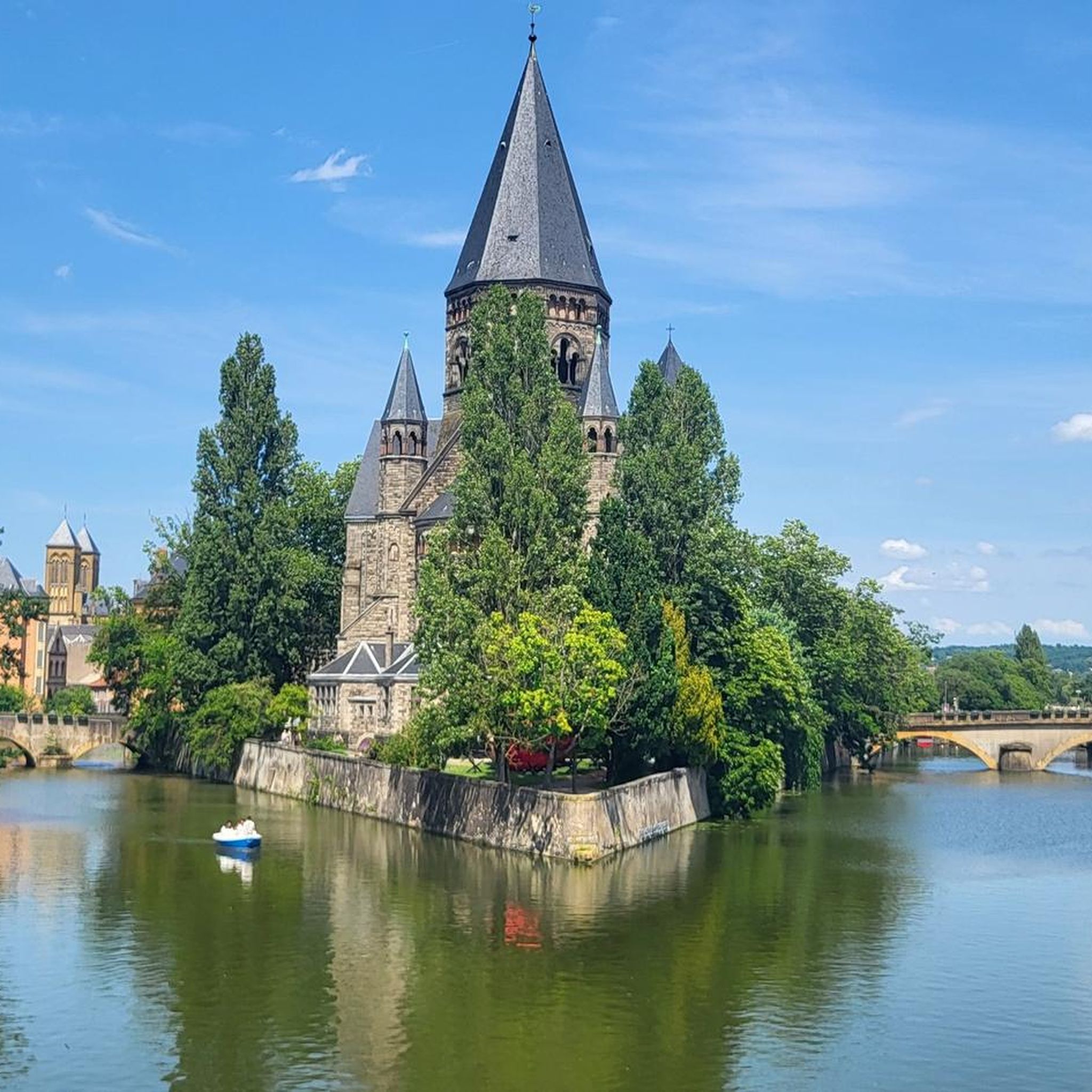
"...Also worth seeing in Metz is the Place de la Comédie, a large square that stretches out in front of the Temple Neuf. The Metz Opera and Theatre is also located here. The first theatrical performance took place in 1752, making the Opéra-Théâtre de Metz the oldest opera house still in operation in France..." Learn more about the sights of Metz in my blog post: 👉 https://www.netreisetagebuch.de/metz-sehenswuerdigkeiten/
2
0

The Fortifications of Saint-Quentin, or Feste Prinz Friedrich Karl form a fortification group in the Scy-Chazelles municipality located northwest of Metz on the Mont Saint-Quentin. Constituted by forts Diou and Girardin, the group is part of the first fortified belt of forts around Metz and had its baptism of fire in late 1944, when the Battle of Metz occurred. The fortified group of forts known as Saint-Quentin belongs to the first fortified belt of Metz designed during Second French Empire by Napoléon III. The first fortified belt consists of Fort Saint-Privat (1870), Fort de Queuleu (1867), Fort des Bordes (1870), Fort de Saint-Julien (1867), Fort Gambetta, Déroulède, Fort Decaen, Fort de Plappeville (1867) and St. Quentin (1867), most of them unfinished or in skeletal form in 1870, when the Franco-Prussian War began. During the annexation, Metz oscillate between a German garrison of 15,000 and 20,000 men at the beginning of the period[1] and will exceed 25,000 men just before the First World War,[2] gradually becoming the premier stronghold of the German Reich.
12
0
Frequently Asked Questions
What types of castles can I explore around Semécourt?
The region around Semécourt offers a diverse range of historical structures. You can find medieval fortifications like the Porte des Allemands in Metz and the Castle of the Dukes of Lorraine in Sierck-les-Bains. There are also classical 18th-century castles such as Pange Castle, early 20th-century architectural examples like Mercy Castle, and historic residences like Château de Romécourt.
Which castles offer a deep dive into medieval history?
For a strong sense of medieval history, visit the Porte des Allemands in Metz, a fortified bridge where you can climb towers and explore loopholes. The Castle of the Dukes of Lorraine in Sierck-les-Bains, originally from the 11th century, also provides a rich medieval experience with well-preserved fortifications and permanent exhibitions of 15th and 16th-century weapons.
Are there any family-friendly castles to visit near Semécourt?
Yes, the Porte des Allemands in Metz is listed as family-friendly. Its impressive structure and the ability to climb its towers can be engaging for children. Additionally, the nearby Sainte-Croix Animal Park could complement a visit to Château de Romécourt, offering a broader family outing.
What is the best time of year to visit the castles around Semécourt?
The castles are generally accessible throughout the year. Spring and autumn offer pleasant weather for exploring the outdoor areas and castle grounds. However, the Porte des Allemands is fully restored and open to visitors, and the Castle of the Dukes of Lorraine frequently hosts public events, suggesting they are prepared for visitors across seasons. Winter visits are possible, but some outdoor areas or events might be limited.
Can I find castles with gardens or natural surroundings?
Yes, Pange Castle, an 18th-century classical castle, is known for its splendid gardens. Château de Romécourt in Azoudange is situated within the Lorraine Regional Natural Park, offering a historic setting surrounded by nature. The Castle of the Dukes of Lorraine also provides magnificent views over the Moselle river and the surrounding landscape.
Are there any castles that offer accommodation?
Yes, Château de Romécourt in Azoudange offers luxury gîtes (holiday accommodations) within an independent wing. These provide a unique opportunity to immerse yourself in a historic 16th-century setting with modern comforts.
What outdoor activities can I do near these castles?
The region around Semécourt offers various outdoor activities. You can find numerous hiking trails, such as the 'Path between Norroy and Fèves' or 'Doorkijkje naar Metz' loops. For running, there are routes like the 'Paved Shared Path' loop. Gravel biking is also popular, with routes like 'Orne River' or 'Plan d'Eau de Metz'. You can explore more options on the hiking around Semécourt guide, running trails around Semécourt guide, or gravel biking around Semécourt guide.
Which castle provides insights into early 20th-century architecture?
Château de Mercy, erected in 1905, is a notable example. It showcases a distinctly French architectural style, built in response to the prevailing German influences of the time, offering a glimpse into early 20th-century regional history and architectural trends.
What do visitors enjoy most about the castles and historical sites in this region?
Visitors appreciate the rich history and architectural diversity, reflecting the region's changing affiliations between German and French empires. The Porte des Allemands is particularly valued for its well-preserved medieval defenses and unique perspective on Metz's history. The overall experience of exploring ancient ruins to well-preserved historical residences is highly rated by the komoot community.
Are there any castles with significant strategic importance in the past?
Absolutely. The Porte des Allemands was once an integral part of Metz's city walls and a main entrance. The Castle of the Dukes of Lorraine in Sierck-les-Bains held a strategic location at the crossroads of three borders and has a rich history of sieges and reconstructions. Fort Saint-Quentin, part of the first fortified belt around Metz, also played a crucial role in the Battle of Metz.
How accessible are the castles by public transport from Semécourt?
Semécourt is approximately 10-13 km from Metz, making the castles within Metz, such as the Porte des Allemands, easily accessible. Metz itself is well-served by public transport. For castles further afield like Château de Romécourt or the Castle of the Dukes of Lorraine, direct public transport options might be less frequent, and a car is often recommended for convenience.
Are there any castles that are particularly well-preserved or restored?
The Porte des Allemands in Metz is fully restored and open to visitors, allowing you to climb its towers. The Castle of the Dukes of Lorraine in Sierck-les-Bains also has well-preserved 11th-century fortifications, including surrounding walls, casemates, and loophole towers, despite later remodels.
Most popular routes around Semécourt
Most popular attractions around Semécourt

Get inspired with the komoot mobile app


Explore more
Looking for the best castles somewhere else? Discover other guides around Semécourt:
