Top 6 Caves around Volano
Best caves around Volano are found within the broader Trentino region, as Volano itself is primarily known for its viticulture and historical sites. This area of Trentino features diverse geological formations, including significant cave systems. The landscape around Volano is characterized by valleys and mountains, offering various natural and historical points of interest. While Volano is recognized for its wine production and sites like the 15th-century St. Rocco church, the surrounding Trentino area provides opportunities for cave exploration.
Best caves…
Last updated: August 9, 2026
Corno Battisti
Highlight • Summit
Translated by Google •
Tip by

Tunnel of the Riflemen
Highlight • Historical Site
Translated by Google •
Tip by

Sign up now to discover places like this
Get recommendations on the best single tracks, peaks, & plenty of other exciting outdoor places.
Sign up for free
Via Ferrata Giulio Segata – Upper Section
Highlight • Climb
Translated by Google •
Tip by

Franco Galli Equipped Trail
Highlight (Segment) • Climb
Showing Translation
Tip by
Damiano Chiesa Cave
Highlight • Historical Site
Translated by Google •
Tip by

Sign up for free to discover even more caves around Volano.
Sign up for free
Already have an account?
Start today with a free account
Your next adventure awaits.
Login or Signup


Tips from the Community

The strategic position of Corno Battisti was the source of bloody battles for its possession during the Great War. To this end, it was equipped with numerous tunnels dug into the rock, with three separate entrances and numerous firing positions. The tunnels can be accessed with great caution, with a torch and preferably a via ferrata kit. Currently (2025), the upper entrance is closed.
0
0

Suggestive and fun via ferrata that climbs to Corno Battisti, winding through the rocks of its southern wall and continuing into its depths! It is officially defined as an 'EEA via ferrata'; but if you have a sure footing, familiarity, and caution, it can also be tackled without a kit... otherwise a harness. It is easy to lose your bearings at the forks and junctions encountered in the darkness of the tunnel: a flashlight is essential. The entire route is characterized by surprising works from the First World War: the stairs carved into the stone; the impressive steep tunnel that pierces the promontory, endless, damp, claustrophobic, and completely dark; its entrance ('the Lion's Mouth'), marked by the original sign of the Miner Company that dug it; an exciting, challenging, and 'anxiety-inducing' vertical metal staircase of about fifteen meters ('the Hoist Shaft'), originally used to lower excavation material. The last section of the tunnel has currently (2025) collapsed — restoration work in progress — so you reach the summit of the Corno by going outdoors and circumnavigating the bastion.
0
0
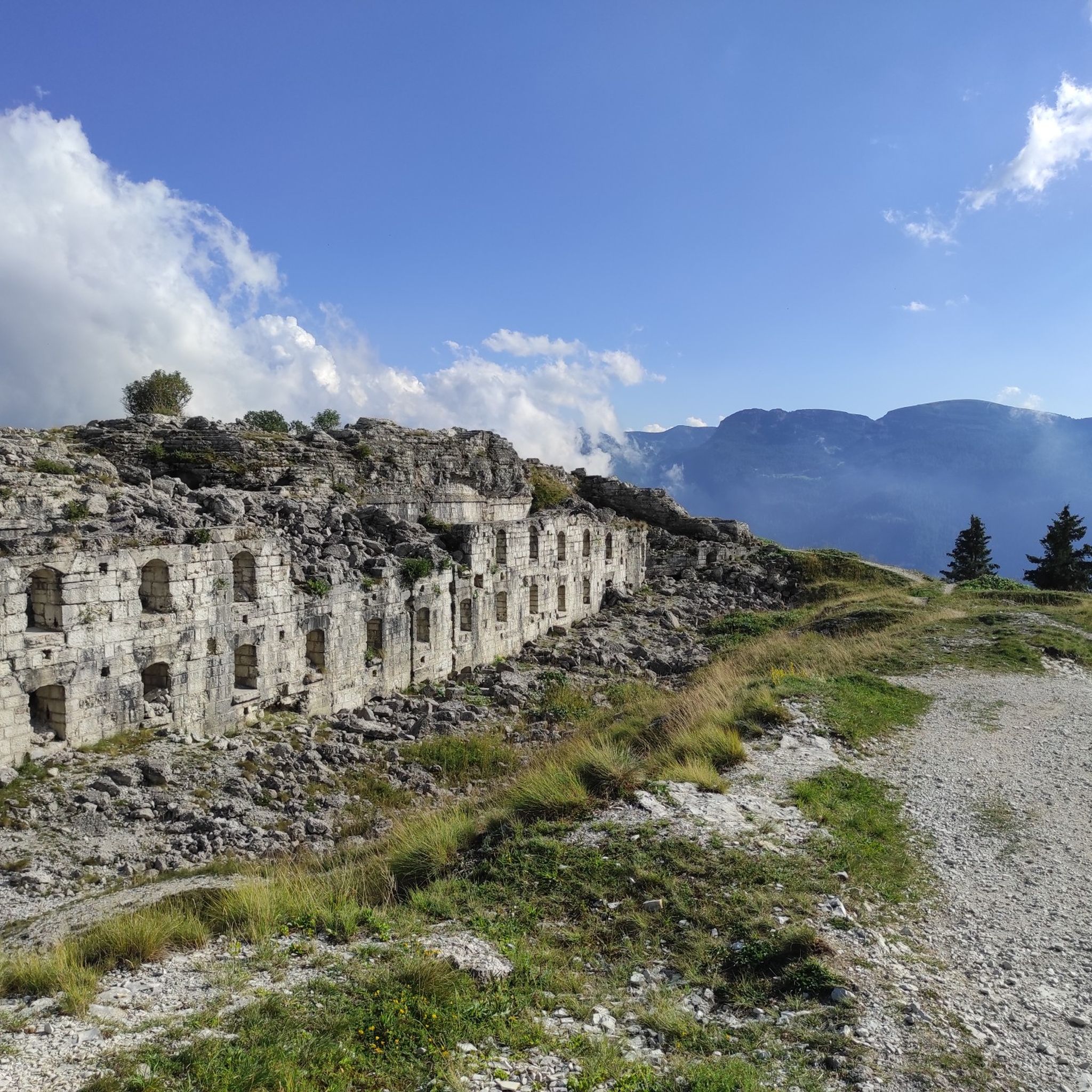
Corno Battisti, an isolated rocky bastion of the Pasubio Group, overlooking the Vallarsa Valley, offers a spectacular view of the long valley and the surrounding mountains: Pasubio, Sengio Alto, Carega, and Monte Zugna. Precisely because of its strategic position, it was fiercely contested during the First World War: the ability to monitor all troop and supply movements along the valley floor from up there made Corno a crucial point to be occupied and defended at all costs... it was in fact nicknamed "the eye of Pasubio" or "the spy of Vallarsa." At the beginning of the conflict, it was a garrison of the Italian army, but with the Strafexpedition of 1916, it was occupied by the Austro-Hungarians. Unable to recapture it, the Italians dug a mine tunnel from below to pierce the Corno and blow up the summit; the Imperials, in turn, dug a countermine tunnel from above. Everything was ready for the detonation, but a coup by a few brave men allowed the peak to be retaken by the Royal Army, which held it until the end of the war. The Austro-Hungarian observatory still survives at the summit. The bowels of the promontory are instead carved out by a surprising and easily navigable labyrinth of dark, damp tunnels with steep steps (EE). In 1916, near the summit, the Austro-Hungarians captured the irredentists Cesare Battisti and Fabio Filzi. They were immediately taken to Trento and hanged at Buonconsiglio Castle as traitors. For this reason, the peak, known at the time as 'Corno della Vallarsa', was renamed 'Corno Battisti' after the war. https://it.wikipedia.org/wiki/Monte_Corno_Battisti https://www.esercito.difesa.it/storia/pagine/monte-corno.aspx
3
0

The Vis Ferrata Giulio Segata is a short, tough via ferrata that is divided into two sections. The second section is even harder than the first section, but becomes easier again as you go up. It starts over long smooth steep walls (E). At the top you climb through a cave with all kinds of stepping aids (C).
2
0

A short walk from the baita car park. Take some time to think about those who fought and died here
0
0
Placed in the wrong location. It is actually the Caverna Damiano Chiesa just a short walk from the baita car park
0
0

A rock in whose niches many different cribs are built
0
0
'Tunnel dei Fucilieri' in the signage: Austro-Hungarian defensive tunnel from the Great War, which passes through the grassy hill of Smelzar, at the foot of Forte Dosso delle Somme, with posts at regular intervals aimed at the underlying Val Terragnolo. Upon exiting, you suddenly emerge onto an exposed but extraordinary panoramic balcony between Val Terragnolo and the Altopiano di Lavarone, before arriving with a steep climb to the fortress.
0
0
Frequently Asked Questions
What kind of caves can I explore near Volano?
While Volano itself is known for viticulture, the broader Trentino region offers diverse cave experiences. You can find historical military tunnels like the Tunnel of the Riflemen and Corno Battisti, natural rock formations, and even challenging via ferratas that pass through caves, such as the Via Ferrata Giulio Segata – Upper Section.
Are there any natural caves in the immediate vicinity of Volano?
Volano is primarily recognized for its vineyards and historical sites. While there are no prominent natural caves directly within Volano, the wider Trentino region, where Volano is located, features significant cave systems. These include the Waterfall and Grotto at Parco Grotta Cascata Varone and the extensive Cave of Bigonda.
What are some of the most historically significant caves or tunnels around Volano?
The area around Volano is rich in historical sites, particularly from the First World War. Notable examples include the Tunnel of the Riflemen, an Austro-Hungarian defensive tunnel, and Corno Battisti, a summit with a labyrinth of dark, damp tunnels that played a crucial role in the war. Additionally, the Damiano Chiesa Cave is a historical rock formation with niches for cribs, located near a significant wartime site.
Are there any challenging cave experiences for experienced explorers near Volano?
Yes, for experienced adventurers, the Via Ferrata Giulio Segata – Upper Section offers a challenging climb that passes through caves. The Cave of Bigonda, located in the broader Trentino region, is also noted for its difficulty and suitability only for experts guided by the Gruppo Grotte Selva due to its complex galleries and risk of sudden flooding.
Are there family-friendly options for visiting caves near Volano?
While some historical tunnels might be accessible, the Cave of Bigonda is not suitable for families due to its difficulty. The Waterfall and Grotto at Parco Grotta Cascata Varone, located in the wider Trentino region, offers a more accessible and family-friendly experience with illuminated walkways through the caves.
What should I wear when exploring caves in the Trentino region?
When exploring caves, especially historical tunnels like those at Corno Battisti, expect dark, damp, and potentially steep conditions. It's advisable to wear sturdy, non-slip footwear, layered clothing to adapt to temperature changes, and always carry a reliable flashlight or headlamp. Some sites may require helmets or other safety gear.
What is the best time of year to visit caves near Volano?
Caves generally maintain a consistent temperature year-round, making them suitable for exploration in various seasons. However, accessibility to some cave entrances or surrounding trails might be affected by snow in winter or heavy rainfall, which can increase the risk of flooding in natural caves like Bigonda. Spring and autumn often offer pleasant weather for outdoor activities leading to cave entrances.
Do I need permits or guides to visit caves in the Volano area?
For some natural caves, especially those that are difficult or prone to flooding like the Cave of Bigonda, permits and expert guides are essential for safety. Historical tunnels and more accessible sites may not require permits but always check local regulations and conditions before visiting. For instance, the Corno Battisti tunnels are easily navigable but require a flashlight.
Are there any easy-to-access caves for beginners near Volano?
For beginners, historical sites like the Tunnel of the Riflemen offer a relatively straightforward experience through an Austro-Hungarian defensive tunnel. The Damiano Chiesa Cave is also easily accessible, just a short walk from a car park. For a more natural cave experience, the Waterfall and Grotto at Parco Grotta Cascata Varone in Trentino provides artificial walkways for easy exploration.
What outdoor activities can I combine with a visit to caves around Volano?
The region around Volano offers various outdoor activities. You can find numerous mountain hikes, such as those detailed in the Mountain Hikes around Volano guide. Cycling is also popular, with routes like those in the Cycling around Volano guide. For mountain biking enthusiasts, the MTB Trails around Volano guide provides challenging options.
Are there hiking trails that incorporate caves near Volano?
Yes, several hiking opportunities in the wider Trentino region can lead to or through cave systems. For example, the trail to the Plague Victims' Cave involves a trail through undergrowth. The tunnels at Corno Battisti are part of a historical site accessible via hiking paths. Always check trail conditions and difficulty before setting out.
What geological features can be observed in the caves around Volano?
The caves in the broader Trentino region, including those near Volano, showcase diverse geological formations. You can observe karst formations, which are typical of limestone regions, as well as features shaped by water erosion. Historical tunnels, while man-made, often reveal the underlying rock strata and geological composition of the mountains they penetrate.
Are there any dog-friendly caves in the Volano area?
While specific regulations for each cave vary, many natural and historical outdoor sites in the Trentino region are dog-friendly, provided dogs are kept on a leash. However, enclosed cave systems or very narrow tunnels might not be suitable or safe for dogs. Always check individual site rules before bringing your pet.
Most popular routes around Volano
Most popular attractions around Volano

Get inspired with the komoot mobile app


Explore more
Extend your search for the best caves by checking out these guides of the top ones around Volano:
