Top 11 Castles around Neukirch/Lausitz
Best castles around Neukirch/Lausitz offer a blend of historical sites and community spaces within a diverse landscape. The region features the historically significant Wasserburg & Rittergut Oberneukirch, a former water castle site now serving as a community hub. Visitors can explore various castle types, from well-preserved structures to ruins, reflecting centuries of regional history. These landmarks provide insights into the area's past and its continuous evolution.
Best castles around Neukirch/Lausitz
- The most popular castles is Nedaschütz Castle, a castle that serves as an event location and features a park. It is also used for party services and catering.
- Another must-see spot is Körse Castle Ruins, a castle and historical site. These are remains of a hilltop castle, once the largest and strongest defensive structure in Upper Lusatia.
- Visitors also love Lipová Castle — Ruins and Park, a castle that was considered the most beautiful castle in the Bohemian Netherlands. It has never been structurally changed, but collapsed after the 1970s.
- Neukirch/Lausitz is known for castle ruins, historical manor houses, and castles with parks. The area offers a variety of historical sites, from former defensive structures to more recent stately homes.
- The castles around Neukirch/Lausitz are appreciated by the komoot community, with more than 80 upvotes and over 90 photos.
Last updated: June 27, 2026
Lipová Castle — Ruins and Park
Highlight • Castle
A special feature of the castle (and what sets it apart from similar castles in Bohemia) is the fact that it has never been structurally changed - it only collapsed after the 1970s, after it was used as a barracks for the Czech army was abandoned...
Today people are considering whether it is worth restoring this object to its original condition. But if you look at the building like this, you can almost be sure that this noble project will fail because of money. The heirs of the last owners, the Ruziska family, from whom the castle was confiscated under the Nazis, also show little interest in the stately property. So the castle will continue to do what it has been doing for 45 years, namely invade...
or maybe there will be someone... - hopefully.
wincontact32naturwunder.blogspot.com/2013/02/das-ehemals-schonste-schlo-des.html
Translated by Google •
Tip by

Körse Castle Ruins
Highlight • Castle
Translated by Google •
Tip by

Sign up now to discover places like this
Get recommendations on the best single tracks, peaks, & plenty of other exciting outdoor places.
Sign up for free
Langburkersdorf Castle
Highlight • Castle
In 1925 the entire property was sold to the State Insurance Saxony. After major structural changes, they built a retirement home there. The manor supplied the Hohwaldklinik with agricultural products. It was a rest home during the 1930s and 40s. Between 1947 and 1966, the castle was used to carry out follow-up treatments for patients with tuberculosis at the Hohwaldklinik. [2]
In 1966 the “Council of the District” became the owner. In 1981 renovation of the castle began. The outer facade was renewed in 1991. In 1992 the property was transferred to the state insurance company, and in 1997 it was sold to Schloss-Park-Entwicklungsgesellschaft mbH. In 2000 the municipality of Hohwald acquired the castle and the property. Since the incorporation of Hohwald in 2007, the castle has belonged to the city of Neustadt in Saxony.
Source: Wikipedia
Translated by Google •
Tip by

Nedaschütz Castle
Highlight • Castle
Today the castle is available as an event location.
Translated by Google •
Tip by

Fountain and Information Board at the Castle
Highlight • Rest Area
The renovation of the partially destroyed pavilion was initiated by the current owners in 2009.
Around 1800, the park received its landscape design, which has been preserved to this day, on behalf of Countess Henriette von Schall-Riaucour, probably with the participation of master architect Christian Friedrich Schuricht and Lord Findlater.
The castle was redesigned by Schuricht in Palladian classicism: plastered blocks on the risalits, lion heads and fabric hangings in the arched areas, etc. This period also saw the redesign of the entrance area (vestibule with Ionic columns), garden hall with herms as a support for the roof to the side doors .
The cemetery was built in 1880 and the chapel was built in 1894. In 1907 the library was added to the south side and several rooms were redesigned.
In 1945 the property was expropriated and then used by the Red Army and briefly by the CDU. As early as 1946, the then TH Dresden was given the castle as a rest home for its teachers by the state government of Saxony. From 1951 the park was also owned by the Technical University of Dresden. The building and park were saved from decay through continued use and conservation measures.
In 2005, Gaußig Palace and Park became the property of the family of Andreas Graf von Brühl-Pohl. The castle was renovated and restored over three years in order to now serve as a castle hotel and the family's seat in Saxony.
Source: including wikipedia.de
Translated by Google •
Tip by

Sign up for free to discover even more castles around Neukirch/Lausitz.
Sign up for free
Already have an account?
Start today with a free account
Your next adventure awaits.
Login or Signup
Other adventures around Neukirch/Lausitz

Tips from the Community

Unfortunately you can only see it from the outside, but very beautiful
0
0

In this gem, which was built in its current form between 1720 and 1725, wedding parties or other events will find the best conditions for a great celebration, as the historic walls form a beautiful setting. In the large hall, over 100 people can feast and celebrate to their heart's content, and a maximum of 60 people can go into the hall for the wedding ceremony. The adjacent park around the castle invites you to stroll and provides a romantic backdrop for beautiful wedding photos. The figurine-decorated porch in front of the entrance, which dates back to 1918, makes for beautiful motifs for a bride and groom, and the porch gives the former simple manor a little more prestige.
0
0

It's worth a detour if you're passing by here anyway.
1
0

First mentioned as a mansion in 1245, the current castle was built in the baroque style in 1700. From 1747 to 1750, the baroque garden was laid out according to plans by the master architect Johann Christoph Knöffel, of which the round pavilion and the canal have been preserved. The renovation of the partially destroyed pavilion was initiated by the current owners in 2009. Around 1800, the park received its landscape design, which has been preserved to this day, on behalf of Countess Henriette von Schall-Riaucour, probably with the participation of master architect Christian Friedrich Schuricht and Lord Findlater. The castle was redesigned by Schuricht in Palladian classicism: plastered blocks on the risalits, lion heads and fabric hangings in the arched areas, etc. This period also saw the redesign of the entrance area (vestibule with Ionic columns), garden hall with herms as a support for the roof to the side doors . The cemetery was built in 1880 and the chapel was built in 1894. In 1907 the library was added to the south side and several rooms were redesigned. In 1945 the property was expropriated and then used by the Red Army and briefly by the CDU. As early as 1946, the then TH Dresden was given the castle as a rest home for its teachers by the state government of Saxony. From 1951 the park was also owned by the Technical University of Dresden. The building and park were saved from decay through continued use and conservation measures. In 2005, Gaußig Palace and Park became the property of the family of Andreas Graf von Brühl-Pohl. The castle was renovated and restored over three years in order to now serve as a castle hotel and the family's seat in Saxony. Source: including wikipedia.de
1
0

This point is on the freely accessible side of the gate and wall, other than the lock. If necessary, you can refresh yourself wonderfully at the small spring on top of the stone. And the panel with the tree disk lists many historical events that this tree has experienced. There are also a few benches to rest on.
0
0
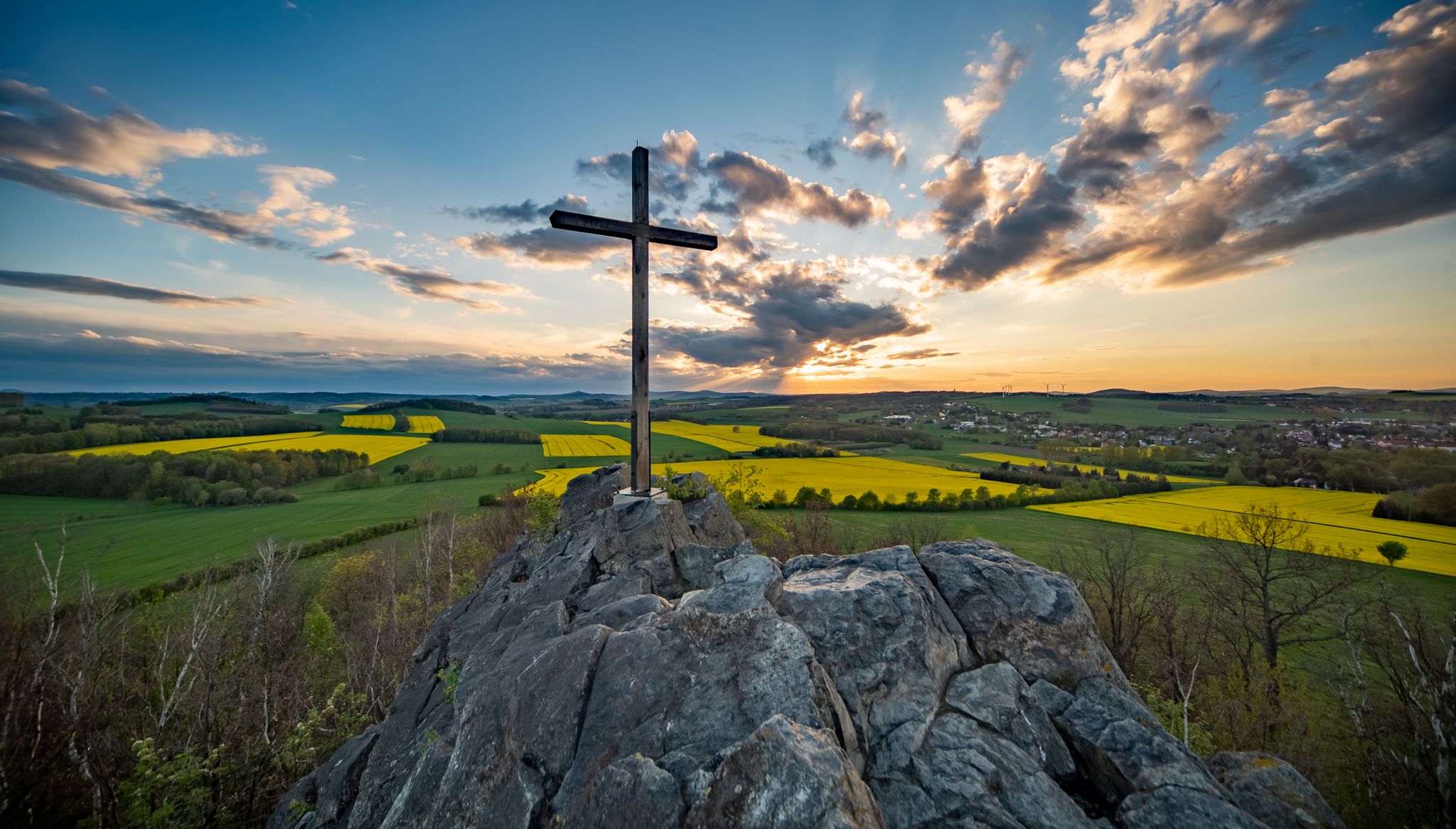
Ruins of a hilltop castle at 275 m above sea level. NN on a granite cone surrounded by the Spree. The name Körse refers to the Sorbian origin. From the 10th century onwards, the rocky spur was used to build a fortification, a redoubt, as the Sorbian settlement area was extended to the region of today's Kirschau. The purpose of the rampart was to protect the settlement area from unexpected attacks. Occupied and destroyed around 1100, a stone German fortification was built on the same site between 1200 and 1250 At that time, the castle was the largest and strongest defensive structure in Upper Lusatia. Their task was to protect the Bohemian Trail, one of the oldest traffic connections between Upper Lusatia and Bohemia (known there as Alte Prager Straße). It led from Bautzen via Obergurig, Kirschau, Schirgiswalde and Sohland to Sderchluckenau (Šluknov), Bohemian Leipa (Česká Lípa) and Prague. In addition, a salt road crossed nearby, which also had to be guarded. Later, however, the lords of the castle were accused of robbery, so that in 1352 the castle was stormed and destroyed by troops from the League of Six Towns. An information board in the remains of today's complex claims that the lords of the castle were declared enemies more because of their opposition to the Bohemian king and the League of Six Towns. In 1359 the castle was again destroyed and razed. There was no reconstruction. Source: Wikipedia
1
0
The castle, park and manor of Langburkersdorf are a pearl today. The decisive turning point for the preservation of the castle only came in 2000. The municipality of Hohwald acquired the castle and the entire complex and the support association was founded. The castle's interior contains many treasures, for example the room on the ground floor, whose ceiling paintings show allegorical representations of the four seasons.
0
0
Very nicely designed, but there is only one entrance in the forest, everything else is now fenced off. Since the property is now private and a castle hotel is operated, you have to accept that for sure. In 2005 Gaussig Castle and Park became the property of the Count Andreas von Brühl-Pohl family. The castle was renovated and restored over a period of three years in order to now serve as a castle hotel and family seat in Saxony.
0
0
Frequently Asked Questions
What types of historical sites and castles can I explore around Neukirch/Lausitz?
The region offers a diverse range of historical sites, from impressive castle ruins to well-preserved manor houses and even a former water castle site that now serves as a community hub. You can find defensive structures like Körse Castle Ruins, which was once the largest in Upper Lusatia, and manor houses like Langburkersdorf Castle with its rich history. The historically significant Wasserburg & Rittergut Oberneukirch, while not a traditional castle today, reflects the area's continuous evolution.
Are there any family-friendly castles or historical sites in the area?
Yes, several sites are suitable for families. Nedaschütz Castle features a park that families can enjoy. Langburkersdorf Castle, with its fascinating history of transformations, can also be an interesting visit for older children. Even the site of the Wasserburg & Rittergut Oberneukirch, now a community hub, offers a redesigned courtyard for public use.
Can I find castle ruins to explore near Neukirch/Lausitz?
Absolutely. The area is home to significant castle ruins. Körse Castle Ruins are the remains of a hilltop castle that was once the largest and strongest defensive structure in Upper Lusatia. Another notable ruin is Lipová Castle — Ruins and Park, which was considered the most beautiful castle in the Bohemian Netherlands before its collapse.
What outdoor activities can I combine with a visit to these castles?
The region around Neukirch/Lausitz offers various outdoor activities. You can find numerous hiking trails, such as those listed in the Easy hikes around Neukirch/Lausitz guide, including routes like 'Forest View – Gerd Scheibe Memorial loop'. For cyclists, there are options for gravel biking and road cycling, allowing you to explore the landscape surrounding the historical sites.
Are there any castles that are now used for events or special occasions?
Yes, Nedaschütz Castle is a popular event location, also offering party services and catering. Langburkersdorf Castle is also frequently used for weddings and special events, showcasing its beautifully preserved interior and historical ceiling panels.
What is the historical significance of the Wasserburg & Rittergut Oberneukirch?
The Wasserburg & Rittergut Oberneukirch has a rich history, first documented in 1636. It originated from an earlier water castle, the site of which is now a protected ground monument. While the original manor house was demolished and the water castle overbuilt, the site today functions as a vibrant community hub, reflecting its continuous evolution and importance to Neukirch/Lausitz.
Where can I find viewpoints near the castles?
The Körse Castle Ruins are situated on a granite cone surrounded by the Spree, offering scenic views from its elevated position. While not explicitly listed as a viewpoint, the historical setting often provides picturesque surroundings.
Are there any castles with parks or gardens to visit?
Yes, Nedaschütz Castle features a pleasant park. Additionally, the site of Lipová Castle — Ruins and Park includes a park area, even though the castle itself is in ruins. The Gaußig Palace, referenced by the Fountain and Information Board at the Castle highlight, is known for its baroque garden and landscape park.
What is unique about Lipová Castle?
Lipová Castle — Ruins and Park was once considered the most beautiful castle in the Bohemian Netherlands. A unique aspect is that it was never structurally changed throughout its history, only collapsing after the 1970s. Its ruins and park still offer a glimpse into its former grandeur.
Are there any castles that have been converted into hotels or accommodations?
Yes, the Gaußig Palace, which is associated with the Fountain and Information Board at the Castle highlight, has been renovated and restored to serve as a castle hotel and family seat. This offers a unique opportunity to stay within a historical setting.
What do visitors appreciate most about the castles around Neukirch/Lausitz?
Visitors appreciate the blend of historical significance and natural beauty. The komoot community has shown strong engagement, with over 80 upvotes and more than 90 photos shared, highlighting the visual appeal and historical depth of these sites. The variety, from ancient ruins to renovated manor houses and community spaces, offers something for every interest.
Most popular routes around Neukirch/Lausitz
Most popular attractions around Neukirch/Lausitz

Get inspired with the komoot mobile app


Explore more
Looking for the best castles somewhere else? Discover other guides around Neukirch/Lausitz:
