The 9 Most Amazing Peaks around Seßlach
Best mountain peaks around Seßlach are found within an undulating landscape in northern Bavaria, Germany. This region features elevated natural features and scenic viewpoints rather than towering alpine summits. The area provides opportunities for exploration, offering impressive vistas of the Upper Franconian countryside and the nearby Haßberge Nature Park. Numerous hiking trails lead to these points of interest.
Best mountain peaks around Seßlach
- The most popular mountain peaks is Heldburg Fortress, a castle that houses the German Castle Museum.…
Last updated: November 24, 2026
Heldburg Fortress
Highlight • Castle
Translated by Google •
Tip by

Kulch Summit and Ring Wall (483 m)
Highlight • Summit
Translated by Google •
Tip by

Sign up now to discover places like this
Get recommendations on the best single tracks, peaks, & plenty of other exciting outdoor places.
Haubeberg Summit (Communications Tower)
Highlight • Monument
Translated by Google •
Tip by

Buchberg
Highlight • Summit
From …
Translated by Google •
Tip by

View of Bleßberg and the Lange Berge
Highlight • Viewpoint
Translated by Google •
Tip by
Sign up for free to discover even more peaks around Seßlach.
Already have an account?
Start today with a free account
Your next adventure awaits.
Popular around Seßlach


Tips from the Community

You will pass by here as part of the HINTERINDIEN.DE tour no. 31.
0
0

This beautifully designed seating area, created by wood sculptor Max Müller, is located on Burgstrasse, right next to the Victoria Rondell at the beginning of the footpath to the fortress, and is part of the children's play area. Beautifully designed and decorated with carvings, the space is not only an eye-catcher but also invites you to linger for a while.
12
0
In keeping with the artistically minded sovereign's philosophy, the theatrical element was not neglected in the design of this outdoor retreat. A small arbor was created on the Commandant's Building beneath a monumental scene depicting Saint George fighting his archenemy – the dragon. Since the 19th century, the Commandant's Building has been adorned with a monumental mural depicting Saint George with the dragon. It was commissioned by Duke George II, a likely coincidence in their names. Source: https://blog.thueringerschloesser.de/veranda-fuer-den-herzog/
12
0
The "Tiefkeller Veste Heldburg (Heidenbaukeller)" (DE 5730-305) FFH area was proposed as a FFH area by the Thuringian Ministry of the Environment in June 2004 and reported to the EU Commission via the Federal Ministry for the Environment. Its inclusion in the list of sites of Community importance in the Continental Biogeographical Region was confirmed by the EU Commission in November 2007 (Official Journal of the European Union - EC No. L 12/383 of November 13, 2007). Source: (Official Journal of the European Union - EC No. L 12/383 of November 13, 2007).
16
0
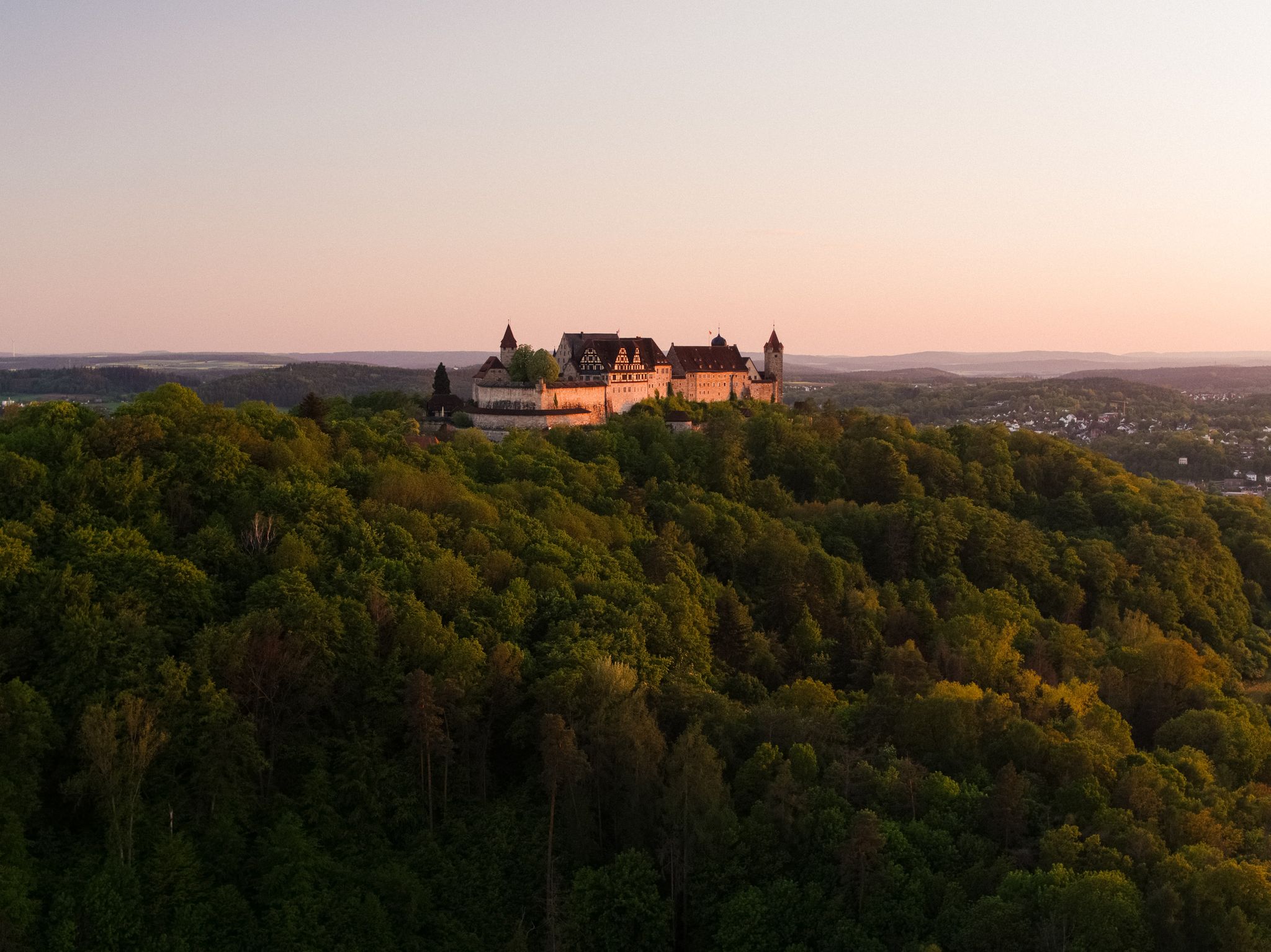
Heldburg Fortress was a high medieval hilltop castle that was rebuilt in the 16th century as a Renaissance-style palace. It rises 113 meters above the town of Heldburg in the Heldburg region, the southernmost tip of the Hildburghausen district in Thuringia, on a 405-meter-high volcanic cone belonging to the former Heldburger Gangschar volcanic region. Founded in the 12th or 13th century, it has been called the "Franconian Light" since the 14th century due to its prominent location, a counterpart to the "Franconian Crown," the nearby Coburg Fortress. Heldburg Fortress is the only Thuringian fortress listed as a sight on the Castle Road. The French-style building of the fortress houses the German Castle Museum, which opened in September 2016. Source: https://de.m.wikipedia.org/wiki/Veste_Heldburg
12
0
Heldburg Fortress acquired its appearance mainly in the 16th and 19th centuries. However, its history goes back much further, probably to the 12th century. The Renaissance architect Nikolaus Gromann had a decisive influence on the design of the complex. He is to be credited with having transformed the medieval castle into a representative ensemble - one with outstanding art-historical significance. He did not simply tear down what had been left behind, but cleverly integrated it into the new building project. The French building, built from 1560 onwards, is now the architectural highlight of the fortress. Source: https://www.thueringerschloesser.de/objekt/veste-heldburg/
17
0
He directed, designed costumes and stage sets, wrote treatises on director's theatre and helped the Meiningen court orchestra to new fame. George II of Saxe-Meiningen became famous as the "Theater Duke" and went down in history. Influenced by the castle romanticism of the 19th century, he realized his romantic ideas of a fairytale castle at Veste Heldburg. However, a major fire in 1982 destroyed much of the precious interior. Today, the German Castle Museum invites you to visit. Source: https://www.thueringerschloesser.de/objekt/veste-heldburg/
16
0

A completely normal mountain where a radio mast stands. Not 300 meters further is the Raueneck ruins
1
0
Frequently Asked Questions
What are some notable elevated features and viewpoints around Seßlach?
While Seßlach is not known for towering alpine summits, the region offers picturesque elevated natural features and scenic viewpoints. Key highlights include the unique Heldburg Fortress, which provides panoramic views, and the Buchberg, offering views of surrounding fields. The Christenstein Rock Formation is another natural monument accessible via hiking routes, and the Staffelberg, though not directly in Seßlach, is a significant mountain with striking rock formations and spectacular views, even reaching Veste Coburg on clear days.
Are there any historical sites among the peaks near Seßlach?
Yes, the region around Seßlach is rich in history. A prominent historical site is Heldburg Fortress, a beautifully restored castle housing the German Castle Museum. Another significant historical feature is the Kulch Summit and Ring Wall (483 m), a wooded hilltop that suggests a larger historical facility from ancient times.
What makes Heldburg Fortress a popular peak to visit?
Heldburg Fortress is highly popular due to its status as one of Germany's most beautiful castle complexes, immaculately restored and housing the German Castle Museum. Visitors enjoy the comprehensive presentation of castle history and the unique worldwide exhibition. From its tower, you can experience panoramic views stretching across the Thuringian Forest, the Rhön, the Haßberge, and the Frankenwald.
What can I expect when visiting Buchberg?
Buchberg offers a pleasant forest path experience. About halfway along the path, you'll find a bench providing views of the surrounding fields. While the 'summit' itself is wooded, the trails around it are popular for walks, though they can be muddy after rain.
What is the Kulch Summit and Ring Wall known for?
The Kulch Summit and Ring Wall (483 m) is a wooded hilltop known for its geological significance as part of the iron mountain limestone landscape. It's also a historical site, with remnants suggesting a larger ancient facility. The mountain is constructed of 40m thick iron sandstone, once valued as silver sand.
What kind of hiking trails can I find around Seßlach's elevated features?
The area around Seßlach offers a variety of hiking trails, from leisurely strolls to more challenging climbs. You can find routes like the 10.4 km circular loop from Seßlach Old Town to the Christenstein Rock Formation, or longer trails such as a 19 km route to Lichtenstein that traverses the varied landscape and offers views of the Haßberge Nature Park. For more options, explore the Hiking around Seßlach guide.
Are there family-friendly hiking options near Seßlach?
Yes, many trails around Seßlach are suitable for families. The undulating landscape and moderate elevation gains make for enjoyable outings. For example, the 10.4 km circular loop to the Christenstein Rock Formation is considered a moderate hike. When planning, look for trails with manageable distances and elevation, often found along the River Itz or leading to scenic viewpoints.
Can I go mountain biking or gravel biking near Seßlach's peaks?
Absolutely! The region around Seßlach is well-suited for cycling. You can find numerous routes for both mountain biking and gravel biking. For gravel biking, consider routes like 'Beer & wine – gravel in the Hassberge Hills' or 'Rothenberg Gate Tower – Seßlach City Wall loop'. For mountain biking, options include 'Rothenberg Gate Tower – Billmuthausen Memorial loop' or 'Tambach Castle – Goldbergsee loop'. More details are available in the Gravel biking around Seßlach and MTB Trails around Seßlach guides.
What is the best time of year to hike the peaks around Seßlach?
The best seasons for hiking around Seßlach are spring and autumn. During these times, the weather is mild, and the natural scenery is particularly vibrant, with wildflowers blooming in spring or colorful foliage in autumn. While some trails may be groomed for cross-country skiing in winter, spring and autumn offer the most pleasant conditions for hiking.
What is the general elevation of the elevated features around Seßlach?
The immediate Seßlach area is characterized by an undulating landscape rather than towering peaks. The highest point recorded in terms of general elevation for a circular route is around 398 meters, with a total ascent of approximately 280 meters on a 12.2 km route. Features like the Kulch Summit and Ring Wall reach 483 meters.
Are the trails around Seßlach dog-friendly?
Many of the hiking trails in the Seßlach region are dog-friendly, allowing you to explore the picturesque landscape with your canine companion. It's always a good idea to keep dogs on a leash, especially in nature reserves or areas with wildlife, and to carry water for them.
Are there any circular hiking routes around Seßlach?
Yes, there are several circular hiking routes available. An example is the 10.4 km circular loop from Seßlach Old Town that leads to the Christenstein Rock Formation. Other options can be found in the Hiking around Seßlach guide, such as 'Rundweg durch den Bürgerwald Seßlach' or 'Seßlach Old Town – Teufelsstein Sculpture loop'.
What should I wear for hiking in the Seßlach region?
For hiking in the Seßlach region, it's advisable to wear comfortable, layered clothing suitable for the season. Sturdy hiking shoes are recommended, especially for trails that can be muddy after rain or involve moderate ascents. Bringing water, snacks, and sun protection is also wise, regardless of the season.
Most popular routes around Seßlach
Most popular attractions around Seßlach

Get inspired with the komoot mobile app


Explore more
See even more amazing summits around Seßlach with these guides:
