Top 14 Caves around Langenbach bei Kirburg
Best caves near Langenbach bei Kirburg offer a diverse range of underground attractions within the surrounding Westerwald region and broader Rhineland-Palatinate. While natural caves are limited directly in the town, the area features significant natural cave systems and historical mines. These sites provide insights into geological formations and past mining activities. Visitors can explore a variety of unique subterranean environments.
Best caves around Langenbach bei Kirburg
- The most popular caves is Assberg slate mine, a historical site and cave…
Last updated: June 26, 2026
Assberg slate mine
Highlight • Cave
Translated by Google •
Tip by

Peterszeche Mine Tunnel and Shelter
Highlight • Historical Site
Translated by Google •
Tip by

Sign up now to discover places like this
Get recommendations on the best single tracks, peaks, & plenty of other exciting outdoor places.
Sign up for free
Stair Path to the Historical Slate Mine Limbach
Highlight • Trail
Translated by Google •
Tip by

Grube Edelstein Visitor Mine
Highlight • Historical Site
From Easter Monday to the end of October, the "Grube Edelstein" is open to visitors every second Sunday of the month without registration.
Currently …
Translated by Google •
Tip by

Limbach Grotto (Madonna Shrine)
Highlight • Cave
Translated by Google •
Tip by

Sign up for free to discover even more caves around Langenbach bei Kirburg.
Sign up for free
Already have an account?
Start today with a free account
Your next adventure awaits.
Login or Signup
Tips from the Community

Open every second Sunday from 2pm to 5pm (or by appointment)
2
0
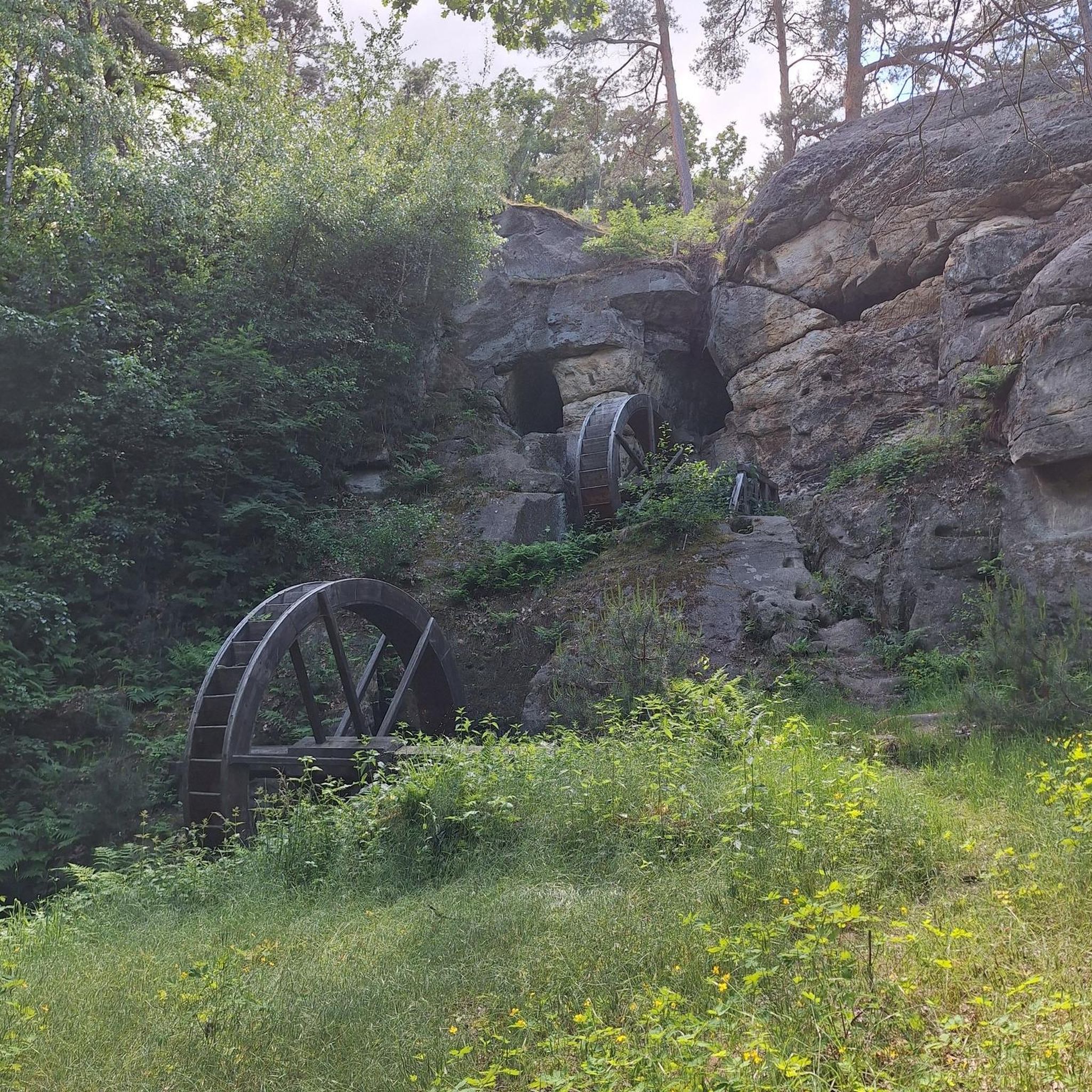
The first records of mining activity in the Luckenbach district date back to 1685/1686. The Edelstein brown iron ore mine runs from the tunnel entrance in the Hardt area, approximately 220 meters northwest, and was operated until around 1922, but became uneconomical. At the end of World War II, the tunnel served as an air-raid shelter. While the men were at war, the population, mothers and children, had to take refuge in the tunnel when air raid warnings sounded. Nowadays, however, only part of the mine is accessible due to overburden deposits. For safety reasons, a solid door was installed in the entrance area. From time to time, guided tours of the mine are offered, which I highly recommend.
3
0

splendid
2
0

Former Edelstein ore mine. The former mine, whose tunnel mouth was reopened in 1991, is located in the Luckenbach district. It was apparently an underground mine operated by hand, as the first information from 1860 suggests. The ore was mined here between 1844 and 1920. The tunnel can also be visited.
2
0

This steep staircase is a very welcome change after all the very wide and flat paths!
0
0
The climb is worth it
1
0

Here there are only the steps up to the mine. Not really suitable as a cycling highlight. There is, however, a path up from the monastery for bicycles, although it is quite steep.
0
0

Information about the Edelstein mine: https://www.luckenbach-ww.de/gemeinde/grube-edelstein/ From Easter Monday to the end of October, the "Grube Edelstein" is open to visitors every second Sunday of the month without registration. Currently (4/2024) guided tours take place from 2 p.m. to 5 p.m. (from 3 p.m. to 6 p.m. the village café in the nearby Backes offers coffee, cake and drinks, highly recommended!) The tunnel leads about 100 meters into the mountain, widens in the rear part and branches off into outgoing tunnels. A water-filled shaft leads into the depths to lower levels.
5
0
Frequently Asked Questions
What types of underground attractions can I explore near Langenbach bei Kirburg?
The region around Langenbach bei Kirburg offers a mix of historical mines and natural cave systems. You can explore former slate mines, visitor mines with guided tours, and natural caves formed by geological processes. These sites provide insights into both the area's industrial past and its unique geological formations.
Are there any historical mines I can visit in the area?
Yes, the region is rich in historical mining sites. A notable example is the Assberg slate mine in Limbach, which was initially an open pit before transitioning to underground mining. It offers an authentic glimpse into the daily work of slate miners and can be explored without a guide. Another is the Grube Edelstein Visitor Mine, which offers guided tours into a 100-meter tunnel.
What is the Herbstlabyrinth-Adventhöhle System and where is it located?
The Herbstlabyrinth-Adventhöhle System, located in Breitscheid in the Westerwald region, is Hesse's largest and one of Germany's most significant cave systems. Its accessible section, the 'Knöpfchenhalle,' is one of Germany's largest single cave rooms, featuring diverse stalactite formations and Europe's first complete LED lighting concept. Guided tours are available, and visitors can even touch a 30,000-year-old cave bear bone.
Are there any family-friendly caves or underground sites?
The Peterszeche Mine Tunnel and Shelter is categorized as family-friendly. Additionally, the Elfengrotte (Käsegrotte) in Bad Bertrich, with its unique basalt formations resembling 'cheese wheels' and proximity to the Elbesbach waterfall, is a popular destination for families and can be explored via several nearby hiking trails.
What are the Birresborn Ice Caves and what makes them unique?
The Birresborn Ice Caves, located in the Volcanic Eifel, are largely man-made tunnels from historical basalt quarrying. They are unique because specific airflow dynamics maintain temperatures between -1 and +6 degrees Celsius year-round, allowing ice formations to persist well into summer after cold winters. They were historically used as natural refrigerators and are crucial winter habitats for bats.
What should I wear when exploring caves in the region?
For cave exploration, especially in sites like the Birresborn Ice Caves, it's advisable to wear sturdy shoes due to potentially uneven terrain. Given the consistent cool temperatures (around 9°C in Herbstlabyrinth-Adventhöhle and -1 to +6°C in Birresborn) and high humidity, warm clothing is recommended. Bringing a torch and potentially a helmet can also enhance safety and visibility in less developed caves.
Are there any caves with unique natural features or geological significance?
Yes, the Herbstlabyrinth-Adventhöhle System showcases diverse stalactite formations and is a protected nature reserve. The Elfengrotte (Käsegrotte) in Bad Bertrich features unique basalt lava formations from ancient volcanic activity. The Birresborn Ice Caves highlight the region's volcanic geology and the natural phenomenon of persistent ice formations.
Can I combine a cave visit with hiking?
Absolutely. Many underground sites are located along or near hiking trails. The Assberg slate mine is a popular resting spot for hikers on the Westerwaldsteig, Marienwanderweg, and Druidensteig trails. The Heinzelmann Caves are also situated on hiking routes, and the Elfengrotte can be accessed via several nearby hiking trails. For more hiking options, explore the Hiking around Langenbach bei Kirburg guide.
What are the access restrictions for the Birresborn Ice Caves?
Due to their importance as crucial winter habitats for bats, access to the Birresborn Ice Caves is restricted from October to April. Visitors planning to explore these caves should check local information for current access regulations outside of these months.
Is public transport available to reach any of the caves?
While specific public transport routes directly to all individual caves may vary, the Assberg slate mine is a well-known landmark in the Westerwald region, which can be accessed via public transport to nearby towns, followed by a hike. It's advisable to check local bus or train schedules for the most up-to-date information when planning your visit.
What is the Felsenstübchen (Froneck-Nister Castle Ruins)?
The Felsenstübchen (Froneck-Nister Castle Ruins) is a historical site and natural monument that includes a small cave formation. It's a unique spot that combines historical ruins with natural rock features, offering a glimpse into both the past and the geological landscape of the area.
Are there any cycling routes near the caves?
Yes, the region offers various cycling opportunities. You can find several routes for road cycling and touring bicycles around Langenbach bei Kirburg. For example, the Cycling around Langenbach bei Kirburg guide lists routes like the 'Elkenrother Weiher loop' and 'Bench With View of Friedewald loop' which can be combined with visits to nearby attractions.
Most popular routes around Langenbach bei Kirburg
Most popular attractions around Langenbach bei Kirburg

Get inspired with the komoot mobile app


Explore more
Extend your search for the best caves by checking out these guides of the top ones around Langenbach bei Kirburg:
