Attractions and Places To See in the Aydin Mountains - Top 20
Best attractions and places to see in the Aydin Mountains are found in Turkey's Aegean region, offering a diverse range of historical sites and natural landscapes. The area encompasses ancient cities, archaeological sites, and national parks, providing opportunities to explore both cultural heritage and natural beauty. This region is characterized by its blend of historical significance and varied terrain, from coastal areas to mountain highlands. It serves as a destination for those interested in ancient civilizations and outdoor exploration.
Best attractions and places to see in the Aydin Mountains
- The most popular attractions is Celsus Library, a historical site that was once the third largest library in the world. It is an impressive ancient structure, built around 100 BC.
- Another must-see spot is Ephesus Archaeological Site, a historical site known as a vital port city of the Roman Empire. Visitors can explore structures like the Celsus Library, Hadrian's Temple, and the Great Theatre.
- Visitors also love Arcadian Street, a historical site that was an 11 meter wide and 530 meter long street lined with columns. It was one of only three streets in the Roman Empire to have street lighting.
- Aydin Mountains is known for its ancient cities, archaeological sites, and national parks. The region offers a variety of attractions to see and explore, from historical ruins to natural wonders.
- The attractions in the Aydin Mountains are appreciated by the komoot community, with 72 upvotes and 374 photos shared across 43 highlights.
Last updated: June 23, 2026
Celsus Library
Highlight • Historical Site
Translated by Google •
Tip by

Ephesus Archaeological Site
Highlight (Segment) • Historical Site
Translated by Google •
Tip by
Sign up now to discover places like this
Get recommendations on the best single tracks, peaks, & plenty of other exciting outdoor places.
Sign up for free
Ancient City of Ephesus
Highlight (Segment) • Historical Site
Translated by Google •
Tip by
Roman Latrines at Ephesus
Highlight • Historical Site
The latrinas were a fairly advanced and civilized structure for their time. The building was built over a canal with a continuous flow of water. The seats were marble benches with holes in the bottom. They were arranged in three rows along the three sides of the room. There were 48 toilets in total, each separated by carved partitions that doubled as armrests. The seats themselves were surrounded by columns that would have supported a roof.
ephesusturkey.com/ephesus-highlights/latrinas
Translated by Google •
Tip by

Church of Saint Demetrios (Aziz Dimitrios Kilisesi), Şirince
Highlight • Religious Site
The earliest written accounts of the life of Demetrios were collected in the 9th century, although there are some earlier pictures of him. There is also a collection of sermons written in Greek, describing the miracles he performed. According to these early accounts, Demetrios was born into a family of pious Christians from Thessaloniki. He is presented as a young man from a senatorial family who died a martyr's death, run through with spears around 306 CE, during the Christian persecutions of Galerius and Diocletian.
The church dedicated to Saint Demetrios in Şirince was the starting point of a five-hour pilgrimage of the faithful to the House of the Mother of God, now known as Meryemana. The procession started on the 15th of August every year, and followed the trail to the House of Mary on the hill of the Nightingales, on the other side of the town of Selçuk, about 15 kilometres west of Şirince.
These pilgimages continued until the 1920s when the Treaty of Lausanne ordered a population exchange between Turkey and Greece. From that moment the village was inhabited by Muslims. The Church of Saint Demetrios and the Church of John the Baptist were abandoned and gradually fell into disrepair. The roof of the Church of Saint Demetrios collapsed, and the general renovation carried out in 2015 restored the church to its former glory.
While visiting the church, it is worth to pay attention to the preserved iconostasis — a decorative wall of icons and religious paintings, separating the nave from the sanctuary. From the vestibule of the church, there is a beautiful view of the part of the village, olive groves, and arable fields.
(turkisharchaeonews.net/city/%C5%9Firince)
Tip by

House of the Virgin Mary (Meryem Ana Evi)
Highlight • Religious Site
de.wikipedia.org/wiki/Haus_der_Mutter_Maria
de.wikivoyage.org/wiki/Ephesos
Translated by Google •
Tip by

Temple of Artemis at Ephesus
Highlight • Historical Site
Translated by Google •
Tip by
Hadrian's Temple
Highlight • Historical Site
Translated by Google •
Tip by
Şirince Village
Highlight • Settlement
[Wikipedia]
Translated by Google •
Tip by

Arcadian Street
Highlight • Historical Site
Translated by Google •
Tip by
Sign up for free to discover even more attractions in the Aydin Mountains.
Sign up for free
Already have an account?
Start today with a free account
Your next adventure awaits.
Login or Signup
Tips from the Community

On Sunday there will be a Holy Mass in English at 10:30 am outside
0
0

The Roman Latrine of Ephesus was built in the 1st century AD as part of what would become the Baths of Scholastica. They were the city's public toilets for poor citizens who could not afford a toilet at home, and an entrance fee was charged. However, the latrines were not used exclusively for relieving oneself. In Roman culture, this building served the same social purpose as the baths. Citizens would stay in the latrines for long periods of time to relax and discuss their daily worries. The latrinas were a fairly advanced and civilized structure for their time. The building was built over a canal with a continuous flow of water. The seats were marble benches with holes in the bottom. They were arranged in three rows along the three sides of the room. There were 48 toilets in total, each separated by carved partitions that doubled as armrests. The seats themselves were surrounded by columns that would have supported a roof. https://www.ephesusturkey.com/ephesus-highlights/latrinas/
0
0

The Temple of Artemis was the largest temple in the ancient world. Because of its imposing size and its sculptures richly decorated with precious stones, it was considered one of the 7 wonders of the world.
10
0
The Hafenstrasse was an 11m wide and 530m long street lined with columns that led to the harbor. It was one of only three streets in the Roman Empire to have street lighting.
9
0
The Celsus Library was built around 100 BC. built. At its time, it was the third largest library in the world, after Alexandria and Pergamon. A fire and an earthquake in the 3rd century. AD, destroyed the library and with it the extensive knowledge that was recorded in the many scrolls.
11
0
The Temple of Hadrian was built in honor of the Roman Emperor Hadrian, who reigned from 117 - 138 AD. ruled, built. Hadrian was considered a "peace emperor" because he focused less on conquest and more on securing the empire's borders.
10
0

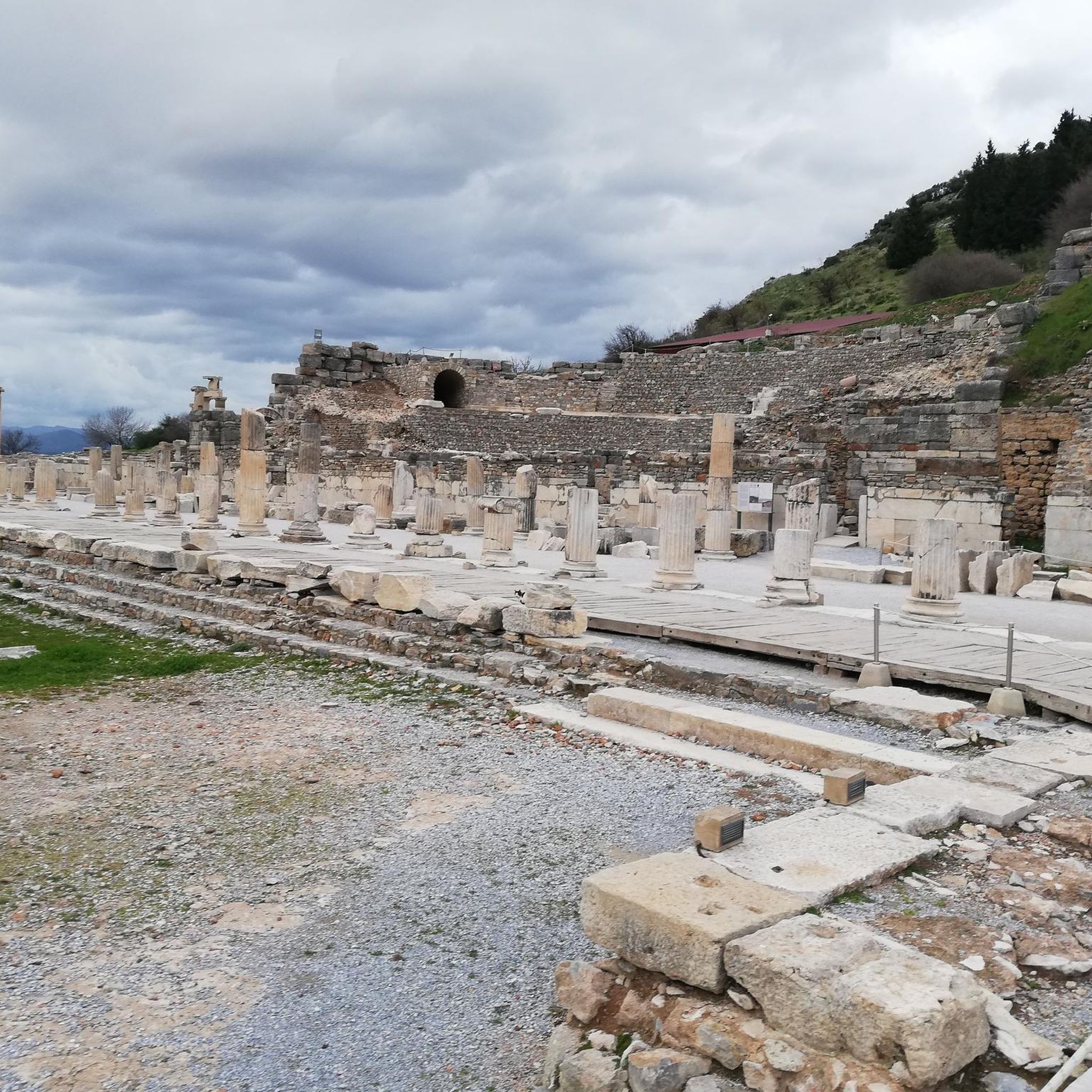
Very wide and beautiful path paved with marble stones.
3
0
The Library of Celsus was an impressive ancient library in the city of Ephesus. It was built in the 2nd century AD in honor of the Roman senator Tiberius Julius Celsus Polemaeanus. The library was known for its impressive architecture and its collection of over 12,000 scrolls. The building had two floors and was decorated with statues and reliefs. Unfortunately, over time the library was damaged and largely destroyed by earthquakes and fires. However, some parts of the facade have been preserved and can still be admired today. The Celsus Library is a popular destination for visitors interested in ancient history.
6
0
Frequently Asked Questions
What are the main historical attractions in the Aydin Mountains region?
The Aydin Mountains region is rich in historical sites. Key attractions include the UNESCO World Heritage Site of Ephesus Archaeological Site, where you can explore the Celsus Library, Hadrian's Temple, and the Great Theatre. Other significant sites are Aphrodisias Ancient City, known for its sculptures, Didyma Ancient City with its impressive Temple of Apollo, and the ancient cities of Milet and Priene. The House of the Virgin Mary also holds significant historical and religious importance.
What natural attractions can I explore in the Aydin Mountains?
The region offers diverse natural beauty. You can visit the Dilek Peninsula-Büyük Menderes Delta National Park for lush nature and wildlife, or explore the impressive Karpuzlu Canyon and Arapapıştı Canyon for hiking and scenic views. Lake Bafa Nature Park is an important bird sanctuary, and the coastal areas offer beaches like Kadınlar Beach and Altınkum. Don't miss Zeus Cave near Dilek Peninsula National Park.
Are there family-friendly activities or sites in the Aydin Mountains?
Yes, several attractions are suitable for families. The Ancient City of Ephesus and the House of the Virgin Mary are listed as family-friendly. The Arcadian Street in Ephesus is also noted as family-friendly. Additionally, national parks like Dilek Peninsula-Büyük Menderes Delta National Park offer opportunities for picnicking and easy nature walks.
What kind of outdoor activities can I do in the Aydin Mountains region?
The Aydin Mountains region is excellent for outdoor enthusiasts. You can enjoy hiking in areas like Dilek Peninsula-Büyük Menderes Delta National Park, Karpuzlu Canyon, and Arapapıştı Canyon. The region also offers road cycling and running trails. For specific routes, you can explore hiking routes, road cycling routes, and running trails available in the Aydin Mountains.
Are there hiking opportunities near the historical sites?
Yes, there are hiking opportunities that allow you to explore historical sites. For instance, you can find easy hiking loops around the Ephesus Archaeological Site, such as the Arcadian Street – Great Theatre of Ephesus loop or the Arcadian Street – Celsus Library loop. The charming Şirince Village also offers an easy hiking loop.
What is the best time of year to visit the Aydin Mountains?
The Aydin Mountains region is best visited during spring (April-May) and autumn (September-October) when the weather is mild and pleasant for exploring both historical sites and natural landscapes. Summers can be very hot, especially for archaeological sites, while winters are generally mild but can have some rain.
Can I find ancient Roman or Greek ruins beyond Ephesus?
Absolutely. Beyond Ephesus, the Aydin Mountains region boasts several other significant ancient sites. These include Aphrodisias Ancient City, famous for its Roman ruins and sculptures; Didyma Ancient City with its monumental Temple of Apollo; Milet Ancient City featuring a large theatre; Priene Ancient City, an excellent example of ancient architecture; and Nysa Ancient City, known for its well-preserved theatre and library.
Are there any unique villages or cultural experiences to visit?
Yes, the charming Şirince Village is a must-visit, known for its traditional architecture and serene atmosphere. Kuşadası is a popular resort town with historical sites like Güvercinada Castle and Kuşadası Caravanserai. The region also features Ottoman landmarks such as the Nasuh Paşa Complex and Süleyman Bey Mosque in Aydın's center.
Where can I find beaches or thermal springs in the Aydin Mountains region?
For beaches, the coastal areas near Kuşadası offer popular spots like Kadınlar Beach and Altınkum. If you're interested in thermal springs, the Aydın province is known for its mineral and thermal waters, with spa facilities available in districts such as Buharkent, Germencik, Söke, Ortakçı, and İmamköy.
What do visitors enjoy the most about the historical sites in the Aydin Mountains?
Visitors frequently express awe at the well-preserved ancient structures. Many appreciate the ability to picture life in antiquity at sites like the Celsus Library and the Ephesus Archaeological Site. The impressive scale and architectural detail of buildings like Hadrian's Temple and the Roman Latrines are also highly praised, offering a profound sense of history.
Are there options for cycling in the Aydin Mountains?
Yes, the Aydin Mountains offer various road cycling routes for different skill levels. You can find routes like the Basilica Site of St. John loop from Selçuk or a roadbike loop from Kuşadası. For more details and route options, refer to the Road Cycling Routes in the Aydin Mountains guide.
What are some lesser-known natural wonders in the Aydin Mountains?
Beyond the well-known national parks, consider exploring the highlands such as Madran Highland in Bozdoğan and Pasha Highland in Efeler, which offer clean air and lush nature for walks. The northern shore of Lake Bafa Nature Park, rising into the slopes of the Beşparmak (Latmos) Mountains, also hides Byzantine-era monastery ruins amidst its untouched beauty.
Is public transportation available to reach attractions or trailheads?
While some major towns like Selçuk (near Ephesus) are accessible by public transport, reaching specific archaeological sites or remote trailheads in the Aydin Mountains often requires private transport, taxis, or organized tours. It's advisable to check local transport options for your specific destination in advance.
Most popular routes in the Aydin Mountains

Get inspired with the komoot mobile app


