The best gravel rides around Moussonvilliers
4.4
(5)
14
riders
4
rides
Gravel biking around Moussonvilliers offers diverse terrain within the Perche Natural Regional Park, an area characterized by a mosaic of environments. The region features bocage countryside with hedged fields and sunken lanes, alongside extensive forests and rolling hills. Quiet country roads and cultivated plateaus provide varied gradients and surfaces suitable for gravel cycling. This landscape includes significant elevation changes and offers scenic views.
Best gravel bike trails around Moussonvilliers
- The most popular gravel bike trail is Brasserie du Perche –…
Last updated: July 6, 2026
4.5
(2)
3
riders
Hard gravel ride. Very good fitness required. Mostly paved surfaces. Suitable for all skill levels.
4.3
(3)
7
riders
Moderate gravel ride. Good fitness required. Mostly paved surfaces. Suitable for all skill levels.

Sign up for free
2
riders
27.7km
01:45
160m
160m
Moderate gravel ride. Good fitness required. Mostly paved surfaces. Suitable for all skill levels.
2
riders
30.3km
01:56
130m
130m
Easy gravel ride. Great for any fitness level. Mostly paved surfaces. Suitable for all skill levels.
Our route recommendations are based on thousands of hikes, rides, and runs completed by other people on komoot.
Start today with a free account
Your next adventure awaits.
Login or Signup
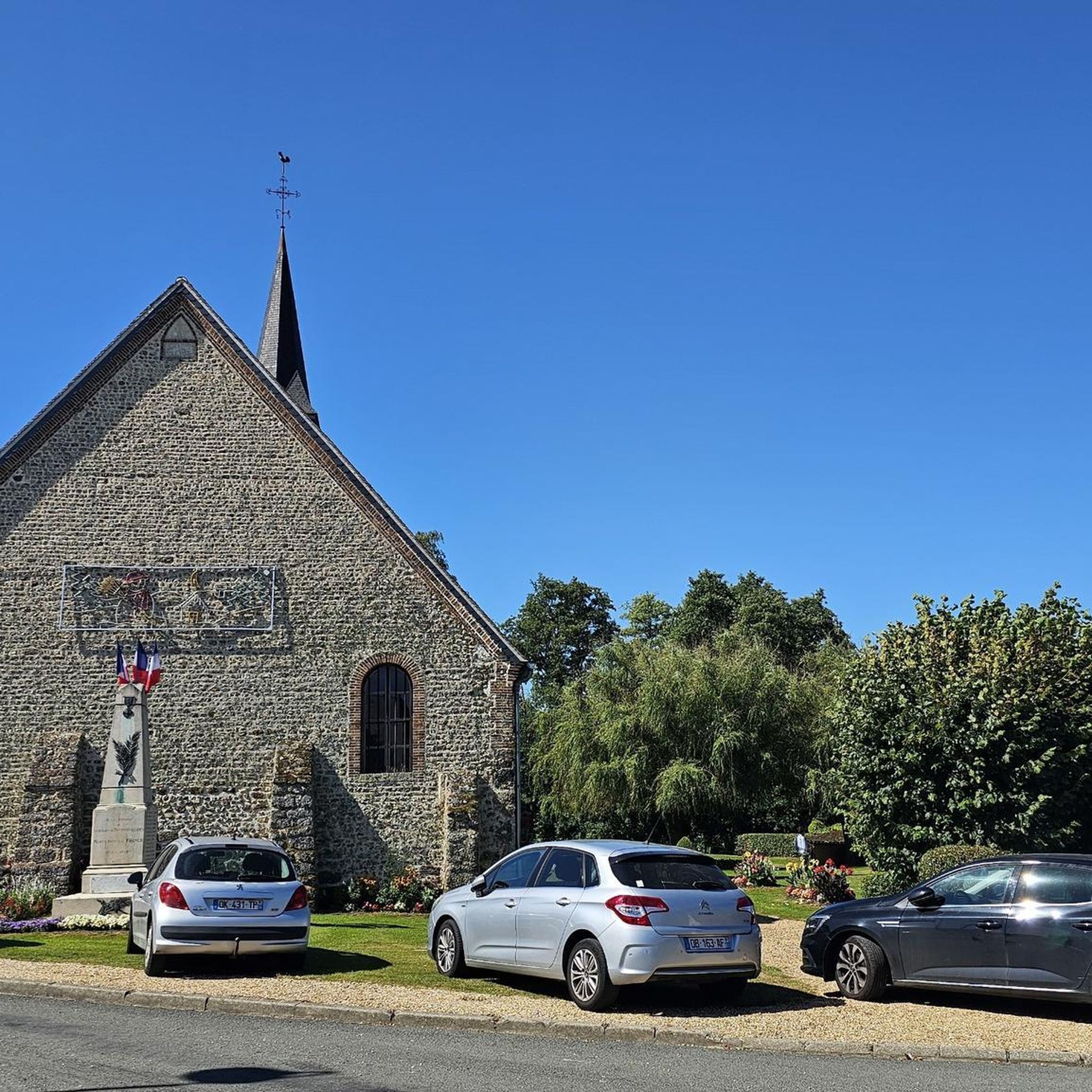
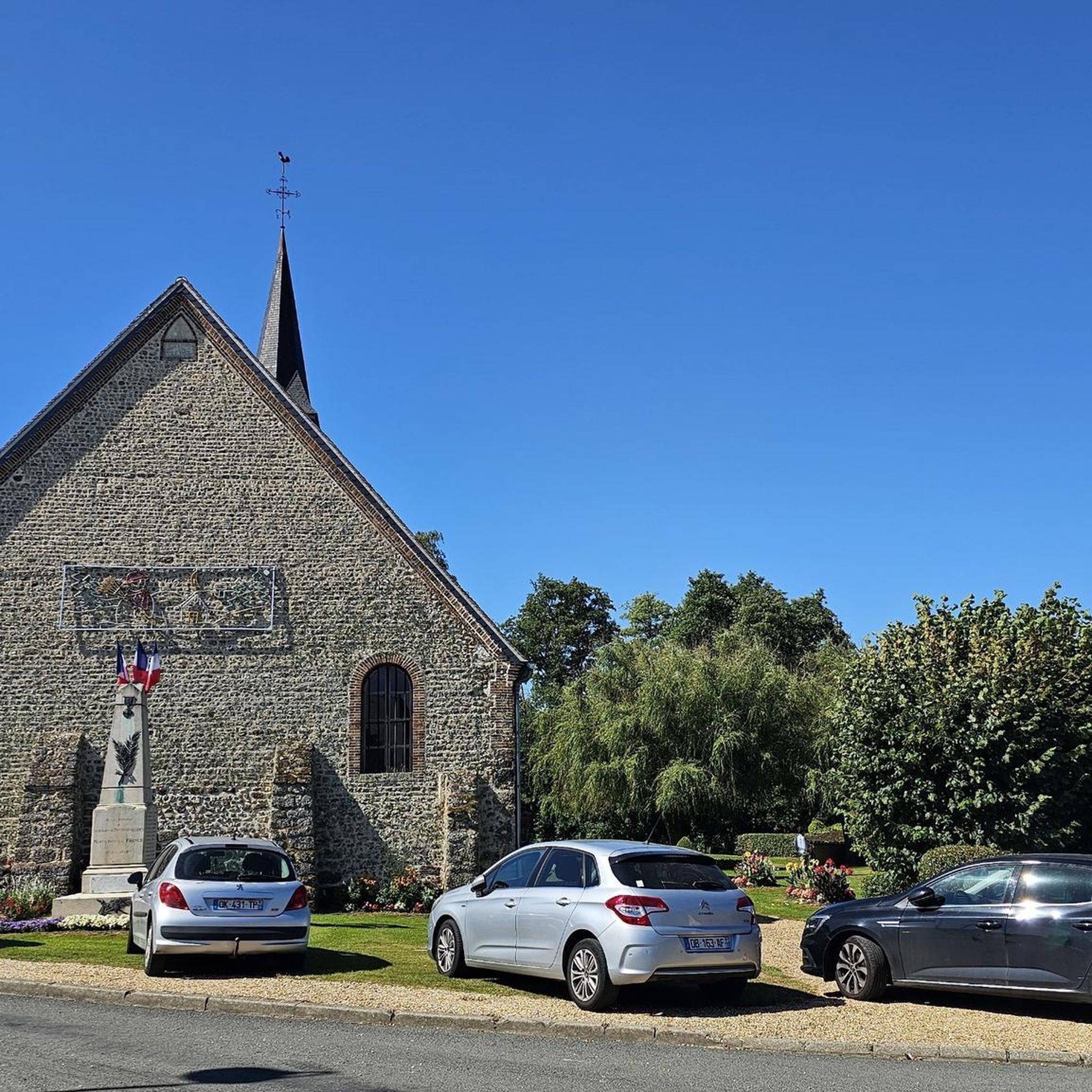


Tips from the Community

The church is closely inserted between the castle park and the houses of the village, which presents a harmonious ensemble of buildings from the 18th and early 19th centuries, combining flint and brick with lime plaster tinted with ochre. You have to step back a little to see its apse, the foundation of which probably dates back to the Romanesque period. Next to the entrance gable, dressed in Grison rubble, the bell tower was built in 1867 (according to the inscription preserving the names of the mason Gelin and the carpenter Hallier, with those of the priest, Abbot Porcher, the mayor, Viscount des Brosses, and the municipal councilors). The nave is extended by a rounded apse, with thick walls pierced by widely splayed semicircular openings, between which are placed the statues of Saint Sebastian, the Virgin and Child, Saint Michael and the dragon, and a holy bishop. On the "perque" (or beam of glory), a large Christ surrounded by the Virgin and Saint John. The transverse chapel, on the right, from the 15th or 16th century, vaulted with ribs resting on four pendentives with a central key carved like lace, was the seat of the brotherhoods. It houses the more recent statues of Saint Sebastian, the Virgin, Saint Michael and a holy bishop. The seigneury of Chennebrun, which belonged successively to Saint-Simon de Courtomer (1650), Caumont de la Force (1670), Grimoard de Beauvoir (1688), Laval Montmorency (1714), d'Espinay Saint-Luc (1765), etc., was acquired during the Restoration by Jacques-Alexandre Giroult des Brosses, whose father had been mayor of Dreux in 1771. In the seigneurial chapel on the left, inscriptions recall the names and dates of the members of this family linked for more than four generations to the life of the commune. We are grateful to them for having admirably maintained the castle, whose 18th century façade and the entrance to the park are visible from the gate. Their coat of arms appears on the stained glass window of this chapel, where we recognize in the center those of a Laval-Montmorency, Lord of Chennebrun, knight of honor of the Duchess of Orléans, master of the cavalry camp, who died in 1757, as indicated by his funerary slab on the threshold. The numerous 19th century stained glass windows with the names of the donors are worth seeing in detail. The one in the center, in the choir, lifts us to the sky with Our Lady of the Assumption. The statue of Mary, patron saint of Chennebrun, never ceases to watch over her church.
0
0
The church dedicated to Saint Christopher was under the patronage of the Abbey of Saint-Père de Chartres in the 12th century. Of Romanesque origin, the building was extensively enlarged and remodeled during the 16th and 19th centuries; it is currently undergoing a general restoration. This church owes its fame to the automobile pilgrimage held on the last Sunday in July. The single-aisled building, preceded by a porch, consists of a nave and a choir with a recessed flat chevet. To the south are the bell tower and a chapel. The use of traditional materials in this part of Normandy—flint and grison, a locally quarried ferruginous stone—indicates that the oldest parts of the building are of medieval origin. The nave is built of rubble masonry (grison and flint) set in mortar. In dressed stone, Grison was used to form, on one side, the corners of the exposed gable of the nave and, on the other, the corner buttresses, to frame the small arched openings, since walled up but still visible on the north and south walls, as well as the pointed arch of the portal. The same approach is found in the choir. The elevations are finished with a quarter-round cornice, part of which is also made of Grison stone. The use of brick corresponds to the 19th-century interventions, in two phases of work whose completion date is unknown. An examination of the construction reveals a first phase of repairs to the openings, particularly in the choir and nave, where large rectangular openings with curved lintels were created, the bricks of which are light in color. This was followed by further interventions with pointed arched openings framed in purplish brick, some of which replaced the rectangular openings of the previous phase. The porch features an ornate gable of light-colored, rendered brickwork, flanked by brick and chipped flint pilasters, and pierced by a central bay framed in brick and topped with a niche; the side sections are timber-framed on a masonry base. The southern flank of the building was added during the 16th century to a vast chapel and a bell tower, made of rubble blockwork, in which bays are pierced, framed in limestone, with curved profiles in the case of the bell tower. Restoration work has revealed several molded courses on the south face of the chapel, corresponding to a bay removed during later restorations, which confirm the dating of this part of the building. This chapel opens onto the nave through a large arcade adorned with several rows of moldings, resting on simple square piers devoid of decoration, with animal figures (reused?) at their bases, unearthed during the restoration work. The interior is remarkably simple, with whitewashed walls and geometric stained-glass windows. Only the choir is more ornate; its entrance is marked by a stone arch resting on hexagonal piers with historiated capitals, where a sculpted frieze of foliate ornaments, figures, and a coat of arms unfolds. The church has a painted faux-marble altarpiece, above which are visible traces of incomplete wall paintings depicting draperies. The rafter frame forming a truss was straightened and reinforced by restoring the removed or weakened kingposts and tie beams. According to tradition, the carpenters left the mark of their work by sculpting a scalloped ... The bell tower's belfry has also undergone a complete restoration. For this restoration, designed to strengthen the church and enhance its architecture, the Sauvegarde de l'Art Français (French Art Protection Agency) granted €10,000 in 2005.
0
0

A beautiful place for a hoppy break! Beautiful trails lead to the brewery.
0
0

Located on the former Norman border, it was one of the most important strongholds in the region. From its medieval past, it has preserved its round towers and traces of an old drawbridge. Visible from the path behind the church. Private property.
0
0
With a very simple plan, with its tiled nave and its small slate bell tower on the ridge, the church surrounded by its cemetery, set back from the road, overlooks the countryside planted with trees. The river is nearby, and its flowing water evokes that of the baptism of Jesus in the Jordan, as soon as we see the statue of the patron, Saint John the Baptist, in the choir. His arm raised towards the sky reminds us of his preaching in the desert of Palestine: "Prepare for the coming of the Messiah...". On the thin banner attached to his staff are written the words: "Ecce Agnus Dei", by which he already announced that he saw in Jesus the victim freely offering himself as a sacrifice for the Redemption of all men. Placed on the ground against the wall, a 17th century painting. depicts Jesus immersed up to his knees in the waters of the river, leaning with his hands crossed on his chest to receive the baptism of penance from the hand of John kneeling on the bank. We see “the Spirit descending on him like a dove” and we recall the words of John reported in the Gospel: “I am not worthy to bow down at his feet… I have baptized you in water; he will baptize you in the Holy Spirit.” Beside him, the angel wearing Jesus’ clothes turns his face towards a young child whom he guides with a hand placed on his shoulder, as if to teach him the profound meaning of baptism. Above the arch through which the nave opens onto the choir, the group of Christ on the cross surrounded by Mary and Saint John the Evangelist is a fine example of 16th century religious sculpture, faithful to traditional iconography. Similarly, at the back of the nave is the charming naive statue of Saint Fiacre: this young monk from Ireland loved to cultivate the vegetable garden of his monastery, near Meaux. Patron saint of gardeners, he holds his spade, and in the Perche region he was also invoked to cure various illnesses. More unique in style, the large Renaissance chest serving as a central altar was the former “work bench of the factory” reserved for the administrators of the parish’s resources and expenses. Let us admire the skill and imagination of the cabinetmaker who carved this series of full-length figures in oak under the arcades separated by “terms” inspired by Roman antiquity. Their distinctive attributes make us recognize Saints Christine, Barbara, Madeleine and Catherine on the front, and on the sides Saints Peter and Paul on the right, John the Baptist and Bartholomew on the left. Their silhouettes are more reminiscent of fairy tale characters…
0
0
Located in a green setting, this chapel of Romanesque origin has preserved all of its 16th century painted decor. An excellent overview of the artistic production of the period. Romanesque in origin and then remodeled in the 12th and 15th centuries, the chapel of Réveillon is one of the rare churches that have preserved their wall paintings. The richness of its treatment and themes is exceptional. We can still read on these walls a profusion of details such as a frieze of arabesques where birds, fruits and flowers are intertwined. Its varied themes represent, among others, The Dict of the Dead and the Three Living, the Passion, the Temptation, the Lives of the Saints and Martyrs, Saint Christopher, etc.
0
0
A flowery village, Moussonvilliers takes particular care of the surroundings of its church. By walking along flower beds, you can access it via the covered porch, off-centre with respect to the axis of the gable, the corners of which are reinforced with double buttresses. The church has two naves of unequal width, gathered under the same roof. Built in the 16th century, its poor condition probably required the alterations carried out in the 19th century. From the outside, you can see in particular the use of bricks for the repair of the windows and the cornices of the roof. Inside, between the two parallel naves, the four stone pillars cut into a prism, dating from the construction, carry a wide horizontal band along the entire length of the building (probably made of large beams covered in plaster, replacing the old stone arcades). This band reinforces the beams on which the "tie beams" of the exposed framework rest, and at the same time supports the fall of the two plaster vaults. These structural modifications nevertheless respect the general appearance of the building. At the central altar, the tabernacle evokes the parable of the Good Shepherd who carries the lost sheep on his shoulders. Above, the classical style altarpiece in wood with decorations enhanced with gold, is decorated in the center with a large painting of the Assumption of Mary taken up to heaven by angels. The landscape placed very low accentuates the upward movement of the composition. This painting, of a certain artistic quality, dated 1855, is signed by Claire Hombcrg. Two statues frame it in the niches: on the left, a pretty Virgin in polychrome stone from the 16th century. Crowned with fleurs-de-lys and draped in a blue cloak, she holds the infant Jesus, who stretches out his arm towards the object she is presenting to him (an apple or a bird? We do not know because the right hand is broken). On the other side, in polychrome wood from the 18th century, Saint Catherine of Alexandria reading a book, was once invoked as the patron saint of schools because of her in-depth education. She had in fact publicly and successfully refuted the erroneous theses of several philosophers whom she converted to the Christian faith. She suffered martyrdom in the 4th century. Other statues deserve particular interest. Leaning against a pillar, the 16th century, in stone, of Saint John the Baptist, his cloak raised over his bare legs, presenting the Mystic Lamb placed on the large book of the Bible. And also, from the same period, the small polychrome stone sculpture depicting the education of the Virgin Mary by Saint Anne. It is difficult to see the details because it is placed in a niche above the door. But it is a precious ancient testimony of the devotion to the patron saint of our parish Sainte-Anne-du-Perche. Finally, to the left of the door, the polychrome wooden statue of Saint Paul. The expression on his face reflects somewhat the ardor of his vocation as an apostle of Christianity. Converted by his vision of the road to Damascus, he devoted himself entirely to preaching the doctrine of Christ the Redeemer, traveling through the countries of the Hellenized East to found and lead new communities of baptized people. Thanks to him, the evangelical message was not limited to populations of Jewish culture, but was addressed to people throughout the world. His writings are an ever-current and living source of the doctrine of the Church, the body of Christ.
0
0
Frequently Asked Questions
What kind of terrain can I expect on gravel bike trails around Moussonvilliers?
The gravel bike trails around Moussonvilliers offer a diverse mix of terrain within the Perche Natural Regional Park. You'll encounter traditional bocage countryside with hedged fields and sunken lanes, extensive forests, and rolling hills. Quiet country roads and cultivated plateaus provide varied gradients and surfaces, making it ideal for gravel cycling.
Are there gravel bike routes suitable for beginners or families in Moussonvilliers?
Yes, there are options for various skill levels. For an easier ride, consider the Bois Francs Castle – Bois Francs Greenway loop from Pullay. This 12.6-mile (20.3 km) path features gentle gradients through wooded areas and past historical landmarks, making it a good choice for those new to gravel biking or looking for a more relaxed outing.
What are some notable landmarks or attractions I can see along the gravel bike trails?
Many routes pass by historical sites and natural beauty spots. For example, the Ferté-Vidame Castle – Brasserie du Perche loop from La Ferté-Vidame takes you near the impressive Ferté-Vidame Castle. You might also encounter the Bois Francs Castle on other routes, offering glimpses into the region's rich history.
Are there any long-distance gravel biking options or routes that are part of a larger network?
While specific long-distance gravel routes are not detailed in the local data, the Perche Natural Regional Park is notably crossed by the Véloscénie bike route, which connects Paris to Mont Saint-Michel. This indicates established infrastructure for longer cycling tours, and local gravel trails can often be linked to create extended adventures.
What is the best time of year for gravel biking around Moussonvilliers?
The region's diverse landscape, with its bocage, forests, and quiet country roads, is enjoyable across multiple seasons. Spring and autumn offer pleasant temperatures and beautiful scenery, with changing foliage or blooming wildflowers. Summer is also suitable, though some routes might be more exposed. Winter conditions could make some unpaved sections muddy, so checking local weather is advisable.
Are there any circular gravel bike routes available?
Yes, many of the gravel bike routes around Moussonvilliers are designed as loops. For instance, the popular Brasserie du Perche – Mairie la Lande sur Eure loop from La Ventrouze is a substantial 46.4-mile (74.7 km) circular trail exploring varied terrain. Another option is the Brasserie du Perche – La Brasserie du Perche loop from Marchainville.
What are the difficulty levels of gravel bike trails in the area?
The gravel biking routes around Moussonvilliers cater to a range of abilities. You'll find routes classified from moderate to difficult. For example, the Brasserie du Perche – Mairie la Lande sur Eure loop from La Ventrouze is considered difficult due to its length and elevation, while the Bois Francs Castle – Bois Francs Greenway loop from Pullay is an easy option.
Can I bring my dog on the gravel bike trails around Moussonvilliers?
The Perche Natural Regional Park, which surrounds Moussonvilliers, is generally welcoming to outdoor activities. While specific regulations for dogs on bike trails can vary, many natural areas in France allow dogs on leash. It's always best to check local signage or park guidelines for any specific restrictions on trails you plan to ride, especially within protected natural areas.
Where can I find parking for gravel biking routes in Moussonvilliers?
Many routes start from villages or specific points that offer parking. For example, routes like the Chapelle de Réveillon – Dovecote by the pond loop from Moussonvilliers typically begin from accessible locations within or near Moussonvilliers itself, where public parking is usually available. For routes starting from other towns like La Ventrouze or Pullay, parking can often be found near the designated starting points.
Are there cafes or places to stop for refreshments along the gravel bike trails?
The region is dotted with charming villages and small towns. While specific cafes on every trail are not guaranteed, planning your route to pass through places like La Ferté-Vidame (where the Ferté-Vidame Castle – Brasserie du Perche loop starts) or other local hamlets will likely provide opportunities for refreshments. The presence of the 'Brasserie du Perche' in several route names also suggests potential stops.
What makes the Perche Natural Regional Park a good location for gravel biking?
The Perche Natural Regional Park is ideal for gravel biking due to its 'mosaic of different environments'. It combines traditional bocage countryside with hedged fields and sunken lanes, extensive forests, and rolling hills. The presence of quiet country roads, VTT (mountain biking) trails, and varied gradients provides a perfect mix of paved and unpaved surfaces that gravel cyclists seek, all within a tranquil and picturesque setting.
How many gravel bike trails are available around Moussonvilliers?
There are at least 6 distinct gravel bike trails documented around Moussonvilliers, offering a good variety of distances and difficulty levels for exploration within the Perche Natural Regional Park.
Most popular routes around Moussonvilliers
Most popular attractions around Moussonvilliers

Get inspired with the komoot mobile app


Explore more
Browse the best Gravel rides in other regions.
