Easy hikes and walks around Henham
4.5
(334)
2,445
hikers
345
hikes
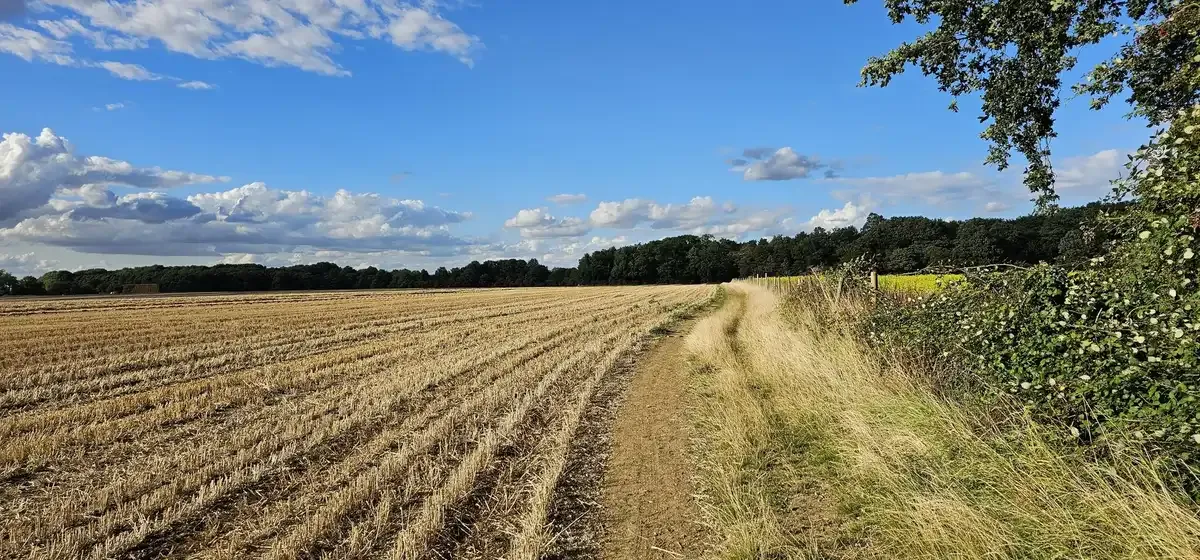
Easy hiking trails around Henham traverse a landscape characterized by gently sloping farmland, open countryside, and historic field boundaries. The terrain often features strong clay and loam soils, situated on Glacial Tills, with the village itself resting on a ridge. This area offers a mix of green spaces, mature trees, and some water features, providing varied environments for walkers.
Best easy hiking trails around Henham
- The most popular easy hiking route is Prior's Hall Barn – Widdington Village Sign loop…
Last updated: June 30, 2026
6
hikers
7.42km
01:58
70m
70m
Easy hike. Great for any fitness level. Easily-accessible paths. Suitable for all skill levels.
4.0
(1)
5
hikers
7.28km
01:53
50m
50m
Easy hike. Great for any fitness level. Easily-accessible paths. Suitable for all skill levels.

Sign up for free
2
hikers
Easy hike. Great for any fitness level. Easily-accessible paths. Suitable for all skill levels.
7
hikers
Easy hike. Great for any fitness level. Easily-accessible paths. Suitable for all skill levels.
5.0
(1)
8
hikers
Easy hike. Great for any fitness level. Easily-accessible paths. Suitable for all skill levels.
Get access to more routes and recommendations from other explorers.
Sign up for free
Already have an account?
Our route recommendations are based on thousands of hikes, rides, and runs completed by other people on komoot.
Start today with a free account
Your next adventure awaits.
Login or Signup
Popular around Henham
Other adventures around Henham

Tips from the Community


St Mary the Virgin is an unusual church, built in three stages with completely different styles. The 13th-century nave is the oldest section, with a wonderful main window. The porch is 17th century, with the tower added in the 18th century. The brick extension was added in the Victorian period.
0
0

An easy downhill westbound and one of those not too steep, but "will it ever end?!" climbs eastbound.
0
0


Prior’s Hall Barn is one of the finest surviving medieval barns in the east of England. In an age when timber was plentiful, and a great barn epitomised the prosperity of a landowner, the building provided scope for the craft of the carpenter on a scale otherwise found only in medieval great halls and church roofs. Soon after the Norman Conquest, Widdington was given by William the Conqueror to the abbey of St-Valery-sur-Somme in Picardy. As lands in foreign ownership became an increasing drain on the English economy, Widdington was subsequently confiscated by Edward III and in 1377 given to William of Wykeham, the powerful Bishop of Winchester. Two years later William founded New College, Oxford, and endowed it with Widdington and it is likely that the barn we see today was built for the college. Though there is no documentary evidence for the date of the barn’s construction, tree-ring dating shows that timbers were felled in 1417–42 and the barn’s stylistic elements are appropriate for this date. The interior of this substantial timber-framed barn is quite breathtaking. Its crown post roof has 71 pairs of upper rafters, with a further eight pairs of rafters of decreasing size in the hipped ends. It is aisled, with eight bays, and has two great porches that allowed carts bearing the harvest to be unloaded under cover inside. The curved bracing and cusped bargeboards on the gable ends are both characteristic 14th century features. Except for the doors and cladding, the barn is built of oak and originally comprised some 900 separate pieces of unseasoned timber, the product of approximately 400 trees. There was no ironwork in the original construction: the straps and bolts now supporting aisle ties and other members were added much later. Beside each porch is a small door that gave access when the big doors were not being used. At the bottom of each of these is a cat door and in the apex of the gables is an owl hole, both for controlling vermin. Farming at Widdington was predominantly arable and the main crops stored in the barn were wheat, barley, oats and rye. On dry days the doors could be left open while hand threshing with flails took place just inside, the draught blowing the husks away leaving the grain to be collected. Source: english-heritage.org.uk
0
0
Parish Church of St. Mary the Virgin stands N. of the village. The walls are of flint and pebble rubble with dressings of limestone; the roofs are covered with tiles and slate. The plan of the church is probably that of the early 12th-century building, but the only remaining detail of that date is a window in the N. wall of the Chancel. The Nave was possibly rebuilt in the 15th century, and the North Vestry was added during the same period. The church was completely restored in 1872, when the West Tower was rebuilt and the South Porch added. ¶Architectural Description—The Chancel (25 ft. by 14½ ft.) with the axis inclined slightly to the S., has a late 13th or early 14th-century E. window, partly restored and of three cinquefoiled lights with intersecting tracery in a two-centred head, under a plain external label; the splays and rear arch are hollow-chamfered and have broach-stops. In the N. wall are two windows, both towards the W. end of the wall; the eastern is of early 12th-century date and of a single light with a flattened round head; the western window is of the 15th century, and of two cinquefoiled lights under a segmental head with a moulded external label, which has grotesque beast-stops now defaced, and a foliated finial; the jambs are moulded and the mullion has an attached shaft with moulded capital and base; the moulded rear arch projects and forms a label with a foliated finial not in situ; E. of the eastern window, opening into the vestry, is a 15th-century doorway with chamfered jambs, two-centred arch and a segmental-pointed rear arch facing the vestry. In the S. wall are two windows; the eastern is of the 14th century and much restored, and of two trefoiled ogee lights with tracery under a two-centred head; the splays are of c. 1280 and have attached shafts with moulded bases and carved capitals set between two lines of dog-tooth ornament; the junctions of the bases and splays are carved with small grotesque heads, and the E. capital has foliage and fruit, with a bird eating fruit partly on the adjoining splay; on the splay adjoining the W. capital is a grotesque head with foliage issuing from the mouth; the western window is of the 15th century, and of two trefoiled ogee lights with modern tracery under a segmental-pointed head. The chancel-arch is modern. The North Vestry has a window in the E. wall and a doorway in the W. wall, both modern. The Nave (40½ ft. by 21 ft.) has one window in the N. wall, all modern, except the splays and chamfered, two-centred rear arch, which are of the 15th century. Further W. is a blocked doorway with a two-centred arch and a chamfered segmental-pointed rear arch, probably also of the 15th century. In the S. wall are two windows; both are modern except the 15th-century moulded splays and pointed rear arch of the western window. W. of the windows is the 15th-century S. doorway, partly restored, with moulded jambs, two-centred arch, plain label, and chamfered segmental rear arch. Fittings—Brass: In nave—on N. wall, of a civilian, c. 1460, in loose belted cloak, feet missing. Door: In S. doorway—of oak, in two leaves, each leaf having three V-shaped battens with hollow-chamfered fillets between them, plain strap-hinges, circular scutcheon and trefoiled handle, back of each leaf with fillets in cross-pattern, probably 15th-century. Glass: In chancel—in N.W. window, hanging inside, two shields of old France and England quarterly, 14th-century, and one medallion with a sundial, hour-glass and crown, dated 1664. Niche: In chancel—in E. wall N. of window, shallow, with moulded jambs and the springing of a four-centred arch, rest of head mutilated, but probably canopied, 15th-century. Piscina: In chancel—with chamfered jambs, moulded stops, moulded and trefoiled head flanked by quatrefoiled panels, circular quatrefoiled basin, late 13th-century. Plate: includes cup of 1562, with two bands of ornament round the bowl; cover-paten, probably late 17th-century, with Elizabethan rim; and alms-dish, probably late 17th-century. Source: british-history.ac.uk
0
0
Widdington is a village and a civil parish near Saffron Walden, in the Uttlesford district.
0
0
Debden Park is a very small lake in Essex at an altitude of about 76 meters. The shoreline of Debden Park is approximately 2.331 Km round and Debden Park's depth is comparatively very shallow. Debden Park is a freshwater lake.
0
0
Frequently Asked Questions
How many easy hiking trails can I find around Henham?
Henham offers a wide selection of easy hiking trails, with over 180 routes specifically categorized as easy. In total, there are more than 340 hiking routes available in the area, catering to various preferences.
What kind of terrain can I expect on easy hikes in Henham?
Easy hikes around Henham typically feature gently sloping farmland, open countryside, and historic field boundaries. The terrain often consists of strong clay and loam soils, situated on Glacial Tills. You'll encounter a mix of green spaces, mature trees, and some water features, providing varied and pleasant walking environments.
Are there any circular easy walks in Henham?
Yes, many easy trails in Henham are circular, allowing you to start and end at the same point. For example, the The Cricketers Arms loop from Quendon and Rickling is an easy circular route that takes you through the local countryside.
What are some interesting landmarks or sights to see on easy hikes?
While hiking, you can discover various points of interest. The area around Henham features historic field boundaries and charming villages. You might also encounter water features like Hatfield Forest Lake or Lakes Near Little Easton Church. For a blend of history and nature, consider routes that pass by sites like Audley End House or Bridge End Gardens.
Are the easy hiking trails in Henham suitable for families with children?
Yes, the easy hiking trails around Henham are generally well-suited for families. The gentle slopes and varied terrain, including woodlands and open fields, provide an engaging experience for all ages. Routes like Home Wood loop from Broxted offer peaceful woodland paths that are great for a family outing.
Can I bring my dog on the easy hiking trails in Henham?
Many of the easy hiking trails in Henham are dog-friendly, allowing you to enjoy the countryside with your canine companion. It's always recommended to keep dogs on a leash, especially when passing through farmland or near livestock, and to check local signage for any specific restrictions.
What do other hikers enjoy most about the easy trails in Henham?
The easy trails in Henham are highly rated by the komoot community, with an average score of 4.6 stars from over 300 reviews. Hikers often praise the peaceful open countryside, the well-maintained paths through farmland and small woodlands, and the opportunity to discover charming villages and historic landmarks along the way.
Are there any pubs or cafes near the easy hiking routes in Henham?
Yes, you'll find several pubs and cafes in and around Henham that are convenient for hikers. Some routes, like the Fleur-de-Lys Pub – River Cam and Granta Byway loop from Widdington, even start or pass by local establishments, offering a perfect spot for refreshments before or after your walk. The village of Henham itself has a welcoming atmosphere with local amenities.
What is the best time of year to go hiking in Henham?
Henham offers pleasant hiking experiences throughout the year. Spring brings blooming wildflowers, while summer provides warm, long days for exploration. Autumn showcases beautiful foliage, and even winter walks can be enjoyable, especially on the well-drained paths. However, some clay and loam paths can become muddy after heavy rain, particularly in wetter seasons.
Is parking available for easy hiking trails in Henham?
Parking is generally available in or near the villages that serve as starting points for many easy trails around Henham. Specific parking details can often be found on individual route descriptions. For example, routes originating from Widdington or Broxted typically have local parking options.
Can I reach the easy hiking trails in Henham using public transport?
While Henham itself is a rural village, some nearby towns and villages with trail access may be reachable by public transport. It's advisable to check local bus schedules or train services to nearby hubs like Stansted Mountfitchet, from which some trails, such as View of Open Fields – Yew Tree Pub loop from Stansted Mountfitchet, are accessible.
Most popular routes around Henham
Most popular attractions around Henham

Get inspired with the komoot mobile app


Explore more
Browse the best Hikes in other regions.
