The best gravel rides around Hoeselt
4.4
(77)
1,015
riders
43
rides
Gravel biking around Hoeselt offers varied terrain within the Haspengouw region of Limburg, Belgium. The area features a hilly landscape with undulating paths, suitable for diverse cycling experiences. Routes often integrate unpaved sections and lead through natural environments and historical sites. This network provides access to both challenging and more accessible gravel paths.
Best gravel bike trails around Hoeselt
- The most popular gravel bike trail is Limburg loop from Bilzen, a 47.3 miles (76.1 km) trail that takes about…
Last updated: October 6, 2026
37
riders
76.1km
05:24
450m
450m
Hard gravel ride. Very good fitness required. You may need to push your bike for some segments of this route.
3.7
(7)
20
riders
40.8km
02:30
220m
220m
Moderate gravel ride. Good fitness required. Mostly paved surfaces. Suitable for all skill levels.

31
riders
106km
06:26
420m
420m
Hard gravel ride. Very good fitness required. You may need to push your bike for some segments of this route.
11
riders
47.2km
02:46
220m
220m
Hard gravel ride. Good fitness required. You may need to push your bike for some segments of this route.
4.5
(4)
18
riders
44.2km
02:37
330m
330m
Moderate gravel ride. Good fitness required. Mostly paved surfaces. Suitable for all skill levels.
Get access to more routes and recommendations from other explorers.
Already have an account?
Our route recommendations are based on thousands of hikes, rides, and runs completed by other people on komoot.
Start today with a free account
Your next adventure awaits.
Tips from the Community

The difference in altitude between the Albert Canal and the Zuid-Willemsvaart is 20 m. It is overcome by two locks. Neerharen: single lock of 55 m x 7.50 m - fall of 8.40 m Briegden: single lock of 55 m x 7.50 m - fall of 8.79 m
3
0
The new Castle De Klee was built on behalf of and for the baroness Sneyers-d'Attenhoven in 1904-07. After a fire in 1933, it was restored again. The whole is located in a landscape-style park, enclosed by an iron entrance gate between bluestone pillars.
4
0
Between Diepenbeek and Hasselt, the F70 cycle highway, also known as the Demerroute, runs along the bank of the Demer river. This cycle highway, which is under construction, connects Hasselt with Bilzen. When completed, the route will be 21 km long. It is already largely passable, but diversions are currently in place in a few locations.
3
0
This section, together with the water lock and the outer bailey, belongs to the oldest parts: in the Apostles' House, remains of the late Gothic ordinance from the second half of the 16th century from the building campaign of Land Commander Wijnandt van Brijel have been preserved. The complex is located at the highest point of the domain, on the eastern side of the commandery. Seven avenues converge at the gate, symbolizing the Seven Sorrows and Joys of Mary. To the right of the gatehouse was the now disappeared Apostles' House; it was an L-shaped building of two storeys, with a chapel on the ground floor, and twelve rooms for needy men, hence the name Apostles' House; late Gothic core from the second half of the 16th century, enlarged and adapted in 1716-1726, under Commander Damian Hugo von Schönborn, as indicated by a facade stone. After World War II, the Apostles' House slowly deteriorated but has since been restored.
2
0
The Katteberg is said to owe its name to a quarry in the nearby Leten called 'In de Kat'. This nature reserve on the Demer is very varied with its fish ponds, species-rich meadows, rough areas, an orchard and a slope forest. The walking path that leads via the Leterweg to Alden Biesen follows the route of a vanished tram line. This was built in 1908-1910 to connect the industrial area of Liège with the Limburg coal mines. The tram line had to bridge a height of 25 meters here and crossed the Demer via a double arched bridge in masonry. The tram tracks were removed in 1952. The pond behind the tram bridge was created by the extraction of clay for the Belisia tile factory in the Zeepstraat.
5
0

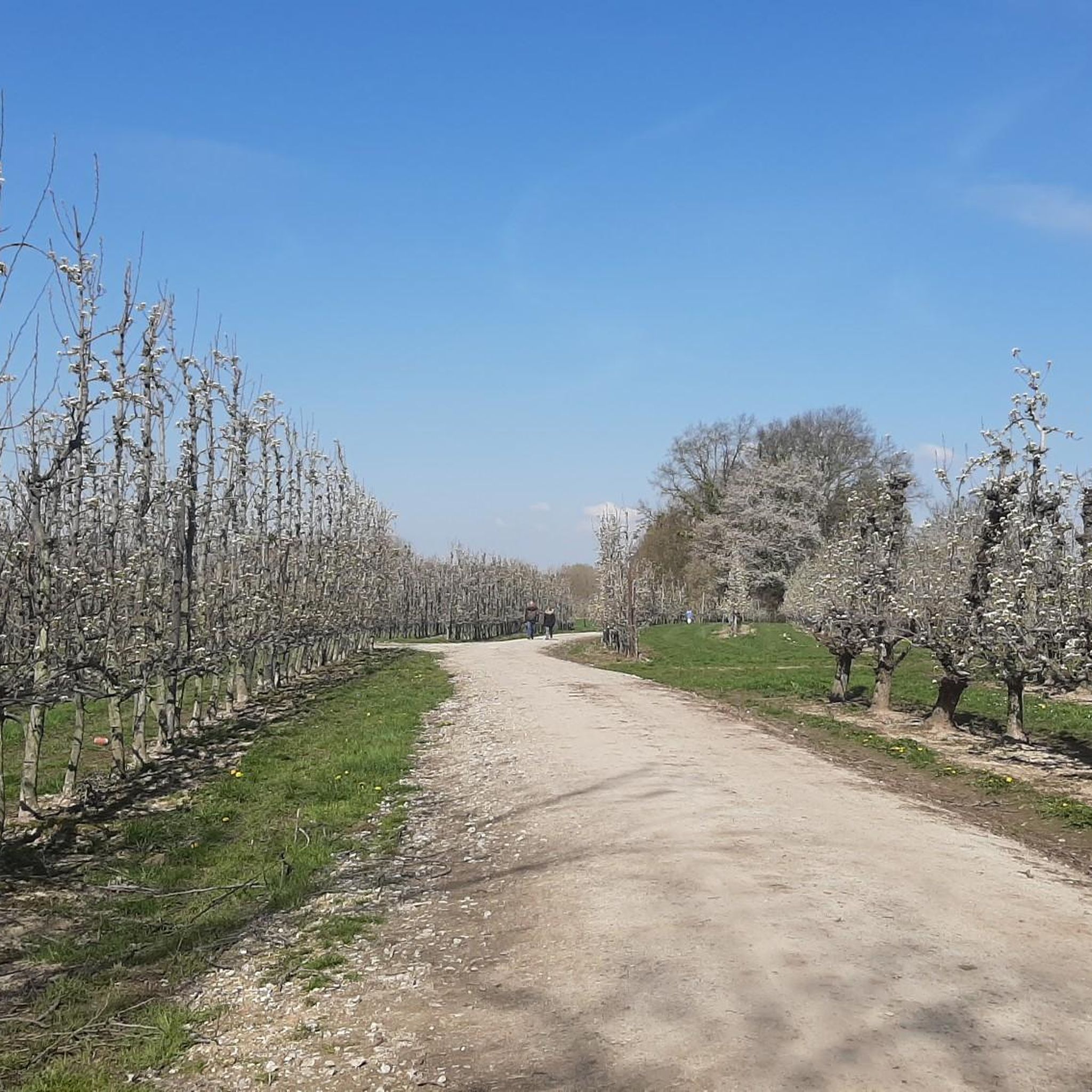
The Katteberg follows the route of an old tramway. A climb not to be underestimated awaits you here. Historical context: This semi-hardened gravel path follows the route of the former tram line that connected the coal mines of Genk with the industrial area of Liège. The construction of the tram line began in 1908. To overcome the difference in altitude between the station and the hamlet of Leten, an earthen embankment was built over a distance of 700 meters, cutting straight through the Katteberg. A double arch bridge in masonry was built over the Demer river. The steam tram was put into operation in 1910 and caused a huge increase in passenger traffic in the region. The tram was definitively taken out of service in August 1948. The tram tracks were removed in 1952. Now, this is a route where recreational users, hikers, and cyclists can cross paths. Each at their own pace, enjoying together.
7
0
Hollow roads are not only important for nature, they also play a valuable role in agriculture and in our free time. Together with other slow roads, they form the perfect routes for hikers, riders, and cyclists to fully enjoy the landscape.
6
0
On the site where a manor house stood in the Middle Ages, the castle of Hardelingen was built in the 19th century. The site had continuous habitation from early on and was closely linked for centuries to agricultural exploitation in the fertile valley of the Werm. As a manor house, the domain served not only as a residence but also as an economic center that managed and structured the surrounding land within the traditional agricultural landscape of Haspengouw. Today, the castle of Hardelingen, located in the quiet village of Werm, is a valuable example of the transformation of a medieval manor house into a stately 19th-century country residence. The castle and the surrounding park landscape strikingly illustrate the neoclassical ideals of order, harmony, and scenic beauty, thus occupying a special place in the heritage of Haspengouw. Want to know more about the past? Click through to https://www.burchten-kastelen.be/provincies/limburg/042%20Kasteel%20van%20Hardelingen/Kasteel%20van%20Hardelingen.html
5
0
Frequently Asked Questions
How many gravel bike trails are available around Hoeselt?
There are over 50 gravel bike trails around Hoeselt, offering a diverse range of experiences. These include routes for various skill levels, from moderate to challenging.
What kind of terrain can I expect on gravel bike trails in Hoeselt?
The gravel bike trails in Hoeselt traverse the hilly Haspengouw landscape, featuring undulating paths and varied surfaces. You'll encounter a mix of unpaved sections, natural environments, and paths that often lead through historic sites and castle complexes.
Are there gravel routes suitable for beginners or families in Hoeselt?
While many routes offer challenging terrain, the Hoeselt area does provide options for different ability levels. Some routes include easier unpaved sections, making them accessible for beginners or families looking for a less strenuous ride. For example, the From Bilzen to Zutendaal - Gravel biking in the province of Limburg is rated as moderate.
What are some notable natural features or landmarks I might see along the trails?
Many gravel routes in Hoeselt integrate natural beauty with historical points of interest. You might pass by historic manor houses and castle complexes. The broader Limburg region also features unique cycling experiences like paths 'through trees' and 'between slag heaps'. Additionally, you could explore highlights such as Cycling Through the Water or the Dauteweyers Ponds Nature Reserve.
Are there any circular gravel bike routes starting from Hoeselt?
Yes, many of the gravel bike routes in the Hoeselt area are designed as loops, allowing you to start and end in the same location. Examples include the challenging Limburg loop from Bilzen or the extensive Kanne Bridge – River Park Meuse Valley loop from Bilzen.
Where can I park my car when going gravel biking in Hoeselt?
While specific parking locations for each trail are not detailed here, Hoeselt and the surrounding towns like Bilzen, which serve as common starting points for many routes, typically offer public parking facilities. It's advisable to check local parking options in your chosen starting town.
Is public transport an option to reach gravel trails in Hoeselt?
Hoeselt is integrated into Limburg's transport network. While direct access to every trail by public transport might vary, you can typically reach Hoeselt or nearby towns like Bilzen via bus or train, and then cycle to your desired starting point. For detailed public transport information, it's best to consult local transport schedules.
What is the best time of year for gravel biking in Hoeselt?
The Haspengouw region is beautiful throughout many seasons. Spring and autumn often offer pleasant temperatures and vibrant landscapes, ideal for gravel biking. Summer can also be great, but be mindful of warmer weather. Winter riding is possible, but trails may be muddier or require more robust gear.
Can I bring my dog on gravel biking adventures in Hoeselt?
Many natural areas and trails in Belgium are dog-friendly, especially if your dog is well-behaved and kept on a leash where required. However, specific rules can vary by nature reserve or private land. It's always recommended to check local signage or regulations for the specific areas you plan to ride through with your dog.
What do other gravel bikers enjoy the most about gravel biking in Hoeselt?
The gravel biking experience in Hoeselt is highly rated by the komoot community, with an average score of 4.6 stars from over 50 reviews. Riders often praise the varied terrain, the scenic Haspengouw landscape, and the integration of historical sites into the routes, offering a rich and engaging cycling adventure.
Are there any challenging gravel bike trails for experienced riders?
Yes, Hoeselt offers several challenging gravel routes for experienced riders. For instance, the Asbroek Lookout – Lanklaarder Forest Hollow Way loop from Diepenbeek is a difficult 100 km trail with significant elevation gain, providing a demanding experience.
Are there places to stop for refreshments or food along the gravel routes?
The region around Hoeselt is known for its hospitality. Many routes pass through or near villages and towns where you can find cafes, pubs, or restaurants. While specific stops are not listed for every route, planning your ride to include a stop in a local village is often feasible.
Most popular attractions around Hoeselt

Get inspired with the komoot mobile app


Explore more
Browse the best Gravel rides in other regions.
