Attractions and Places To See around Dickel - Top 20
Best attractions and places to see around Dickel feature a blend of art, nature, and history. The region is characterized by its unique sculpture trails, which integrate art into the natural landscape. Visitors can explore expansive moors and discover historical landmarks. This area offers varied experiences for those interested in outdoor exploration and cultural discovery.
Best attractions and places to see around Dickel
- The most popular attractions is Diepholz sculpture trail, a trail that features 21 works of art…
Last updated: October 10, 2026
Diepholz sculpture trail
Highlight (Segment) • Trail
Translated by Google •
Tip by

Fibonacci Cubes by Petra Paffenholz
Highlight • Monument
They are the artist's perspective on the subject of infinity. The nine permeable cubes of different sizes stand in the extensive …
Translated by Google •
Tip by

Sign up now to discover places like this
Get recommendations on the best single tracks, peaks, & plenty of other exciting outdoor places.
A Perfect Circle Sculpture by Pablo Hirndorf
Highlight • Monument
A frame made of welded wire mesh was densely filled with segments of tree trunks by the students. Through the opening in …
Translated by Google •
Tip by
Haus im Moor – Goldenstedter Moor Nature and Information Center
Highlight • Natural Monument
Translated by Google •
Tip by

Diepholz Castle
Highlight • Castle
Translated by Google •
Tip by

Sign up for free to discover even more attractions around Dickel.
Already have an account?
Start today with a free account
Your next adventure awaits.
Tips from the Community

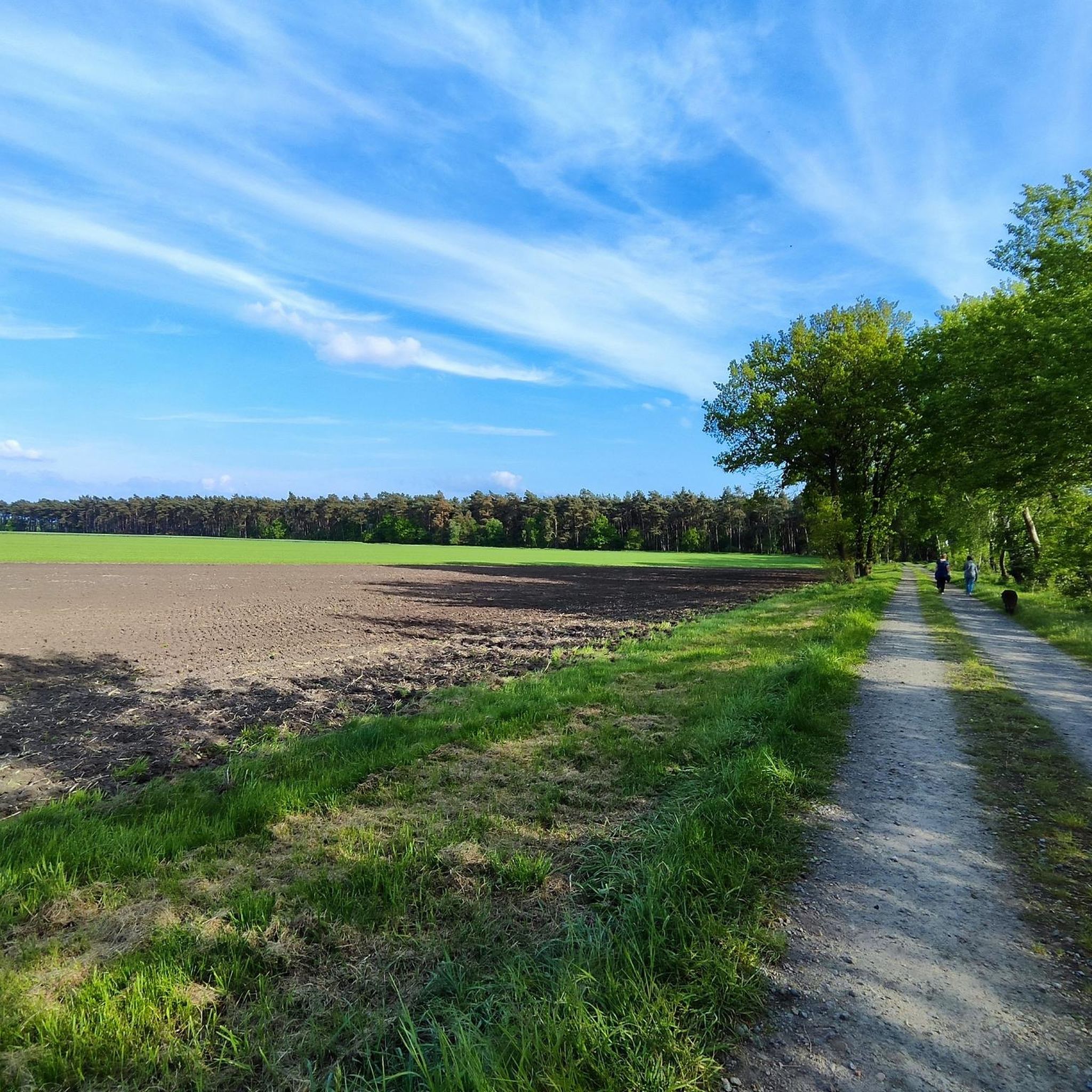
In the middle of the beautiful landscape along the sculpture trail are the impressive Fibonacci Cubes by artist Petra Paffenholz. If you don't know the background, you'll inevitably wonder what their meaning is. An information panel next to the artwork will give you the answer. The Fibonacci Cubes are the artist's take on the theme of infinity. The nine permeable cubes of different sizes stand in the expansive agricultural landscape. The dimensions of the cubes are derived from the Fibonacci series. The Fibonacci sequence is the infinite sequence of natural numbers that begins with two times the number 1, and in which each subsequent number is the sum of the two preceding numbers. In modern notation, this sequence is additionally given a leading number 0: 0, 1, 1, 2, 3, 5, 8, 13, 21, 34, 55... The numbers contained therein are called Fibonacci numbers. The sequence is named after Leonardo Fibonacci, who used it to describe the growth of a rabbit population as early as 1202. However, the sequence was already known in ancient times to both the Greeks and the Indians. Further research has shown that the Fibonacci sequence also describes numerous other growth processes in nature. It seems as if it is a kind of growth pattern in nature. Highly interesting and initially easy to follow, but increasingly difficult to understand the deeper you delve into this subject and the associated mathematical formulas. This is "higher mathematics" that you have to like and understand. https://de.wikipedia.org/wiki/Fibonacci-Folge https://www.stadt-diepholz.de/info/poi/fibonacci-cubes-903000152-21770.html
3
0

After the revolution of 1848, jurisprudence was separated from administration in the Kingdom of Hanover and patrimonial jurisdiction was abolished.[1] The district court was then founded as the royal Hanoverian district court with the ordinance of August 7, 1852 regarding the formation of the district courts and lower administrative authorities. It included the Diepholz office and the Auburg zu Diepholz office.[2] The district court was subordinate to the Nienburg Higher Court.[3] In 1859 it was assigned to the judicial district of the Osnabrück Higher Court. At the same time, the Lemförde district court was dissolved and its jurisdiction was added to that of the Diepholz district court.[4] With the annexation of Hanover by Prussia, it became a Prussian district court in the province of Hanover.
3
0

Well - a perfect circle?! But a lot of effort was put into creating two interlocking circles out of wood and structural steel mesh.
1
0

Wolfgang Zellhorst, a Diepholz resident who lives on the sculpture trail himself and volunteers for tourism in Diepholz, has even created two videos about the trail and its sculptures: https://www.youtube.com/watch?v=ewABqvhXiKc https://www.youtube.com/watch?v=i4tCBO1RSJk
6
1
Pablo Hirndorf's family comes from Silesia and after the end of the Second World War in 1946 they settled in the district of Altenbücken in the municipality of Bücken in Lower Saxony. His father practiced painting. From an early age, Pablo Hirndorf played and worked artistically with whatever was available at home due to his father's job: materials in the form of leftover paint, old wallpaper books or lumps of putty for modelling. From 1984 to 1986 Pablo Hirndorf studied art education at the University of Hanover, from 1986 to 1992 free art at the University of Applied Sciences in Hanover with Peter Krahe, Helmut Rogge and Verena Vernunft. In 1991 he received his diploma and in the same year became a member of the Lower Saxony Association of Visual Artists. In 1992, Hirndorf completed the Fine Art course at the University of Applied Sciences in Hanover as a master student. In 1993 he received a studio grant from the state of Lower Saxony. In the same year, Pablo Hirndorf founded a studio in Warpe in the district of Nienburg/Weser in Lower Saxony. Hirndorf decided to consciously live with his family in the middle of nature. Source: https://de.wikipedia.org/wiki/Pablo_Hirndorf
8
0
In the mathematical field of graph theory, the Fibonacci cubes or Fibonacci networks are a family of undirected graphs with extensive recursive properties due to their origin in number theory. Mathematically, they are similar to hypercube graphs, but have a Fibonacci number of vertices. Fibonacci cubes were first explicitly defined in Hsu (1993) in the context of connection topologies for connecting parallel or distributed systems. They have also been applied in chemical graph theory. The Fibonacci cube can be defined in terms of Fibonacci codes and Hamming distance, independent vertex sets in path diagrams, or via distributional lattices. Source: https://en.wikipedia.org/wiki/Fibonacci_cube
5
1
As part of land consolidation measures, a new route was planned west of the B 51 from Diepholz to Dümmer - or vice versa - a few years ago. Over time, a total of 21 works of art were created, each in collaboration between an artist and a group of citizens of the region. The aim of the sculpture trail was to connect art and nature. At the same time, an attractive path connection for cyclists and pedestrians from Diepholz to Dümmer and back as well as a tourism offer of supra-regional importance should be created. The sculpture path is regularly maintained, renewed and expanded. The new sculpture “Zeitzeichen” was only opened in 2022. Source: https://www.stadt-diepholz.de/regional/touren/skulpturenpfad-die-sicht-900000001-21770.html?title=Sculpture Path+-+Die+Sicht
10
1
The castle was built at the beginning of the 12th century as a moated castle with a square floor plan and four wings. The monumental 16.50-meter-high tower base, made of granite blocks, dates back to the original construction period between 980 and 1030. Above it rises a twelve-sided brick storey with a roofed perimeter. This supports a similarly designed, but recessed, half-timbered superstructure, crowned by a sweeping, twelve-sided, slate-roofed hood with delicate bay windows. Around 1550, nobleman Rudolf had the castle completely rebuilt before he moved in with Countess Margarete von Hoya. A stone frieze added at that time above the castle's north door displays the coats of arms of the two families of Diepholz and Hoya. During the Thirty Years' War, the moated castle proved itself several times as a defensive and stronghold. Nevertheless, it was set on fire by Danish troops in 1626 and destroyed to its foundations by Swedish soldiers in 1637. Duke Christian Ludwig of Lüneburg-Celle had the castle rebuilt around 1660. Unfortunately, the south wing and parts of the west wing burned down in 1790. The castle tower, as you see it today, is a rebuilt version of the 1660s. The outbuildings received their present appearance around 1837 and 1877. Until 1723, the castle housed the district governors, later the bailiffs and other lordly officials. It also served as a hunting lodge for the dukes and electors of Celle and Hanover. In 1852, a district court was established in the castle, which still occupies its current location today. From 1885 to 1994, the district administration office was also housed in the old knights' hall in the west wing. Source: https://www.diepholz.de/info/poi/das_diepholzer_schloss-3000026-21770/info.html
4
1
Frequently Asked Questions
What are the main types of attractions to explore around Dickel?
The Dickel area is known for its unique blend of contemporary art, natural landscapes, and historical sites. You'll find extensive sculpture trails, vast moors, and historical landmarks. The region offers varied experiences for those interested in outdoor exploration and cultural discovery.
Are there any sculpture trails to visit in the Dickel area?
Yes, the region is famous for its sculpture trails. A prominent example is the Diepholz sculpture trail, which features 21 works of art created in collaboration between artists and local citizens. This path connects art and nature along the Hunte river, offering an attractive route for cyclists and pedestrians.
What natural attractions can I visit near Dickel?
A key natural attraction is the Haus im Moor – Goldenstedter Moor Nature and Information Center. This center provides insights into the Goldenstedt high moor, featuring a bog tunnel and an educational trail. It's a great place to learn about the unique ecosystem of the moor.
Are there any historical sites or castles in the Dickel region?
Yes, you can visit Diepholz Castle, an impressive structure that has stood in the heart of Diepholz since the 12th century. The castle tower houses the "Museum im Schlossturm" (Museum in the Castle Tower), which is open to visitors. From April to October, climbing the castle tower is also possible on the first Saturday evening of each month.
Are there family-friendly activities or attractions around Dickel?
Many attractions in the Dickel area are family-friendly. The Diepholz sculpture trail, Fibonacci Cubes by Petra Paffenholz, and A Perfect Circle Sculpture by Pablo Hirndorf are all suitable for families. Additionally, the Haus im Moor – Goldenstedter Moor Nature and Information Center offers an educational trail and a moor train, which can be exciting for children.
What kind of outdoor activities can I do near Dickel's attractions?
The Dickel area offers various outdoor activities. You can enjoy hiking on easy loops like the Erlingshof Pond loop, or explore MTB trails ranging from easy to moderate, such as the 'Bridge over the Lohne – Sculpture Trail 'Die Sicht' loop'. Gravel biking is also popular, with routes like the 'Aschener Moor Boardwalk – Moor View loop'. For more details, explore the hiking, MTB, and gravel biking guides for the region.
Where can I find food or drinks near the natural and information center?
The Haus im Moor – Goldenstedter Moor Nature and Information Center includes a restaurant where you can treat yourself to delicious buckwheat pancakes. It's a super great destination with a class restaurant right on site.
What makes the Fibonacci Cubes sculpture unique?
The Fibonacci Cubes by Petra Paffenholz are part of the sculpture trail and represent the artist's perspective on infinity. These nine permeable cubes of different sizes stand in the extensive agricultural landscape, with their dimensions derived from the Fibonacci series. Visitors can even drive through the largest cube, becoming part of the art itself.
What do visitors enjoy most about the Diepholz sculpture trail?
Visitors appreciate how the Diepholz sculpture trail connects art and nature. The path along the Hunte river is described as an attractive route for both cyclists and pedestrians, allowing them to admire 21 unique works of art. Many recommend taking time for individual exhibits to understand the artist's intention.
Is the Diepholz Castle accessible for people with wheelchairs?
Yes, Diepholz Castle is listed as wheelchair accessible, making it possible for more visitors to explore this historical site and its surroundings.
Are there any specific tips for visiting the Haus im Moor – Goldenstedter Moor Nature and Information Center?
When visiting the Haus im Moor – Goldenstedter Moor Nature and Information Center, be sure to explore the bog tunnel, which gives a unique look under the earth, and walk the educational trail. You might also catch a ride on the moor train. The center has specific opening hours, generally from April to October on weekends, and some weekdays in July-August, with a winter break from December to February. It's advisable to check their website for current times.
Can I combine art and cycling in the Dickel area?
Absolutely! The Diepholz sculpture trail is designed to be an attractive route for cyclists along the Hunte river, allowing you to enjoy 21 works of art while cycling through the natural landscape. It's a perfect way to combine art appreciation with an active outdoor experience.
Most popular attractions around Dickel

Get inspired with the komoot mobile app


Explore more
Still not found the Highlight you’re looking for? See guides of the top attractions in other regions:
