Attractions and Places To See around Eschfeld - Top 20
Best attractions and places to see around Eschfeld are found within the South Eifel Nature Park in Rhineland-Palatinate, Germany. This municipality offers a combination of historical insights, natural beauty, and cultural points of interest. Its location makes it suitable for outdoor activities. The area features ancient settlements, burial grounds, and scenic river valleys.
Best attractions and places to see around Eschfeld
- The most popular attractions is European Monument at the Three-Country Point, a man-made monument where the borders of…
Last updated: September 25, 2026
European Monument at the Three-Country Point
Highlight • Monument
Translated by Google •
Tip by

Georges-Wagner Bridge
Highlight • Bridge
Translated by Google •
Tip by

Sign up now to discover places like this
Get recommendations on the best single tracks, peaks, & plenty of other exciting outdoor places.
The Our
Highlight • River
Translated by Google •
Tip by

Ruins of Reuland Castle
Highlight • Castle
Even Charlemagne is said to have been here for a time.
Translated by Google •
Tip by

Pronsfeld Railway Museum
Highlight • Monument
Translated by Google •
Tip by

Sign up for free to discover even more attractions around Eschfeld.
Already have an account?
Start today with a free account
Your next adventure awaits.

Tips from the Community

Very narrow passage. Bicycle with panniers on both sides might have difficulties. The bridge has steps on one side with a very steep ramp. It is not ideally solved.
1
0


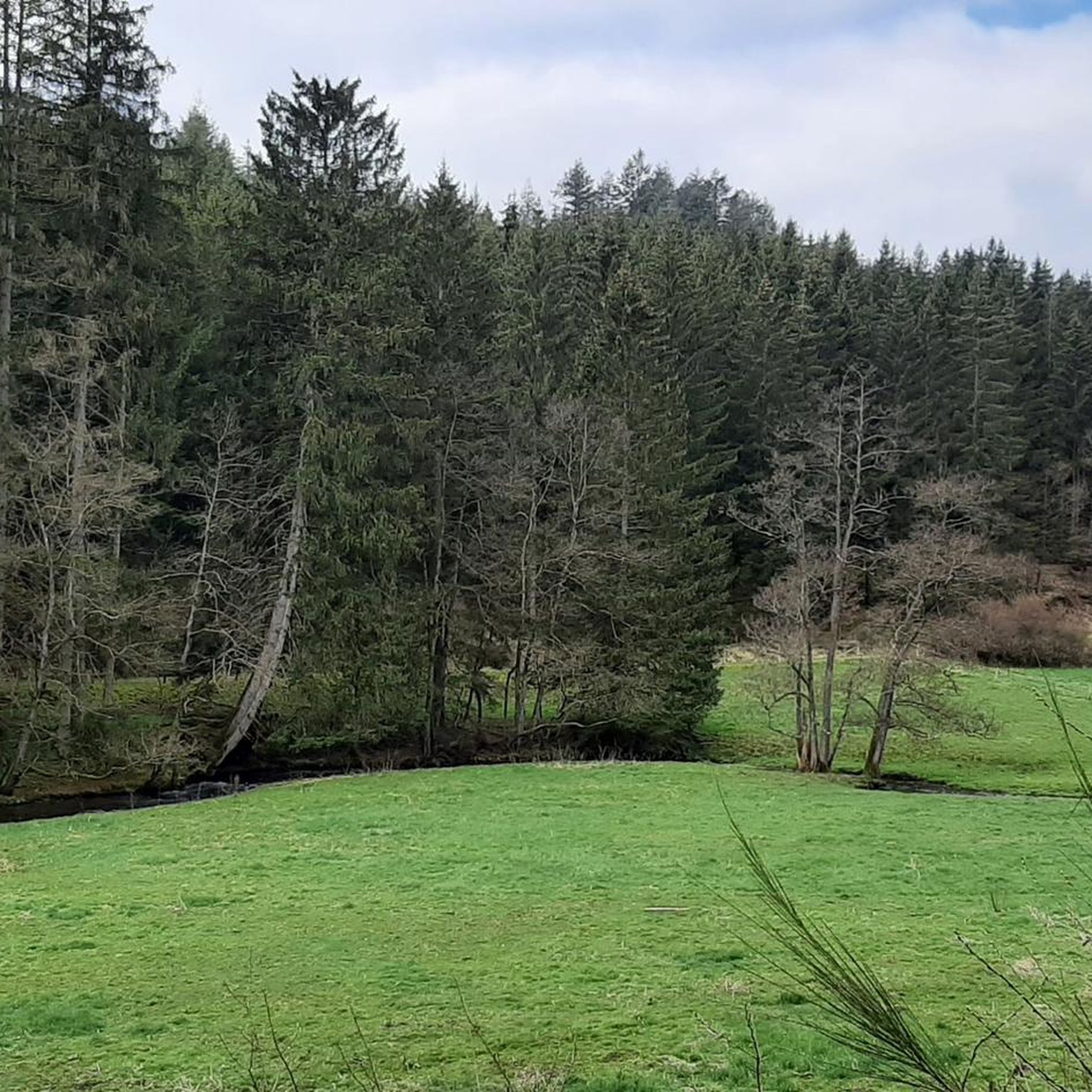
The Our (German, Luxembourgish and French Our) is a 96.1 km long tributary of the Sauer along the border between Germany (D) and its western neighbours Belgium (B) and Luxembourg (L). It flows mainly from north to south and meanders in sections. The Our rises in the eastern Ardennes and the western Eifel on Belgian territory. Its source is in the municipality of Büllingen near the district of Losheimergraben. The Our initially flows a little southwest of the B 265, which runs close to the river directly along the German-Belgian border. It passes two districts of Büllingen, Hüllscheid and Berterath. Shortly afterwards it flows into Germany for a while near Verschneid, a hamlet in Auwer in Rhineland-Palatinate. Shortly afterwards the Our flows back into Belgium near Schönberg, Atzerath and Alfersteg. From about Weppeler to Auel it runs along the Belgian-German border and then back into Belgium near Weweler. Then the Our flows again along the state border between Stoubach (B) and Stupach (D) and past Welchenhausen (D) and Oberhausen (B). It then flows through Belgium for the last time near Peterskirchen-Ouren. From around the European Monument at the border triangle of Belgium, Germany and Luxembourg between Ouren (B), Sevenig (D) and Lieler (L), the Our flows almost entirely along the German-Luxembourg border. It flows into the Sauer, a tributary of the Moselle, coming from the west near Wallendorf (D). (Source: Wikipedia)
4
0
Very beautiful, but also somewhat more demanding hikes are possible from Ouren
3
0

Here you can treat yourself to a delicious cup of coffee after a hike or walk. But delicious homemade cakes are also available. There is also an e-bike charging station on site.
2
0

The two rivers that meet here form the border between Germany, Belgium and Luxembourg. You can see this point from the bridge. Where the river used to be a barrier between countries, the bridge is now a symbol of European cooperation.
3
0
Frequently Asked Questions
What historical sites can I visit in and around Eschfeld?
Eschfeld has a rich history. You can explore the St. Luzia Church, a neo-Gothic church known for its interior adorned with biblical scenes by Pastor Christoph März. The area also features ancient Celtic settlements and burial grounds, with evidence dating back to 400 BC. Further afield, the impressive Ruins of Reuland Castle, one of the largest castle ruins in the Eifel region, offers a glimpse into medieval times.
Are there any family-friendly attractions near Eschfeld?
Yes, several attractions are suitable for families. The European Monument at the Three-Country Point is an interesting spot where children can stand in three countries at once. The Georges-Wagner Bridge, a pedestrian bridge connecting Belgium and Germany, is also family-friendly and offers views of the Our river. For a unique experience, the Pronsfeld Railway Museum, located on a cycle path, features an old locomotive and exhibits on railway history.
What natural features can I explore in the Eschfeld region?
Eschfeld is located within the picturesque South Eifel Nature Park, characterized by rolling hills, green meadows, and dense forests. The idyllic Irsen Valley, where beavers are known to shape the landscape, is a notable natural feature. You can also experience the scenic Our river, which forms part of the border between Germany, Belgium, and Luxembourg.
What outdoor activities, like hiking and cycling, are available around Eschfeld?
The region around Eschfeld is excellent for outdoor activities. There are various hiking trails, including an easy circular route along the Eschbach and the Irsen, and the moderate 'Irsen trail (Dahnen)'. For more options, explore the many hiking routes around Eschfeld. Cyclists can enjoy routes like those found in the road cycling guide for Eschfeld, often utilizing old railway lines.
Are there any unique viewpoints or scenic spots in the area?
Yes, the region offers several scenic viewpoints. From the spiral staircase of the Ruins of Reuland Castle, you can enjoy fantastic views of the castle grounds and the surrounding village. The European Monument at the Three-Country Point also provides an idyllic setting by the Our river. Additionally, many hiking and cycling routes offer magnificent long-distance views of the Western Eifel hills.
What is the significance of the European Monument at the Three-Country Point?
The European Monument at the Three-Country Point marks the spot where the borders of Belgium, Luxembourg, and Germany meet in the Ourtal. It features a large stone block for each of the six founding members of a united Europe, with each stone originating from its respective country. It's a quiet and idyllic location despite its historical and political significance.
Can I find any ancient Roman or Celtic history near Eschfeld?
Absolutely. Eschfeld has a deep historical past with evidence of Celtic settlement dating back to around 400 BC. Discoveries include bone remains and vessel shards. The area also contains a group of tumuli (burial mounds) and a cremation burial ground from the Hunsrück-Eifel culture period and the Roman period, forming a connected necropolis. A 2400-year-old Celtic clay pot, the oldest evidence of settlement, is even featured on the municipality's coat of arms.
What is the Our river, and why is it important to the region?
The Our river originates in the High Fens in Belgium and flows south, forming the border between Belgium and Germany, and later between Germany and Luxembourg. It's nearly 100 kilometers long and plays a significant role in the natural landscape, flowing through picturesque valleys and past historic towns like Vianden. The river is a central feature of the border triangle area.
Are there running trails available around Eschfeld?
Yes, the area around Eschfeld offers a variety of running trails suitable for different fitness levels. You can find routes ranging from easy to difficult, including scenic loops through the Our Valley. For detailed information and routes, refer to the Running Trails around Eschfeld guide.
What is the Pronsfeld Railway Museum?
The Pronsfeld Railway Museum is a small museum dedicated to the history of the railway in Pronsfeld since 1886. It features a lovingly restored museum locomotive, the Köf II, along with flat wagons, a 3rd class passenger carriage from 1940, and other historical railway devices like level barriers and semaphore signals. It's located on a cycle path, making it easily accessible.
What other castles are in the broader Eifel region near Eschfeld?
Beyond the Ruins of Reuland Castle, the broader Eifel region offers several other notable castles. These include Malberg Castle, a 17th-century structure, and Rittersdorf Castle, a medieval castle. Just across the border in Luxembourg, you can also visit the prominent Vianden Castle and Clervaux Castle, which houses museums.
What is the South Eifel Nature Park like?
The South Eifel Nature Park, where Eschfeld is situated, is a picturesque natural area characterized by its rolling hills, lush green meadows, and dense forests. It's an ideal destination for nature lovers, offering a tranquil environment perfect for hiking, cycling, and observing local wildlife, such as beavers in the Irsen Valley.
Most popular routes around Eschfeld
Most popular attractions around Eschfeld

Get inspired with the komoot mobile app


Explore more
Still not found the Highlight you’re looking for? See guides of the top attractions in other regions:
