The best cycling routes around gmina Terespol
5.0
(7)
57
riders
14
rides
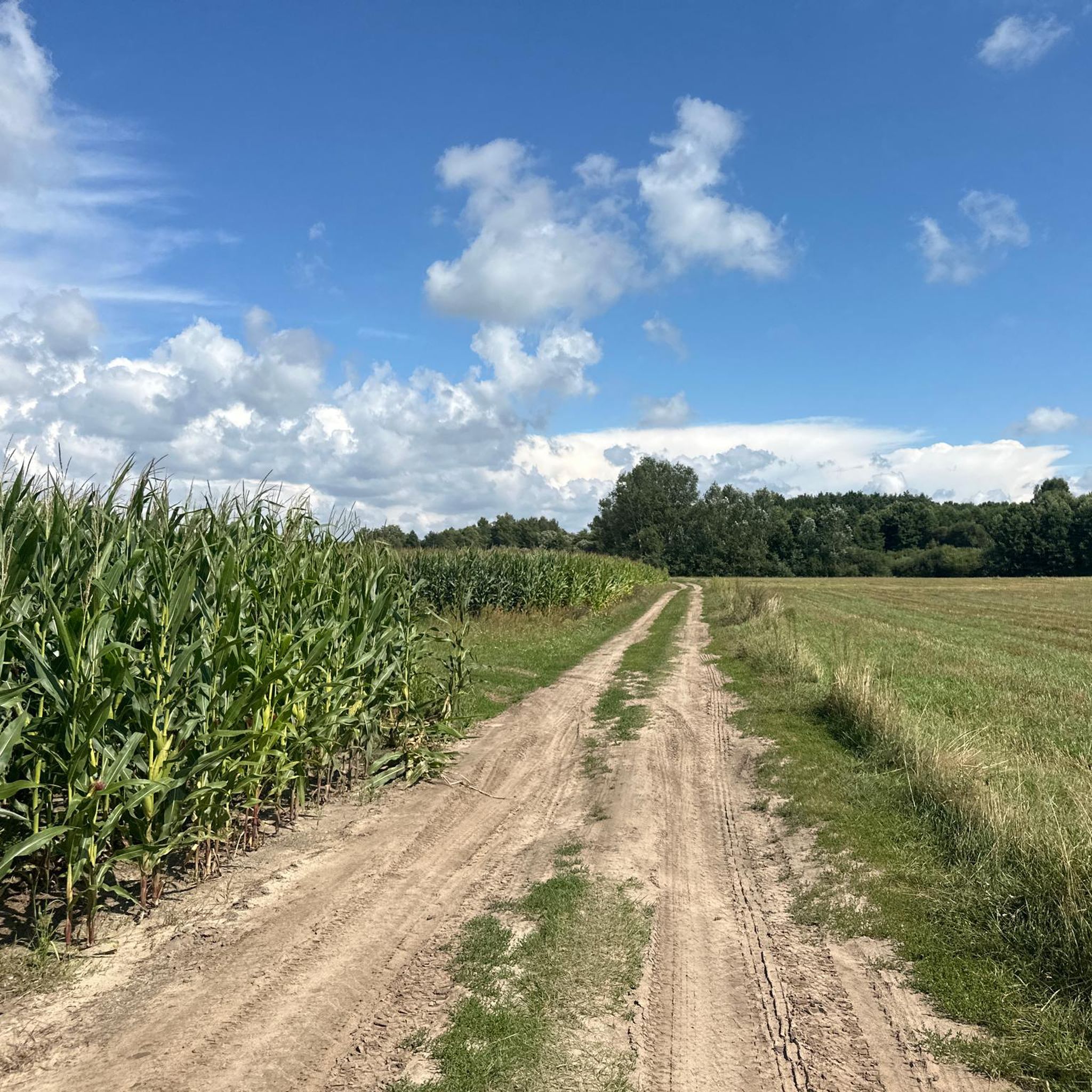
Gmina Terespol cycling routes traverse a landscape characterized by the Bug and Krzna river valleys, offering generally flat or gently rolling terrain. The region is part of the Podlaski Przełom Bugu Landscape Park, featuring extensive forests, meadows, and wetlands. Protected areas like the Szwajcaria Podlaska Nature Reserve provide natural beauty and viewpoints over the Bug River. This environment creates diverse touring cycling opportunities, from paved paths to unpaved segments.
Best touring cycling routes around gmina Terespol
- The most popular touring…
Last updated: October 21, 2026
11
riders
Easy bike ride. Mostly paved surfaces.
5.0
(1)
10
riders
12.2km
00:43
20m
20m
Easy bike ride. Mostly paved surfaces.

5.0
(1)
6
riders
23.6km
01:23
40m
40m
Easy bike ride. Mostly paved surfaces.
2
riders
29.6km
01:43
90m
90m
Easy bike ride. Mostly paved surfaces.
2
riders
24.7km
01:58
50m
50m
Hard bike ride. You may need to push your bike for some segments of this route.
Get access to more routes and recommendations from other explorers.
Already have an account?
Our route recommendations are based on thousands of hikes, rides, and runs completed by other people on komoot.
Start today with a free account
Your next adventure awaits.
Popular around gmina Terespol

Tips from the Community

When driving NSR it is worth staying overnight in this place, cleanliness, silence, good food (breakfast, lunch or dinner) quite modern equipment, large parking lot and covered, closed parking lot for bicycles. The area is quiet and monitored. Above all, clean and comfortable rooms. On the second floor, guests have at their disposal a small coffee shop and kitchen with a fridge / coffee and tea available. Here you can prepare your own meal.
1
0

A few connections to Warsaw... generally the place is not bustling with life.
0
0
Touch history and land on the Bug River.
0
0

Colonel Stein, meanwhile, issued orders and regrouped the soldiers. They fixed bayonets on their rifles, wanting to take the Uniate church by force. Among its defenders were former soldiers from the Tsar's army. They knew the rules of military craft. They knew that the law forbade military brutality. That is why Feliks Osypiuk, who had not long served in the Tsar's army, said: "We know that according to the Tsar's decree, it is forbidden to beat anyone. Therefore, if you attack and beat us, we will defend ourselves with whatever we can. But if the Tsar has authorized you to kill us, the people are ready to die for God and faith and will not retreat a step from death." However, the army crossed the fence and, beating people with rifle butts and stabbing with bayonets, made their way to the church. The response to the Cossacks' brutality was stones thrown and stakes found nearby raised in a combative manner. Colonel Stein withdrew the slightly battered soldiers. He now ordered the military banner to be unfurled, the weapons loaded and the trumpet to sound "to attack". The drums were beaten. The order to shoot was given. Daniel Karmasz, who was holding a large cross, shouted to the temple's co-defenders: "Throw everything, stakes and stones, under the church. This is not a battle for the church. This is a fight for faith and for Christ!" Someone intoned the song: Who will take care of... The command was given: fire! https://sanktuariumpratulin.pl/historia/meczenstwo/
3
0
In Pratulin, similar methods were used as in many other Uniate parishes. They wanted to “force” the Uniates to follow the religion of the Tsar. The faithful strongly opposed these attempts. There was an open and public confrontation with Kutanin, the Tsar’s head of the Konstantynów district, who demanded that the Uniates hand over their church to a new parish priest appointed by the government authorities. The people did not agree to a government parish priest. The head gave them a few days to think it over. He returned to Pratulin on January 24, 1874, with a Cossack sotnia under the command of Colonel Stein, a German Lutheran. Almost the entire parish gathered at the church. The head demanded the keys to open the church and bring in a new parish priest, the anti-Uniate, Father Leontyn Urban. He threatened the gathered with the army, which was positioned just behind the church fence. The nervous negotiations did not resolve the matter. "Mr. Chief," said Daniel Karmasz, one of the parish authorities, today a blessed Martyr, "when you were taking away our organs, you assured us that the government had no intention of imposing Orthodoxy on us. You said that if anyone ever demanded anything more from us or from our church, then we could all, old and young, take stakes and chase anyone out of the village, even if you yourself were interfering with our faith and church. You yourself taught us and authorized us that today we stand in defense of our church and faith, when you want to impose Orthodoxy on us through the priest and profane the holy church. Today, sir, you are judging your own case and your own words. However, we did not take the stakes that you ordered us to, we prefer to stand and die defenseless, at the holy threshold of our church."
3
0
The persecution of the Uniates in this diocese took place according to a scenario developed in St. Petersburg. First, there were orders from the rulers of the diocese, and especially the self-proclaimed administrators in Chełm, obedient to the tsarist authorities, to remove from the Uniate churches everything that was connected with the Latin liturgy, i.e. organs, confessionals, monstrances, bells, etc. - This was associated with Polishness. Tsarist officials, in turn, encouraged the Uniates to voluntarily accept the tsar's religion. Then threats were used and draconian contributions were levied. And when this did not bring the expected results, the "resistant" were imprisoned or exiled to Siberia. Finally, they resorted to the use of weapons and murder. A parish - so the persecutors of the Union reasoned - ceased to be Catholic by the very fact of installing a clergyman there who was submissive to the tsarist orders of Russification and pro-Orthodox.
3
0
The Church Union of Orthodox bishops from the territory of the Republic with the Roman Church was concluded in Rome on 23 December 1595, during the pontificate of Clement VIII. Its provisions were announced in Brest on the Bug (then Lithuanian) in the church of St. Nicholas on 9 October 1596. The Brest Union effectively restored the unity of the Church, for which Christ prayed in the Cenacle, on the eve of his death on the cross. At that time, he asked the Father that those who believe in Him be one, following the example of the unity that is in God in the Holy Trinity (cf. Jn 17:21). This divine work, undertaken by the signatories of the Brest Union in a completely free way and for purely religious reasons, was marked by suffering from the very beginning. The very fact of announcing the Brest Union took place in an atmosphere of decisive contestation on the part of the still recent supporters of this idea. The opponents of the Union, led by Prince Konstanty Wasyl Ostrogski, supported by Bishop Gedeon Balaban from Lviv, The partitions of Poland in the 18th century significantly worsened the situation of the Uniates. The Russification plans of the Russian tsars assumed the possibility of using the Orthodox Church to implement them. The influence of the Orthodox Church would be much greater by restoring the Uniates to Orthodoxy. Hence, Tsar Nicholas I, implementing the concept of destroying the Union, developed by a former Uniate priest, Father Józef Siemaszko, a specialist in Union matters in St. Petersburg, in 1839 incorporated, administratively, all the Uniate dioceses in his Empire into the Orthodox Church. In the Kingdom of Poland, whose king was the Russian tsar, the only Uniate diocese left was Chełm.
3
0

Attention! Around Terespol you get into the Belarusian network: High roaming charges threaten
0
0
Frequently Asked Questions
How many touring cycling routes are available in gmina Terespol?
There are 15 touring cycling routes in gmina Terespol, offering a mix of easy and more challenging options for cyclists.
What kind of terrain can I expect on touring cycling routes in gmina Terespol?
The terrain in gmina Terespol is generally flat or gently rolling, characterized by the river valleys of the Bug and Krzna. You'll find a mix of paved paths and unpaved segments, traversing extensive forests, meadows, and wetlands. The landscape is shaped by its lowland river systems and past glaciations, providing varied and picturesque scenery.
Are there any easy touring cycling routes suitable for beginners or families?
Yes, gmina Terespol offers several easy routes. For instance, the Terespol Murals – Terespol Powder Magazine loop from Terespol is an easy 7.6-mile (12.2 km) path, perfect for a relaxed ride. Another accessible option is the Terespol Powder Magazine – Terespol Murals loop from Terespol, which is 14.7 miles (23.6 km) and also rated easy.
What natural attractions can I see along the cycling routes?
The region is rich in natural beauty. You can explore the Bug Gorge, part of the Podlasie Bug Gorge Landscape Park, which preserves the natural fragments of the Bug River's left bank. The Bug River itself, with its natural course and floodplains, offers picturesque views. Don't miss the Szwajcaria Podlaska Nature Reserve, where you can find monumental trees and a viewpoint overlooking the Bug River.
Are there any historical or cultural landmarks to visit while cycling?
Absolutely. You can visit the historic Church of St. Nikita the Martyr in Kostomłoty, a significant pilgrimage site. The T-34 Tank Monument in Szwajcaria Podlaska Nature Reserve is another notable historical marker. Additionally, the Cieleśnica Palace offers a glimpse into the region's past and can be a pleasant stop.
Are there any circular touring cycling routes in gmina Terespol?
Yes, many routes in gmina Terespol are designed as loops. For example, the popular Prochownia Terespol Museum – Terespol Powder Magazine loop from Terespol is an easy 10.4-mile (16.8 km) circular trail. Another option is the more challenging Krzna River – Sanctuary of Pratulin loop from Malowa Góra, which is 18.1 miles (29.2 km) long.
What is the best time of year to go touring cycling in gmina Terespol?
The best time for touring cycling in gmina Terespol is typically during the spring, summer, and early autumn months. These seasons offer pleasant weather conditions for exploring the river valleys and natural landscapes. Spring brings blooming nature, while summer provides warmth, and autumn showcases beautiful foliage.
Where can I park my car when accessing cycling routes in gmina Terespol?
While specific parking locations for each route are not detailed, gmina Terespol is generally accessible. It is advisable to look for designated parking areas near the start points of routes, especially in towns like Terespol or Malowa Góra, or near major attractions. Always check local signage for parking regulations.
Is public transport available to reach the cycling routes in gmina Terespol?
Gmina Terespol is located in eastern Poland. While specific public transport connections directly to every route start are not provided, Terespol itself is a town with transport links. You may be able to reach the general area by train or bus, and then cycle to your chosen route starting point. It's recommended to check local public transport schedules for the most up-to-date information.
What do other touring cyclists say about the routes in gmina Terespol?
The touring cycling routes in gmina Terespol are highly rated by the komoot community, with an average score of 5.0 stars from 7 reviews. Cyclists often praise the scenic river valleys, the mix of natural and historical sights, and the variety of routes suitable for different skill levels.
Are there any places to eat or stay along the cycling routes?
Yes, there are options for refreshments and accommodation. For example, the Cieleśnica Palace functions as a small hotel with restaurant and cafe services, offering a potential stop for cyclists. You can also find the Cafeteria at the Oblates. In larger towns like Terespol, you'll find more amenities.
Most popular routes around gmina Terespol
Most popular attractions around gmina Terespol

Get inspired with the komoot mobile app


Explore more
Browse the best Cycling routes in other regions.
