Attractions and Places To See in Mt. Shasta Wilderness - Top 16
Best attractions and places to see in Mt. Shasta Wilderness include a diverse range of natural features and significant landmarks. The region is dominated by Mount Shasta, a potentially active stratovolcano standing at 4,322 meters, which is the second-highest peak in the Cascades. This area features several glaciers, alpine lakes, and numerous waterfalls, offering varied landscapes for exploration. It also holds cultural significance for local Native American tribes, with several sacred sites.
Best attractions and places to see in Mt.…
Last updated: September 26, 2026
Horse Camp Sierra Club Hut
Highlight • Mountain Hut
Tip by

Mt Shasta summit 🌋 (4321m)
Highlight • Summit
For a winter snowshoe/crampon ascent route via Casaval Ridge and descent via standard Avalanche Gulch route see: komoot.com/tour/9090975
For an AT ski ascent …
Tip by
Sign up now to discover places like this
Get recommendations on the best single tracks, peaks, & plenty of other exciting outdoor places.
Upper Clear Creek Route bivouac /camp sites
Highlight • Rest Area
Tip by
Olberman's Causeway - Mt Shasta
Highlight • Trail
Tip by
Avalanche Gulch 🌋 Mt Shasta
Highlight • Climb
Tip by
Sign up for free to discover even more attractions in Mt. Shasta Wilderness.
Already have an account?
Start today with a free account
Your next adventure awaits.
Popular around Mt. Shasta Wilderness

Tips from the Community

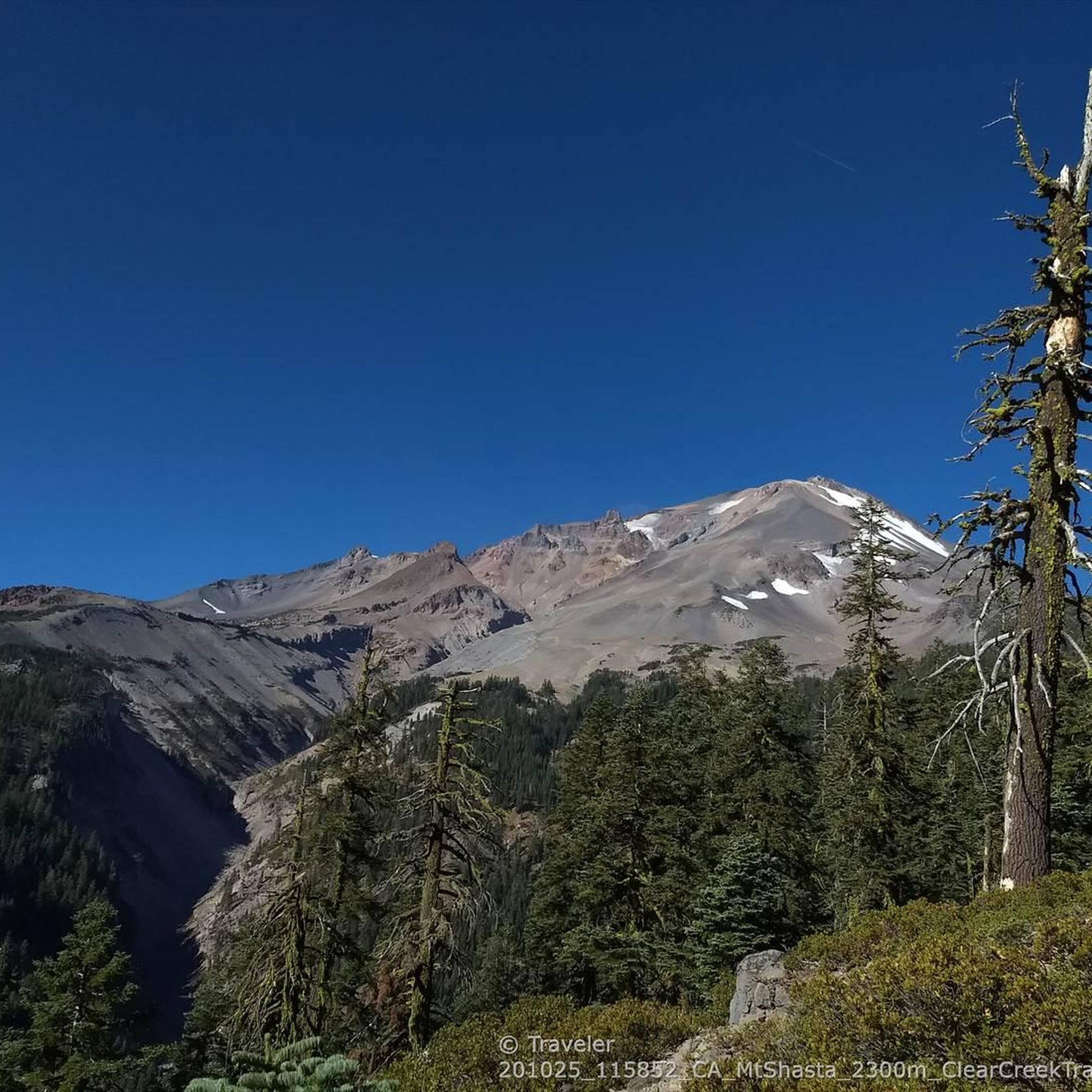
Clear Creek route is frequently used for one-day trips up and down Mt Shasta from the trailhead, which can be pleasant to just have to carry a daypack. However, it is a significant elevation and means for slower hikers to miss out on a lot of the beauty along the lower sections as they climb/descent these in the dark. While most who want to break it into several days camp near the water sources at Clear Creek Springs, there is a set of decently flat bivouac /camp sites at 3333 m (about 11000 ft) elevation. No water, and more wind exposed, but they might save slower climbers an hour or two in the morning.
1
0
Excellent shelter hut for winter ascents, though should not be used for camping by non-members except for emergencies.
0
0
In the fall you can literally hike up to the summit of this tallest free-standing mountain in the lower US via the eastern route without climbing or any snow. The standard Avalanche Gulch route would be too dangerous without snow due to frequent life-threatening rockfall.
2
1
Olberman's Causeway is a path built over many years by the guard living at the Sierra Club's Horse Camp Hut; it leads up Avalanche Gulch to the standard route to climb Mt Shasta. It is typically not visible under the snow in spring/early summer when it is safer to climb as long as snow holds the loose rocks in place that pose a severe rock fall danger (helmets are essential here). Most people camp around 10000 feet at Lake Helen on Day 1 and summit the next morning. For a winter route climbing from Horse Camp via Casaval Ridge and descending via Avalanche Gulch see: https://www.komoot.de/tour/9090975
0
0
Avalanche Gulch is the standard route to climb Mt Shasta, typically done in spring/early summer as long as snow holds the loose rocks in place that pose a severe rock fall danger (helmets are essential here). Most people camp around 10000 feet at Lake Helen on Day 1 and summit the next morning. For a winter route climbing from Horse Camp via Casaval Ridge and descending via Avalanche Gulch see: https://www.komoot.com/tour/9090975
0
0
Tallest free standing Cascade volcano in California. For a winter snowshoe/crampon ascent route via Casaval Ridge and descent via standard Avalanche Gulch route see: https://www.komoot.com/tour/9090975 For an AT ski ascent and descent via West Face see: https://www.komoot.com/tour/9089213 For the least technical snow-free route via Clear Creek Trail see https://www.komoot.com/tour/277653983
2
0
Horse Camp is a property on Mount Shasta owned by the nonprofit Sierra Club Foundation. It is a 720-acre (2.9 km2) enclave within the Mount Shasta Wilderness of the Shasta-Trinity National Forest in California, United States. It is located at approximately 7,950 feet (2,420 m) elevation at the lower end of Avalanche Gulch, the most popular climbing route on the mountain. Horse Camp is accessible from the Bunny Flat trailhead by hiking approximately 2 miles (3.2 km) on a developed trail with an elevation gain of about 950 feet (290 m). The most notable feature of Horse Camp is the Shasta Alpine Lodge, a climber's hut constructed in 1923. Mostly indigenous materials were used for construction, including volcanic rock and Shasta red fir. The lodge can be used for emergency shelter for climbers. It contains a guest register, a library of mountain books, and displays about Mount Shasta. Other features of Horse Camp include a freshwater spring, low impact campsites, and a solar-powered composting toilet facility. The lodge measures about 450 square feet (42 m2), and was financed primarily by a donor named Hall McAllister at a cost of $6,725. A caretaker is on duty during the summer months. The first caretaker (1923–1934) was Joseph Macatee "Mac" Olberman (1862–1946). With the help of volunteers, Olberman built a 950 yard long flagstone paved path leading uphill from Horse Camp to facilitate access to the Avalanche Gulch climbing route. This structure still exists and is known as Olberman's Causeway. The camp and the lodge are open year round, even when no caretaker is on duty. Horse Camp is utilized as a mountaineering base camp for ascents of Mount Shasta by Avalanche Gulch, Casaval Ridge, the West Face Gully and other routes on the south and west side of the mountain. https://en.wikipedia.org/wiki/Horse_Camp http://www.sierraclubfoundation.org/what-we-fund/horse-camp-mt-shasta
1
0
Mount Shasta (Karuk: Úytaahkoo or "White Mountain") is a potentially active volcano located at the southern end of the Cascade Range in Siskiyou County, California. At an elevation of 14,179 feet (4321.8 m), it is the second highest peak in the Cascades and the fifth highest in California. Mount Shasta has an estimated volume of 85 cubic miles (350 km3), which makes it the most voluminous stratovolcano in the Cascade Volcanic Arc. Shasta dominates the northern California landscape. It rises abruptly and stands nearly 10,000 ft (3,000 m) above the surrounding terrain. On a clear winter day, snowy Mount Shasta can be seen from the floor of the Central Valley 140 miles (230 km) to the south. The mountain consists of four overlapping volcanic cones that have built a complex shape, including the main summit and the prominent satellite cone of 12,330 ft (3,760 m) Shastina, which has a visibly conical form. If Shastina were a separate mountain, it would rank as the fourth-highest peak of the Cascade Range (after Mount Rainier, Rainier's Liberty Cap, and Mount Shasta itself). Mount Shasta's surface is relatively free of deep glacial erosion except, paradoxically, for its south side where Sargents Ridge runs parallel to the U-shaped Avalanche Gulch. This is the largest glacial valley on the volcano, although it does not presently have a glacier in it. There are seven named glaciers on Mount Shasta, with the four largest (Whitney, Bolam, Hotlum, and Wintun) radiating down from high on the main summit cone to below 10,000 ft (3,000 m) primarily on the north and east sides. The Whitney Glacier is the longest, and the Hotlum is the most voluminous glacier in the state of California. Three of the smaller named glaciers occupy cirques near and above 11,000 ft (3,400 m) on the south and southeast sides, including the Watkins, Konwakiton, and Mud Creek glaciers. https://en.wikipedia.org/wiki/Mount_Shasta
1
0
Frequently Asked Questions
What natural features can I explore in the Mt. Shasta Wilderness?
The Mt. Shasta Wilderness is rich in natural wonders. Beyond the majestic Mt Shasta summit 🌋 (4321m) itself, you can discover several glaciers, alpine lakes like Castle Lake and Lake Siskiyou, and numerous waterfalls such as McCloud Falls and Hedge Creek Falls. The area also features unique geological formations like Pluto's Cave.
Are there any significant historical or cultural sites to visit in the Mt. Shasta area?
Yes, the region holds deep cultural and spiritual significance. Mount Shasta is considered sacred by local Native American tribes. You can visit the historic Horse Camp Sierra Club Hut, built in 1923, which serves as a mountaineering base. Panther Meadows is also considered an ancient outdoor temple site, and Stewart Mineral Springs is known for its natural mineral waters and indigenous traditions.
What are some popular hiking trails in the Mt. Shasta Wilderness?
The Mt. Shasta Wilderness offers a variety of hiking experiences. For those seeking a challenge, the Avalanche Gulch 🌋 Mt Shasta is a standard climbing route. More moderate options include the Gray Butte Trail, offering panoramic views. For easier walks, consider trails like Green Butte Trail Loop or South Gate Meadows Trail. You can find more hiking options in the Hiking in Mt. Shasta Wilderness guide.
Are there any easy hikes suitable for beginners or families?
Absolutely. The Mt. Shasta Wilderness has several easy trails perfect for beginners or families. Options include the Green Butte Trail Loop, South Gate Meadows Trail, and the Old Ski Bowl Trail. These trails offer a chance to experience the natural beauty without extreme difficulty. For more details, check the Easy hikes in Mt. Shasta Wilderness guide.
Where can I find the best viewpoints of Mount Shasta?
Mount Shasta is visible from many locations, but some offer particularly stunning vistas. Lake Siskiyou, especially from Cable Beach, provides exceptional views. Highway 97 and Bunny Flat are also popular spots. For a higher perspective, the Old Ski Bowl parking lot offers views of the mountain's rugged terrain and surrounding areas.
Can I climb Mount Shasta, and what are the main routes?
Yes, Mount Shasta is a popular climbing destination. The Avalanche Gulch 🌋 Mt Shasta is the most common route, typically undertaken in spring or early summer when snow stabilizes loose rocks. Another option is the Clear Creek Trail, which can be a less technical snow-free route in the fall. Climbers often use Horse Camp Sierra Club Hut as a base.
What are some notable waterfalls in the Mt. Shasta area?
The region boasts several impressive waterfalls. The McCloud Falls, a series of three (Lower, Middle, and Upper), are easily accessible via a trail. Hedge Creek Falls allows you to walk behind the curtain of water, a unique experience. Faery Falls and Potem Falls also offer picturesque settings after a short hike.
Are there any unique geological formations to explore, like caves?
Yes, you can explore Pluto's Cave, a partially collapsed lava tube that offers a unique underground experience. Visitors should come prepared with sturdy shoes and multiple light sources to navigate its passages. It's considered both a natural wonder and a mystical landmark.
What is the best time of year to visit Mt. Shasta Wilderness?
The best time to visit depends on your planned activities. Late spring to early fall (May to October) generally offers the most favorable weather for hiking and exploring lakes. For climbing Mount Shasta, spring and early summer are ideal when snow conditions are more stable. Glaciers are more visible in late summer and fall.
Are there any family-friendly activities or attractions in the Mt. Shasta Wilderness?
Families can enjoy various activities. Lake Siskiyou offers warm waters and sandy shorelines for swimming, kayaking, and paddleboarding. Castle Lake is great for swimming, fishing, and picnicking. Easy hiking trails, such as those found in the Easy hikes in Mt. Shasta Wilderness guide, are also suitable for families.
What should I know about parking and permits for hiking in the Mt. Shasta Wilderness?
Common starting points like Bunny Flat Trailhead offer parking and restrooms. For climbing Mount Shasta, permits are generally required for overnight stays and for climbing above 10,000 feet. It's advisable to check with the Shasta-Trinity National Forest for the most current information on permits and regulations before your visit.
What do visitors enjoy most about the Mt. Shasta Wilderness?
Visitors frequently praise the stunning natural beauty, particularly the commanding presence of Mount Shasta itself. The diverse range of activities, from challenging climbs to tranquil lake experiences and scenic waterfall hikes, is also highly valued. Many are drawn to the area's spiritual significance and the sense of peace it offers.
Most popular routes in Mt. Shasta Wilderness
Most popular attractions in Mt. Shasta Wilderness

Get inspired with the komoot mobile app


Explore more
Still not found the Highlight you’re looking for? See guides of the top attractions in other regions:
