Top 11 Caves around Hennersdorf
Best caves around Hennersdorf are located within the broader Lower Austria region. Hennersdorf, a municipality bordering Vienna, offers access to diverse underground landscapes nearby. While no notable caves are directly within Hennersdorf, the surrounding area features various geological and historical cave sites. These locations provide insights into natural formations and historical uses, making Hennersdorf Lower Austria a point of interest for cave exploration.
Best caves around Hennersdorf
- The most popular caves is Matterhörndl, a natural monument that is a…
Last updated: July 1, 2026
Matterhörndl
Highlight • Natural Monument
Translated by Google •
Tip by

Seegrotte Hinterbrühl – Europe's Largest Underground Lake
Highlight • Lake
Translated by Google •
Tip by

Sign up now to discover places like this
Get recommendations on the best single tracks, peaks, & plenty of other exciting outdoor places.
Sign up for free
Underground Virgil Chapel beneath Stephansdom subway station
Highlight • Religious Site
Translated by Google •
Tip by

Mariengrotte Hinterbrühl
Highlight • Cave
Translated by Google •
Tip by

Frauenstein Cave
Highlight • Cave
Translated by Google •
Tip by

Sign up for free to discover even more caves around Hennersdorf.
Sign up for free
Already have an account?
Start today with a free account
Your next adventure awaits.
Login or Signup
Tips from the Community

Definitely go in if you are in the area. The staff is great. Admission is 18 Euros and definitely worth it. The boat trip is, of course, the absolute highlight. More info on opening hours etc. can be found here: http://seegrotte.at/ The parking spaces are free
3
0

First, you walk through a low tunnel far into the mountain, where you are finally given a detailed explanation of the working conditions in former times and what happened in the tunnel during the Second World War, including the construction of the first fighter jet. After the mine tour, you continue a bit further down to the largest underground lake in Europe, where you take a short boat trip. The lake is very clear, the air is great, and the lighting is also very beautiful to look at. We went to the Seegrotte purely by chance and were lucky enough to get a private tour, as apparently no one else wanted to visit the grotto at lunchtime. Our guide was very nice, explained everything in great detail, and in the end, we were even allowed to do two laps on the lake.
1
0
The Grotto of Mary is located on a forest clearing below ground level, the entrance is secured with posts or a small concrete wall, the interior of the grotto is largely natural. At the entrance there is a small table and a seat, a small bell can be rung by pulling a cord. On the right side of the grotto is a painted statue of the Virgin Mary, modeled after Gothic madonnas, protected above the entrance by a wooden gable roof, a carved, unframed figure of the Virgin Mary in the style of the mantle madonnas.
1
0

This underground chapel is very impressive and highly recommended.
3
2

The Grotto of the Virgin Mary is located in a forest clearing below ground level, the entrance is fenced off or secured with a small concrete wall, the interior of the grotto is largely natural. At the entrance there is a small table and a place to sit, a small bell can be rung using a cord. On the right side of the grotto there is a painted statue of the Virgin Mary based on the model of Gothic Madonnas, above the entrance protected by a wooden gable roof, a carved, unpainted figure of the Virgin Mary in the style of the protective cloak Madonnas. Various pictures have been placed inside the grotto.
2
0
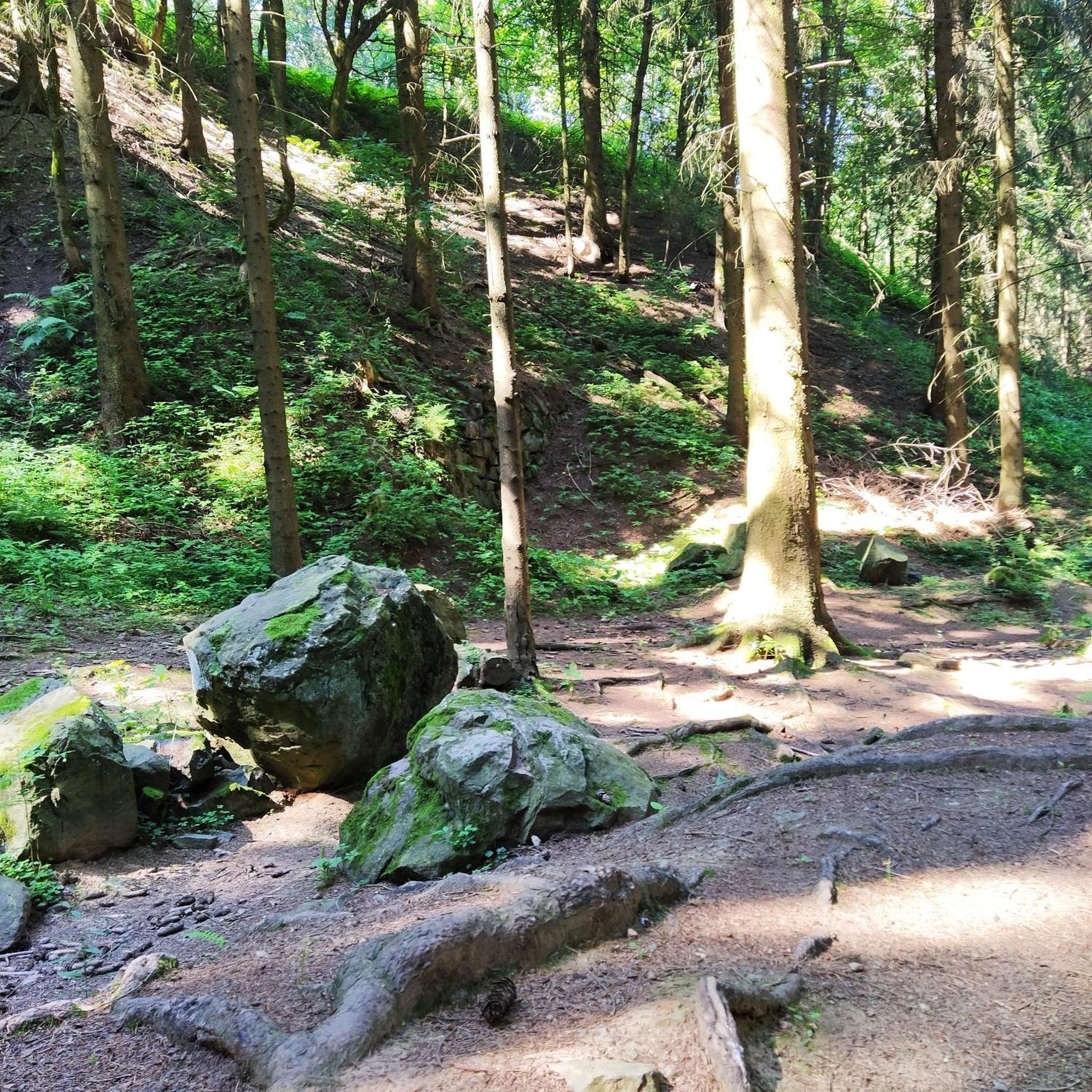
The Matterhörndl is a small but impressive rock in the Vienna Woods that is perfect for a short rest. It is a little hidden away from the main path and easy to miss, but it is worth the visit. With a small opening through and the opportunity to climb around a bit, it is a mystical place for photographers, children and nature lovers. I visited this mountain as part of my Dwarf Mountain Tours series. My goal is to climb every mountain in the Vienna Woods. Find my tours here: https://www.komoot.com/de-de/collection/2517195/-zwergbergtouren-im-wienerwald
7
1

The history of the chapel is not entirely clear: its architecture can be dated to the early 13th century. At this time, the last duke of the House of Babenberg, Frederick the Quarrelsome (1230–1246), was Lord of Vienna. The hypothesis was put forward that the Duke, who would have liked to see Vienna as a bishopric, had a crypt built for Saint Koloman, the then patron saint of the desired diocese. Source and further information https://de.m.wikipedia.org/wiki/Virgilkapelle
3
3

The Seegrotte Hinterbrühl is a former gypsum mine near Vienna that has become a show mine and a popular attraction. The Seegrotte has an eventful history, ranging from mining to the Second World War to a film set. The main attraction is the largest underground lake in Europe, where you can take a romantic boat trip. The sea grotto is open all year round and is a unique experience whatever the weather.
2
1
Frequently Asked Questions
Are there caves directly within Hennersdorf?
No, there are no notable caves located directly within Hennersdorf itself. However, the broader Lower Austria region, where Hennersdorf is situated, offers several impressive caves worth visiting.
What are some of the most popular caves near Hennersdorf?
Among the most popular caves and cave-like attractions are Seegrotte Hinterbrühl – Europe's Largest Underground Lake, known for its vast subterranean lake and historical significance, and Matterhörndl, a unique 10-meter high limestone rock formation in the Vienna Woods.
Are there family-friendly caves to visit near Hennersdorf?
Yes, several caves in the region are suitable for families. Seegrotte Hinterbrühl offers guided boat tours on its underground lake, which is a captivating experience for all ages. The Hochkarhöhle, located on Mount Hochkar, also provides an adventurous experience with spacious halls and an impressive stalactite organ.
What kind of natural features can I expect to see in the caves?
You can expect to see diverse natural features. The Seegrotte Hinterbrühl features Europe's largest underground lake. The Alland Dripstone Cave showcases various stalagmites, stalactites, and unique rock formations. Matterhörndl is a striking limestone rock formation.
Are there any historical or cultural cave sites near Hennersdorf?
Yes, the region offers several sites with historical significance. The Seegrotte Hinterbrühl was a former gypsum mine and served as an aircraft factory during World War II. The Underground Virgil Chapel beneath Stephansdom subway station is a Gothic chapel from 1220 discovered during subway construction. Additionally, the Residential Cave near Nußdorf ob der Traisen was once used by day laborers until World War I.
What is the Seegrotte Hinterbrühl known for?
The Seegrotte Hinterbrühl is famous for being home to Europe's largest underground lake. Visitors can take a guided boat tour through its mythical-looking tunnels, learning about its history as a gypsum mine and its use during World War II.
What is the temperature like inside the Seegrotte Hinterbrühl?
The Seegrotte Hinterbrühl maintains a constant year-round temperature of 9°C (48°F), so it's advisable to bring warm clothing regardless of the season.
Are there hiking opportunities near the caves around Hennersdorf?
Yes, the region offers various hiking opportunities. For example, the hike to the Residential Cave near Nußdorf ob der Traisen is considered easy, takes about an hour, and passes through vineyards and orchards. You can find more hiking trails in the area by exploring guides like Easy hikes around Hennersdorf.
What other outdoor activities can I do near these caves?
Beyond cave exploration, the area around Hennersdorf provides opportunities for various outdoor activities. You can find numerous routes for mountain biking, such as those listed in MTB Trails around Hennersdorf, or enjoy gravel biking, with options available in Gravel biking around Hennersdorf.
What is the Frauenstein Cave like?
The Frauenstein Cave in Mödling is a small grotto located on the Frauenstein rocky outcrop. It's primarily a resting spot for hikers, accessible via a trail from the Black Tower, and offers a viewpoint rather than extensive geological features.
Where can I see dripstone formations?
The Alland Dripstone Cave (Allander Tropfsteinhöhle) is an excellent place to see various dripstone formations, including stalagmites and stalactites, as well as unique rock formations and rare corrosion forms like boxwork.
What is the Einhornhöhle (Unicorn Cave)?
The Einhornhöhle, or Unicorn Cave, is located in Markt Piesting. It is typically open to visitors from Easter to the end of September on Sundays and public holidays.
Most popular routes around Hennersdorf
Most popular attractions around Hennersdorf

Get inspired with the komoot mobile app


Explore more
Extend your search for the best caves by checking out these guides of the top ones around Hennersdorf:
