The best cycling routes around Clarendon Park
4.6
(223)
2,559
riders
235
rides
Touring cycling around Clarendon Park encompasses varied landscapes, primarily characterized by chalk downland, valley meadows, and ancient royal hunting forests. The region offers a network of routes that traverse the countryside between historic towns. Terrain includes both moderate paths and routes with significant elevation changes through the downs.
Best touring cycling routes around Clarendon Park
- The most popular touring cycling route is Salisbury and Amesbury loop, a 24.2 miles (38.9 km) moderate trail that takes 2 hours 29 minutes…
Last updated: April 28, 2026
4.1
(8)
43
riders
38.9km
02:29
270m
270m
Moderate bike ride. Good fitness required. Mostly paved surfaces. Suitable for all skill levels.
5.0
(3)
18
riders
79.0km
05:08
740m
740m
This difficult 49.1-mile touring cycling loop from Salisbury offers challenging climbs, stunning views, and historic sites like Old Sarum.

Sign up for free
4.5
(2)
21
riders
76.1km
04:37
630m
630m
Hard bike ride. Very good fitness required. Mostly paved surfaces. Suitable for all skill levels.
12
riders
22.1km
01:46
210m
210m
Moderate bike ride. Good fitness required. Mostly paved surfaces. Suitable for all skill levels.
4.0
(1)
5
riders
12.5km
00:46
40m
40m
Easy bike ride. Great for any fitness level. Mostly paved surfaces. Suitable for all skill levels.
Get access to more routes and recommendations from other explorers.
Sign up for free
Already have an account?
Our route recommendations are based on thousands of hikes, rides, and runs completed by other people on komoot.
Start today with a free account
Your next adventure awaits.
Login or Signup

Tips from the Community

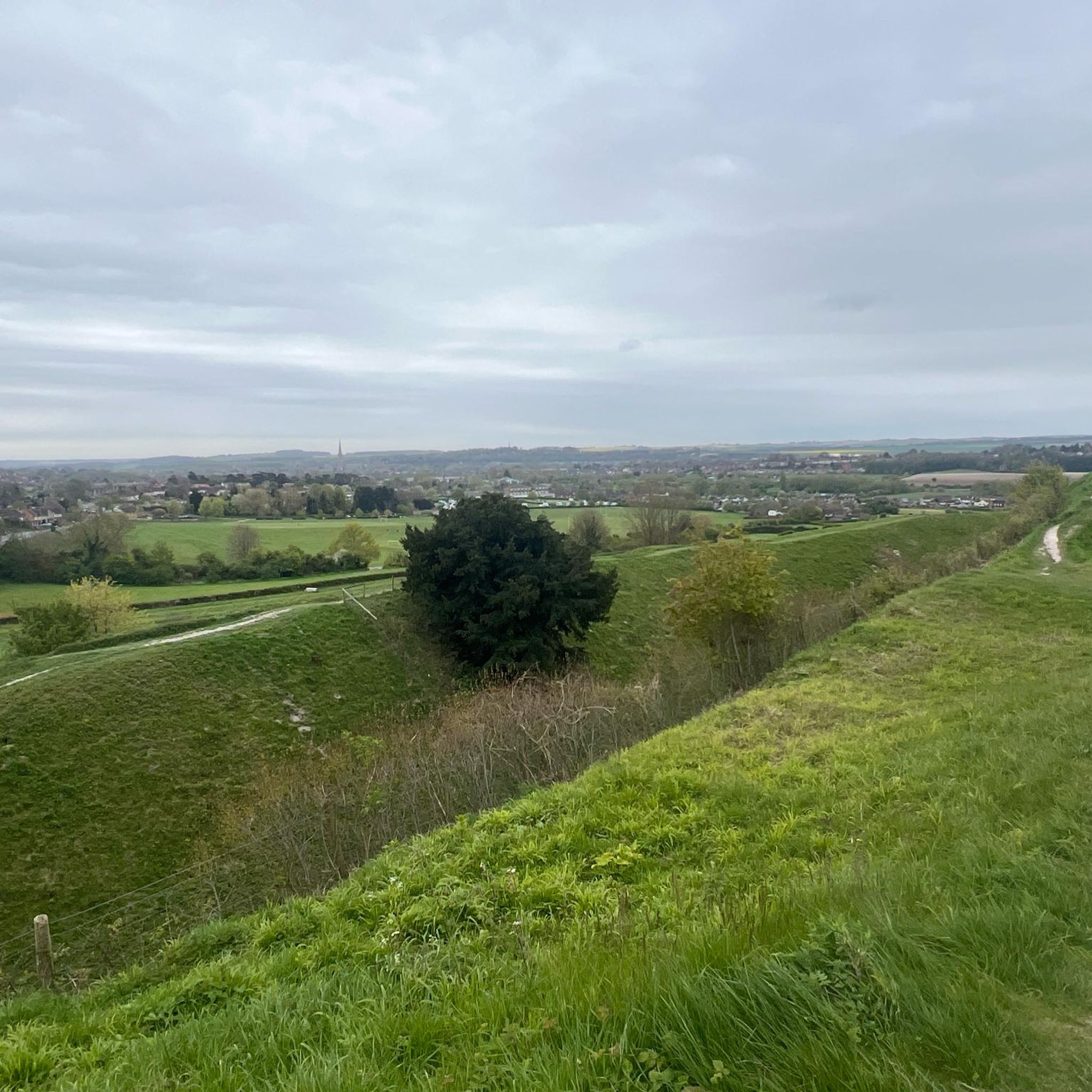
The views from Old Sarum are highly praised and are one of the main reasons visitors come to the site. Because the castle is situated on a commanding hilltop, it offers sweeping and far-reaching views across the Wiltshire countryside. Wiltshire Countryside: You get unrivalled, expansive views over the surrounding Wiltshire plains and farmland. The ancient earthworks of the hillfort provide a perfect vantage point to take in the landscape. Modern Salisbury: From the inner castle ramparts, you can clearly see the city of Salisbury (sometimes called "New Sarum"), including the tall spire of Salisbury Cathedral in the distance. This visual link connects the historic, lost city on the hill with the modern city that grew from it. The Plains and Sky: The high, open position of Old Sarum makes it a great spot for enjoying the sky and weather, with many visitors noting the dramatic atmosphere or simply the pleasure of the open air. The ramparts, in particular, are described as the perfect place to explore on foot and take in these views. As one visitor noted, "You can see miles from the inner castle ramparts." Old Sarum itself is a historical marvel, layered with over 5,000 years of history, including an Iron Age hillfort, a Roman settlement, and the site of William the Conqueror's motte-and-bailey castle and the original Salisbury Cathedral. The views serve as a stunning backdrop to this significant historic site.
0
0

The striking bronze statue of King Alfred the Great is one of Winchester's most recognizable landmarks, dominating The Broadway at the eastern end of the High Street near the River Itchen. Sculpted by Sir Hamo Thornycroft, the colossal, 15-foot-tall figure was erected in 1901 to commemorate the millennium of the king's death—a pivotal figure who made Winchester his capital and is credited with being "The Founder of the Kingdom and Nation," as inscribed on its granite base. Depicting a heroic, bearded Alfred in a regal stance with a downward-pointing sword hilt forming a cross, the statue celebrates his dual role as a military champion against the Vikings and an early Christian leader, all while standing proudly in the city he helped define.
1
0
The Sword: Alfred is shown grasping a large, cross-hilted sword with the point facing downwards. This posture is symbolic, representing not just his prowess as a warrior who defended his kingdom against the Vikings, but also his role as a Christian leader, with the hilt forming the shape of a cross. The Pedestal: The statue rests on a large pedestal of Cornish granite, which is inscribed with just one word: AELFRED. Historical Portrayal: Thornycroft's depiction is a romanticized, heroic one—showing Alfred with a long, flowing beard—even though contemporary coins suggest the King was clean-shaven. The monument represents the Victorian-era idea of Alfred as a perfect warrior, statesman, and philosopher king.
0
0
The statue depicts Alfred the Great (847–899 AD), who was the King of the West Saxons and is traditionally regarded as the first King of the Anglo-Saxons and the founder of the Kingdom of England. Winchester was his capital. Sculptor: Sir Hamo Thornycroft, a highly-regarded Royal Academician. Completion: It was completed in 1901, although it was commissioned to mark the millennium of King Alfred's death (which was in 899 AD). Size: The bronze statue is monumental, standing at 15 feet (4.57 m) high and weighing about five tons. The total height with its granite pedestal is around 40 feet. Location: It stands prominently at the eastern end of The Broadway, near the junction with Bridge Street and Eastgate Street, with the High Street extending behind it toward the city centre.
0
0
Ancient Origins: The earliest surviving structure of the gate is of Anglo-Saxon character, though it was rebuilt in the 12th century and later modified in the 13th and 14th centuries. Military Features: The 14th-century modifications included a portcullis in the western façade and two inverted-keyhole gunports (for hand-held cannon), which are considered some of the earliest in the country. Today, the structure houses the Westgate Museum, which is operated by the Hampshire Cultural Trust.
0
0
The Westgate in Winchester is one of the city's most significant and iconic historical landmarks. It is a fortified medieval gateway that stands prominently at the upper end of the High Street, close to the Great Hall of Winchester Castle. Key Facts and History Surviving Gate: It is one of only two fortified medieval gateways that survive in Winchester (the other being Kingsgate), the rest having been demolished in the 18th century.
0
0

"Discover the story of the original Salisbury and take the family for an action-packed day out at Old Sarum. Stand in the footprint of Salisbury's first cathedral, conquer the ruins of the royal castle, and discover the awe-inspiring landscape where it all began. One of the South’s most significant historic sites – William the Conqueror once hosted a great gathering at Old Sarum. Soak up the atmosphere as you explore a city lost to time. There’s over 2,000 years of history to discover, as well as unrivalled views across the Wiltshire countryside. (Text from https://www.visitwiltshire.co.uk/salisbury/things-to-do/old-sarum-p133943 )
2
0
Frequently Asked Questions
How many touring cycling routes are available around Clarendon Park?
The Clarendon Park area offers a wide selection of touring cycling routes, with over 230 options available. These routes cater to various skill levels, including 50 easy, 125 moderate, and 62 difficult trails.
Are there any easy or family-friendly touring cycling routes in the area?
Yes, there are plenty of options for beginners and families. The Clarendon Park area features 50 easy touring cycling routes. Many of the moderate routes, such as the Salisbury and Amesbury loop, are also suitable for those looking for a pleasant ride without extreme challenges, exploring the countryside between historic towns.
What kind of landscapes can I expect on touring cycling routes in the Clarendon Park area?
Touring cycling routes in the Clarendon Park area, particularly around the Clarendon Way in England, offer diverse and picturesque landscapes. You can expect to cycle through watery valley meadows, high chalk downland with exhilarating views, and ancient royal hunting forests. The routes also pass through charming villages and offer glimpses of historical sites.
Are there any circular touring cycling routes?
Yes, many of the touring cycling routes around Clarendon Park are circular, allowing you to start and end at the same point. Examples include the Salisbury and Amesbury loop and the Old Sarum Ruins – Salisbury Cathedral loop from Salisbury, which are popular choices for exploring the region.
What historical sites or landmarks can I visit along the cycling routes?
The Clarendon Park area is rich in history. Along the routes, you can encounter significant landmarks such as the Salisbury Cathedral and Historic City Centre, the Old Sarum Ruins, and St Thomas’s Church, Salisbury. The Clarendon Way itself passes through villages with historic churches and near the site of Clarendon Palace, a former royal hunting lodge.
Can I find places to eat or drink along the touring cycling routes?
Yes, many of the touring cycling routes, especially those passing through villages like Pitton, Broughton, and King's Somborne along the Clarendon Way, offer opportunities to stop at local pubs or cafes for refreshments. Planning your route in advance can help identify suitable stops.
What are the typical distances and durations for touring cycling routes here?
The routes vary significantly in length and duration. You can find shorter rides like the Old Sarum Ruins – Salisbury Cathedral loop from Salisbury, which is 17.4 miles (28.0 km) and takes about 1 hour 39 minutes. Longer, more challenging routes, such as the West Wiltshire Downs loop from Salisbury, span 49.1 miles (79.0 km) and can take over 5 hours to complete.
What do other cyclists say about the touring routes in Clarendon Park?
The touring cycling routes around Clarendon Park are highly regarded by the komoot community, with an average rating of 4.6 stars from over 220 reviews. Cyclists often praise the varied terrain, the historical points of interest, and the scenic beauty of the chalk downland and valley meadows.
Are there any routes that offer particularly scenic views?
Absolutely. The Clarendon Way in England is known for its exhilarating views from high chalk downland. Routes like the View of Stonehenge – Old Sarum Ruins loop from Salisbury Cathedral offer expansive vistas, including distant views of iconic landmarks. Natural features like Figsbury Ring and Harnham Chalk Pit also provide excellent viewpoints.
What is the best time of year to go touring cycling in the Clarendon Park area?
The best time for touring cycling in the Clarendon Park area is generally from spring through autumn. During these seasons, the weather is typically milder, and the landscapes are at their most vibrant, offering pleasant conditions for exploring the valley meadows and chalk downland. Always check local weather forecasts before heading out.
Where can I park my car to access the touring cycling routes?
Access points for touring cycling routes often include parking facilities in or near the starting towns and villages. For routes around Salisbury, you can typically find parking within the city or at designated car parks near trailheads. For specific routes, it's advisable to check the route details on komoot for recommended parking locations.
Are there any challenging routes for experienced touring cyclists?
Yes, experienced touring cyclists will find several challenging options. The Clarendon Park area offers 62 difficult routes, such as the West Wiltshire Downs loop from Salisbury, which features significant elevation changes and covers a substantial distance of 49.1 miles (79.0 km). Another demanding option is the Winchester Cathedral – Mottisfont Country Road loop from Alderbury, spanning 76.1 km with considerable climbs.
What natural features can I see while cycling?
Beyond the picturesque chalk downland and valley meadows, you can encounter various natural features. The Clarendon Way traverses ancient royal hunting forests. In other Clarendon Park locations, such as Clarendon Hills, Illinois, you might find routes along river valleys like Salt Creek, offering opportunities to observe local wildlife and dense forest cover. The area also includes natural monuments like Langley Nature Reserve.
Most popular attractions around Clarendon Park

Get inspired with the komoot mobile app


Explore more
Browse the best Cycling routes in other regions.
