The best cycling routes around Lake Kamienieckie
4.7
(31)
180
riders
49
rides
Touring cycling routes around Lake Kamienieckie traverse a landscape characterized by numerous lakes, gentle rolling terrain, and agricultural areas within the Kujawsko-Pomorskie region of Poland. The area offers a network of paths suitable for exploring the natural environment and local villages. Elevation changes are generally minimal, making it accessible for various cycling abilities. The routes often follow quiet country roads and dedicated paths, providing views of the water and surrounding countryside.
Best touring cycling routes around Lake Kamienieckie
- The most…
Last updated: July 2, 2026
3
riders
Hard bike ride. Great for any fitness level. You may need to push your bike for some segments of this route.
5.0
(1)
12
riders
Moderate bike ride. Good fitness required. Mostly paved surfaces. Suitable for all skill levels.

Sign up for free
5.0
(2)
6
riders
10.4km
00:42
30m
30m
Easy bike ride. Great for any fitness level. Mostly paved surfaces. Suitable for all skill levels.
5
riders
9.97km
00:34
30m
30m
Easy bike ride. Great for any fitness level. Mostly paved surfaces. Suitable for all skill levels.
5.0
(1)
6
riders
23.7km
01:54
90m
90m
Easy bike ride. Great for any fitness level. Mostly paved surfaces. Suitable for all skill levels.
Get access to more routes and recommendations from other explorers.
Sign up for free
Already have an account?
Our route recommendations are based on thousands of hikes, rides, and runs completed by other people on komoot.
Start today with a free account
Your next adventure awaits.
Login or Signup




Tips from the Community

The now-defunct manor house was likely built at the turn of the 20th century on the site of an older structure. It was here that the writer and music critic Jerzy Waldorff-Preyss spent his childhood and youth. His father, Witold Preyss, bought the small farm immediately after the end of World War I, and after his death, the family moved from Rękawczyn to Warsaw, while the estate was leased. The area surrounding the manor house is home to numerous archaeological sites, explored in 2018 and 2019. The last pre-war tenant, Jan Piechowiak, and his son were executed by the Germans on September 15, 1939. The manor house was surrounded by a park, from which a beautiful linden avenue leading to the manor courtyard still survives. At the rear of the manor house stood a barn. To the right stood a long building housing a sheepfold, stables, and stables. Parallel to the manor house stood a pigsty, chicken coops, and a granary. Opposite the barns and stables was an orchard and vegetable garden. Between the stable and the granary was a coach house, containing an open yoke, a one-horse carriage, and an old 19th-century carriage. In 1937, the granary and pig house, along with all the livestock, burned down. (FB Manors and Palaces of Greater Poland)
0
0

🪵 History and Foundation - The church was built between 1789 and 1792, funded by Petronela Mlicka, née Gałczyńska, with the support of Father Ignacy Gułkowski. - During World War II, it was converted into a warehouse for water equipment and then renovated in 1968. - A thorough restoration was carried out between 1997 and 2002, during which the polychrome by Professor Wiktor Gosieniecki from the 1920s was removed. 🏛️ Architecture - The church is built using a log construction, clapboarded, with a slight southward orientation. - It has a hall-like layout, with a three-sided enclosed chancel. - There are annexes on either side of the nave: the Chapel of St. Joseph to the south and the sacristy to the north. - A square tower of post-and-beam construction rises from the front, with a ground-floor porch, topped by a bulbous dome with a lantern. - The roofs are shingled, emphasizing the building's traditional character. 🎨 Interior and Furnishings - The interior is covered with a flat, faceted ceiling, with a choir loft supported by four columns. It houses a five-stop organ by Wilhelm Sauer from 1900. - A Rococo crucifix from the late 18th century is placed on the chancel beam. - The interior furnishings are Baroque, Rococo, and Classicist, and include: - The main altar and two side altars, - A fourth altar in the chapel with Baroque figures, - A pulpit, baptismal font, confessionals, - A folk crucifix by Józef Glanc in the sacristy. 🔔 Surroundings - Next to the church is a brick and wooden bell tower from the mid-19th century, with a shingled roof. - The entire complex is surrounded by a wooden fence, and nearby stands a rectory from the turn of the 19th and 20th centuries.
0
0

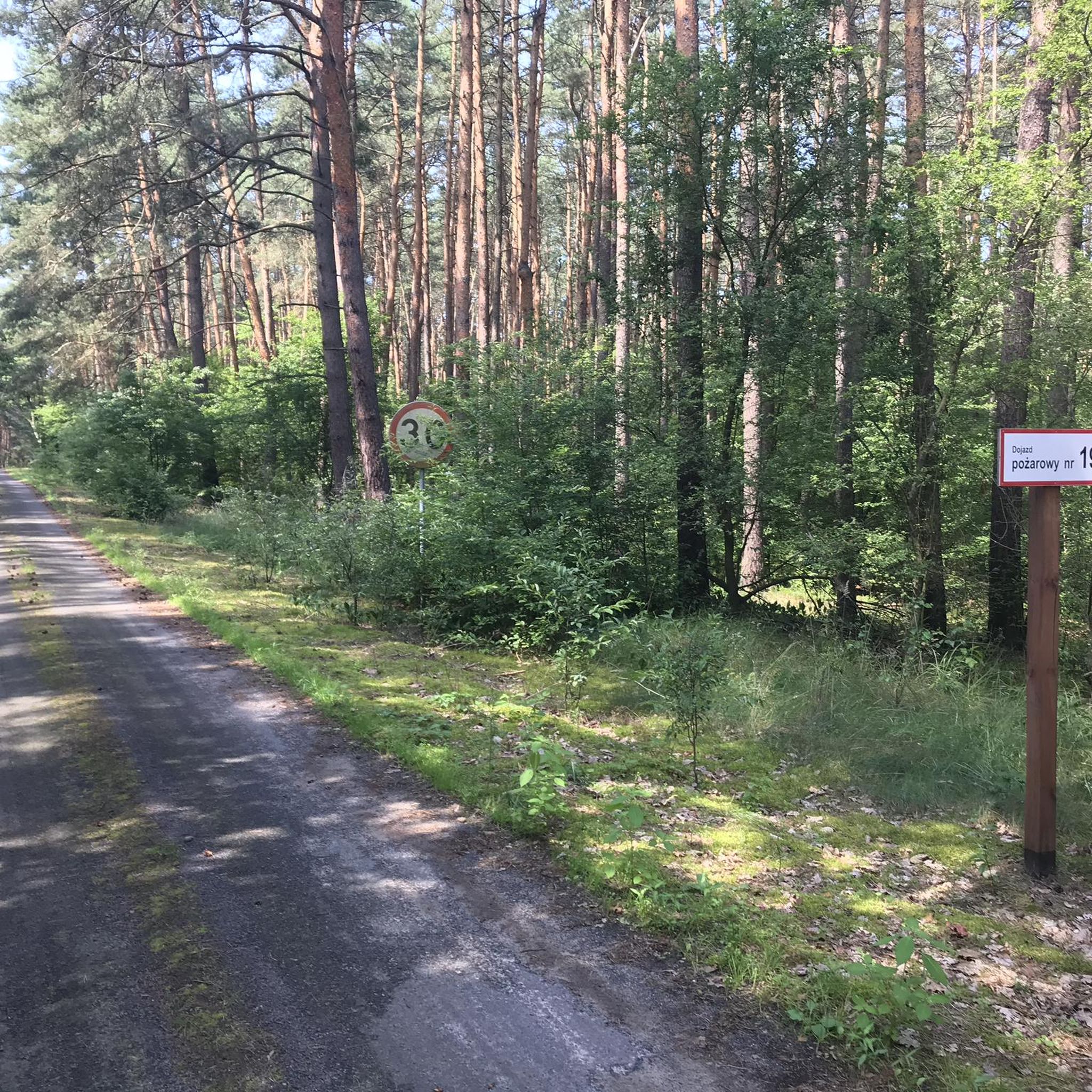
Good quality gravel section.
0
0
Obelisk commemorating the German murder of Jews and prisoners of war in 1942.
0
0
The station was the end point of the line no. 239 Barcin-Mogilno-Orchowo, built in the years 1913-1921. The initial plans assumed the construction of a route from Września through Witkowo, Orchowo, Mogilno, Barcin to Łabiszyn and Bydgoszcz, facilitating communication for German colonialists, but for various reasons, mainly financial, the entire project was not implemented. Work on the Orchowo-Witkowo section was abandoned after only a few months, and the construction of the Barcin - Łabiszyn - Bydgoszcz section was not started at all. (bazakolejowa.pl)
0
0
A single-storey manor house from the beginning of the 20th century, with a high basement, built on a rectangular plan in the longer axis NEzN-SWzS, with the facade facing west (NWzW). Covered with a hipped roof containing a usable attic. (polskiezabytki.pl)
0
0
There is a former water mill by the lake, now private property.
1
0
Frequently Asked Questions
How many touring cycling routes are available around Lake Kamienieckie?
There are over 40 touring cycling routes recorded around Lake Kamienieckie on komoot, offering a wide range of options for exploring the region.
Are there easy touring cycling routes suitable for beginners or families?
Yes, Lake Kamienieckie is well-suited for beginners and families, with 28 of the routes classified as easy. An excellent option is the Bike loop from gmina Orchowo, which is 6.5 miles (10.4 km) long and features minimal elevation changes.
What kind of terrain can I expect on touring cycling routes in this area?
The terrain around Lake Kamienieckie is generally gentle, characterized by numerous lakes, rolling agricultural areas, and quiet country roads. Elevation changes are minimal, making it accessible for various cycling abilities. Routes often follow dedicated paths and provide views of the water and surrounding countryside.
Are there any longer or more challenging touring cycling routes for experienced riders?
While the region is known for its gentle terrain, there are routes that offer a bit more distance and varied scenery. For example, the View of Lake Budzislawskie – Wooden Church loop from Orchowo is a moderate 27.7 miles (44.5 km) route that includes more extensive exploration of the landscape.
What are some notable landmarks or points of interest along the cycling routes?
Many routes pass by local points of interest. The All Saints' Church loop from Orchowo guides cyclists past local landmarks. Another route, the Statue of St. Hubert – Piłka Lake loop from Orchowo, offers lake views and passes by the statue.
What is the best season for touring cycling around Lake Kamienieckie?
Given the region's characteristics of lakes and agricultural areas, spring, summer, and early autumn are generally the most pleasant seasons for touring cycling. The weather is typically mild, and the natural scenery is at its most vibrant. Always check local weather conditions before heading out.
Are there any circular touring cycling routes available?
Yes, many of the routes around Lake Kamienieckie are designed as loops, providing convenient starting and ending points. Examples include the popular Bike loop from gmina Orchowo and the Remains of the Preyss Family Estate loop from Orchowo.
What do other touring cyclists say about the routes in Lake Kamienieckie?
The touring cycling routes around Lake Kamienieckie are highly rated by the komoot community, holding an average score of 4.6 stars from over 30 reviews. Cyclists often praise the quiet country roads, scenic lake views, and the accessibility of the routes for various skill levels.
Are there opportunities for wildlife spotting while cycling?
The routes traverse natural environments including lake shorelines and open fields, which can offer opportunities for observing local wildlife. Keep an eye out for various bird species and other small animals typical of rural Polish landscapes, especially during quieter times of day.
Where can I find parking for bike trails around Lake Kamienieckie?
Many routes start from villages like Orchowo, which typically offer public parking options. It's advisable to check the specific starting point of your chosen route on komoot for detailed parking information, as local villages often have designated areas for visitors.
Are there any routes that offer particularly scenic viewpoints?
Routes that hug the lake shorelines or pass through elevated sections of the gentle rolling terrain often provide scenic views. The Statue of St. Hubert – Piłka Lake loop from Orchowo is noted for its lake views, and other routes may offer vistas over the agricultural landscape.
What is the typical distance of touring cycling routes in this area?
The routes vary in length, catering to different preferences. You can find shorter loops around 6 miles (10 km), such as the All Saints' Church loop from Orchowo, as well as longer options extending up to 27 miles (44 km) like the View of Lake Budzislawskie – Wooden Church loop from Orchowo.
Most popular routes around Lake Kamienieckie

Get inspired with the komoot mobile app


Explore more
Browse the best Cycling routes in other regions.
