The best cycling routes around Riserva Naturale La Pietra
4.5
(150)
1,381
riders
77
rides
Touring cycling routes around Riserva Naturale La Pietra traverse a landscape characterized by rolling hills, dense woodlands, and open countryside. The region features a mix of paved and unpaved roads, suitable for various touring cycling experiences. Elevations vary, offering both gentle gradients and more challenging climbs through the natural reserve. This area provides a diverse environment for exploring on a touring bike.
Best touring cycling routes around Riserva Naturale La Pietra
- The most popular touring cycling route is San Galgano…
Last updated: August 31, 2026
5.0
(4)
23
riders
28.3km
02:11
440m
440m
Moderate bike ride. Good fitness required. Mostly paved surfaces. Suitable for all skill levels.
5
riders
28.4km
02:27
490m
490m
Hard bike ride. Very good fitness required. Mostly paved surfaces. Suitable for all skill levels.

Sign up for free
6
riders
23.7km
01:34
360m
360m
Moderate bike ride. Good fitness required. Mostly paved surfaces. Suitable for all skill levels.
4.8
(17)
220
riders
68.5km
04:36
1,120m
1,120m
Hard bike ride. Very good fitness required. Mostly paved surfaces. Suitable for all skill levels.
4.4
(9)
78
riders
59.4km
03:58
930m
930m
Hard bike ride. Very good fitness required. Mostly paved surfaces. Suitable for all skill levels.
Get access to more routes and recommendations from other explorers.
Sign up for free
Already have an account?
Our route recommendations are based on thousands of hikes, rides, and runs completed by other people on komoot.
Start today with a free account
Your next adventure awaits.
Login or Signup

Tips from the Community

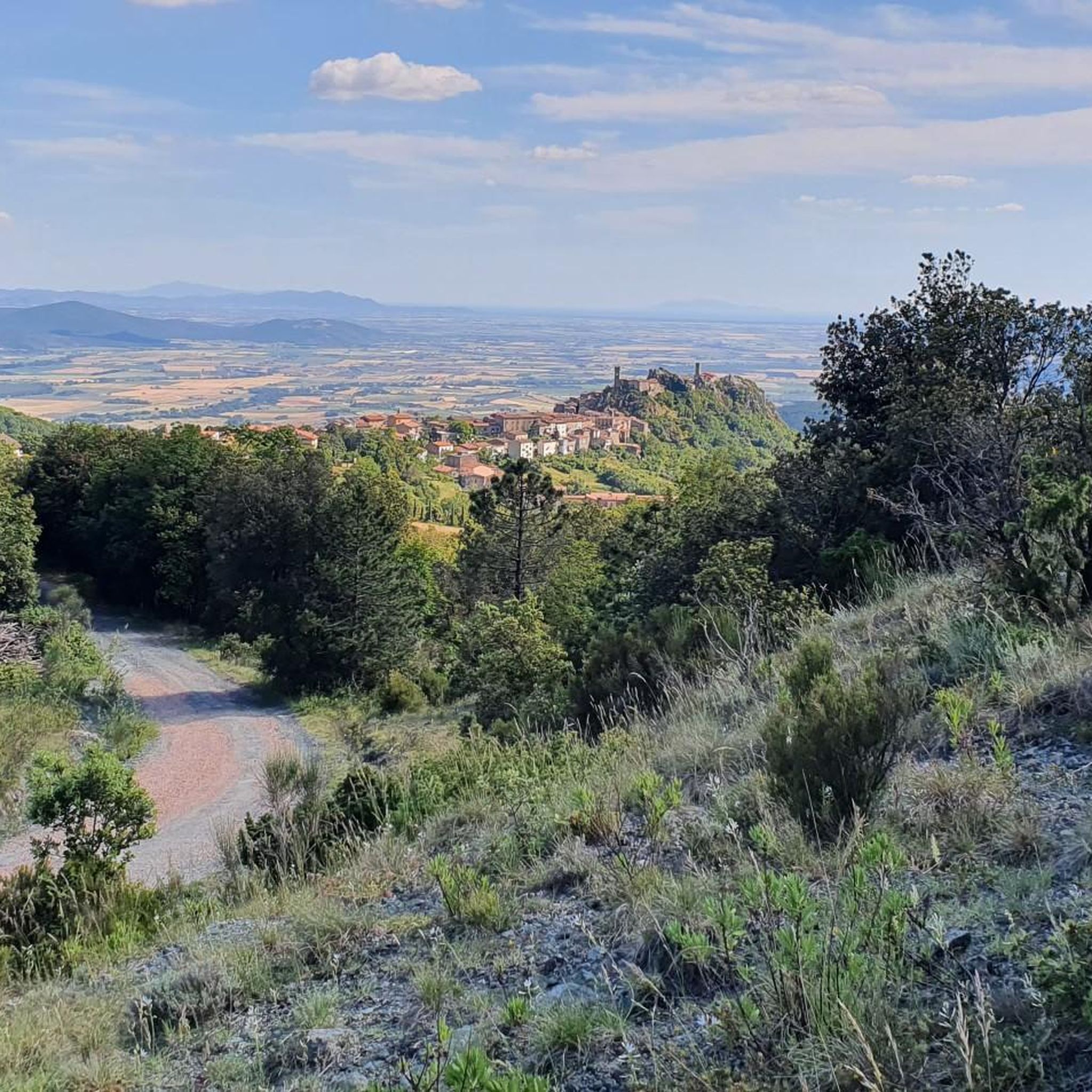
Tatti is an ancient and evocative Italian medieval village, part of the municipality of Massa Marittima, located in the province of Grosseto in Tuscany. Perched at about 412 meters above sea level on the Colline Metallifere, it overlooks the Tuscan Maremma and has a small community of about 200 inhabitants.
0
0
The Archaeological Museum is housed in the ancient Palazzo del Podestà (1225), which overlooks the Piazza del Duomo of Massa Marittima. The collection is organized into sections, ordered chronologically from the lower paleolithic to the etruscan age; the main piece of the prehistoric collection is the eneolithic statue-stele of Vado all’Arancio, the only find of its type in Maremma; the etruscan finds come mainly from excavations carried out at the village of Lago dell’Accesa, they are mainly kitchenware, loom weights, fishing weights and bricks; also present are the funerary trousseaux found in the necropolises, especially pottery (figulina clay and bucchero), bronze fibulae, iron pot stands, iron and bronze weapons. On the ground floor, an educational section is set up with a life-size reconstruction of typical caves: a paleolithic and an eneolithic one. Guided tours and educational activities, organization of cultural events and film screenings are available.
1
0

Used in the past as a set for Mulino Bianco product advertisements.
0
0
The perimeter walls are still partially visible, especially in the southern section, where an arched gate surmounted by three rounded stones stands. At the highest point of the hill stands the imposing stone keep, which extends around a courtyard. Within the walls is the church of Santa Maria Assunta, dating back to the 13th century but completely renovated in the late 19th century. It has a distinctive urban layout, dominated by an imposing stone keep arranged around a courtyard accessed through two round-arched gates, defended by a large tower with a massive base.
0
0

Loop starting from Monticiano (Si) by i'Lupo che cammina
1
0
Massa Marittima is a fortified medieval village located on a hill, known for its beauty and wealth of artistic and architectural heritage. Key attractions include the magnificent Piazza Garibaldi, with the Cathedral of San Cerbone, the Palazzo del Podestà, and the Palazzo Comunale. Other points of interest include the Fonti dell'Abbondanza with its famous fresco of the Tree of Fertility and, in the upper town, the Torre del Candeliere and the Cassero Senese within the medieval walls.
1
0
Massa Marittima is a municipality located in the southern area of the Colline Metallifere, an area that has been inhabited since prehistoric times, as documented by numerous archaeological finds. The settlement is thought to be of Etruscan origin, but the city's most important period began in the 9th century, when it became a bishop's seat. From then until the 14th century, the city reached its peak splendor, thanks in part to the area's abundant mineral resources.
3
0
In 1335, Massa Marittima lost its political autonomy, having to yield to the conquest of Siena, which had long been attempting to seize control of the Massa Marittima mines. A period of economic and demographic decline followed, further exacerbated by the plague of 1348. Despite the serious problems, however, mining activity was never completely abandoned, although it was certainly significantly reduced. The Medici family, who incorporated the province of Siena into the Grand Duchy in 1557, attempted some interventions to promote the area's recovery, while a significant revival occurred in 1737 with the arrival of the House of Lorraine as successors to the extinct Medici family.
3
0
Frequently Asked Questions
What is the overall difficulty level of touring cycling routes in Riserva Naturale La Pietra?
The touring cycling routes in Riserva Naturale La Pietra offer a range of challenges. While there are no routes classified as 'easy', you'll find 16 moderate routes and 54 difficult routes. This means the area is well-suited for cyclists looking for a good workout with varied terrain, including rolling hills and ascents.
Are there any routes suitable for beginner touring cyclists?
While there are no routes specifically categorized as 'easy', some of the moderate routes can be a good starting point for beginners with a reasonable level of fitness. For example, the San Galgano – Montesiepi Hermitage loop from Scalvaia is a moderate 28.3 km ride that connects historical sites with scenic rural paths, offering a manageable challenge.
Where can I find more challenging touring cycling routes in the reserve?
For experienced touring cyclists seeking a challenge, Riserva Naturale La Pietra offers 54 difficult routes. These often feature significant elevation changes and longer distances. A good option is the Montesiepi Hermitage – San Galgano loop from Scalvaia, a 32.4 km trail with substantial climbs, leading through historical landmarks and varied terrain.
Are there long-distance touring cycling routes available in Riserva Naturale La Pietra?
Yes, the reserve features several longer touring cycling routes. For instance, the Roccatederighi – Tatti Village loop from Roccatederighi covers approximately 68.5 km with over 1100 meters of elevation gain, making it a substantial ride for those looking to spend more time exploring the region.
Can I find circular touring cycling routes in the area?
Many of the touring cycling routes in Riserva Naturale La Pietra are designed as loops, allowing you to start and finish at the same point. Examples include the View of Roccastrada – Roccastrada Clock Tower loop from Torniella, which offers panoramic views and passes through charming villages, and the Roccatederighi – Montieri Village Center loop from Roccatederighi.
Are the touring cycling routes in Riserva Naturale La Pietra suitable for families?
Given the prevalence of moderate and difficult routes, and the rolling hills characteristic of the region, the touring cycling routes in Riserva Naturale La Pietra are generally better suited for families with older children or those who are already comfortable with longer distances and some climbing. There are no easy, flat routes specifically designed for very young children.
What is the best time of year to go touring cycling in Riserva Naturale La Pietra?
The best time for touring cycling in Riserva Naturale La Pietra is typically spring (April to June) and autumn (September to October). During these months, the weather is generally mild and pleasant, with less intense heat than summer and fewer crowds. The landscapes are also particularly beautiful, with blooming wildflowers in spring and vibrant foliage in autumn.
What kind of scenery can I expect on the touring cycling routes?
The touring cycling routes in Riserva Naturale La Pietra offer diverse and picturesque scenery. You can expect to ride through rolling hills, dense woodlands, and open agricultural land. Many routes provide panoramic views of the Tuscan countryside, charming medieval villages, and historical landmarks like the Montesiepi Hermitage and San Galgano Abbey.
Are there any places to stop for refreshments or food along the touring cycling routes?
Yes, many routes pass through or near small villages and towns where you can find local cafes, trattorias, or small shops to refuel. It's always a good idea to check your chosen route beforehand and plan your stops, especially on longer rides, as services might be sparse in more remote sections of the reserve.
Where can I park my car when visiting Riserva Naturale La Pietra for a bike ride?
Parking is generally available in the villages and towns that serve as common starting points for routes, such as Scalvaia, Torniella, or Roccatederighi. Look for designated public parking areas. It's advisable to arrive early, especially during peak season, to secure a spot.
Is it possible to reach the touring cycling routes in Riserva Naturale La Pietra by public transport?
Access to Riserva Naturale La Pietra by public transport can be limited, as is common with many natural reserves in rural Italy. Regional bus services connect some of the larger towns surrounding the reserve, but direct access to specific trailheads might require a combination of bus and a short ride or taxi. Bringing your bike on public transport may also have restrictions, so checking local transport schedules and policies in advance is recommended.
What do other touring cyclists enjoy the most about touring cycling in Riserva Naturale La Pietra?
The area is highly rated by the komoot community, with an average score of 4.6 stars from over 100 reviews. Reviewers often praise the diverse terrain, the blend of historical sites with natural beauty, and the quiet, scenic rural paths that allow for an immersive cycling experience away from heavy traffic.
Most popular routes around Riserva Naturale La Pietra

Get inspired with the komoot mobile app


Explore more
Browse the best Cycling routes in other regions.
