Attractions and Places To See around Saint-Pantaléon-Les-Vignes - Top 20
Best attractions and places to see around Saint-Pantaléon-Les-Vignes. This village in Drôme Provençale is known for its vineyards and tranquil setting. It features historical landmarks such as a Romanesque church and an 1870 wash house. The surrounding countryside offers opportunities for walks and exploring the viticultural heritage.
Best attractions and places to see around Saint-Pantaléon-Les-Vignes
- The most popular attractions is Château de Grignan, a castle that transformed from a medieval structure into a Renaissance palace. This raised complex is…
Last updated: July 6, 2026
Nyons Roman Bridge
Highlight • Bridge
Translated by Google •
Tip by

Château de Grignan
Highlight • Castle
Translated by Google •
Tip by

Sign up now to discover places like this
Get recommendations on the best single tracks, peaks, & plenty of other exciting outdoor places.
Sign up for free
Chapel of Our Lady of Good Help of Nyons
Highlight • Religious Site
Translated by Google •
Tip by

Venterol Village Square and Raoul Taburin Film Location
Highlight • Settlement
Translated by Google •
Tip by

Templar Commandery of Richerenches
Highlight • Historical Site
The Commandery of Richerenches was founded in …
Translated by Google •
Tip by
Sign up for free to discover even more attractions around Saint-Pantaléon-Les-Vignes.
Sign up for free
Already have an account?
Start today with a free account
Your next adventure awaits.
Login or Signup
Popular around Saint-Pantaléon-Les-Vignes

Tips from the Community

The Templars' Castle in Richerenches is a special visit. Here, one can retrace the steps of the mythical Order of the Templars, who founded a unique commandery there. The Templars left a deep-rooted imprint on the land for 2 centuries before their departure; its architectural foundation is very beautiful, created by the Templars, a group of soldiers themselves inspired by the natural beauty of the territory. Inside, you can see tributes to the Order: It is a pleasure not to be missed if you pass through Rivesrenches, and it is the best-preserved commandery in Provence (a charming small village with a medieval style that attracts with its gastronomic truffles). A true historical crossroads and a lot of heritage to discover on site related to its past! Small village, great cultural richness.
1
0

One of the almost obligatory attractions of Nyons, with a beautiful view.
1
1


The Romanesque bridge of Nyons, which crosses the Eygues River, was built between 1399 and 1400. It was inaugurated in 1409 by the Bishop of Vaison. Its two main architects were Guillaume de Pays, a carpenter from Romans, and Jean Felisson, a stonemason from Saint-Robert de Cornillon. While its construction was relatively rapid, its financing took several decades. A "work of the bridge" was already created in 1341. A first prize was awarded in 1361 to Thibaut de Noyx, but it does not appear that he saw its completion: at the end of the 14th century, the Eygues River was crossed using a ferry. Its single arch is one of the largest in France, with a span of 40.50 m and a height of 19 m. This bridge can be compared to the Pont du Roc in Castellane (Alpes-de-Haute-Provence), built by Jean Felisson around 1405, or the Mollans-sur-Ouvèze bridge (Drôme), which may date back to the early 15th century. Listed as a historical monument since 1925, it is the second bridge in France (after the one in Ceret) of such a pure style.
3
1
It was Father François who initiated the construction of the upper part of the monument, and the architect Adrien Boisson who designed the pedestal. It is composed of two pyramidal walls arranged diagonally and forming three floors. The first floor (the lower one) has blind arches, but the two upper floors have Neo-Gothic arcades. At the intersection of the two walls is a central shaft supporting the pedestal of the Virgin. The pedestal is very richly decorated: small columns, rose windows, trefoil arches, and small towers. Statues are placed at the edges of the different floors: 1st floor: the Saints: Saint Joseph, Saint John, Saint Bernard, and Saint Vincent; 2nd floor: the Saints: Saint Anne, Saint Elizabeth, Saint Madeleine, and Saint Theresa. On the third floor, angels have been sculpted. The architect Boisson thus intended to symbolize the prayer that springs from the earth to heaven, then is transmitted by the saints, men and women, and finally by the angels to the Virgin Mary. The statue of the Virgin Mary at the summit is 3.50 m high. It is said that she watches over the serenity and tranquility of the city. Once the construction of the pedestal was completed, the building was inaugurated on May 3, 1863 (six months after its purchase) by the Bishop of Valence, in the presence of Father Gabriel of the Abbey of Notre-Dame d'Aiguebelle, forty priests, and 15,000 faithful. The first mass at the Notre-Dame de Bon Secours chapel was held on August 14, 1864, but its consecration took place on the Feast of the Assumption on August 15, 1864. It was on that day, in the presence of a jubilant crowd, that the statue of the Virgin, the one currently inside the chapel, was placed on the altar and blessed by Father Gabriel of Aiguebelle Abbey. Inside the chapel, on the south side, is a small gilded wooden altar dating from the late 17th century. It is surmounted by the statue of the Virgin, which was placed there on August 15, 1864. Two wooden staircases, on either side of the altar, lead to the gallery, whose three tiers of seats are arranged in an amphitheater around the tower. The altar, steps, altarpiece, and tabernacle are listed as historical heritage by the Ministry of Culture, under the reference PM26000450. Numerous paintings adorn the walls, most of them the work of the painter Léon Alègre, originally from Bagnols-sur-Cèze (Gard). These paintings were created between 1867 and 1869. The paintings depict: along the east and west staircases: the Flight into Egypt and the Adoration of the Magi; on the faces of the vaulted arches: to the south, the Presentation of Mary in the Temple and Our Lady of Good Help; to the west: the Assumption and the Sorrowful Mother; to the north: the Holy Family and the Visitation; to the east: the Annunciation and the Marriage of the Virgin; On the edges of the vaulted arches, four portraits appear: to the east: Saint Mark and Saint Matthew; to the west: Saint John and Saint Luke; above the entrance door: between Saint Stephen and Saint Francis of Assisi, the Coronation of the Virgin.
0
0
The Randonne Tower, overlooking the town, is built on a sandstone mound in the center of the Nyons Forts district. It measures 8 meters on each side and 10 meters high. Its origins are said to date back to 1280. Nyons was then the capital of the Barony of Montauban. Dame Randonne de Montauban is said to have had a castle built there to serve as a military prison. Only a defensive tower, with walls 2 meters thick, remains today. This origin, which is only a hypothesis, is the most plausible: a 16th-century representation of the tower shows that it was at the center of a system of fortifications adjoining the "Maison de la Randonne," the stately home of Randonne de Montauban. This residence was destroyed in the last century during the development of the square in front of the chapel. After the Montaubans, the keep had several owners, including the dauphins in the 14th century. In 1633, the prison was dismantled when Nyons was opened and its fortifications were destroyed, in accordance with Louis XIII's wish to see the region's Protestant strongholds fall. In 1854, Father Francou suffered a serious and fatal illness. He then prayed to Mary and was cured. In gratitude for this healing, he prostrated himself before the altar of the parish church. Ten years later, during his sermon on August 15, 1862, he announced his wish to erect, on one of the tallest towers in Nyons, a pedestal upon which would rest a large and beautiful statue of the Blessed Virgin, which would, he claimed, dominate the town and be seen from afar in the countryside. The tower having been sold by the commune, Father Francou bought it back from its owners on October 21, 1862, and donated it to the Fabrique de Nyons (the parish council at the time). The Randonne Tower subsequently became the Chapel of Our Lady of Good Help. Every August 15th, the Randonne Tower is honored with a grand celebration retracing the origins of the monument, the places, deeds, people, and events that have marked the town's history. Each year, the tower, where Baroness Randonne of Montauban once lived, remembers the lives of the inhabitants of Nyons, since its construction around the mid-13th century. It tells us of all the generations of Nyons residents whose lives were born there.
0
0

The Roman bridge from the 14th century (classified as a historical monument), which, by the way, stands in miniature in the roundabout in the twin town of Mechernich.
4
1
The Tour Randonne was built around 1280 by the Baroness de Montauban. On a rock overlooking Nyons, this building with medieval architecture served as the castle's keep and military prison. The tower was bought by Abbot Francou and converted into a chapel.
1
0
Frequently Asked Questions
What historical landmarks can I explore within Saint-Pantaléon-Les-Vignes itself?
In the village, you can visit the Romanesque Église Saint-Pantaléon, which features a Carolingian baptistery and 19th-century neoclassical trompe-l'œil decorations. Other historical points of interest include an 1870 Lavoir (wash house), the 1901 Mairie (Town Hall), and the charming Chapelle Notre-Dame-de-Santé. Don't miss the Domaine d'Urdy, a 19th-century bourgeois house with a romantic park.
What are some notable attractions in the wider region around Saint-Pantaléon-Les-Vignes?
The area offers several significant attractions. You can visit the magnificent Château de Grignan, a Renaissance palace visible from a distance. Explore the historic Nyons Roman Bridge, a single-arch structure built between 1341 and 1409. Also, consider the Chapel of Our Lady of Good Help of Nyons, a former medieval tower converted into a chapel overlooking Nyons. The nearby town of Nyons is also home to the Old Olive Oil Mills and Historic Soap Factory.
What outdoor activities can I do near Saint-Pantaléon-Les-Vignes?
The region is ideal for outdoor enthusiasts. You can explore the extensive vineyards and surrounding countryside through various activities. The "Sentier des Terroirs" is a marked trail perfect for hiking, mountain biking, and cyclotourism, offering insights into the local wine culture. For more structured routes, you can find numerous options for hiking, mountain biking, and road cycling around Saint-Pantaléon-Les-Vignes.
Are there any family-friendly attractions or activities in the area?
Yes, several attractions are suitable for families. The Nyons Roman Bridge and the Old Olive Oil Mills and Historic Soap Factory of Nyons are considered family-friendly highlights. Additionally, the nearby Parc de Loisirs Aquatiques Nyonsoleïado offers recreational water activities. Exploring the village's charming stone houses and the Domaine d'Urdy park can also be pleasant for families.
What is the best time of year to visit Saint-Pantaléon-Les-Vignes for outdoor activities and wine tasting?
The best time to visit for outdoor activities like hiking and wine tasting is typically during the spring (April to June) and early autumn (September to October). During these periods, the weather is pleasant, ideal for exploring vineyards and trails. The village also hosts a grape and wine festival in early June, offering a unique cultural experience.
Where can I experience the local winemaking culture?
Saint-Pantaléon-Les-Vignes is at the heart of Drôme Provençale's wine region. You can explore the extensive vineyards via the "Sentier des Terroirs," a marked hiking trail that educates visitors about nature, wine, and the winemaking process. Many local wine cellars offer tours and tastings of the renowned Côtes du Rhône wines.
Are there any hidden gems or unique places to discover?
Beyond the main attractions, wandering through the village's streets reveals many charming stone houses and a picturesque fountain on the square. The Domaine d'Urdy, with its romantic park, offers a tranquil escape. For film enthusiasts, the Venterol Village Square was a filming location for "Raoul Taburin," offering a unique connection to cinema.
What kind of natural features can I expect to see around Saint-Pantaléon-Les-Vignes?
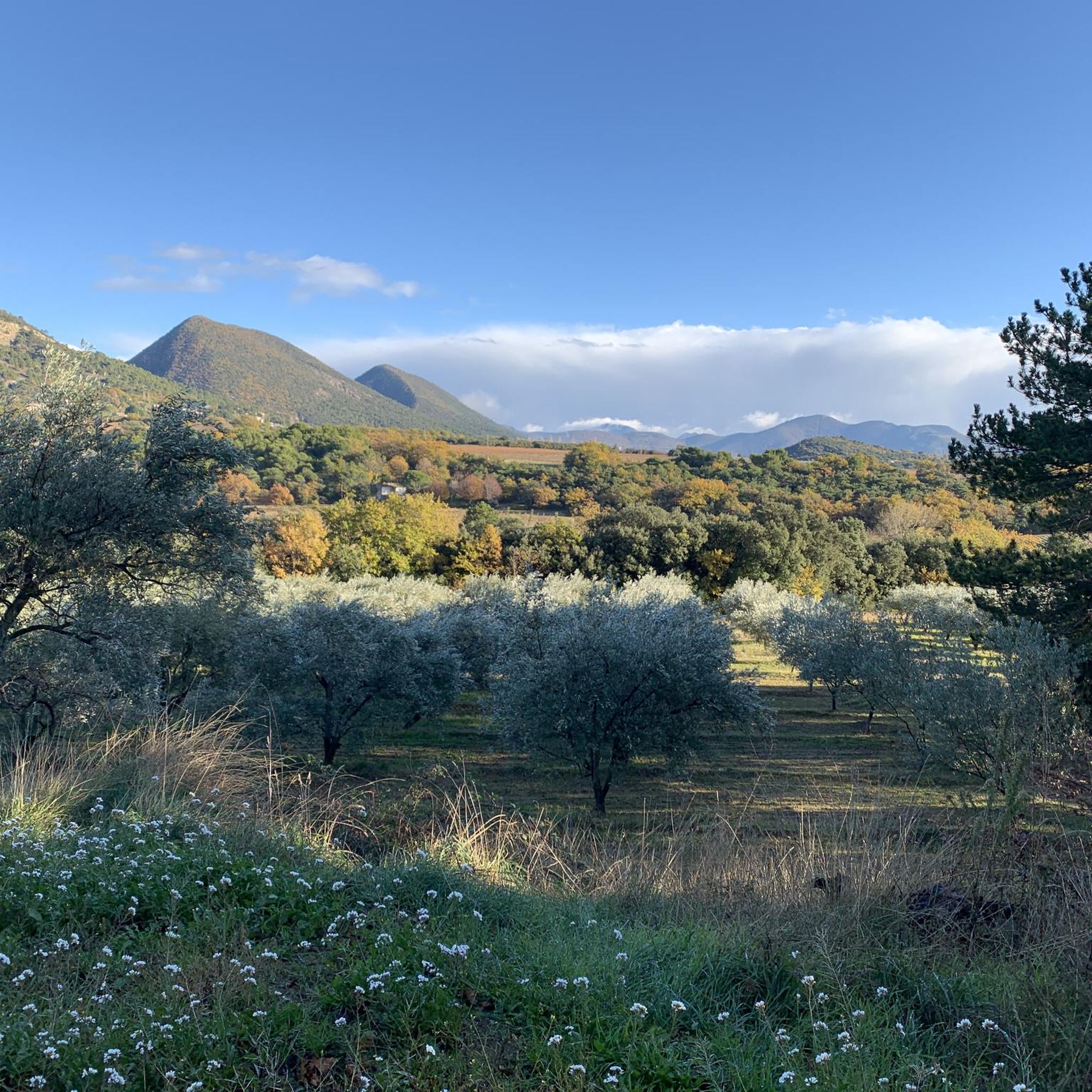
The village is set in a lush green landscape, characterized by extensive vineyards and rolling clay-limestone hillsides. The surrounding countryside offers beautiful walks with views of the Massif de la Lance. The "Sentier des Terroirs" provides an immersive experience in the natural and cultivated landscapes of the region.
What do visitors enjoy most about the attractions near Saint-Pantaléon-Les-Vignes?
Visitors frequently praise the historical significance and architectural beauty of sites like the Château de Grignan, noting its impressive structure and views. The Nyons Roman Bridge is appreciated for its Romanesque style and the pleasant surroundings of Nyons. The Old Olive Oil Mills are highlighted for their interesting historical insights and the opportunity to learn about local traditions.
Are there any towns or villages nearby worth visiting?
Absolutely. The lively town of Nyons, about 9-10 km away, is famous for its olive oil, markets, and charming old castle streets. Valréas, approximately 5 km distant, boasts picturesque medieval streets, churches, and towers. You can also visit Venterol, known for its village square which served as a film location.
Are there any specific hiking trails recommended for different difficulty levels?
Yes, the area offers a variety of hiking trails. For an easy walk, consider the "Church of Rousset-les-Vignes loop from Rousset-les-Vignes" (2.65 km). Moderate options include the "Venterol village center – Free (2024) parking loop from Venterol" (12.41 km) or the "Small hill – Sandstone rocks loop from Saint-Pantaléon-les-Vignes" (8.19 km). For more challenging hikes, try the "View of Notre-Dame de Beauvoir – Rousset-Les-Vignes loop from Rousset-les-Vignes" (4.04 km). You can find more details and routes on the hiking guide page.
Most popular routes around Saint-Pantaléon-Les-Vignes
Most popular attractions around Saint-Pantaléon-Les-Vignes

Get inspired with the komoot mobile app


Explore more
Still not found the Highlight you’re looking for? See guides of the top attractions in other regions:
