The best cycling routes around Juvigny
4.4
(95)
856
riders
145
rides
Touring cycling around Juvigny offers a diverse landscape characterized by varied terrain suitable for different cycling preferences. The region features a mix of rural roads, often passing through bocage landscapes with hedgerows and pastures, and areas near historical towns. Cyclists can explore routes that connect significant landmarks and natural features, providing a blend of cultural and outdoor experiences. The area's cycling infrastructure supports both shorter, easier rides and more challenging, longer excursions.
Best touring cycling routes around Juvigny
- The most…
Last updated: July 5, 2026
4.8
(12)
82
riders
122km
07:26
870m
870m
Hard bike ride. Very good fitness required. Mostly paved surfaces. Suitable for all skill levels.
5.0
(6)
13
riders
79.9km
06:43
1,080m
1,080m
Hard bike ride. Very good fitness required. You may need to push your bike for some segments of this route.

Sign up for free
4.0
(3)
10
riders
39.0km
02:16
210m
210m
Moderate bike ride. Good fitness required. Mostly paved surfaces. Suitable for all skill levels.
17
riders
31.6km
01:53
110m
110m
Easy bike ride. Great for any fitness level. Mostly paved surfaces. Suitable for all skill levels.
7
riders
66.8km
04:01
500m
500m
Hard bike ride. Very good fitness required. Mostly paved surfaces. Suitable for all skill levels.
Get access to more routes and recommendations from other explorers.
Sign up for free
Already have an account?
Our route recommendations are based on thousands of hikes, rides, and runs completed by other people on komoot.
Start today with a free account
Your next adventure awaits.
Login or Signup



Tips from the Community

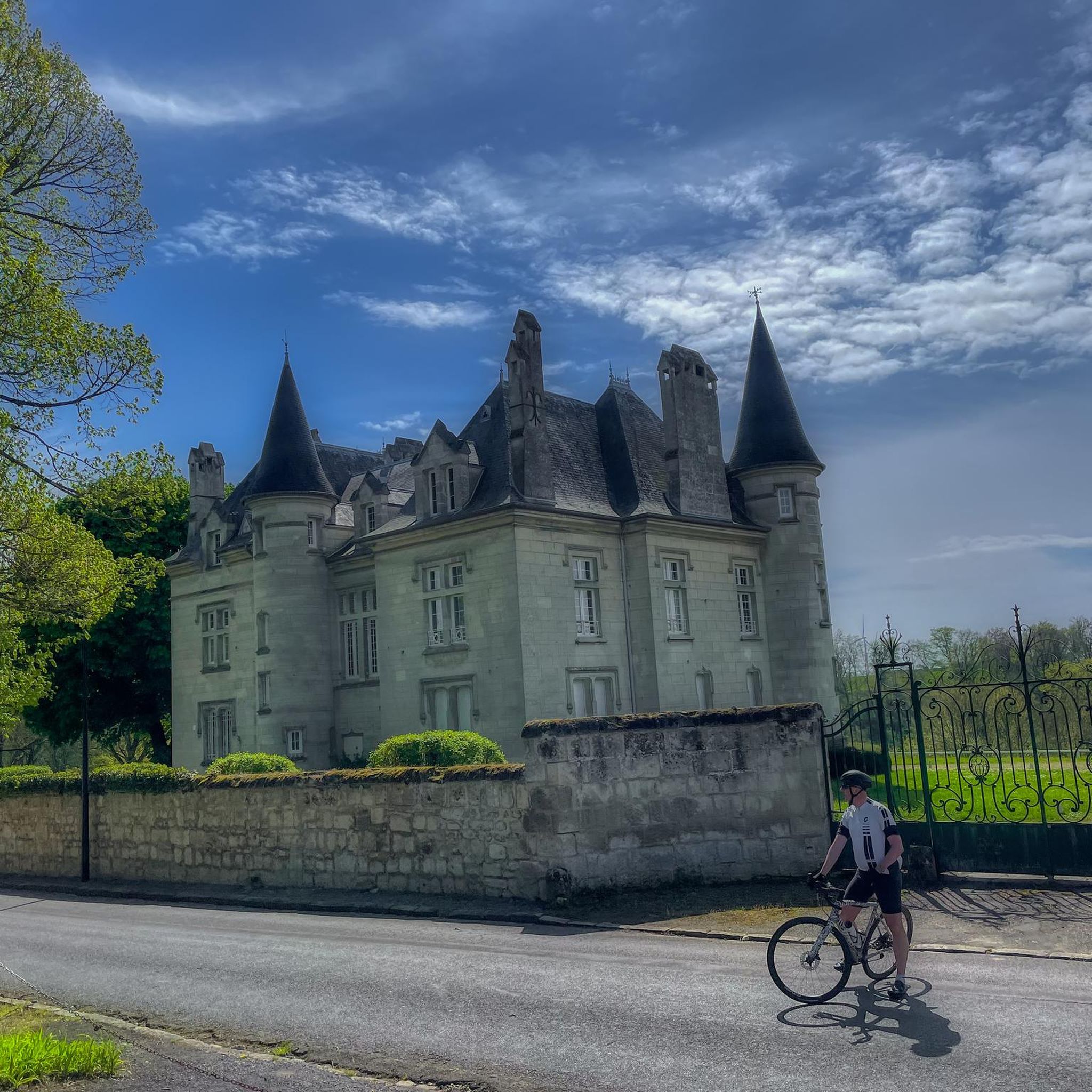
-1552 Purchase by Jean d'Estrées. -1552-1575 Construction work on the current château. -1573 Birth of Gabrielle d'Estrées in Coeuvres-Valsery. -1575 Death of Jean d'Estrées, grandfather of Gabrielle d'Estrées. -1590 Visit of Henri IV to Coeuvre-Valsery, where he met Gabrielle d'Estrées. -1739, The degraded château passed to the Le Telliers. -1793-1795 Sale as national property, demolition, and division of the estate. -19th century, purchase by the Berthier de Sauvigny family, who carried out extensive restoration work at the end of the 19th century. -1918 Bombings during the Battle of the Marne. -Around 1920, restoration work as war damage. -1953 Sale to the municipality of Madeleine-lès-Lille, which established a summer camp there. -1974 Conversion into a retirement home.
1
0
Inside this pavilion, a large room adorned with a neo-Renaissance fireplace, black and white floor, beamed and joist ceiling decorated with paintings and coats of arms, and low paneling. Two other rooms. A stone spiral staircase. Upstairs, a large, undecorated room, two other rooms. A large attic. On the southeast side, a superb cryptoporticus on which the wooden gallery may have stood, comprises a series of vaulted rooms, including the large kitchens with their superb stereotomy. Beautiful stone slab floors. A second basement level houses flooded galleries. Remains of the staircase pavilion with two semicircular bays, a straight staircase with a ramp under a semicircular vault. To the northeast, the outbuildings wing, largely rebuilt after the First World War, in the center, a porch dwelling topped with a hipped roof, adjoining a staircase turret topped with a dome. Inside, there are a few rare original features, a stone spiral staircase, and a neo-Renaissance fireplace. A lovely volume on the first floor of the porch. Character: Gabrielle d'Estrées. Born in Coeuvres-Valsery in 1573, died in Paris in 1599. A woman with a tumultuous life, whose mother was already described as frivolous, the family of seven sisters was called "the seven deadly sins" by Madame de Sévigné, the father saying that Coeuvres-Valsery was "a rabbit hutch for whores." The family had great social ambitions, and she already held important offices and positions. Gabrielle met King Henry IV at Coeuvres-Valsery in 1590, through her lover. The King courted her ardently, returning especially to Coeuvres-Valsery; after six months, she yielded. He wanted to marry her, even going so far as to announce their marriage publicly at a celebration at the Louvre on February 23, 1599. She died shortly thereafter, on April 10, 1599, carrying the child she had with Henry IV, likely from the effects of her pregnancy, although she showed every sign of poisoning, which long cast doubt on the cause of her death. Henry IV showered the d'Estrées family with titles and offices. Gabrielle's father, Antoine d'Estrées, was Governor of the Île-de-France; her brother, François-Annibal, Bishop of Noyon and French Ambassador to Rome; her sister, Abbess of Maubuisson. Historical origins: -Villiers family
1
0
Hello, Here is the true story of the Château de Coeuvres. For your information, I was born and lived for 20 years in a house opposite Gabrielle's pavilion! Meeting place of Henri IV and Gabrielle d'Estrées in 1590 - An original and dreamlike Renaissance Mannerist festive castle, built for the Dukes of Estrées in the mid-16th century, completed around 1575. Henri IV met Gabrielle d'Estrées there in 1590, the date of the beginning of their romantic and tumultuous affair. Six hectares of land. Although it has the appearance of a fortress, it is a pleasure castle, and more precisely a festive one, given its off-center layout characterized by a small, off-center main building, the presence of four imposing pavilions, and a possibly missing large gallery to the southwest. The ambitious d'Estrées family, which included a French ambassador to Rome, had a festive and social reputation, close to the royal family; Coeuvres-Valsery was elevated to a marquisate and then to a duchy-peerage for them. Of this ambitious complex, built in the second half of the 16th century, close to royal achievements, only vestiges remain, resulting from the demolitions of the Revolution and the bombardment of 1918, while the restoration initiated at the end of the 19th century had just been completed. The setting, curiously located on a marshland, confirms a Baroque choice, which can be explained by Mannerism, a 16th-century school of thought and art with a taste for the strange, the curious, the bizarre, and the original; sometimes going to extremes of incongruity and bad taste. Architecture: A square plan, marked by large dry moats spanned by bridges on both sides, flanked by slightly projecting square corner pavilions. The architecture is beautifully patterned with limestone, and the moat walls are slightly sloped. The most remarkable feature is the Henri IV pavilion to the west, with a square plan topped with a large hipped roof, adjoined by a square stair tower topped with a dome; on the side, a low wing. The windows are mullioned and transomed, with dormers featuring arched pediments. Beautiful moldings on the facades, and windows with bands.
1
0

The Château de Cœuvres dates back to the 16th century and was probably built by a member of the Estrées family, a nobleman renowned since the 15th century. In September 1914, German troops entered the castle, forcing Albert to shelter Ernst Gunther, Duke of Schleswig-Holstein, and the Prince of Saxe-Meiningen. Two weeks later, the Germans were driven out during the First Battle of the Marne, and the castle was occupied by the French 6th Army. General Michel Joseph Maunory established his headquarters there. During World War I, the castle was used by various regiments and served as a hospital. In 1918, during the Second Battle of the Marne, the village and castle were caught in the middle of intense artillery fire and tank battles, which completely destroyed them. Cœuvres Castle is currently closed to the public as it is now used as a retirement home. The west tower is empty. A beautiful castle. It must be special to live there as an older person.
5
0
Pedestrian and cyclist bridge over the Aisne River. The name, "Passerelle des Anglais," refers to the important role the British played in the liberation of Soissons in 1918 and in the reconstruction of the city after the First World War, including the reconstruction of the original bridge, which was destroyed by the German army.
6
0
A place steeped in history https://www.abbayedelongpont.fr/fr
6
0
A place steeped in history. https://www.abbayedelongpont.fr/fr/un-lieu-charge-d-histoire
5
0

Frequently Asked Questions
How many touring cycling routes are available around Juvigny?
There are nearly 150 touring cycling routes around Juvigny, offering a wide variety of options for different skill levels and preferences. This includes 35 easy routes, 80 moderate routes, and 34 difficult routes.
What kind of landscapes can I expect to see while touring cycling around Juvigny?
The region around Juvigny offers diverse landscapes, including the characteristic bocage with its hedgerows and pastures, and the picturesque Andaines Forest. Many routes also pass through charming rural roads and connect to historical towns, providing a blend of natural beauty and cultural interest.
Are there touring cycling routes suitable for beginners or families in Juvigny?
Yes, Juvigny offers 35 easy touring cycling routes, which are generally suitable for beginners and families. These routes often feature gentler gradients and less demanding terrain, allowing for a relaxed ride through the scenic countryside.
What historical sites or landmarks can I visit along touring cycling routes in Juvigny?
Many touring cycling routes in Juvigny connect to significant historical sites. For instance, you can explore routes that lead to Coucy Castle, the Saint-Jean-des-Vignes Abbey, or the Pernant Castle — 700 years. The region's rich history is often woven into the cycling experience.
Are there any challenging touring cycling routes in the Juvigny area?
Yes, for experienced touring cyclists seeking a challenge, there are 34 difficult routes available. One such route is the Château de Coucy – Soissons Town Hall loop from Crouy, which spans over 120 km with significant elevation changes, connecting historical sites for an extensive ride.
Are there any moderate-difficulty touring cycling routes available?
Absolutely. Juvigny features 80 moderate touring cycling routes. A popular option is the Soissons Town Hall – Vic-sur-Aisne Castle loop from Crouy, a 47.6 km path that links historical towns and a castle, offering a scenic journey without extreme difficulty.
Can I find circular touring cycling routes in Juvigny?
Yes, many of the touring cycling routes around Juvigny are designed as loops, allowing you to start and end at the same point. Examples include the Longpont Abbey – Abbaye de Longpont loop from Crouy and the Chateau du Fief Champėtre – Pernant Castle — 700 years loop from Pasly, which offer convenient circular journeys.
What do other touring cyclists say about the routes in Juvigny?
The touring cycling routes in Juvigny are highly rated by the komoot community, with an average score of 4.5 stars from over 87 reviews. Cyclists often praise the varied rural roads, the blend of open and wooded landscapes, and the historical towns encountered along the way.
Are there touring cycling routes that pass through forests?
Yes, the region is home to the beautiful Andaines Forest, which provides picturesque and often shaded routes. While specific routes are not listed in the provided data, the forest is a significant natural feature in the area, suggesting many opportunities for forest cycling.
Can I find routes that connect to long-distance cycling paths like the Véloscénie?
Juvigny is notably situated along or near sections of "La Véloscénie," a renowned long-distance cycling route connecting Paris to Mont Saint-Michel. This offers opportunities to connect to or explore parts of this heritage and nature-rich path, characterized by charming small roads and often passing through the edge of the Andaines forest.
What is the best time of year for touring cycling in Juvigny?
While specific seasonal data isn't provided, the Normandy region generally offers pleasant cycling conditions from spring through early autumn (April to October). During these months, the weather is typically mild, and the landscapes are vibrant, making it ideal for exploring the rural roads and forests.
Are there any natural features or scenic viewpoints to discover?
Beyond the bocage landscape and the Andaines Forest, the region offers natural beauty spots. While not directly on the listed routes, the "Petite Cascade de Mortain" is a notable natural scenery attraction nearby, indicating the presence of other picturesque spots that enhance cycling tours.
Most popular attractions around Juvigny

Get inspired with the komoot mobile app


Explore more
Browse the best Cycling routes in other regions.
