The best road cycling routes around Cérons
4.4
(38)
959
riders
18
rides
Road cycling around Cérons, located in the Gironde department of Nouvelle-Aquitaine, offers routes through the renowned Bordeaux vineyards and along river systems like the Ciron and Garonne. The region features a generally gentle topography, with an average elevation of 12 meters, making it accessible for various fitness levels. Cyclists can explore diverse terrain, from mostly well-paved surfaces to segments with moderate elevation changes, often passing historical châteaux and churches. This area provides a characteristic French countryside experience, combining natural beauty…
Last updated: July 2, 2026
4.0
(3)
29
riders
51.7km
02:21
430m
430m
Moderate road ride. Good fitness required. Mostly well-paved surfaces and easy to ride.
16
riders
51.1km
02:02
160m
160m
Moderate road ride. Good fitness required. Mostly well-paved surfaces and easy to ride.

Sign up for free
5.0
(1)
6
riders
37.4km
01:33
140m
140m
Moderate road ride. Great for any fitness level. Some segments of this route may be unpaved and difficult to ride.
8
riders
33.5km
01:31
230m
230m
Easy road ride. Great for any fitness level. Mostly well-paved surfaces and easy to ride.
5
riders
72.2km
03:17
680m
680m
Moderate road ride. Good fitness required. Mostly well-paved surfaces and easy to ride.
Get access to more routes and recommendations from other explorers.
Sign up for free
Already have an account?
Our route recommendations are based on thousands of hikes, rides, and runs completed by other people on komoot.
Start today with a free account
Your next adventure awaits.
Login or Signup



Other adventures around Cérons

Tips from the Community

The Abbey of La Sauve-Majeure, founded in 1079, a masterpiece of Romanesque art, is today part of the Way of St. James and a UNESCO World Heritage site. This is stated on the france-voyage website, and continues: "This former Benedictine abbey, dear to pilgrims and classified as a Historic Monument, has managed to preserve beautiful remains in its ruined church, including the remarkable carved capitals in the choir. The wonderfully preserved details of the chiselled capitals feature biblical, fantastical, or plant-based motifs. Original sin, Daniel in the lions' den, the life of Samson, the temptation of Christ, the sacrifice of Abraham, the martyrdom of Saint John, or the fight between mythical creatures can be admired as sculptural elements in the Abbey of La Sauve-Majeure."
0
0

In 1079, the Benedictine abbot Gérard de Corbie and about ten monks and knights founded Notre-Dame de La Sauve-Majeure in the large forest (in Latin Silva Major) of the Entre-deux-Mers. The support of the dukes of Aquitaine and the pilgrimage to Santiago de Compostela favored a rapid boom. At its peak in the 12th and 13th centuries, the abbey had about a hundred monks. The Hundred Years' War precipitated its decline.
0
0

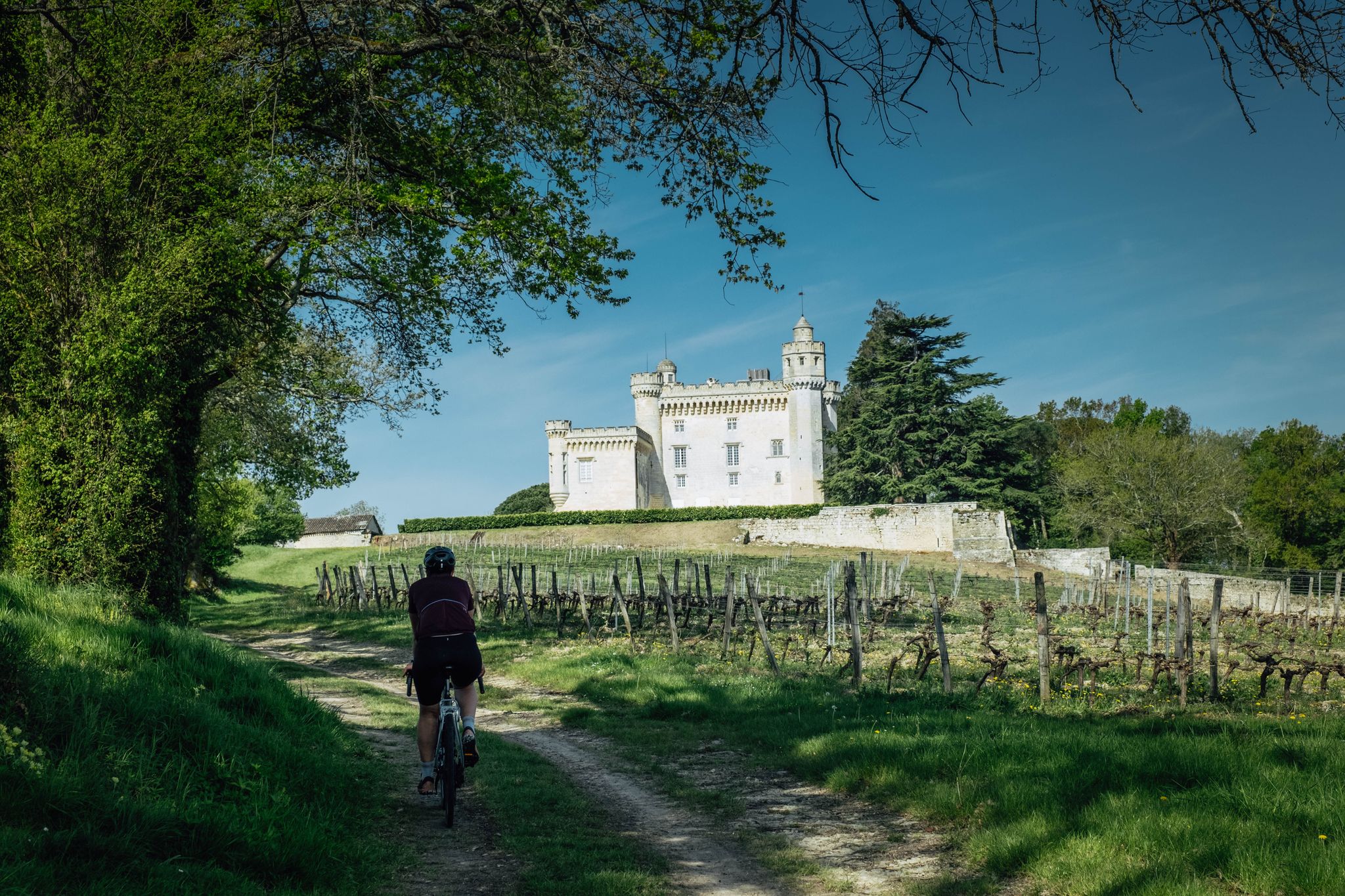
Budos Castle is the work of Raymond Guilhem de Budos, nephew of Pope Clement V. Largely supported by his uncle, he rebuilt the old family castle in 1306, adopting the architectural features of the neighboring Château de Villandraut, as evidenced by the following document from King Edward I, written from Wynten on March 9, 1306, to the Seneschal of Gascony[4]: "The Knight of Budos, nephew of Clement V, Sovereign Pontiff, has begged us to allow him to crenellate his house in Budos, to surround it with walls, towers, moats, and finally to fortify it. Out of respect for the Sovereign Pontiff, and because a fortress of this nature will protect not only our possessions in this part of Guienne, but also the subjects of the Pope's nephew, we grant the aforementioned Raymond permission to fortify his castle and we grant it to him, his heirs, and successors in perpetuity, and we undertake not to disturb him in any way in this possession." In 1422-23, the King of England took possession of the castle and placed Pons, Lord of Castillon, in charge. Around 1433, Henry VI granted the lands and the castle to the Duke of Gloucester. In 1446-47, Budos was given to Gaston IV of Foix-Béarn, Count of Foix, following the death of the Earl of Gloucester. After the conquest of Guyenne, the Budos family, which had supported the cause of France, regained possession of its lordships in Guyenne. Purchased from the Budos family by Raymond de La Roque in 1571, Budos Castle suffered a severe assault in 1652 during the Fronde Wars. Lasserre ransacked, pillaged, and burned its archives. The Budos lordship remained in the La Roque family until the Revolution, which nearly destroyed it. It was sold as national property and used as a quarry to build dikes on the Ciron. In 1841, the Gironde Historical Monuments Commission was informed of this by Léo Drouyn. In 1860, it became the property of Léon de Brivazac, son of Delphine Catherine de La Roque de Budos (born at the castle in 1789). Five descendants (including Savary de Beauregard) entrusted it to the Adichats association, which brings together young people to enhance and preserve what can be preserved. The castle was registered as a historic monument in 1988
0
0

Very beautiful castle and long history since Henry III. Beautiful exhibitions and interesting permanent exhibition on the reformatory for young girls (early 20th century).
0
0

This small town has four sturdy city gates.
0
0

Very beautiful medieval gate tower. Definitely worth a visit
1
0

As of September 2023, the castle can be visited for 6 EUR. You can see magnificent fireplaces, many picture tapestries, large rooms and you can learn shocking details about the time when the castle was used as a women's/girls' prison. Very worthwhile.
1
0

Small church of Arbi in a green setting at the edge of a stream.
1
0
Frequently Asked Questions
How many road cycling routes are available around Cérons?
There are over 15 road cycling routes around Cérons, offering a variety of distances and difficulty levels. These routes traverse the picturesque Bordeaux vineyards and the scenic Ciron and Garonne river systems.
Are there road cycling routes suitable for beginners or those looking for an easy ride?
Yes, Cérons offers several routes suitable for beginners or those preferring an easier ride. The region's generally gentle topography, with an average elevation of 12 meters, means many paths are relatively flat. For instance, the Budos Castle – Landiras Castle Ruins loop from Cérons is a moderate 37.4 km ride with only 140m of elevation gain, making it accessible for various fitness levels.
What kind of terrain can I expect on road cycling routes in Cérons?
You can expect diverse terrain, primarily well-paved surfaces winding through the renowned Bordeaux vineyards. While the overall landscape is relatively flat, some routes include moderate elevation changes, offering a varied experience. You'll also encounter scenic stretches along the Ciron and Garonne rivers.
Are there any challenging road cycling routes for experienced cyclists?
For experienced cyclists seeking more of a challenge, routes with greater elevation gain are available. The Château de la Benauge – Saint-Martin Church of Arbi loop from Cérons, for example, is a 52.5 km route with over 450 meters of elevation gain, requiring good fitness. Similarly, the Church of Langon – View of Saint-Macaire loop from Cérons covers 68.0 km with 430m of ascent.
What historical sites or landmarks can I see while cycling around Cérons?
The region is rich in historical and architectural heritage. Many routes pass by significant landmarks such as Budos Castle, Château de la Benauge, and various Romanesque churches like Saint-Martin Church of Arbi and Saint-Michel Church. The Saint-Michel Church – Château de Villandraut loop from Cérons is a great option to explore some of these historical gems.
Are there family-friendly road cycling options in the Cérons area?
While the listed routes are primarily for road cycling, the broader region offers family-friendly options. The Roger Lapébie Greenway, a peaceful route built on a former railway line, is ideal for families, offering smooth asphalt surfaces through vineyards and past historical sites. Bike stations, such as the one in Créon, provide rentals and information for exploring these paths.
Can I find circular road cycling routes around Cérons?
Yes, the majority of road cycling routes around Cérons are designed as loops, allowing you to start and finish at the same point. This includes popular options like the Saint-Michel Church loop from Cérons and the Château de la Benauge – Saint-Martin Church of Arbi loop from Cérons.
What makes the road cycling experience in Cérons unique?
The road cycling experience in Cérons is unique due to its immersion in the heart of the Bordeaux vineyards, offering a characteristic French countryside experience. The combination of cycling through world-renowned wine country, alongside the Ciron and Garonne rivers, and past numerous historical châteaux and churches, provides a rich blend of natural beauty and cultural heritage.
What do other road cyclists enjoy the most about road cycling in Cérons?
The area is highly rated by the komoot community, with an average score of 4.4 stars from over 30 reviews. Cyclists often praise the scenic routes through the vineyards, the generally well-maintained roads, and the opportunity to combine cycling with exploring historical sites and the unique regional landscape.
Is there public transport access to the road cycling routes in Cérons?
While specific public transport connections directly to route starting points in Cérons might be limited, the region is accessible by train to nearby towns like Langon. From there, you might consider local taxi services or cycling to Cérons to begin your route. For exploring the wider area, the Roger Lapébie Greenway is part of the larger Canal des 2 Mers à Vélo cycle route, which has good connections.
Where can I find bike rentals or cycling infrastructure near Cérons?
For bike rentals and cycling information, you can visit bike stations in nearby towns. For example, the Créon bike station, approximately 15 km from Cérons, offers bike rentals and is a good starting point for exploring the Roger Lapébie Greenway. More information can be found on the Gironde Tourisme website.
What is the best season for road cycling in Cérons?
The spring and autumn months generally offer the most pleasant conditions for road cycling in Cérons, with mild temperatures and beautiful scenery as the vineyards change color. Summer can be warm, but early mornings or late afternoons are still enjoyable. Always check the local weather forecast before heading out.
Most popular attractions around Cérons

Get inspired with the komoot mobile app


Explore more
Browse the best Road cycling routes in other regions.
